

21 Fantasy Hockey Rambles
Dobber Sports
2026-02-15
Every Sunday, we share 21 Fantasy Rambles from our writers at DobberHockey. These thoughts are curated from the past week’s 'Daily Ramblings'.
Writers/Editors: Ian Gooding, Michael Clifford, Alexander MacLean, Puneet Sharma, and Dobber
—
1. With the Olympics, NHL hockey is on pause and the roster freeze shutting down trade chatter, it feels like everything has gone quiet. Although, that might be true on the surface, for fantasy hockey GMs, this stretch is actually gold. It’s the perfect window to step back, take a hard look at your roster, and figure out where you can squeeze out extra value. Trades are one option, but the real edge often comes from the waiver wire, especially when it costs you nothing.
With that in mind, I went digging for players who can help plug short term or situational gaps and are rostered in under 30% of Yahoo leagues. These are the types of adds you cycle through your roster to chase categories, improve nightly coverage, or steal a bit of extra production in weekly matchups. You are not married to these players long term but you are using them intentionally, moving on when the value dries up, and maximizing every roster spot while others are waiting for the action to pick back up.
Pierre-Luc Dubois – C/LW – Washington Capitals – 25%
There’s been a noticeable bump in Dubois ownership since he returned to the Capitals lineup, and it makes sense. He stepped right back into his familiar second-line role alongside Aliaksei Protas and Tom Wilson, logging 17:35 of ice time with 2:27 coming on the power play. That usage alone tells you he is fully back in the mix.
I really like the look of that second line for Washington. It has size, puck retrieval, and enough skill to drive steady production, which plays directly into Dubois’ strengths. We have already seen how seamlessly he has fit with this group since arriving last season, when he went on to post a career-best 66 points. The role likely will not change, and neither has the trust from the coaching staff. From a scheduling standpoint, things line up nicely in the short term. Coming out of the Olympic break, Washington has three games, with two of them falling on lighter nights. That helps ease roster congestion and makes Dubois easier to slot into fantasy lineups without tough start-sit decisions. The caveat is the following week, when the Capitals are the lone NHL team playing just two games, which caps his overall short-term volume. Still, given the role, linemates, and immediate schedule bump, Dubois is firmly back on the radar as a useful add or hold, especially if you are looking for reliable top-six production with power-play exposure. (feb9)
2. Anze Kopitar – C – Los Angeles Kings – 28%
With the recent news of the Bread Man, Artemi Panarin, heading to LA, it’s hard not to expect a meaningful boost across the Kings’ top six. Panarin’s presence should elevate the overall offensive environment, and that rising tide matters for fantasy. Adrian Kempe, Kevin Fiala, Quinton Byfield, and Brandt Clarke are already heavily rostered in most leagues. Panarin only adds more quality touches, better puck movement, and more sustained offensive zone time. Even in what’s expected to be Kopitar’s final season, here is still value to be had. He may no longer be the focal point of the offense and may not be locked into the top power-play unit, but he can still contribute meaningfully in a top-six role. Surrounded by this level of skill, Kopitar doesn’t need prime deployment to remain relevant. In deeper formats, that steady 5v5 production and leadership-driven usage can still translate into useful fantasy output. (feb9)
3. Pavel Buchnevich – C/LW/RW – St. Louis Blues – 22%
I scooped up Jordan Kyrou from a fantasy manager who had clearly run out of patience, which is usually the ideal window to make a move. That frustration is often when value opens up, whether through a trade or even on the wire. At the time, Kyrou was not producing much and his roster percentage sat well below where it is now at 52%. Since then, the production has come around, which is exactly what I was betting on. The Blues’ spot in the standings doesn’t change the fact that there’s real talent on that roster, and Kyrou is a big part of it. He’s the kind of player who can flip the switch quickly once things start clicking. He’s not the only one worth noting either. Pavel Buchnevich continues to ride those familiar peaks and valleys, but the signs of life are back. Over his last seven games, he’s put up nine points with four goals and five assists, while averaging more than three minutes of power-play time on the top unit. Add in his tri-eligibility in Yahoo leagues, and Buchnevich is once again making a strong case as a versatile and timely fantasy option. (feb9)
4. Ryan Hartman – C/RW – Minnesota Wild – 19%
For Ryan Hartman upside starts with prime deployment. Hartman has spent close to 30% of his ice time centering Mats Zuccarello and Kirill Kaprizov, which is prime real estate in Minnesota. That trio has controlled play well, sitting north of 53 % in both shot share and Corsi, and 11 of Hartman’s 26 points have come alongside Kaprizov. He just has to keep up, win puck battles, and cash in on secondary looks, which fits his game perfectly. There’s also sneaky value in multi-cat formats. Hartman brings a steady mix of shots, hits, and faceoff wins. He’s averaging over 16:40 per night and right around two shots per game, which helps absorb the cold stretches that tend to show up over a full season. His PP usage helps a bit as well. He is not locked into a permanent role, but has rotated through several effective units with Kaprizov, Boldy, and Zuccarello. The concern is stability. Hartman’s individual scoring rates are down, and his role is not guaranteed. One lineup shuffle or a trade deadline addition down the middle could push him back into the middle six. If that happens, both the opportunity and fantasy value take a hit. (feb9)
5. Gabriel Landeskog – LW/RW – Colorado Avalanche – 27%
If you have not been paying close attention, Gabriel Landeskog is no longer listed as DTD and is back in action, representing Sweden at the Winter Olympics. That alone puts him firmly back on the fantasy radar. Before his injury earlier this season, Landeskog was playing solid hockey, posting seven points in nine games and riding a clear hot streak. His usage in Colorado was encouraging. He rotated freely throughout the top six and, even in a small sample, earned time on the first power-play unit. At 5v5, he spent close to 25 percent of his ice time alongside Brock Nelson and Valeri Nichushkin, with another notable chunk, roughly 18 percent, coming next to Nathan MacKinnon and Martin Nečas. On the surface, the season-long numbers look modest: seven goals and 15 assists in 41 games, which works out to a 44-point pace. Context matters here. For a player who had not suited up for NHL action in three years, that level of production is quite impressive, especially given the quality of minutes he was earning.
From a scheduling perspective, Colorado lines up well for most fantasy playoff formats. In the first week all of their games fall on off nights, which is a subtle but meaningful edge. That said, that week is fairly well spread out across the league. If you find your roster heavily concentrated on just a few busy nights, this could be a good opportunity to reassess, make small adjustments, and spread your starts more evenly to squeeze out maximum value from your lineup. (feb9)
6. I haven’t offered to do Q&A in the Ramblings for a while. But with an empty slate for today, I thought I’d take the time to reach out to my social media followers. To be honest, I thought there’d be a lot more activity on the social media app formerly known as Twitter – I wonder if the guy who paid $44 billion for it has anything to do with that. As a general observation, I haven’t noticed as much interaction there in the past couple years.
Anyway, here are the questions I received. Thank you to those who sent them in. Keep in mind that these are simply my perceptions, observations, and opinions, which may differ from other fantasy hockey content creators.
From Bluesky:
Which tweener (many choices around the league, Rutger McGroarty, Ville Koivunen, Matt Savoie, Jonathan Lekkerimäki, Sabres trio Noah Ostlund, Isak Rosen, Konsta Helenius, too many to add) has the best chance to break out into a meaningful fantasy contributor by the end of next year? Very nonspecific question, but you can go in many directions with it.
I’ll start with the group of players that you listed. There could be a valid argument made for many of these players to stand out. Based on the timeline you’ve given, I’ll go with Ostlund because he has been the most impactful of this group in the NHL this season (see Frozen Tools Player Compare). Ostlund has seen modest yet gradual improvements to both his scoring and icetime this season, and he was even on the Sabres’ top power play for several games during January. The Sabres are finally on the rise, and Ostlund could be a major part of that.
Ostlund may not be the highest-upside play of the group, though. His teammate Helenius is two years younger and has played fewer NHL games than Ostlund. However, Helenius is scoring at nearly a point-per-game pace in the AHL at only 19 years of age. If you’re willing to play the long game with this, Helenius might be the better add. I wouldn’t even be shocked if Helenius leapfrogs Ostlund by this time next year.
If you can wait at least another season, Bradly Nadeau is another name to add to that list. Carolina is in a position to let the 20-year-old Nadeau marinate in the AHL, and that is precisely what he is doing with 40 points in just 32 games. Nadeau will likely be the first callup in the event of an injury to one of the Hurricanes’ forwards, but he will have to wait for his full-time NHL opportunity with the Canes an Eastern Conference contender with many established forwards locked up long-term. Of course, that timeline could be expedited if the Canes happen to trade Nadeau for win-now help.
To complete a trade recently, I allowed my league mate (who happens to be a fellow Dobber writer) to choose between several prospects that have had at least a taste of the NHL: Nadeau, Ostlund, Ben Kindel, and Braeden Cootes. His choice was Nadeau. By the way, the trade was agreed upon one day before Dobber’s social media post above. Now that I’ve traded Nadeau, he’s bound to be a star! (feb8)
7. From X:
What is Jake Neighbours‘ ceiling? Is Luca Cagnoni the future Sharks PP1 D? Thanks.
Dobber replied by saying Neighbours’ ceiling is in the high 50’s. I think that seems about right, although I could also see Neighbours cracking 60 points at some point in his career. The 23-year-old forward is on a full-season pace of 47 points (although he has missed 13 games this season), and he has yet to reach a 50-point pace in any of his three full seasons including this one. The 60-point season might have to wait a few seasons, as the Blues appear to be gearing up toward selling before the trade deadline. The lack of high-end talent that St. Louis has now, let alone after the deadline, could limit his ceiling.
I like Cagnoni’s offensive upside enough that I drafted him in a deep keeper league. The fact that he is an offensive-minded defenseman that lacks size (5-9, 181 lbs.) could mean that he flips either way. Sam Dickinson (2024 Round 1, Pick 11) was a higher pick than Cagnoni (2023 Round 4, Pick 123), so he seems like the safer bet to be the Sharks’ future PP1 defenseman based on draft pedigree. On top of that, Dickinson is already in the NHL despite being drafted a year later, while Cagnoni is still in the AHL. Dickinson is being sheltered and is playing limited even-strength and power-play minutes, but he is only 19 years of age. Cagnoni has been putting up points in the AHL (78 PTS in 103 GP), so he has fairly decent odds of being a fantasy contributor one day. (feb8)
[Follow the link for more…]
8. Men’s Olympic hockey is well underway with many names that you’re familiar with from fantasy hockey leagues. A 5-1 win for Canada over Switzerland on Friday was overshadowed by what appears to be a serious injury suffered by Kevin Fiala late in the third period. The Swiss forward was carried off on a stretcher face down and taken to the hospital after a collision with Tom Wilson. Following the game, the Swiss team announced that Fiala will miss the rest of the Olympic tournament with a lower leg injury. Given how quickly this announcement was made and how bad this injury looked, Fiala will most likely miss NHL games as well.
Wilson’s playing style is well-documented, but the hit wasn’t particularly dirty. Fiala just appeared to get tangled up with him. Fiala broke his left femur when he was with Nashville, so hopefully this is not the same injury. Unfortunately, this is the downside of allowing NHL players to play in a midseason best-on-best Olympic tournament, as it has both real-life and fantasy implications. The Kings are already struggling to score (more on that later), so being without their second-leading scorer in both goals (18) and points (40) is a blow, even with the recent acquisition of Artemi Panarin. (feb14)
9. On paper, the “Mack” line with Nathan MacKinnon, Connor McDavid and Macklin Celebrini seems to resemble Gretzky and Lemieux in 1987 or the US basketball Dream Team of 1992. A line with that much firepower could be impossible for any team to stop. McDavid’s six points in two games is the most ever by a player in the first two games of the Olympics, while Celebrini does not look too young for this tournament with two goals and an assist in two games. (feb14)
10. The Jordan Binnington vs. Logan Thompson debate is one that Thompson seems to be winning in the court of public opinion. A comparison of the season stats shows Thompson as the better goalie this season, and it’s not even close. Binnington still has the equity of being able to come through in the clutch, most recently in backstopping Canada to a 4 Nations win and prior to that with the Blues’ 2019 Stanley Cup run. To real-life coaches that counts for something, even if you know who you would start in your fantasy league. Canada’s goalies will be on a very short leash in this tournament with no clear-cut #1. (feb14)
11. Since Quinn Hughes was traded to the Wild, he has 34 points in 26 games, good for 1.3 pts/gp, compared to his usual rate of around 1.1 from the last few years. It could be unsustainable, but at the same time all of his underlying metrics are within normal ranges (the 5on5 Sh% is a little high, but that might account for a point or two), and his shooting percentage is quite low. This may just be the production we get from Hughes between now and the end of the season.
In those 26 games, Brock Faber has 22 points, playing alongside Hughes at even strength. It’s quite the fantasy glow-up for Faber compared to playing in more of a shutdown role alongside Jonas Brodin. Brodin still has another 4-6 weeks on his initial injury timeline, but it will be interesting to see how the pairings shake out upon his return, and whether Faber keeps the plum gig with Hughes, or returns to the shutdown role with Brodin.
Over that same 26-game period since the Hughes trade, Kirill Kaprizov has 36 points, Mats Zuccarello has 21 (in 23 games), Joel Eriksson Ek has 18 (in 20 games), and Matt Boldy has 27 (in 22 games) – that makes up the entire top powerplay unit with Hughes, a big boost to all five of them. Meanwhile, with Marco Rossi having gone the other way, Ryan Hartman (17 points in 26 games) and Danila Yurov (14 in 26) both saw their production jump by an extra 50%. (feb13)
12. Over on the Vancouver side of the trade, the Canucks are not faring so well. The only two players on the team on hot streaks entering the break are Liam Ohgren (part of the Hughes package) and Teddy Blueger (who returned Jan 21st after missing all but two games due to injuries).
Ohgren has scored all nine of his points this year with the Canucks and is thriving with the steady increase in ice time he has seen. If he could find some consistency with his shot volume, he might be a worthwhile fantasy own in regular leagues pretty soon.
Marco Rossi meanwhile was injured two weeks into his Canucks tenure, going minus-five in eight games while collecting two points. Not a great look, but it can’t have been easy for him going from a solid team where he is flanked by an MVP caliber winger, to the Canucks… (feb13)
13. Zeev Buium scored two points in his Canucks debut on Dec 14th, but in the 19 games since then, has amassed four points and a broken cheek bone that is now holding him out of the lineup. Buium has the most fantasy upside of anyone that came back to the Canucks for Hughes, but he’s not going to be that player right away. It will take some patience from his fantasy owners.
For the first three Hughes-free weeks, Filip Hronek picked up the slack and was a point-per-game player, but he has cooled down over the last month, just like the rest of the team. There’s some fantasy upside there, but as with any player on a bottom team, the production is unpredictable and inconsistent, which doesn’t pair well with a steady dose of minus ratings.
Both Brock Boeser and Elias Pettersson say production declines with Hughes gone, and it’s tough to see a future where they get back to their usual production rates within the next few years. With Thatcher Demko out for the season, and not a ton currently in the pipeline, the future is fairly bleak in Vancouver. (feb13)
14. The Buffalo Sabres have been on a huge run lately, which lines up very neatly with when former GM Kevyn Adams was fired on December 15th. It shouldn’t really affect anything directly with the on-ice product, but we’ll call it a culture shift.
The Sabres went 16-5-2 since then on the backs of Alex Lyon, Ukko-Pekka Luukkonen, and Colten Ellis. Both UPL and Lyon missed stretches during that run, but overall the Sabres have been getting solid if unspectacular goaltending most of the season from those three.
One of the big reasons the Sabres have surged here, is how their top-four blueliners have really come together. Both Owen Power and Bowen Byram have been playing excellent hockey of late, and are logging big minutes and controlling the game at both ends of the ice. Meanwhile, the pairing of Rasmus Dahlin and Mattias Samuelsson has made their success visible not just on the ice, but on the scoresheet as well. Dahlin has 23 points in 24 games since the culture shift, and Samuelsson has 22 in 25. Samuelsson’s underlying numbers on the season are completely unsustainable, while Dahlin’s are right in the expected range for him, actually being a hint low if anything.
Up front, there have been contributions from the whole lineup, but it has been the second line duo of Ryan McLeod and Jack Quinn that has led the way since mid-December, with either a healthy Jason Zucker or Zach Benson making up the trio. McLeod especially has been dominant, posting 25 points and a plus-20 rating across 25 games. In multi-category leagues he does have a weakness that the peripherals aren’t very strong, with only 29 SOG across that same 25-game span, and minimal Hits or Blocks. Quinn has 20 points in his last 25 games, and 59 shots to go with it, though surprisingly he only carries a plus-eight rating, which differs vastly from the center he spends so much time with. A testament to McLeod, or a knock against Quinn and his ability to defend without McLeod on the ice…
Zucker has also been productive, with 11 points in 17 healthy games since mid-December, and still has plenty left in the tank at 34. Lots of fantasy value across Buffalo’s top nine, but outside of Tage Thompson, there likely isn’t anyone that will consistently put up close to a point-per-game the rest of the way. (feb13)
15. You might have already heard that the Blue Jackets went into the Olympic break on a 10-1 run, coinciding with Rick Bowness being hired on January 13th. The team has been excellent in that stretch, and it seems like Bowness is pushing all the right buttons.
Charlie Coyle has been the most noticeable change, seeing over a minute more per game, and reaping the rewards with 16 points in those 11 games. Linemate Cole Sillinger has also jumped of late after having worked himself into Dean Evason’s doghouse by the end of his tenure. Sillinger has six points in his last six games, and has been meshing well after being reunited with Coyle.
On the flip side, Sean Monahan has seen his minutes drop, especially on the power play where he has lost over a minute per game. Despite that, he has remained just as productive as he was earlier in the year. His shot rate is way down this year, and without the power play production the overall numbers might be ready for another step down.
Dmitry Voronkov may have been the one who was hurt the most by the coaching change, going from over 15 minutes per game with first-unit power play time, all the way down under 10 minutes per game in the last nine contests, along with very limited power play time. He could be a good buy-low for those with long-term goals, but he’s droppable in the short term.
The addition of Mason Marchment to the team on Dec 19th has made a big difference as well, with Marchment piling up 13 points in his 14 games in Columbus, and still flying very much under the radar. (feb13)
16. The St. Louis Blues went on a big run in the second half last year, and there are some signs that we might see something similar again in 2026. In the last six games entering the break, the Blues are averaging 4.0 goals per game, and at least the offence is clicking. Working against them though is that keeping the puck out of their own net has become a challenge, allowing nearly five goals per game in that same stretch.
Looking at the forwards, Pavel Buchnevich has six points in his last four games, and has seen his shot rate and ice time tick up a little. Jimmy Snuggerud, with nine points in six games, has seen an even bigger growth in his ice time, and his underlying metrics say there’s still some positive regression to go. Jordan Kyrou has put up eight points in his last four games, and might still be one of the best buy-low options out there.
The trio of forwards is also keeping some of the defencemen afloat, with recent point-per-game or better stretches from Philip Broberg, Tyler Tucker, and Justin Faulk. On top of that, Robert Thomas is due back fully healthy after the Olympic break. It’s worth getting in on the forwards, and if this “rest” (maybe less of a rest for Jordan Binnington playing for Canada at the Olympics) helps out the goalies, then they could be great buy-low options for the stretch run as well. (feb13)
17. In a Ramblings two months ago, I wrote about player market share of shots, shot attempts, and expected goals. To be brief about it, market share is what percentage of shots, shot attempts, or expected goals that accumulate with a given player on the ice are taken by that player. So, if the Minnesota Wild land 1000 shots on goal in a season with Kirill Kaprizov on the ice, and Kaprizov takes 250 of those 1000 shots, then his market share is 25%.
The main reason we use this measure is to try and find players whose teams might not generate a lot with them on the ice, but who are responsible for a big percentage of whatever the team can generate. We can also capture big changes in players graduating from lesser roles. To do this, we are using data from Evolving Hockey, evaluating only forwards today to see what they’ve done so far in the 2025-26 season, and compare it to the two seasons from 2023-25.
Last note: we are doing relative change from the 2023-25 seasons, not total change. So, if a player goes from 25% of market share to 30%, that is a jump of 20% [(30 – 25) / 25] and not a jump of 5%.
The red and blue lines denote a change of at least one standard deviation above/below average, or at least the 84th/16th percentile of improvements.
Marat Khusnutdinov (Boston Bruins)
Considering that Khusnutdinov had just 16 points in his first 91 games of his NHL career and has 26 points in 52 games so far in 2025-26, it shouldn’t be much of a surprise that there have been some improvements under the hood. It is the extent of the improvements that are impressive as he has the largest increase in both market share of shot attempts and expected goals:
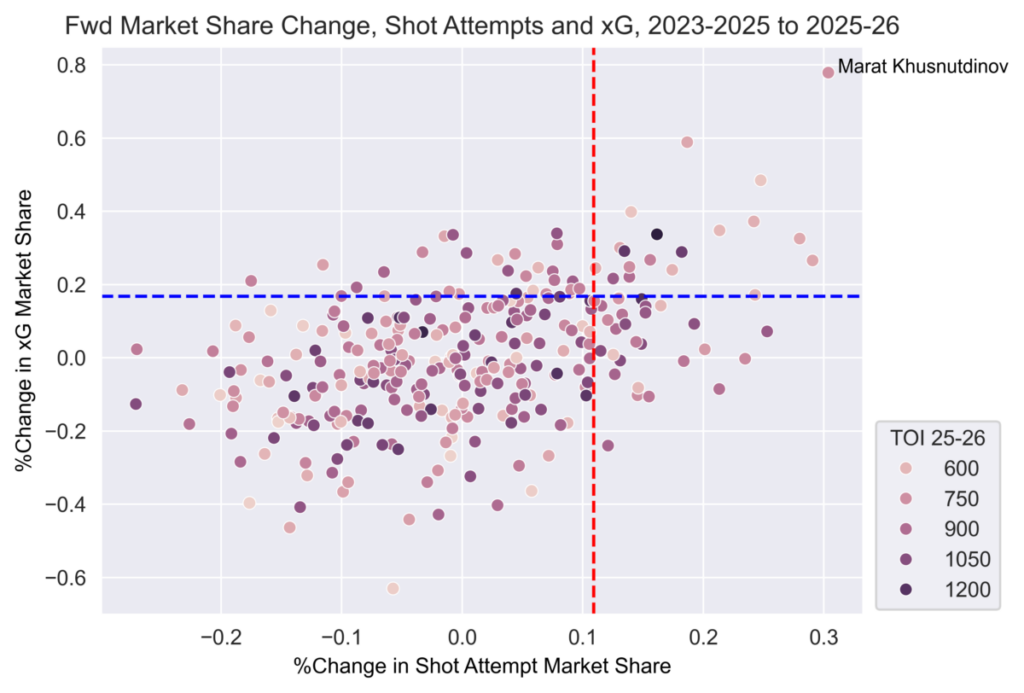
The overall numbers still aren’t large with Khusnutdinov just over a shot per game this season, and as he’s not a player who racks up hits or blocks at a high rate. That means there is still very meagre fantasy value here. He has gotten some top PP time when the Bruins had injuries or they wanted a brief change, but he’s still not a focal point of the offence. All the same, with Elias Lindholm not living up to his contract, and the potential for Khusnutdinov to play the wing if things don’t work at centre, we have seen him move up the lineup a few times this year. If he can keep these improvements going, this is someone to keep an eye on for next season. (feb11)
18. Justin Brazeau (Pittsburgh Penguins)
It is easy to look at Brazeau shooting 19.2% against a career average of 13.3% prior to this season and write off his 2025-26 campaign as being built on luck. There is always some level of luck involved, but he has the fifth-largest jump in market share of shot attempts and third-largest jump in market share of expected goals:
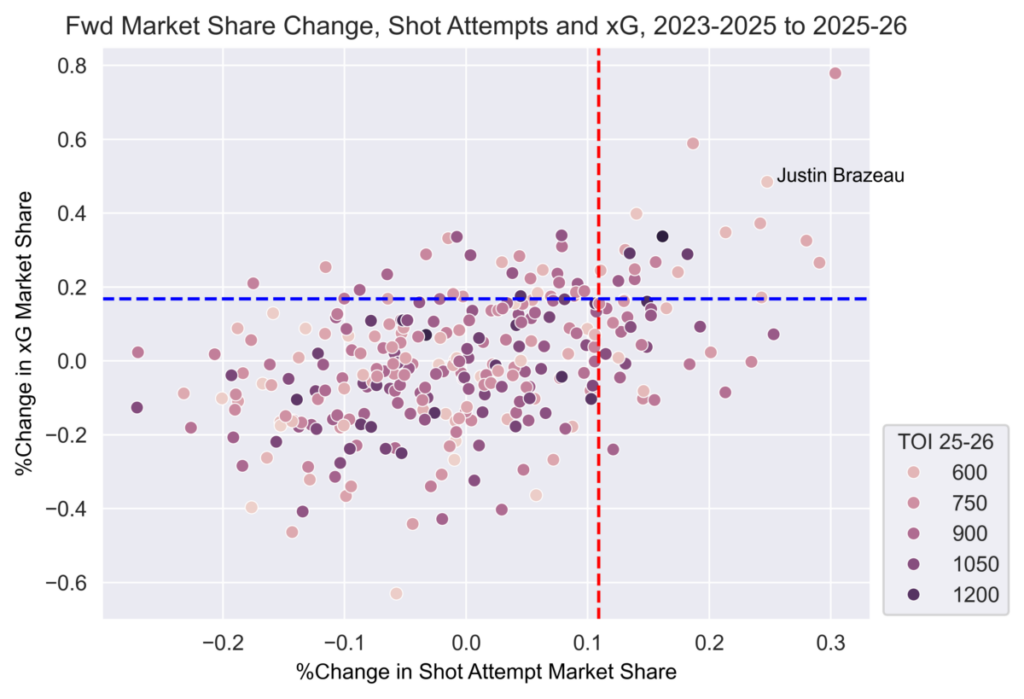
With 1.9 shots, 1.3 hits, and 0.6 blocks per game, Brazeau has some modest multi-cat appeal. To really be valuable, he needs to produce goals and assists, and being at a 53-point/82-game pace certainly qualifies. The problem is he’s not a key cog of the forward group, averaging under 13 minutes a game and earning less than 25% of the power-play time (per Frozen Tools). The real test will be next season and whether Brazeau can make these changes permanent, because if this improvement persists, he should be a roster regular in banger leagues of all sizes. (feb11)
[Follow the link for more…]
19. In yesterday’s Ramblings, we covered changes in market share of shots and expected goals among forwards. To get everyone up to speed, the term ‘market share’ refers to the percentage of a team’s shots or expected goals taken by a specific player when they’re on the ice. So, if Cale Makar is on the ice for 1000 shots for Colorado, and he personally takes 200 of them, his market share of shots is 20%.
The reason we do this is to capture players who may not be on the ice for a lot of shots, but take a big percentage of them, indicating a diamond in the rough whose fantasy value can rise in the right spot. It also helps capture skills improvements from players who might otherwise go unnoticed.
Today, we are moving to the blue line and market share changes among defencemen. We are limiting the sample to defencemen with at least 1000 minutes across the 2023-25 seasons, and at least 500 minutes thus far in 2025-26 (a sample of 159 defencemen). We are using data from Evolving Hockey unless otherwise indicated, looking at market shares of both shot attempts and expected goals. The red and blue dotted lines are the barriers for being one standard deviation above/below average, which means a positive change higher than the 84th percentile or a negative change worse than the 16th percentile.
As mentioned yesterday, the changes mentioned are relative changes, not raw changes. That means if a player goes from 25% to 30% in market share of shots, the increase is 20% ([30 – 25] / 25) and not 5% (30 – 25).
Rasmus Andersson (Vegas Golden Knights)
The largest improvement in market share of shot attempts of the 159 defencemen in our sample also had the third-largest improvement in market share of expected goals. It is Andersson, who started the season in Calgary and has since been traded to Vegas:
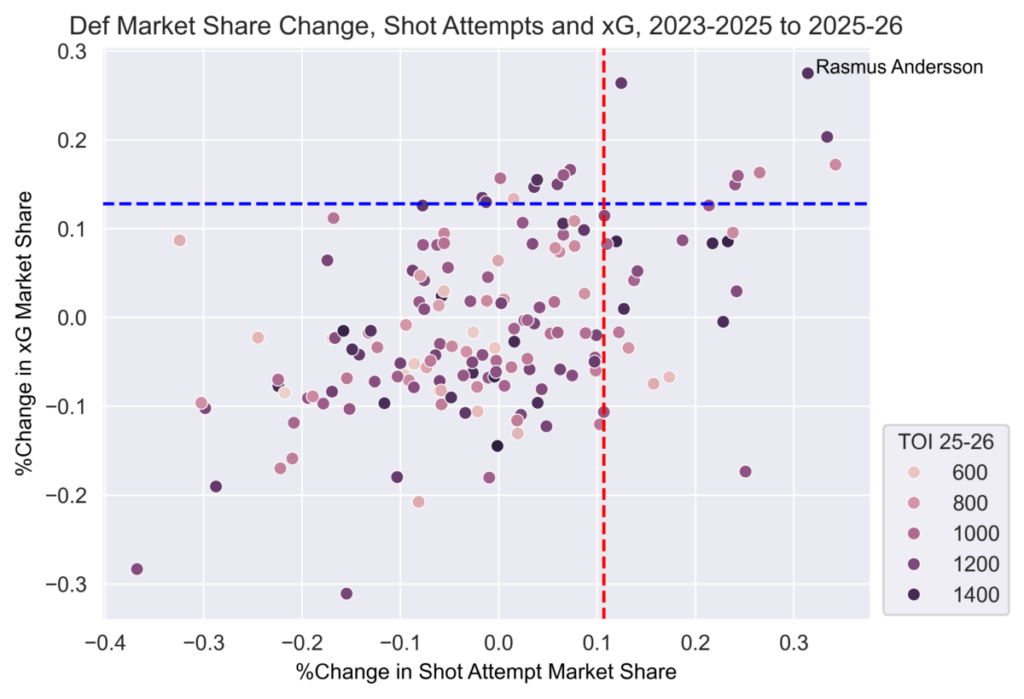
Importantly, there hasn’t been much change in his short Vegas tenure compared to what he did with Calgary to start the season: Andersson took 23.2% of shot attempts in 48 games with the Flames and that number is 22.6% in eight games with Vegas. Across the prior two seasons, he took just 17.6%.
For a frame of reference here, Zach Werenski took 23.9% of Columbus’ shot attempts when he was on the ice across the 2023-25 seasons while Quinn Hughes took 22.9% of Vancouver’s attempts. Andersson is currently at 23.2% between Calgary and Vegas this season, so if he can stay anywhere around the 23% mark, it would put him among some of the top offensive producers around the league.
This isn’t to say that Andersson will be as productive as Werenski or Hughes – they are clearly in a higher tier offensively. Additionally, the worry is that a 29-year-old defenceman facing unrestricted free agency hasn’t genuinely changed his approach to the game but is trying his hardest to get that one last, big contract of his career.
For now, anyway, it does provide Andersson with a bit of security in the fantasy realm, even without top power-play time. There is more than enough scoring among Vegas’ forward group to push him close to the 40-point/82-game plateau, he always blocks a lot of shots, and the shots per game are up around 15% from the last couple of years. It should make him a valuable defenceman down the stretch, even without that power-play time. The worry is that the shot boost is temporary and reverts to where it usually is wherever he signs this summer. (feb12)
20. Bowen Byram and Mattias Samuelsson (Buffalo Sabres)
When looking at the highest changes in market shares, we don’t get a lot of pairs of teammates, especially among defencemen. That isn’t the case this year as we have a couple of Buffalo blue liners in Byram and Samuelsson. The former is among the 25 largest changes in market share of shot attempts and top-3 by expected goals, and the latter is top-3 for largest increase in market share of both shot attempts and expected goals:
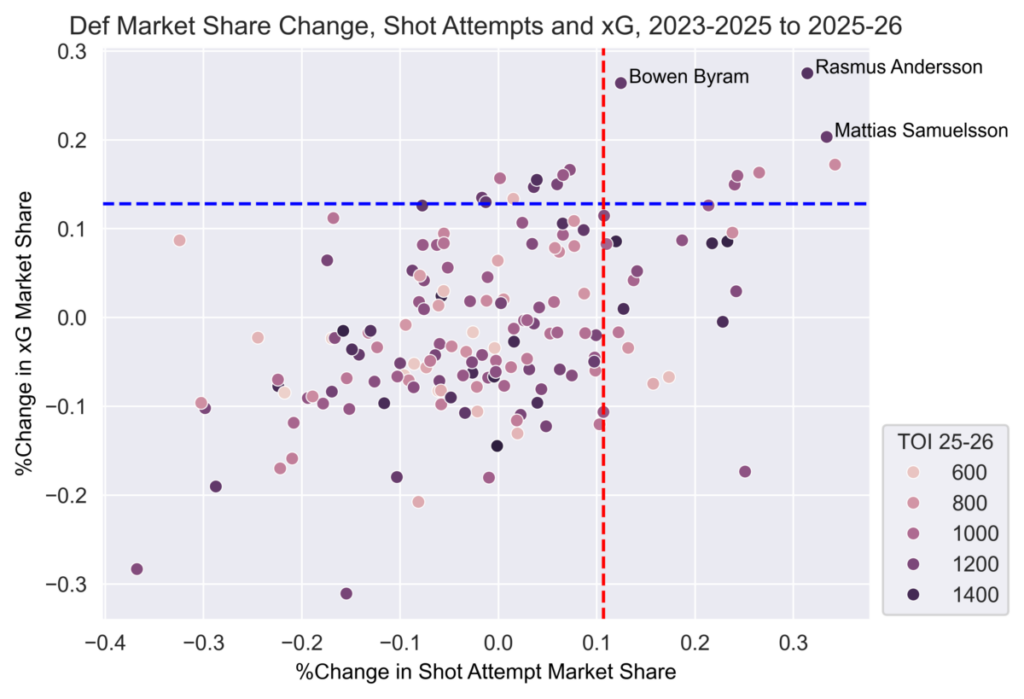
Just 7 of 159 defencemen in our sample have an increase in both areas that is higher than the 84th percentile, and two of them come from the Sabres. This might be something we expect from Byram, given his success earlier in his career, but Samuelsson’s increase is certainly not one we could have seen coming.
It is important to note that Samuelsson’s increase hasn’t been at the expense of Rasmus Dahlin, by far his most common defence partner. Dahlin’s market share from 2023-25 was 20.1% and that has increased to 21.9% this season. That means the forwards are taking far fewer of the shots, but it hasn’t really hurt the team’s scoring. In fact, the team’s 60-minute scoring rate with Dahlin on the ice is up 10% from the last two years.
Of course, the issue is what does this look like once Samuelsson stops shooting 14.5%? It will be interesting to see if he starts deferring his shots more often once the pucks stop going in as they have.
Byram’s market share of expected goals across the 2023-25 seasons was just 9.1%, a rate that has jumped considerably to 12.6% this season. He still isn’t shooting very much – his rate of shot attempts is in the bottom 30% of the league’s regular defencemen – but he is getting more quality looks which has helped him to 14.1% shooting. That is high for a defenceman, but he also shot 13.1% across 145 games from 2021-2024, so this isn’t anything new for him. If Byram can retain these shooting improvements, he will be a perennial threat for 15 goals. (feb12)
[Follow the link for more…]
21. With the NHL on break for over the next couple of weeks and the roster freeze in effect, there is an opportunity to free-wheel these Ramblings a bit. For today, I want to review two players that are having breakout seasons in Josh Doan and Darren Raddysh, and whether they are ‘for real’ or whether fantasy managers should prepare themselves for a downturn.
Individual player and/or team data is from Evolving Hockey and tracking data is from All Three Zones. All charts are my own, with the red and blue dotted lines showing the average of the specific stat being discussed.
Josh Doan (Buffalo Sabres)
With 18 goals and 21 assists to this point, Doan is a genuine threat for 25 goals, 30 assists, two shots per game, and one hit per outing. That would be an excellent multi-cat season, especially for someone who tallied just 12 goals and 16 assists for their entire career before this season. He has been rewarded with a seven-year extension from the Sabres, so he’s going to be around for a while, and it’s worth figuring out what the upside is here.
The problem, of course, is that Doan isn’t a guy with a lot of NHL experience (119 games across three years and no season with at least 60 games played yet). Such is the nature of a breakout player, but it should give us a bit of pause before we over-estimate how good he can be. Just so we’re clear, I was a fan of Doan’s in Utah and thought he could be the biggest winner of the trade that sent him to Buffalo.
First, I wanted to see where Doan stands offensively looking at historical comps. To do that, we’re going to use Evolving Hockey’s Rate-Adjusted Plus/Minus. For anyone unfamiliar, it is a statistical method that tries to account for teammates, opponents, zone starts, and more, to see what a player’s true contributions are to their team. In this instance, we’re looking at expected goals-for (xGF) play-driving in prior seasons to find similar performances to Doan’s across his age 22-23 campaigns. After that, we’re looking for similar players by points per 60 minutes at 5-on-5. Going back to 2007, here are the comparable seasons to Doan’s last two years:
The overlapped names up top are Jeff Carter (2007-09) and Michael Grabner (2010-12), and the overlapped names below them are Sean Couturier (2015-17) and Chris Kreider (2013-15). We then see Brendan Gallagher, Brandon Dubinsky, and Jesse Puljujarvi.
Among all those players, the most generous comp would be Carter, who had six seasons of at least 60 points, one season of 84 points, and four 30-goal efforts. However, Carter and Doan aren’t really that similar by shot volume right now as Carter’s rate of 5-on-5 shot attempts across his age-22 and age-23 seasons was 24% higher than Doan’s. There is a difference between being a player who can threaten for 30 goals, which it seems Doan can/will, and being a player who can regularly score 30 goals, which is Carter’s level. Doan playing in a higher-scoring environment than Carter did in the 2010s will help, but that also helps everyone else. (feb10)
[Follow the link for more detailed analysis on Doan and Raddysh…]
—
Have a good week, folks!
Thanks for continuing to support the website and if you’re bored and need a fantasy hockey fix – visit the gang in the forum here.
Related Posts
Starting Goalies













Top Skater Views
 DET
DET CHI
CHI STL
STL BOS
BOS
Top Goalie Profile Views
| Players | Team | |
|---|---|---|
| DYLAN GARAND |
 NYR NYR | |
| DEVON LEVI |
 EDM EDM | |
| JACOB FOWLER |
 MTL MTL | |
| JOSHUA RAVENSBERGEN |
 S.J S.J | |
| JAKUB DOBES |
MTL
| |
LINE COMBOS
| Frequency |
 BUF Players BUF Players
| |
|---|---|---|
| 122.0 | JACK QUINN NOAH OSTLUND ZACH BENSON | |
| 99.4 | TAGE THOMPSON PEYTON KREBS JOSH DOAN | |
| 53.4 | BECK MALENSTYN JUSTIN DANFORTH SAM CARRICK | |
DobberHockey Podcasts

Keeping Karlsson: Short Shifts – NHL Frozen Frenzy Recap
Elan and Lewis recap the Frozen Frenzy as well as two big returns and more!
Keeping Karlsson: Delusions of Garandeur
Elan and Brian dive into the latest NHL hot streaks, cold streaks, line changes, outjuries, injuries, buy-lows and sell-highs to give you top notch tips in your fantasy hockey league

Fantasy Hockey Life: TiDy Takes Part 2
Last week, Victor Nuno and Ryan Downey broke down trades from our top tier dynasty league. This week, they consider some dynasty trades from other divisions. Have a listen! Our show is part of the Dobber Podcast Network and sponsored by Fantrax.com. Email [email protected] and ask to join our free discord. Join our Patreon at […]
Keeping Karlsson: Matchup Maximizer 2026/27 Week 3
Elan takes a look at the schedule for the upcoming weeks of NHL action and recommends players with good schedules that you should consider streaming in to win your head to head matchups.
Keeping Karlsson: Short Shifts – Sharks Looked Like Celebweenies
Elan recaps the major injuries, outjuries, game results and changed line combos that we’ve seen since Sunday’s mega-show.