

21 Fantasy Hockey Rambles
Dobber Sports
2026-07-26
Every Sunday, we share 21 Fantasy Rambles from our writers at DobberHockey. These thoughts are curated from the past week’s 'Daily Ramblings'.
Writers/Editors: Ian Gooding, Michael Clifford, Alexander MacLean, Puneet Sharma, and Dobber
___
1. The 2026-27 Fantasy Guide is now available! If you have already purchased it, you’ll receive the following documents with your purchase:
- PDF Guide, which includes both articles and team-by-team projections
- Excel Draft List, which includes sortable projections
Both documents are updated as needed until the start of the regular season. To take advantage of the updates, go back to the Downloads folder and download a new copy.
To buy the guide, you can head over to the DobberHockey Shop, and we’ll wait for you to get back. The guide is what supports most of what we provide on this site, and it’s filled with articles covering schedule, trends, analytics, rookies, and the most in-depth team-by-team breakdown you will be able to find for your fantasy team. Don’t fall behind the competition this early. Purchase yours if you haven’t already. You won’t be disappointed!
The French version will be available early this week, in just a day or two. You can pre-order it here.
2, One of the topics I wrote about in the Fantasy Guide was injuries. Any injuries that could affect a player’s availability to start the season have been noted in the Injuries section for each team, while injuries to key players such as Connor Bedard and Seth Jarvis have been accounted for in their projections. The last thing you want to do is use a high pick on a player that will miss a significant chunk of games (in a single-season league, anyway).
Just prior to releasing the Fantasy Guide, Dobber also released his 2026 Band-Aid Boy list. All of the Band-Aid Boys have been listed in the Injuries sections as well. Which teams have the most Band-Aid Boys, and which teams have the fewest? I’ll pull that data for you and try to analyze what it could mean.
MOST BAND-AID BOYS
Pittsburgh (10)
Andrei Kuzmenko, Blake Lizotte, Egor Chinakhov, Justin Brazeau, Samuel Girard, Bryan Rust, Evgeni Malkin, Rickard Rakell, Tommy Novak, Trevor van Riemsdyk.
If there was ever a Band-Aid Boy lifetime achievement award for a team, the Penguins would be the recipient. The Penguins never make it through an NHL season without a rash of injuries. However, I could not locate any Penguins players entering the season with any kind of lingering injury issues. Perhaps they are turning a corner!
No Sidney Crosby or Kris Letang seems surprising, yet they’ve become more durable as they’ve gotten older. (Who among us is fortunate enough to have experienced that?) Crosby missed 14 games last season, but he missed only two combined games in his previous three seasons. Letang has missed eight games in each of his previous two seasons but appeared in all 82 games in 2023-24. Being a Band-Aid Boy isn’t forever.
My assumption was that the Penguins are the oldest team in the league because of all the over-35s (Crosby, Letang, Evgeni Malkin, Erik Karlsson), but as per Elite Prospects, they are only the 11th-oldest team (average age 28.88). Age and injury risk should be taken into account if drafting multiple Penguins to your fantasy team.
[Follow the link for more…] (july25)
3. The Chicago Blackhawks brought Patrick Kane back into the fold thanks to a two-year contract carrying a cap hit of $8-million per season. Michael Clifford wrote about it here.
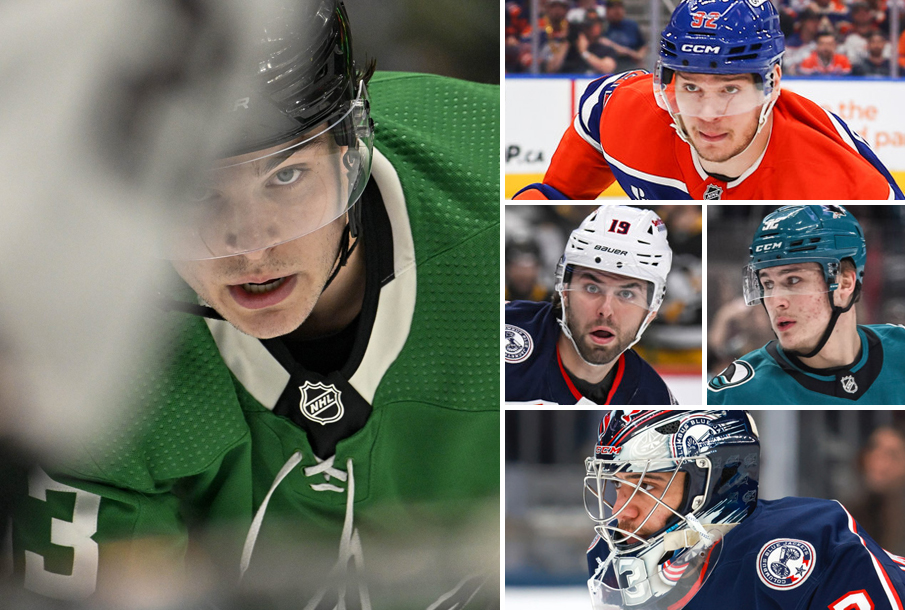
4. Jason Robertson and the Dallas Stars agreed to a one-year $12 Million contract, which kicks the can down the road to when the Stars may have a bit more cap next season, and where Robertson will probably sign with them for at least $14 Million. This also likely makes the trade chatter between Dallas and Pittsburgh die down in the meantime.
Dallas can now sort out their cap situation just by selling off Sam Steel, Radek Faksa, or Nils Lundkvist for picks, and running with 20 skaters, two above the minimum. All-in-all, they have options, and are not going to be forced into another big move just because of the cap. (july22)
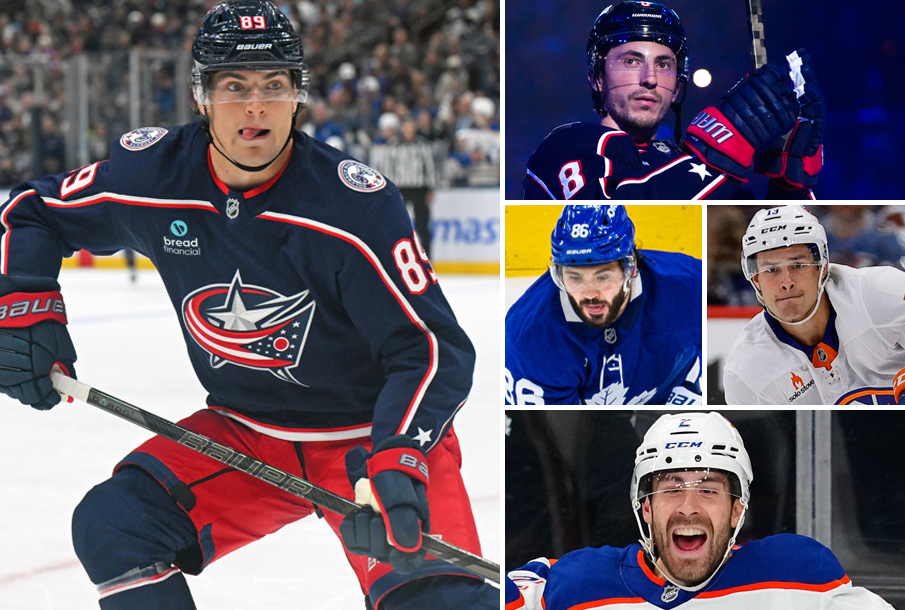
5. Elsewhere, the Columbus Blue Jackets avoided arbitration with goaltender Jet Greaves by signing him to a three-year deal worth $5-million per season, as reported by Elliotte Friedman. Among goalies with at least 70 starts over the last three seasons, Greaves sits third by save percentage (.912) trailing only Anthony Stolarz and Connor Hellebuyck. Unless Columbus takes a big step as a team, Greaves’ ceiling is probably 30 wins, but at 25 years old and with nothing but a sterling track record so far in his NHL career, he can be a top-10 goalie, and even top-5 if he gets a few bounces. (july24)
All arbitration cases have now been settled, with two prominent RFAs avoiding arbitration with agreements announced on Friday.
Cole Sillinger also avoided arbitration with the Columbus Blue Jackets with a three-year, $4.625 million AAV contract. Sillinger finished 2025-26 with 33 points in 81 games, although with just eight goals. The 33 points tied a career high for Sillinger, though. He has finished with 32 or 33 points in each of his last three seasons, topping out at 0.5 PTS/GP in 2024-25. Sillinger, who played on Charlie Coyle‘s line in 2025-26, seems unlikely to finish with more than 40 points in 2026-27. However, he has added value in bangers leagues with 100+ hits in three of his past four seasons.
Akira Schmid also avoided arbitration with the Florida Panthers with a two-year, $2 million AAV deal. Schmid was acquired by the Panthers from Vegas earlier in the offseason and is projected to start 2025-26 as Jacob Markstrom‘s backup. If Markstrom continues to struggle the way he had last season, Schmid could earn more of a timeshare. Schmid appeared in a career-high 34 games with the Golden Knights last season, finishing with 16 wins, a 2.59 GAA, and .893 SV%. (july25)
6. Brayden Point‘s disappointing season last year led to some wacky underlying numbers. I had a leaguemate asking in our general chat what we thought of Point for this upcoming year, and here was the gist of my reply after looking into it:
Point’s drop off was almost completely on the power play (20/30 of the points he lost). Beside that, he was super lucky with his team shooting over 15% with him on the ice. I think with Darren Raddysh's point bomb gone from the power play, Point gets re-involved more on the power play, to the level of scoring 25-30 PPPs again. The even strength scoring may stay a little depressed though, as there’s no indication of that being set for a rebound. If anything, the shooting percentage will regress and hold it down a little. Overall, I say it's a bit of a middle ground where he bounces back but is still under a point per game (maybe 78 points in 84 games as a full season pace).
The Bolts are also hoping for a bit more production from their bottom six, a healthier season on D, and some more reliable goaltending behind Andrei Vasilevskiy, which would all help the team overall. Regardless of Point’s stats, they should be a lock for the playoffs again this year. (july22)
7. The NHL schedule release was last Thursday, and it’s something I always dive into for the fantasy leagues. I had my schedule article completed for the guide before I went to bed that same day, and the next morning I had started looking into trade options.
In one league I sent out an offer of Noah Cates for Jaden Schwartz, and ended up moving Blake Coleman for him instead. In another I was looking at Erik Karlsson for someone like Darnell Nurse or Mackenzie Weegar, but haven’t found any takers on reshaping my defence core yet.
You’ll have to buy the guide to get my full breakdown, which includes teams to target or avoid based on your H2H championship weeks, and many other notes on how to best navigate the gaps, peaks, and valleys in the schedule. Take the first week of the season for example. It’s usually quite lopsided as some teams start out with more or less volume, and you can much more easily target those teams with more games (the Rangers and Canucks this year have four games the first six days) or avoid the teams with less volume (the Senators only play once in the first six-day week).
I will say though, if you’re the owner of a few Washington Capitals players, then you’re going to be happy come H2H playoff time. (july22)
8. I did also have a preliminary discussion around taking on some salary on top of Cates for an upgrade with another team, but that didn’t work out for the specific player he initially offered. However, knowing that the team wanted to shed a bit of cap, I decided to look into something bigger. I offered up Dylan Larkin, Noah Cates, Michael Hage, Yegor Zavragin, and another prospect for Nikita Kucherov and Jared McCann. We went back and forth a little on the last prospect, and ended up adding both Tristan Luneau and Sasha Boisvert to push it over the line. I add $1.8 Million in cap, lose a couple of possible cheap fillers who are still minors eligible in Boisvert and Luneau, and had to give up my favourite prospect to own in Hage, but the offensive boost should hopefully cement my contender status for the year – before Kucherov’s next contract has me back to the drawing board in a year.
There is a lot to plan for with a deal like that, and knowing that my farm team was well stocked enough to take that hit and still be able to provide a couple of fillers over the next two years is a big part of it. It might also mean having to sell off Vladimir Tarasenko depending on his new deal (and if it’s more than $3 Million per year), but adding 40 points on top of Larkin’s numbers, solidifying RW which can be tougher to find, and upgrading on Cates too with a few players ideal for the H2H playoffs, it felt like a worthwhile gamble to make. (july22)
9. In that same Salary Cap Fantasy league we had the draft start on Wednesday last week, and there were a few surprises even in the top-10 picks. Tynan Lawrence and Ethan Belchetz went early with picks #7 and #8, but with how defencemen take longer to develop and also end up with higher salaries relative to their production, them being picked earlier than expected shouldn’t really be too much of a surprise.
Wyatt Cullen went at #6, and he was that high on my list too. If you can get him in the #5-#9 range in fantasy drafts, he will probably pay dividends. I have previously compared him to Beckett Sennecke with the hands and the recent growth spurt, and that kind of potential without real flaws is pretty rare in this draft class.
Carson Carels ended up going at pick #10, and despite him having a solid statistical profile coupled with a high floor, he’s someone that was lower than 10th on my final list. I see Carels more as a Ryan Suter type (with better peripherals), and on a team that already has Simon Nemec, Zayne Parekh, Hunter Brzustewicz, and Henry Mews for offence, Carels may be a lot less likely to end up running a top PP, which caps his offence. He might still be great in multicat, but that lack of PP offence would hold him back from being a top-tier fantasy asset.
Alberts Smits dropped all the way to pick 15, which is a big drop for a top-five player in the NHL draft. The uncertainty in his offensive ceiling really makes him a riskier fantasy pick, because no one wants a second-pair Defenseman who doesn’t add many points when there are still 60-point wingers on the board. (july22)
10. Another deal I made recently was trading the 20th pick in our draft in exchange for Patrick Kane and a later pick. I’m confident enough in my drafting that I can find a bit of value with a late pick (likely an older drop as opposed to a later 2026 draftee). As for Kane, I’m hoping he comes in on a cheaper deal with bonuses, though neither Buffalo nor Chicago where he’s rumoured to sign have cap trouble at the moment, so it’s not a given. (Ed. note: Kane finally signed with Chicago on Thursday). He still has some skill left, pacing for 70-points last season on a Red Wings team that didn’t look dangerous at all in the second half – which is where Kane took over and scored 23 points in his final 19 games.
The selection made at pick 20 was exactly who I would have taken had I kept the pick, Red Wings selection J.P. Hurlbert, who on my final list was up to my #13th ranked player. He seems like a very solid all-around option in a year where most players after the top ten or so have at least one big flaw to their game.
The thought of Kane inking a 35+ contract had me look at Vladimir Tarasenko as well, knowing he’s 34 and wondering if he could wait out until his 35th birthday and then sign a bonus laden deal, but that’s unlikely to transpire as he doesn’t turn 35 until December. Next summer! (july22)
11. Back to the draft, the same team had picks 19 and 21, surrounding my #20 pick. I had originally thought about trying to get one of the two in order to try and select the Ruck twins, but I didn’t have the right assets to make it work. In the end, the other GM at 19 and 21 ended up selecting both. They’re either going to thrive or fall short as a pair, so it’s the ultimate risk/reward double-down scenario.
This GM actually ended up with this pair of picks as a result of a trade, where he sent Leo Carlsson out in exchange for Adam Fantilli and the two late firsts. He was in a bind for cap space, while the other GM acquiring Carlsson had space to spare, less need for the picks, and was looking to consolidate more skill at the top of the lineup. That’s going to be a fun one to look back on.
Oliver Suvanto and Mathis Preston went back to back at picks 26 and 27, and capped off the top tier that I saw for players that might be able to land on a top line in the future (although likely more in a support role rather than coming close to carrying their own line).
After trading my pick at #20 away, my first selection was #34, where I took Jaxon Cover. His story on its own is fantastic, and because of the very recent transition into hockey, he has a steeper runway than most prospects. The hockey sense has to catch up a bit as well, but if he can figure it out, there’s going to be no one with a higher upside left in your drafts past pick 30. To boot, he plays for the London Knights, who seem to have a conveyor belt set up pumping out a prospect in the mid-late first round every year. (july22)
12. The offseason is all about opportunity, but every trade and free-agent signing also creates a few fantasy losers. While some players on this list have seen their fantasy value take another hit after already dealing with declining roles, others are younger players whose path to fantasy relevance became more difficult because of new additions around them. Whether it's increased competition for power-play time, a reduced role or a more crowded depth chart, these players are heading into the season with a tougher fantasy outlook than they’ve had over the past couple of years.
Any hope of Verhaeghe returning to the 30-goal, 70-point producer we saw a few seasons ago took yet another hit the moment Florida acquired Brady Tkachuk. While the Panthers dealt with injuries throughout much of last season, creating opportunities for players to take on larger roles, this season projects much differently with the expectation that the roster will be healthy from the start. At even strength, there is still plenty to like. Verhaeghe is projected to skate alongside Sam Bennett and Matthew Tkachuk, which should give him a strong opportunity to remain productive. There are also reasons to believe he can improve on last season's 55-point finish. His shooting percentage was not the issue, as his 13.4% rate was right in line with his career average. The bigger concern was his declining shot volume. After averaging 246 and 278 shots in the previous two seasons, that number dropped to just 187 last year. If he can push back above 220 shots, another 30-goal season may be a possibility.
The bigger fantasy concern is his power-play role. If Brady Tkachuk takes a spot on the top unit alongside Barkov, Reinhart and Matthew Tkachuk, Verhaeghe could be pushed to the second power-play unit. The second unit isn’t anything to scoff at but its not the first unit. Regardless, that would affect his fantasy value. Losing that premium deployment does not mean Verhaeghe is a worse player, but it does lower his ceiling. Instead of being viewed as a legitimate 70-point threat he was a couple of years back, he looks much more like a 55 to 60-point winger unless injuries or lineup changes open the door for him to regain a top power-play role, which is never out of the question in Florida. (july20)
13. Artyom Levshunov / Sam Rinzel
Chicago's blue line was still searching for a true No. 1 defenseman last season, which forced Artyom Levshunov and Sam Rinzel into bigger roles earlier than expected. The two rookies finished with 24 and 14 points, respectively, and while Levshunov appeared to have a slight edge in terms of future offensive deployment after seeing a bit more power-play time, neither player was ready to fully take over as the team's top option. In fact, Alex Vlasic ended up leading all Chicago defensemen in average ice time, showing just how unsettled the hierarchy was. The addition of Bowen Byram changes that immediately. Chicago finally gets the top-pairing defenseman it has been looking for. Byram averaged over 22 minutes per game last season, more than any current Blackhawks defenseman, and brings exactly what this group needed. He's a strong puck mover, can push the pace offensively, join the rush and create offense from the back end while also handling heavy minutes against top competition.
Chicago is still likely to mix and match its pairings throughout the season, but Byram should enter the year with the inside track on the top power-play unit and the biggest workload among their defensemen. That makes it much harder for Levshunov or Rinzel to immediately carve out a high-end fantasy role. Long term, I still believe both Levshunov and Rinzel have the talent to eventually become Chicago's offensive leaders from the blue line. The question is simply when that happens. Defensemen typically take longer to develop than forwards, and with Byram now in place, Chicago has the luxury of allowing both prospects to develop properly rather than forcing them into roles before they are ready. (july20)
14. Victor Hedman
I briefly touched on this in my article projecting each team's power-play quarterback. At the time, I had Victor Hedman penciled in for the role before Tampa Bay went out and signed John Carlson. That addition changes the outlook considerably. Hedman appeared in just 33 games last season and later revealed he stepped away from the team to focus on his mental health. It is difficult to project Hedman ahead of Carlson for the Lightning's top offensive opportunities. Carlson proved last season that he can still perform at an elite level, averaging 23:10 of ice time and 2:44 on the power play while recording 60 points in 71 games split between Washington and Anaheim. He remains an excellent puck mover, distributes the puck well and has shown he can still quarterback a productive power play.
We've seen a similar situation before in Tampa Bay. When Mikhail Sergachev earned a larger offensive role, Hedman's fantasy value took a noticeable hit as the workload became more evenly distributed. Once Sergachev was traded, Hedman reclaimed the lion's share of the power-play opportunities and responded with back-to-back 76 and 66-point seasons before last year's injury-shortened campaign. With Carlson now in the fold, it feels like Tampa Bay is heading back toward that earlier deployment. Hedman should still play significant minutes at even strength and remain an important part of the blue line, but Carlson has to be considered the favorite to run the top power-play unit. If that happens, Hedman's fantasy ceiling likely takes another step back compared to what we've seen over the past two seasons prior to this. (july20)
15. Morgan Rielly
I know Morgan Rielly‘s value wasn’t that high to begin with but the signing of Darren Raddysh was likely all fantasy managers needed to see when it came to Rielly's projected role moving forward. His path to premium deployment in Toronto has become even more difficult, and it obviously does not bode well for his fantasy value. Rielly has bounced in and out of the Maple Leafs' top power-play unit over the past few seasons, but with Raddysh now entering the picture, it is becoming harder to see him even getting those minutes back. In 2023-24, when Rielly was receiving nearly 58% of Toronto's power-play opportunities, he finished with 58 points. Over the last two seasons, that usage has dropped to 43% and 55%, and his production has followed, with Rielly recording just 41 and 36 points. Heading into this season, there is a legitimate chance he loses that top-unit role altogether, which makes it difficult to see where the offensive upside comes from. The arrival of Jim Hiller as head coach adds another layer of uncertainty to Rielly's deployment. However, the one positive is that Hiller previously worked as an assistant coach in Toronto, and during that time, Rielly continued to produce offensively while playing under him. Whether that familiarity leads to a larger role remains to be seen. Rielly is still a reliable NHL defenseman who can handle big minutes and contribute in multiple areas of the game. From a fantasy perspective, though, the trend is moving in the wrong direction. Unless Toronto's blue line situation changes or Raddysh fails to establish himself on the power play, Rielly looks like a player to fade in most fantasy drafts rather than a defenseman with legitimate top-end upside. (july20)
16. The Stanley Cup has been awarded, trades have been made, free agency has slowed to a crawl, and that means preparation for the 2026-27 season is in full swing. It is still too early to make firm determinations about player draft value, but there is one source we can look to for average draft positions.
Underdog Fantasy runs a best ball league called The Best Puck Classic every year. For those unfamiliar with the format, best balls are draft-and-hold leagues. That means you draft your team before the season and then that’s it – there are no trades, waivers, or roster moves; what you draft is what you have. Each week, the players with the most fantasy production at each position – on this site it’s centre (C), wing (W), defence (D), goalie (G), and flex (C/W/D) – are counted towards your final total. In these particular drafts, 18 players are drafted and only the best scores from two centres, three wingers, one defenceman, one flex, and one goalie count each week.
* Note: Neither I, nor Dobber, nor Dobber Hockey in general is affiliated with Underdog in any way. I just use this site for some season-long fantasy leagues, particularly this format, and they are the earliest with actionable data.
In this instance, it is a season-long league that plays like a head-to-head format. There are thousands of entries, and the entries are split into individual 12-team leagues. The top three teams in the fantasy regular season from each individual 12-team league move to the next round where they’re re-assigned to a 10-team league for a playoff round. Then those playoff leagues are cut down after another round, and so forth. It is also a points league that counts production as such:
- Goals – 6
- Assists – 4
- Power-Play Points – 0.5
- Shots – 1
- Hits – 0.5
- Blocks – 1
- Goalie Win – 6
- Goalie Save – 0.6
- Goalie Goal Against – (-3)
So, it is a season-long league that incorporates what is functionally head-to-head playoffs and uses a points format. Cool? Cool.
Their drafts started a couple of weeks ago, and it’s the middle of July so only about 50 drafts have been completed, but it does give us an idea of early ADPs, so let’s look at some players whose early draft positions stand out.
Today will be centres only, and then we’ll move to other positions in future Ramblings.
Macklin Celebrini (San Jose Sharks – C)
Celebrini was a player I was incredible bullish on last year and ended up drafting in over half my leagues, sometimes paying a second-round price. I thought even a second-round price was fair, and after his outstanding 2025-26 season, he’s now being drafted as a top-3 pick:

Last year with this scoring system, Celebrini finished with the third-most fantasy points and was fourth by FPs per game. Obviously elite, but it’s notable that he finished nearly 1.2 FPs per game behind Connor McDavid and 1.7 FPs per game behind Nathan MacKinnon. To get to that next level, he needs to add something like 8 goals and 50 shots, or 3 goals, 8 assists, 5 power-play points, 5 hits, and 30 shots, or some similar combination. It isn’t a heavy ask, but he does need to be (roughly) a 50-goal, 70-assist, 300-shot player to climb into the MacKinnon/McDavid tier. The last player age-20 or younger to manage 50 goals and 70 assists in a season was Wayne Gretzky in 1980-81 (per StatHead). I believe Celebrini is among the elite in the league, it just seems like a lot to ask. (july21)
17. Tage Thompson (Buffalo Sabres – C)
In the Best Puck Classic last season, Tage was often going somewhere in the third round, frequently between picks 27-36. After finishing as 1 of 9 players with at least 40 goals, 40 assists, and 3.0 shots per game, Tage’s ADP has crept to the top of the second round:

In this format last season, Tage finished 4th among centres by total points, but the FPs per game gap between him and Celebrini (1.78) was larger than the gap between Tage and the 58th-ranked forward (Dylan Cozens).
I will form a firmer opinion once I have finished my projections (probably won’t be until mid-August because of some vacation time coming up), but that FP gap is one of the reasons I don’t really like taking Tage this high. He turns 29 years old in October so he very well may have already had his career year. At this draft position, I would prefer to wait on taking another centre later on and focus on the elite wingers or defencemen like Matt Boldy, Brady Tkachuk, Martin Necas, or Zach Werenski. Then again, this is the first year where the Best Puck Classic is counting two centres each week rather than one.
[Follow the link for more…] (july21)
18. In my Ramblings on Tuesday (above), I reviewed some early average draft position (ADP) data from Underdog Fantasy. That write-up focused strictly on centres like Macklin Celebrini, Wyatt Johnston, Adam Fantilli, Sebastian Aho, and others.
Today’s Ramblings will round out the forwards by reviewing winger ADPs.
Kirill Kaprizov and Matt Boldy (Minnesota Wild)
Last season, among 411 forwards with at least 40 games played, there were 13 who managed at least 10 fantasy points (FPTS) per game in this format, and two of those 13 were Kaprizov and Boldy. Unsurprisingly, then, both are being drafted in the back half of the first round or very early in the second round:

The interesting one to me is Boldy. Across his first four seasons, he had never shot higher than 13.3% (and that was in 47 games as a rookie), and the last three seasons saw him average 11.6%. Then, in 2025-26, he shot 16.5%. If his conversion rate was 13% – which would still have been a four-year high – then he scores nine fewer goals and drops from the 9th highest-scoring forward to 17th. If he shoots 11.5%, he falls to the 23rd highest scoring forward. A big reason for the spike is he scored as many empty-net goals last year (5) as he had for his entire career prior, a span of 285 games. Is he really that much better/safer at that ADP than Martin Necas or Kyle Connor? (july23)
19. Mikko Rantanen (Dallas Stars)
Last year, one team I wasn’t super excited about drafting because of their ADPs were the top players from the Dallas Stars. For Jason Robertson, that backfired on me as he finished as the fifth-highest scoring forward overall. It did work out for me with Rantanen as his ADP was as a late first/early second-round pick and he finished outside the top-30 forwards by FPTS per game. As a result of last season, Rantanen’s ADP has dropped ~10 picks:
This is a prime example of the importance of league settings: Rantanen had an 82-game pace for 99 points but he still was a poor draft value. Without much for hit/block peripherals, and with his shot volume in Dallas dropping about 1.3 shots per game when compared to his last few years in Colorado, he is heavily reliant on elite point production. Rantanen could be a 30-goal, 70-assist forward and completely brick at this ADP because of the lack of peripherals.
[Follow the link for more…] (july23)
20. Here are some interesting ADPs among blue liners.
Zach Werenski (Columbus Blue Jackets)
As expected, Cale Makar is the first defenceman off the board at the end of the first round, then there are three defencemen going in the mid-to-late second round, Werenski among them:

Last year, Werenski led all defencemen by fantasy points (FPTS) per game in this format, finishing second by total FPTS behind Evan Bouchard. Over the last two seasons, Werenski leads all defencemen by both FPTS per game and overall FPTS. Despite that, he’s going as the second defenceman off the board and can sometimes be had even later if someone in your league is particularly high on Bouchard or Quinn Hughes.
This is interesting. Not that I necessarily disagree with it because Makar should be first and Quinn Hughes can be a 15-goal, 90-point defenceman with the Minnesota Wild given his improved roster over the Vancouver Canucks combined with absurdly heavy usage. But given that Werenski has had back-to-back super-elite seasons and is still on the right side of 30 years old, it seems that potentially being able to get him as the third or fourth defenceman off the board is good value. (july24)
21. Matthew Schaefer (New York Islanders)
From rarely being drafted last season to being the sixth defenceman off the board this season, Schaefer finds himself in pretty good company:

The 2025-26 season saw Schaefer finish 8th overall by total FPTS among defencemen, and tying Shayne Gostisbehere for 12th by FPTS per game (Schaefer playing all 82 games obviously made him the much more valuable blue liner). Given these finishes as a rookie, that he’s going as the sixth defenceman makes sense to me.
We don’t really have a comparison for Schaefer. No rookie defenceman has had a 20-goal, 30-assist season since the 1980s. No defenceman has had a 50-point, 200-shot season since the 1980s, either. The closest is Cale Makar‘s 57 games back in 2019-20 and he was three years older at the time. Either Schaefer is a one-year anomaly that will regress or he’s a generational player. It is reminiscent of Macklin Celebrini last year – you either believe or you don’t. I am a believer, and if I miss on any of the top guys, I am perfectly fine grabbing him in the fourth round.
[Follow the link for more…] (july24)
***
Programming note: The Offseason Fantasy Grades articles will be back again this offseason, starting on Tuesday August 4. We will cover them in reverse alphabetical order this season, so Winnipeg Jets fans will not have to wait until the end like they have in past seasons. You can find last season’s Offseason Fantasy Grades here if you would like a trip down memory lane to see what the teams looked like at this time last year.
***
Have a good week, folks!
Thanks for continuing to support the website and if you’re bored and need a fantasy hockey fix – visit the gang in the forum here.
Related Posts
Starting Goalies











Top Skater Views
 T.B
 PHI
 N.J
 ANA
Top Goalie Profile Views
 MTL
 WSH
 EDM
 MIN
LINE COMBOS
| Frequency |
 PIT Players | |
|---|---|---|
| 21.0 | RICKARD RAKELL TOMMY NOVAK SIDNEY CROSBY | |
| 17.8 | HENDRIX LAPIERRE VILLE KOIVUNEN AVERY HAYES | |
| 17.2 | ELMER SODERBLOM NICK ROBERTSON CONNOR DEWAR | |
DobberHockey Podcasts

Keeping Karlsson: Matchup Maximizer 2026/27 Week 5
Jeremy takes a look at the schedule for the upcoming weeks of NHL action and recommends players with good schedules that you should consider streaming in to win your head to head matchups.
Keeping Karlsson: Short Shifts – Injuries, Outjuries, and Duds
Elan talks about all the latest injuries, outjuries, big performances and duds over a tight 20 minutes in this week’s episode of Short Shifts.
Keeping Karlsson: Never Tell Me the Podz
Elan and Brian do a wellness check on the Maple Leafs, lament Chicago and Buffalo snoozers, wonder whether and which Flyers have figured it out, and pick out the Capital standing out from the crowd.

Fantasy Hockey Life: Ep 505 Prospects With Plenty to Prove Part 1
Victor and Jesse return to talk about prospects with plenty to prove. This week it’s: Tij Iginla, Berkly Catton, Konsta Helenius, Zayne Parekh, Igor Chernyshov, Jett Luchanko, Axel Sandin-Pellikka, Artyom Levshunov, Michael Hage, and Carter Bear. Have a listen! Our show is part of the Dobber Podcast Network and sponsored by Fantrax.com. Email [email protected] and […]
Keeping Karlsson: Matchup Maximizer 2026/27 Week 4
Elan takes a look at the schedule for the upcoming weeks of NHL action and recommends players with good schedules that you should consider streaming in to win your head to head matchups.