

Ramblings: Finding Useful Stats for Predicting Future Goal and Point Production Among Defencemen
Michael Clifford
2026-08-07
In yesterday's Ramblings, we went over stats that are, or are not, useful when searching for future goal and point production among forwards. There were some surprising results, particularly when it came to the types of stats that were useful, so to get a foundation on these Ramblings, go read that first.
Today, we'll move to the blue line and do the same type of analysis for defencemen. It is a different position, and one that has been underdoing significant changes over the last 15 years, so what was a helpful stat in 2022 may not be helpful in 2026.
As a reminder, this is only for 5-on-5 production, and we're looking at stats for the 2023-24 season and production the year after, and then stats for the 2024-25 season and what happened in 2025-26. Production at 5-on-5 is just one portion of how high-end fantasy skaters get their value, but it's an important one, and it can help identify those with good skills that can translate elsewhere.
The tracking data used is from All Three Zones and the standard player data is from Evolving Hockey. We are going to limit the defencemen used for the analysis to those with seasons where they had at least 500 minutes at 5-on-5 overall and 100 minutes in tracked data. Overall, we are using 18 individual data points in each season to search for predictive value, ranging from things as simple as shot rates to various tracking stats.
Points
One of the interesting parts of the analysis on the forwards is that there was one season where 5-on-5 point production correlated well to point production the following year, and one season where the correlation was much weaker. That isn't really the case with defencemen as both 2023-24 and 2024-25 points rates had similar correlation values in both seasons:
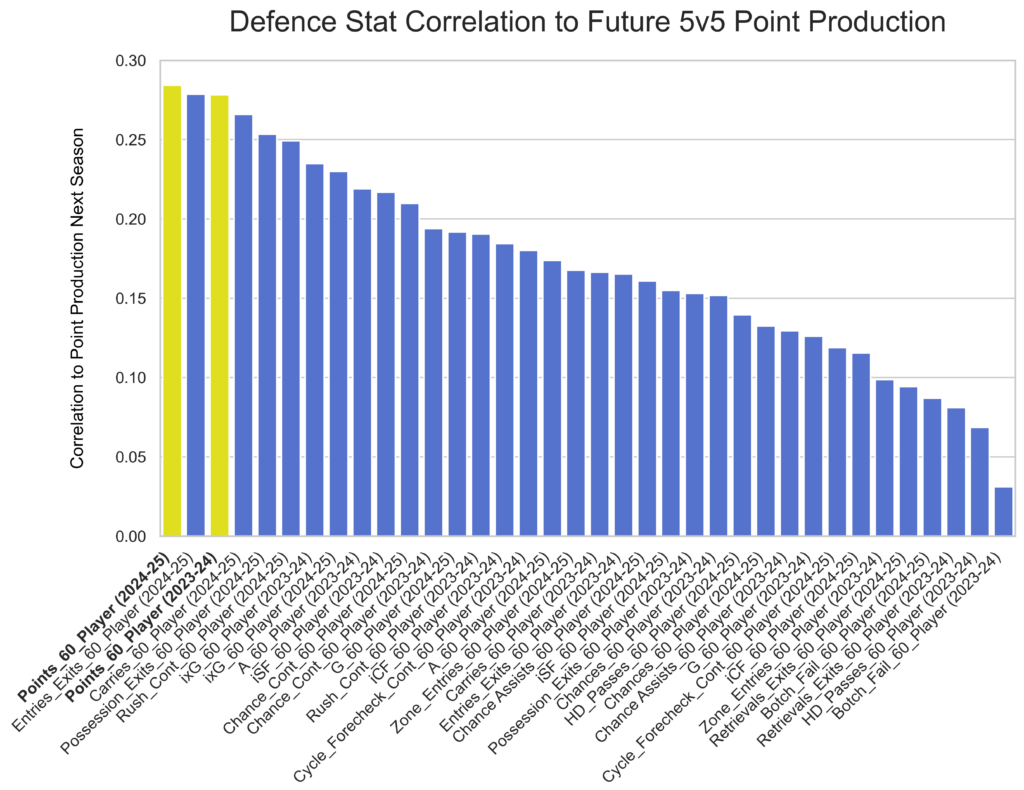
What also stands out is that of the 18 stats we're using to predict future production, a defenceman's points rate is one of two stats where the correlation in both seasons is at least 0.2. Fantasy value for defencemen is more complicated than just sorting the points column, but there are worse ideas.
If a blue liner's point rate is one of the stats that has had two straight years of good correlation to future point production, the other must be a similar stat, right? Maybe assist rate? What about scoring chance contributions? Controlled zone entries? None of the above, actually, and it's one that really surprised me.
Expected goals are a stat that approximate shot quality. The type of shot, where it was taken, how long after a zone entry it occurred, whether it's a rebound or not, and other factors determine the expected goal value of any shot. Because it is a direct result of a player taking a shot, we would probably see some correlation to points, but this might be the most incredible finding of the last two days: Aside from points rate, a defenceman's individual expected goals rate at 5-on-5 (ixG/60) appeared in the top-10 from each of the last two seasons by correlation to future point production. This is what that looks like:
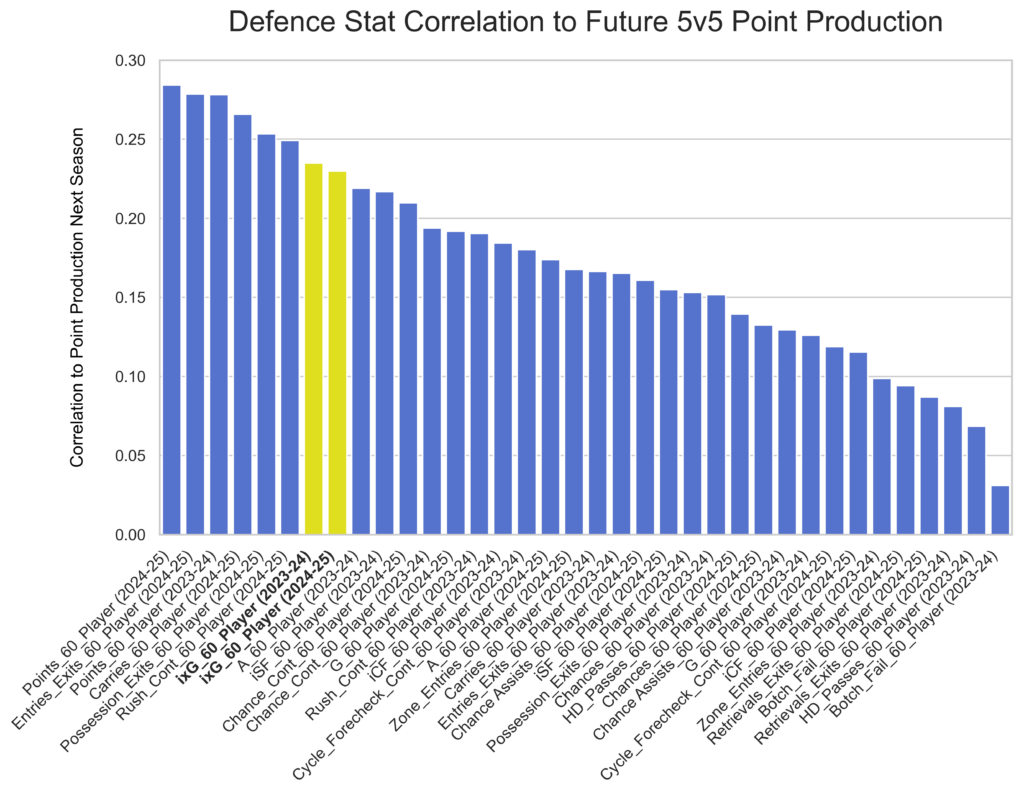
This is why separating forwards from defencemen is important. In the forward analysis, the predictive value of individual expected goals to point production in the next campaign was under 0.1 in both seasons. For defencemen, that number is between 0.2 and 0.25 in each campaign. If we look at the top of the leaderboard for ixG/60 over the last two seasons, the only name that stands out as an odd duck is Olen Zellweger. Otherwise, we're looking at Zach Werenski, Cale Makar, Jackson LaCombe, Rasmus Dahlin, Brandon Montour, Dougie Hamilton, Jakob Chychrun, Evan Bouchard, and Roman Josi. We can quibble about Montour, but that seems to be a Seattle Kraken problem and not entirely a Brandon Montour problem.
With the forwards, we saw how their rate of Scoring Chance Contributions, or individual scoring chances plus assists on teammate chances, correlated well both years to future point production: The r-squared, or correlation, of the Chance Contributions to points the next season was around 0.27. That wasn't the case with defencemen as their correlation was between 0.19 and 0.21 in both years, and were further down the list among all the stats we're using:
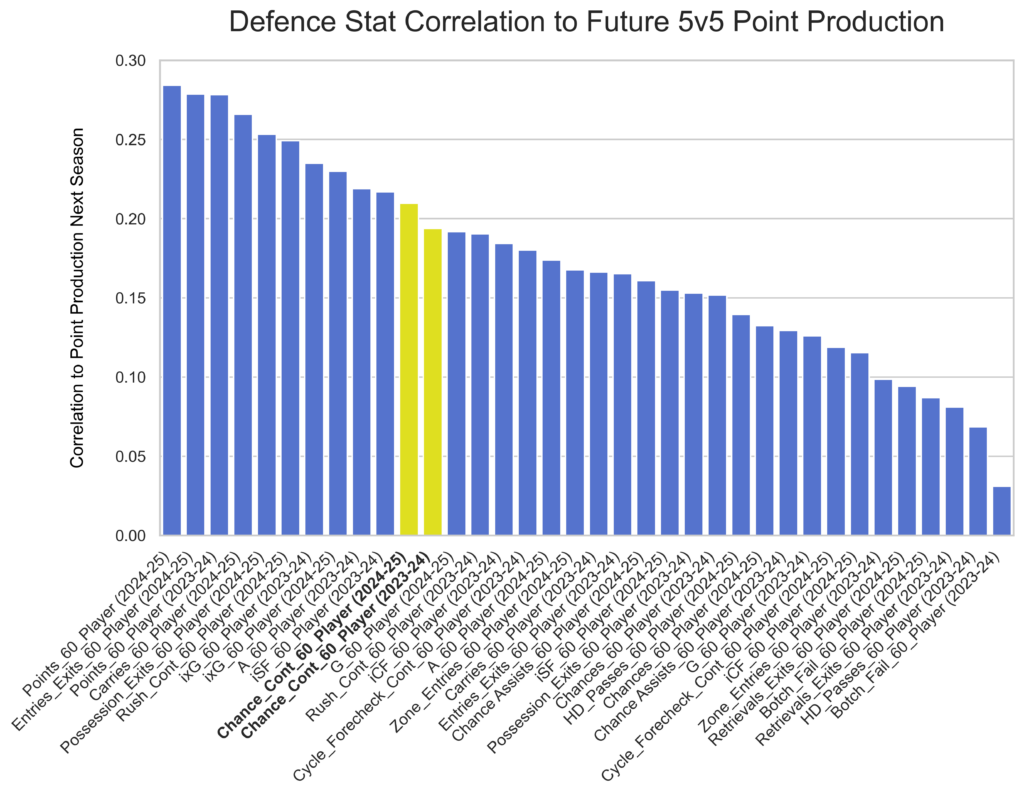
It isn't bad, per se, but this particular stat just doesn't hold up to what we saw among the forwards. When we did the forward analysis, the top of the chance contribution list was a veritable who's-who of elite fantasy options all throughout; there weren't any middling fantasy forwards in the list. It is different for defencemen as the top-10 over the last two years includes Luke Hughes, Travis Sanheim, and Brandt Clarke. All useful fantasy blue liners in virtually any format, but none have been high-end fantasy talents, let alone elite. At least Hughes and Clarke are young enough to take another step.
Another interesting finding in the forward analysis from yesterday was that how a forward generated their offence mattered a lot. The tracking data splits 5-on-5 offence into two categories: off the rush and off the cycle/forecheck, and both have assists and shot components, much like we saw with Chance Contributions. Let's follow up on that to see how the rush contributions and cycle/forecheck contributions did with future point production for defencemen:
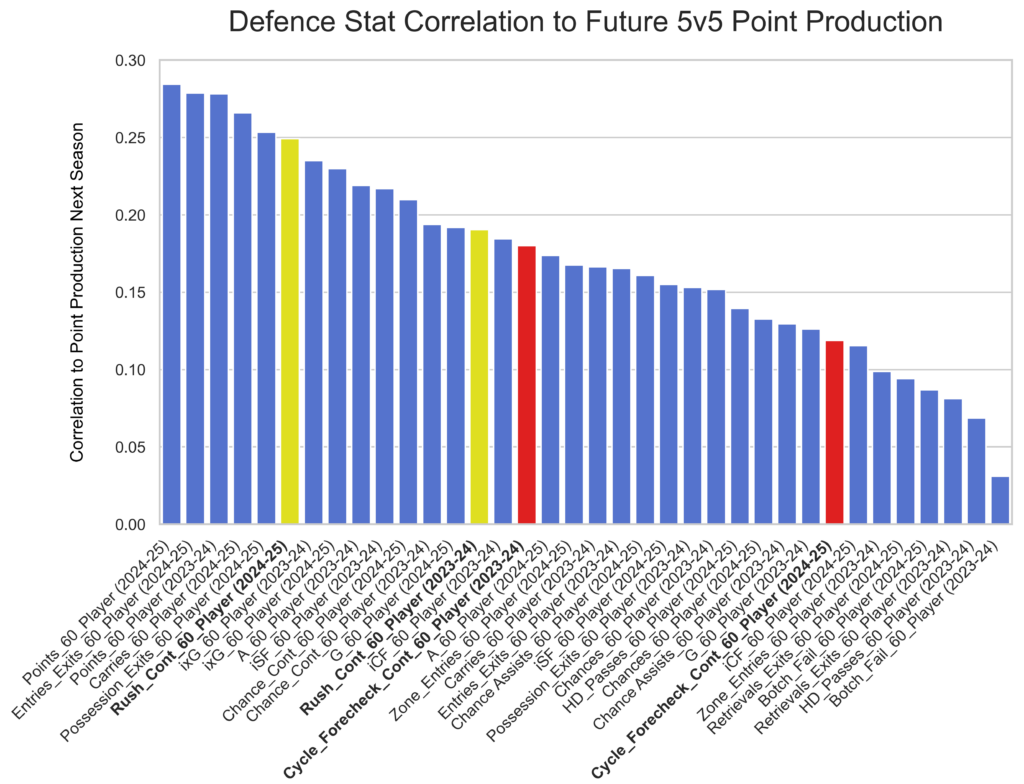
Yet again, generating off the rush provided a stronger correlation to future point production than generating off the cycle/forecheck in each of the last two seasons. They were close in 2023-24, then it was a massive gulf in 2024-25. As mentioned yesterday's analysis, a lot of successful teams this past season were teams who increased their offence off the rush, including the Carolina Hurricanes, Buffalo Sabres, and Boston Bruins. The best defencemen can do both – Werenski, Makar, Dahlin, Adam Fox, and Quinn Hughes excel in both areas – but it is another instance where if we have to choose one or the other, the counter-attackers outperform the grinders by future point production.
Goals
Moving to goals, we get kind of an inverse image that we saw with forwards. In the analysis on the attackers, we saw how there were a few tracking stats that had higher correlations to future goal scoring in both 2023-24 and 2024-25 than both shots on goal and individual expected goals. When looking at defencemen, if we focus on their ixG/60 rate, a different story emerges:
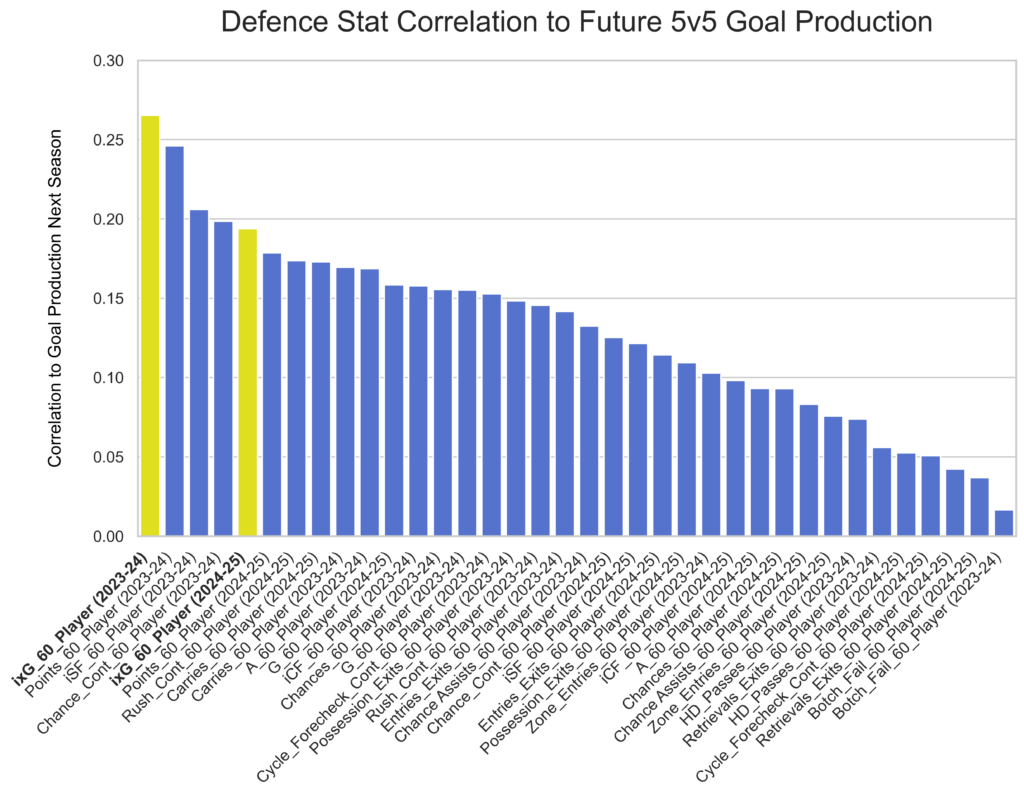
The only stat analyzed here with a correlation value to future goals of at least 0.25 was a defenceman's expected goals rate in 2023-24. It is also the only stat that appears twice in the top 5, and it outperformed points rate in both seasons. When we think back to the list of defencemen in the expected goals section for point production, it makes sense. And when we look just a bit further down the list, we get names like John Carlson, Adam Fox, and Charlie McAvoy inside the top 20. There should always be a mix of stats used for these kinds of things, and when evaluating defencemen, ixG should be at the top of the list.
Individual expected goals and points are two stats that can help us predict future goal production from a defenceman. There is a tracking stat, though, which can also help us. It is one we haven't seen yet for either forwards are defencemen, and does not refer to contributions off the rush, cycle/forecheck, or on scoring chances. Rather, it's simply how often a defenceman carries the puck into the zone:
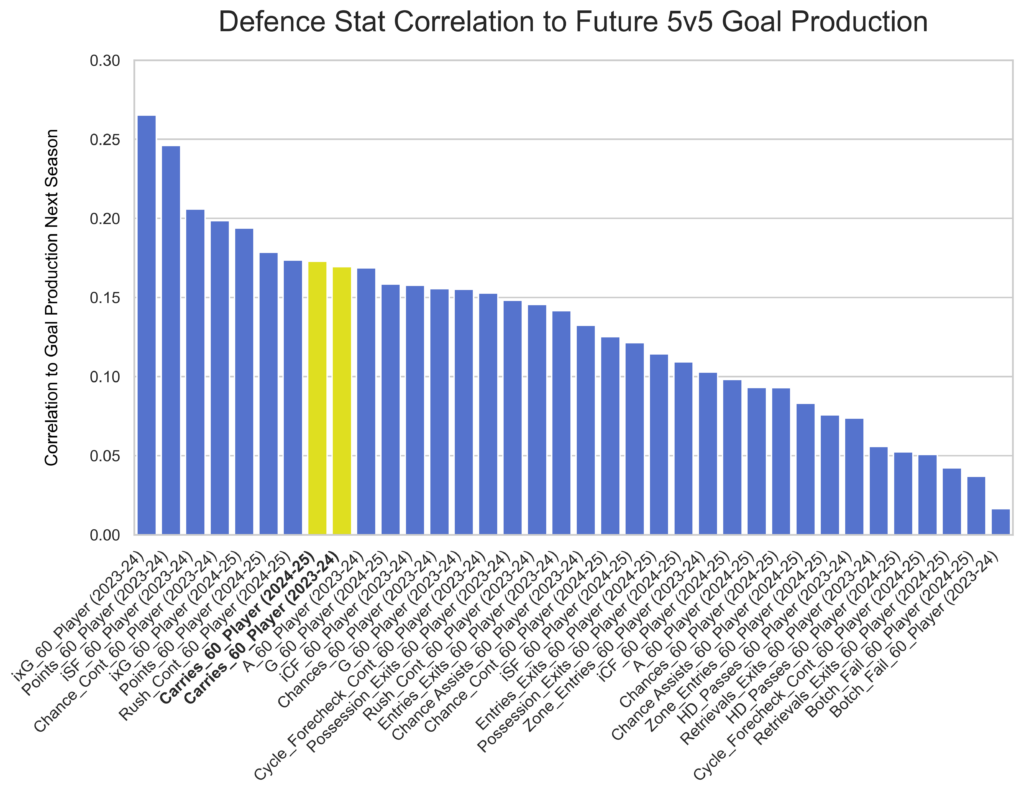
For me, the interesting part isn't that there's a strong correlation with future goals (it really isn't that high). For me, it's that the correlation in both seasons was solid, if unspectacular, and consistent. There is such a thing as consistently bad, as things like zone entries and defensive zone retrievals are consistently irrelevant, but how often a defenceman carries the puck into the zone has some value each year, and that is notable.
Finally, we should look at the two obvious stats, and that is shots and goals. As far as shots are concerned (yellow), the results are mixed, but for goals, there is some consistency for both seasons (red):
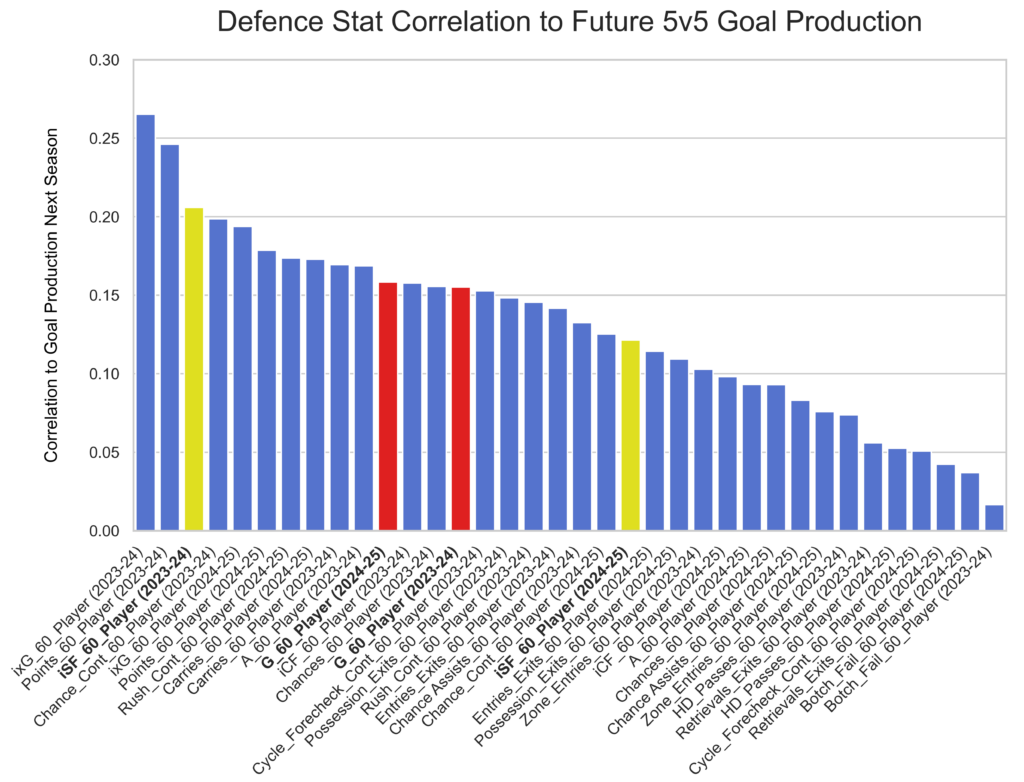
The goals rate correlations aren't as strong as we saw for carries, but they do have some meaning, and the fact that it's consistent in both seasons is why it's worth mentioning. I wouldn't just sort by the goal column, but it's something else we can add to the mix.
Shots are a different story. One season has a very good correlation, and one does not. We might want to consider it, obviously, but considering we've seen better consistency when looking at just the goal-scoring rate, and much better correlations in both seasons from ixG rates, makes me think we don't have to give shots on goal heavy consideration.
Everything discussed today is why it's important to do this kind of analysis. Fantasy managers might assume that shot volume is what we need to look at for goals, but that wasn't really true for either forwards or defencemen. We might assume that sorting the points column for defencemen will help us with future point totals, and there's truth to that, but expected goal rates were also a high, consistent predictor of point production. It isn't a matter of using just one or two stats, as with a lot of things in life, there are a variety of factors giving us any result. Not only that, but what is important, and how important those things are, varies among forwards and defencemen. It is quite the game, this fantasy hockey thing.
Related Posts


Starting Goalies



Top Skater Views
 S.J
S.J VAN
VAN


Top Goalie Profile Views
| Players | Team | |
|---|---|---|
| JOEL HOFER |
 STL STL | |
| CARTER HART |
 VGK VGK | |
| SCOTT WEDGEWOOD |
 COL COL | |
| JAKUB DOBES |
 MTL MTL | |
| DEVON LEVI |
 EDM EDM
| |
LINE COMBOS
| Frequency |
 ANA Players ANA Players
| |
|---|---|---|
| 21.7 | ROGER MCQUEEN ALEX KILLORN SAM COLANGELO | |
| 21.2 | BECKETT SENNECKE NICO MYATOVIC MIKAEL GRANLUND | |
| 20.1 | NIKITA KLEPOV CUTTER GAUTHIER LEO CARLSSON | |
DobberHockey Podcasts

Fantasy Hockey Life: New Jersey Devils with James Nichols
James Nichols joins the program to discuss the New Jersey Devils. Jesse and Victor ask about pros Jack Hughes, Jesper Bratt, Nico Hischier, Timo Meier, Connor Brown, Arseni Gritsyuk, Anthony Mantha, Dougie Hamilton, Luke Hughes, Jake Allen, David Rittich, and Nico Daws. In Cat’s instincts, Cat Silverman of InGoal magazine joins to discuss prospect goalies […]
Fantasy Hockey Life: Nashville Predators with Emma Lingan
Emma Lingan joins the program to discuss the Nashville Predators

Keeping Karlsson: The 2026-27 Keeping Karlsson Breakfast Club
Don’t you forget about them! Elan and Brian remind you of at least one player on each NHL team whose name you might forget to consider at the draft table.
Fantasy Hockey Life: Tampa Bay Lightning with Erik Erlendsson
Erik Erlendsson joins the program to discuss the Tampa Bay Lightning. Jesse and Victor ask about pros Nikita Kucherov, Jake Guentzel, Brandon Hagel, Brayden Point, Anthony Cirelli, Ilya Mikheyev, Gage Goncalves, Conor Geekie, Benjamin Rautiainen, John Carlson, Victor Hedman, Charle-Edouard D’Astous, Andrei Vasilevskiy, Jonas Johansson, and Dennis Hildeby. In Cat’s instincts, Cat Silverman of InGoal […]
Fantasy Hockey Life: New York Rangers with Colin Stephenson
Colin Stephenson joins the program to discuss the New York Rangers.