

Ramblings: Signs of Production Upswings for Slafkovský, Kane, Vilardi, Eklund, and Mittelstadt – August 11
Michael Clifford
2026-08-11
In a pair of Ramblings last week, I looked at which forward stats correlated well to future goal and point production at 5-on-5, then I repeated the same thing for defencemen stats. Go read those to get a foundation on what we're discussing.
Today, we're going to look at the relevant stats mentioned for future production to see which players are showing signs of a breakout or just a career upswing. To do this, we are using standard player data from Evolving Hockey and tracking data from All Three Zones. We will start with the tracking data; this is all at 5-on-5 and on a 60-minute basis. We are limiting the sample to forwards with total 5-on-5 ice time and tracked 5-on-5 ice time above the median for both the two seasons from 2023-25 and the single season in 2025-26. It gives us 160 forwards to sort through. The focus will be on point production for the 2026-27 season.
*
Be sure to grab a copy of Dobber's 2026-27 Fantasy Hockey Guide, which is available now in the Dobber Shop! It has team-by-team outlooks and a customizable a draft list, as well as articles breaking down the 84-game schedule, players to target for peripheral stats like hits, blocks, and penalty minutes, sleeper picks in each conference, and a whole lot more. It is also constantly updated right up until the start of the regular season to reflect new signings, trades, injuries, or anything else. Support what we do year-round and get a headstart on your league mates by ordering the 2026-27 Fantasy Guide!
*
Two of the tracking stats that we focused on in the write-up on correlation with future point production are:
- Chance Contributions – A player's individual scoring chances plus their assists on teammate scoring chances.
- Rush Contributions – A Player's shots taken off the rush plus assists on teammate shots off the rush.
The red lines in the following graphs are the average change in the 60-minute rate in 2025-26 compared to 2023-2025 among these 160 forwards. The yellow dots are the forwards whose improvement in their rates of chance contributions and rush contributions were both top 25 increases, and the blue dots were below that top 25 threshold in at least one if not both areas.
Juraj Slafkovsky (Montreal Canadiens – RW)
In a season where Slafkovský posted his first career 30-goal campaign, his first career 70-point effort, and managing over 2.0 shots per game for the first time, it makes sense that he had increases in some of the underlying processes, and that's exactly what happened with his chance and rush contributions:
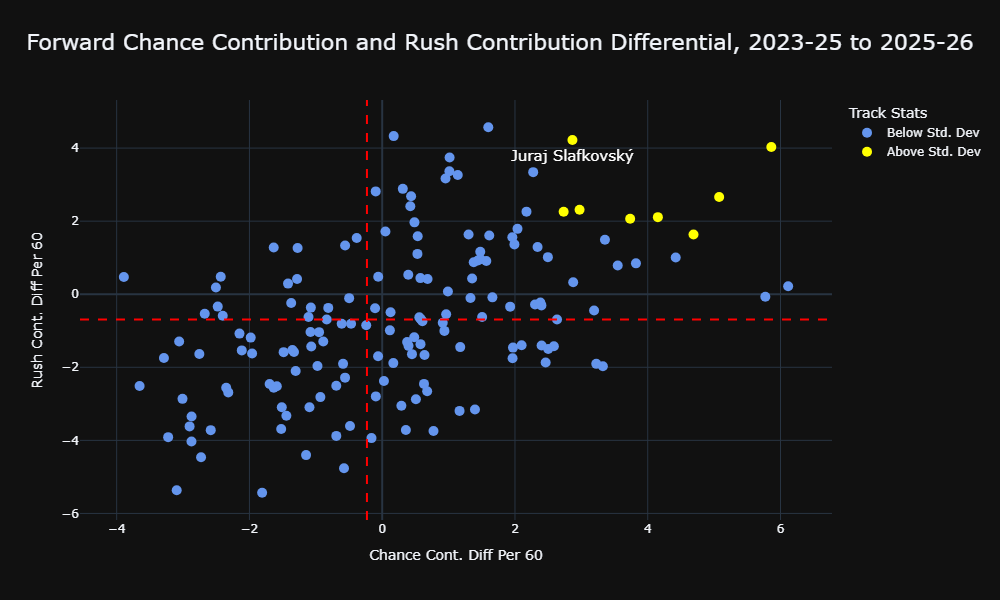
The interesting part for me is that Slafkovský had a higher increase in his chance contribution rate (+2.87) than both his usual line mates Nick Suzuki (+2.38) and Cole Caufield (+1.51). Additionally, Slafkovský's increase in his contributions off the rush was the third-highest increase among the 160 forwards in our sample (+4.22) while both Suzuki and Caufield saw slight declines. Slafkovský spent over half his 5-on-5 ice time with that duo, but his changes were considerably larger than either of them.
Slafkovský now has 3.5 NHL seasons to his name but he's still just 22 years old. The 2026-27 Dobber Fantasy Guide has the Large Adult Winger projected for 28 goals and 80 points in 83 games, increasing his point output by about 10%. I do wonder where his ADP is going to land because early ADP data from Underdog Fantasy has him 44th overall. That format tends to devalue goalies, so maybe it'll be around picks 50-60 in other standard leagues. That feels about right to me.
Patrick Kane (Chicago Blackhawks – RW)
There was only one player in the data whose improvements in both tracking stats were among the top 5 in their respective categories. In fact, he was the only player with top 10 improvements in both areas. That it came from a 37-year-old winger is surprising, but that was the case with Kane:
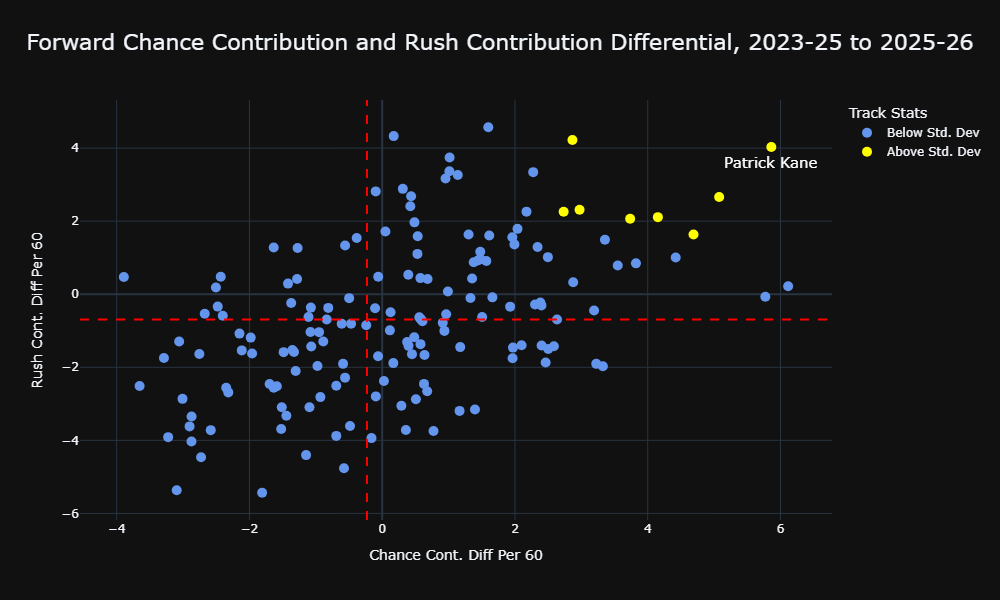
This stands out because Kane is leaving one of the worst 5-on-5 scoring teams over the last two years to one that has been marginally better but should be on an upswing. The Blackhawks added Bowen Byram, Artyom Levshunov and Frank Nazar are a year older, and Anton Frondell should be a Calder Trophy candidate, if not winner. It is just a matter of those young players improving and Kane finding instant chemistry with Connor Bedard when he returns.
Last year, I was very bullish on a scoring upswing from the San Jose Sharks, but I don't have that same bullishness on this year's Blackhawks. As always, I reserve the right to wildly change my opinion on this over the next seven weeks, but if Kane were doing this at 27 years old, I'd be much more intrigued. At his age on this team, I am skeptical.
For posterity, the Dobber Guide has Kane projected for 54 points in 65 games.
Gabriel Vilardi (Winnipeg Jets – RW)
One way to seek out fantasy value is to target players with big roles on bad teams. Stas Pupkov wrote about this a few weeks ago in his 'Analytics Advantage' column, and I encourage everyone to go read that. Coming off a 26th-place finish in the league, the Jets qualify as such, which is why we're noting the large increases in chance and rush contributions from Vilardi:
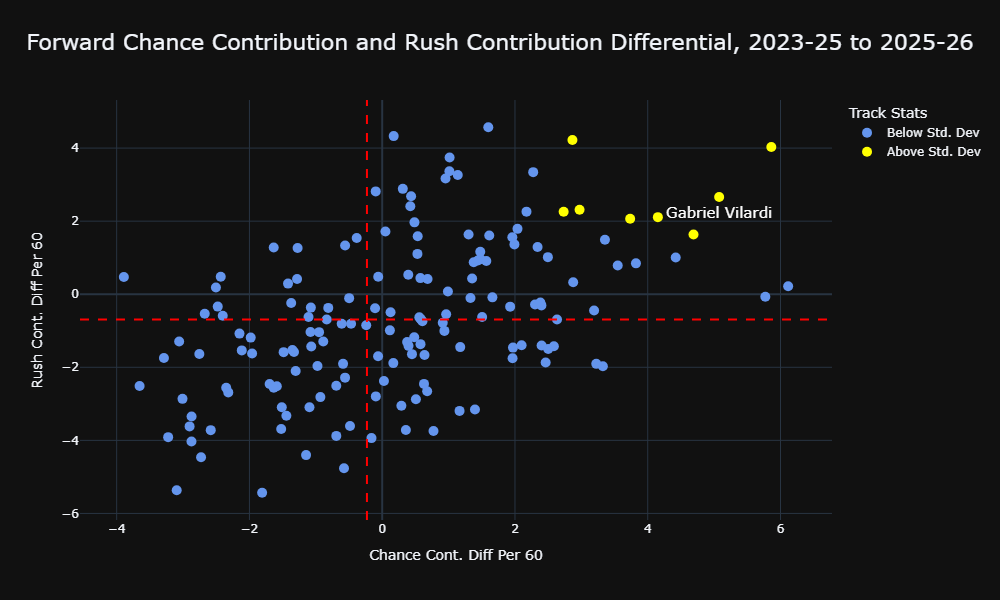
Vilardi posted a career year with 30 goals and 69 points, though that was just because he played all 82 games. On a per-game basis, his goal, assist, and shot rates were pretty much identical to the year before. On the flipside, Vilardi saw those tracking stat improvements, and identical production, despite playing under 60% of his 5-on-5 ice time with Mark Scheifele. That is still a big chunk of his minutes, but pales in comparison to the 92% of shared ice time the year before. The Jets struggled mightily to produce with the Scheifele line off the ice, Vilardi spent considerably less ice time on that top line than he did the year before, but his production was unchanged. Imagine what he can do if he stays healthy and the depth scoring improves? That is one reason the Dobber Guide has him with 72 points in 75 games for the 2026-27 campaign.
William Eklund (Ottawa Senators – LW)
Eklund was added by the Sens to replace the loss left behind by Brady Tkachuk. They are completely different players and Eklund will not be the same physical presences, but he did have sizeable increases in the two tracking stats we've been discussing:
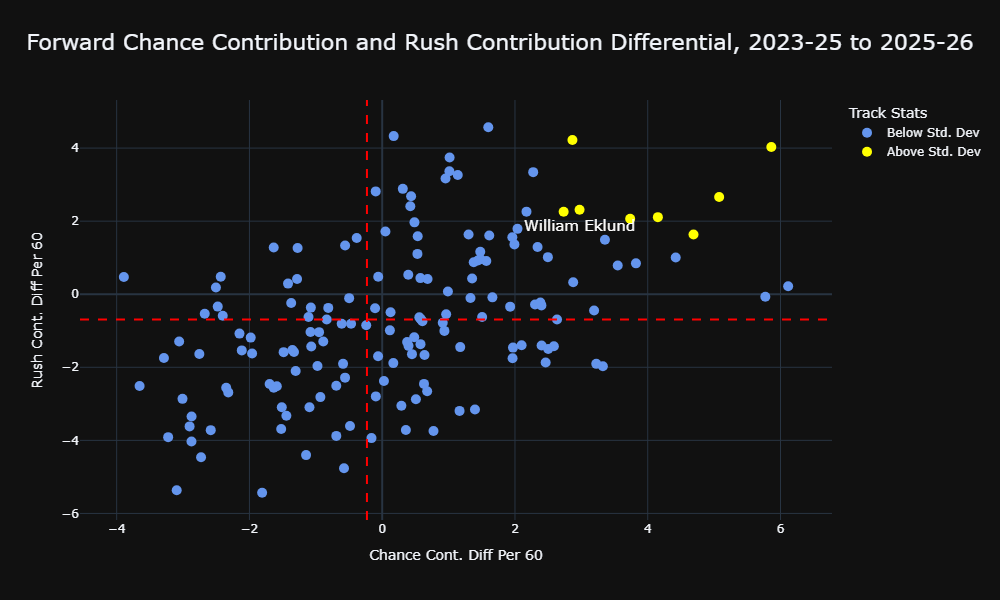
In 2024-25, Eklund produced 58 points in 77 games. That is why his 53 points in 78 games this past season may be a letdown. The mitigating factor is that two years ago, Eklund spent 41% of his 5-on-5 ice time with Macklin Celebrini, and that fell to 23% in 2025-26. Despite that, his 60-minute rates of goals, shots, and expected goals all increased. Add that to the large increase in his chance and rush contributions, and the downturn in overall point production shrouds Eklund's improvements in several key areas.
Over the last two years, the Senators are top-10 in the league in goals per minute on the power play while the San Jose Sharks were in the bottom-10. The Sens also lead the league in power-play opportunities per game, and the combination of successful power play rate with a lot of PP opportunities means they lead the league in PP goals over the last two years. Things will change without Tkachuk, but Eklund has a chance to spend the season on the top line and top PP unit with Tim Stutzle and a vastly better puck-moving blue line than what he had in San Jose. I wouldn't be surprised if Eklund not only had a career year, but a true breakout year in the 25-goal, 70-point realm.
The Fantasy Guide has him projected for 57 points in 80 games.
Casey Mittelstadt (Boston Bruins – C)
Mittelstadt stood out because he fell about 5% short of the threshold to qualify as a top 25 increase in chance contributions but had a rush contribution increase that was one of the highest in our sample. He technically didn't qualify in both areas, but one was very close and the other was considerably larger so I thought it was worth highlighting his improvements:
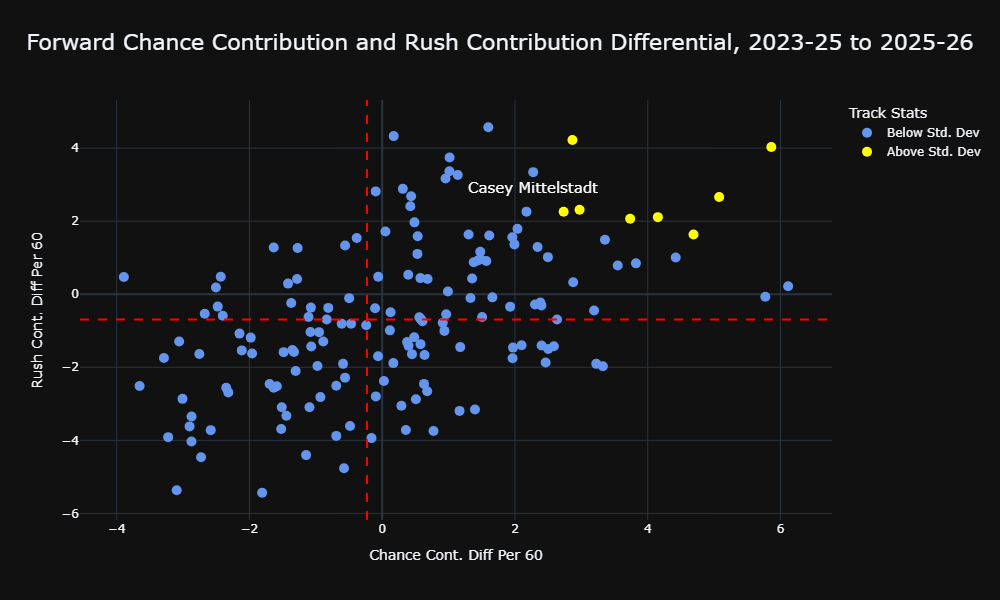
Boston was one of the teams who increased their rush offence, but of the five Bruins forwards in our sample (Mittelstadt, David Pastrnak, Elias Lindholm, Morgan Geekie, and Pavel Zacha), three saw a decrease in rush contributions and Mittelstadt's improvement was over 3x higher than the next-closest Bruin (3.34 to 1.1). Also, Mittelstadt's chance contribution increase was over 4x higher than the next-closest Bruin (2.28 to 0.53). Even on a team that was much better than the year before, Mittelstadt stands out.
Viktor Arvidsson wasn't included because he fell shy of the ice time cut-offs, and he did have a much larger chance contribution increase (+4.25) than Mittelstadt (+2.28), but his contributions off the rush fell quite a bit (-1.63). Arvidsson is no longer with the team, so how Mittelstadt meshes with new line mates will determine his total production.
I am not overly bullish on Mittelstadt just because he won't get a top PP role out of the gate, and probably only gets sparse usage throughout the season. That caps his upside, so he'll probably finish in the 40- to 50-point range again, I just wouldn't expect a career year as I might with players like Vilardi or Eklund.
Related Posts

Starting Goalies



Top Skater Views
 S.J
S.J CBJ
CBJ CHI
CHI


Top Goalie Profile Views
| Players | Team | |
|---|---|---|
| DAN VLADAR |
 PHI PHI | |
| SCOTT WEDGEWOOD |
 COL COL | |
| SERGEI MURASHOV |
 PIT PIT | |
| CARTER HART |
 VGK VGK | |
| KAREL VEJMELKA |
 UTA UTA
| |
LINE COMBOS
| Frequency |
 L.A Players L.A Players
| |
|---|---|---|
| 16.6 | TAYLOR WARD ERIK HAULA JOEL ARMIA | |
| 16.2 | JARED WRIGHT AATU JAMSEN KENNY CONNORS | |
| 13.2 | ALEX TURCOTTE ANDRE LEE ALEX LAFERRIERE | |
DobberHockey Podcasts

Fantasy Hockey Life: Dallas Stars with Taylor Newby
Taylor Newby joins the program to discuss the Dallas Stars.

Keeping Karlsson: KKUPFL Tier 1 Draft Roundtable
Elan and Brian are joined by several KKUPFL Tier 1 managers, to bring you inside their draft table decisions and thought processes in building the teams competing in the top division of the world’s best fantasy hockey league.
Fantasy Hockey Life: New Jersey Devils with James Nichols
James Nichols joins the program to discuss the New Jersey Devils. Jesse and Victor ask about pros Jack Hughes, Jesper Bratt, Nico Hischier, Timo Meier, Connor Brown, Arseni Gritsyuk, Anthony Mantha, Dougie Hamilton, Luke Hughes, Jake Allen, David Rittich, and Nico Daws. In Cat’s instincts, Cat Silverman of InGoal magazine joins to discuss prospect goalies […]
Fantasy Hockey Life: Nashville Predators with Emma Lingan
Emma Lingan joins the program to discuss the Nashville Predators
Keeping Karlsson: The 2026-27 Keeping Karlsson Breakfast Club
Don’t you forget about them! Elan and Brian remind you of at least one player on each NHL team whose name you might forget to consider at the draft table.