

Analytics Advantage: Edvinsson’s Usage; Finnie’s Multi-Category Appeal; Mantha’s Efficiency; Olofsson’s Varying Value, and More
Stas Pupkov
2025-10-31
This week's standouts mix skill efficiency with strong deployment trends — whether it's a playmaker finally surrounded by talent, a rookie converting hustle into offense, or a veteran rediscovering form through simplified usage.
Player Data is from Natural Stat Trick with Yahoo roster percentages via Frozen Tools. Line combinations and power-play deployment via Daily Faceoff and Frozen Tools.
All information is current as of October 29, 2025.
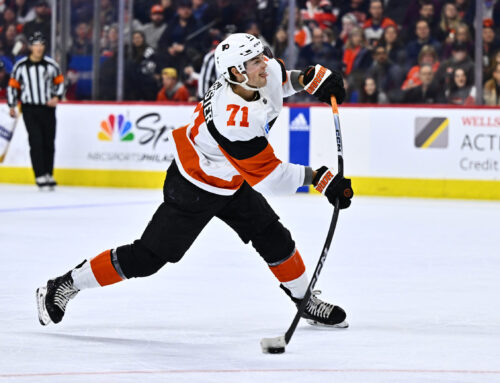
Philadelphia Flyers — Trevor Zegras (21%, F)
The move to Philadelphia has sharpened Zegras' strengths rather than stretching them thin. He's averaging 1.10 points per game (3 G, 8 A in 10 GP) on 16:29 TOI, with 2:35 coming on PP1 alongside Michkov and Tippett. The Flyers are sheltering him just enough — offensive zone starts near 57% — to let his creativity breathe. He's no longer asked to carry weak linemates; instead, he's become the connective tissue on a high-skill unit that finally lets his passing game drive possession. The 21% shooting rate won't hold, but the consistency of touches on the man advantage (four PPP) shows that his fantasy relevance isn't just hot streak noise.
Takeaway: Zegras' fit in Philadelphia has turned him from a volume-dependent winger into a focused playmaker whose per-minute impact is climbing. In points formats, he's trending toward top-six stability with strong power-play insulation; in multi-cat leagues, the limited peripherals are offset by efficient scoring in an optimized role. Treat this as a real rebound, not a mirage.
Detroit Red Wings — Simon Edvinsson (11%, D)
Edvinsson has solidified himself as one of Detroit's minutes-eating pillars, averaging 20:57 per night with consistent top-four usage. The production line reads modestly (3 G, 1 A through 10 GP), but the underlying workload drives his value. He's piling up 2.8 blocks and nearly a hit per game while facing top competition and eating heavy shorthanded time. His lack of PP exposure (just seven seconds per night) keeps ceiling limited, but the stability and peripherals offer a steady defensive backbone for multi-cat formats. Detroit trusts him in all zones — that reliability translates to fantasy durability.
Takeaway: Edvinsson's fantasy case rests on volume: elite ice time, strong block totals, and a steady defensive role. He won't light up scoreboards, but he fills stat columns that often go overlooked. In deep leagues, he's the kind of glue defenseman who quietly wins categories over time — a rock-solid hold wherever peripherals matter.
Minnesota Wild — Brock Faber (42%, D)
Still the heartbeat of Minnesota's blue line, Faber is logging 22:22 a night with heavy all-situations usage and top-pair minutes next to Jonas Brodin/Jacob Middleton (with Zeev Buium rotating in). The surface line (1 G, 4 A in 12 GP) just ticked up thanks to a 4-point, two-game burst, but the scaffolding has been there: 31 SOG (2.6/g) on a chilly 3.2% shooting, 21 blocks (1.75/g), and three PPP despite only ~0:35 PPTOI per game. That's efficiency doing the lifting while the role stays massive.
Takeaway: You're buying elite deployment with a stable multi-cat floor (shots + blocks) and a realistic path to more scoring if even a sliver of PP2 responsibility grows—or if the shooting luck normalizes. Treat him as a set-and-forget D in all formats, with upside if special-teams usage inches up.
Los Angeles Kings — Brandt Clarke (20%, D)
Clarke is driving real offense at 5-on-5: 7 points in 11 games on 16:28 TOI, rotating on the second pair (Joel Edmundson/Drew Doughty/Brian Dumoulin) and logging ~1:25 PPTOI per night (~34% share). The quirky bit: zero PPP so far despite steady PP2 run. Under the hood it's solid—18 SOG (1.64/g), 19 blocks (1.73/g), and a +7—so the box score isn't getting there on the man-advantage yet, but the process and deployment are. Recent game log pop (2A vs NSH, 1G1A vs S.J) backs the 5v5 playmaking.
Takeaway: This is a classic patience spot. If PP2 starts cashing even a little, the PPP column wakes up and his profile jumps. In multi-cat formats, the blocks provide a floor; in points leagues, the 5v5 production plus steady PP usage makes him a buy/hold while the special-teams dam breaks.
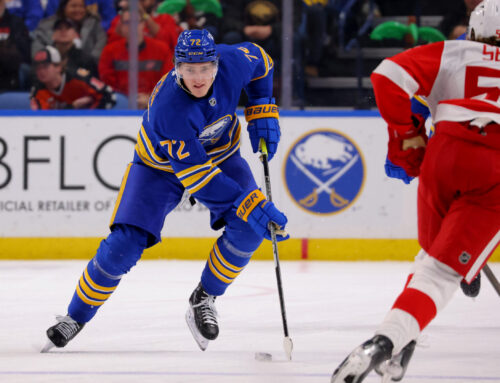
Detroit Red Wings — Emmitt Finnie (42%, F)
Finnie's top-line audition has become a full-time assignment — and the rookie's making the most of it. Through 10 games, he's produced 4 G and 4 A (0.8 P/GP) with 27 hits (2.7/g) and 18 shots (1.8/g) while skating 16:05 a night. His shot efficiency (22.2%) will dip, but the usage is real: steady run beside Larkin and Raymond, light PP2 exposure (1:07 per game), and heavy forechecking minutes. The physicality hasn't faded as the points arrived, which makes him a rare mix of scoring touch and peripheral reliability for a 20-year-old.
Takeaway: Finnie's progression from "energy rookie" to "impact top-liner" came fast, and Detroit's not pulling him off that line anytime soon. In points leagues, he's trending toward long-term hold status; in multi-cat leagues, the blend of hits and finishing makes him a breakout-level asset. Early-season efficiency plus stable usage make this real, not noise.
Colorado Avalanche — Victor Olofsson (9%, F)
Middle-six at even strength, top-unit on the power play—that's the whole pitch. Olofsson has 10 points in 11 games (3 G, 7 A) on just 13:41 TOI/GP, but he's chewing up 3:24 PPTOI per night (~49% share) and already banked 4 PPP. The shot base is sturdy (34 SOG; 3.1/g), and while the 5-point outburst vs. New Jersey juiced the box score, the usage is the real story: Colorado funnels a ton of chances through PP1, and he keeps showing up for the finish or the touch pass. Peripherals will be light (3 hits total), yet the trigger is hot enough to matter every scoring period.
Takeaway: Treat him as a PP1 specialist with reliable shot volume. In points formats, he's a stream-to-hold while that top-unit seat is secure. In multi-cat formats, the lack of hits/blocks lowers the floor, but PPP + SOG can carry weekly matchups on their own. If a league-mate is dismissing him as a "hat-trick blip," buy before the role—not the heater—keeps paying.
Pittsburgh Penguins — Anthony Mantha (11%, F)
The role is lean, the output is not. Mantha has 10 points in 12 games (5 G, 5 A) on just 14:49 a night, riding middle-six minutes primarily with Evgeni Malkin and Justin Brazeau. The shot rate is modest (22 SOG; 1.8/g), but the finishing has been sharp (22.7%); he's also chipped one PPP on ~1:19 PPTOI (~35% share). This is classic optimized usage: dangerous at 5v5 with a playmaking center, plus enough PP2 to matter. Peripherals are thin (6 hits, 7 blocks), yet the line's chemistry is doing heavy lifting for his per-minute scoring.
Takeaway: Treat Mantha as an efficiency play tied to Malkin's creation. In points formats, he's a stream-to-hold while that trio hums; in multi-cat leagues, the light peripherals mean you're banking on goals/assists and occasional PPP. If the PP share or shot volume ticks up even a little, he pushes into steady every-week starter territory. If Malkin's production crashes and burns, so does Mantha's.
Final Thoughts
Usage tells the truth before the box score does. Players like Finnie, Faber, and Clarke are proving that sustained deployment — not shooting streaks — builds fantasy stability. As the season settles, keep your eye on who's trusted rather than who's hot. Those are the names that keep producing when regression hits.
Related Posts
Starting Goalies







Top Skater Views
 DET
DET STL
STL CHI
CHI BOS
BOSTop Goalie Profile Views
 EDM
EDM NYR
NYR MTL
MTL S.J
S.J WSH
WSH


LINE COMBOS
| Frequency |
 FLA Players FLA Players
| |
|---|---|---|
| 22.0 | MATTHEW TKACHUK BRADY TKACHUK SAM BENNETT | |
| 21.0 | CARTER VERHAEGHE SAM REINHART LARS ELLER | |
| 18.7 | SANDIS VILMANIS EETU LUOSTARINEN ANTON LUNDELL | |
DobberHockey Podcasts

Keeping Karlsson: Short Shifts – NHL Frozen Frenzy Recap
Elan and Lewis recap the Frozen Frenzy as well as two big returns and more!
Keeping Karlsson: Delusions of Garandeur
Elan and Brian dive into the latest NHL hot streaks, cold streaks, line changes, outjuries, injuries, buy-lows and sell-highs to give you top notch tips in your fantasy hockey league

Fantasy Hockey Life: TiDy Takes Part 2
Last week, Victor Nuno and Ryan Downey broke down trades from our top tier dynasty league. This week, they consider some dynasty trades from other divisions. Have a listen! Our show is part of the Dobber Podcast Network and sponsored by Fantrax.com. Email [email protected] and ask to join our free discord. Join our Patreon at […]
Keeping Karlsson: Matchup Maximizer 2026/27 Week 3
Elan takes a look at the schedule for the upcoming weeks of NHL action and recommends players with good schedules that you should consider streaming in to win your head to head matchups.
Keeping Karlsson: Short Shifts – Sharks Looked Like Celebweenies
Elan recaps the major injuries, outjuries, game results and changed line combos that we’ve seen since Sunday’s mega-show.