

21 Fantasy Hockey Rambles
Dobber Sports
2026-04-26
Every Sunday, we share 21 Fantasy Rambles from our writers at DobberHockey. These thoughts are curated from the past week’s 'Daily Ramblings'.
Writers/Editors: Ian Gooding, Michael Clifford, Alexander MacLean, Puneet Sharma, and Dobber
___
1. I was down with a virus last week, so stick taps to Dobber for pinch hitting with his thoughts on the season wrap up and playoff previews. I’m playing catch up on the season wrap up and the beginning of the playoffs, but allow me to rectify that now.
One thing I like to follow is the rise and fall of playoff teams, the cyclical nature of it, and how it helps project which teams might be better to jump in for fantasy purposes.
Overall the 2025-26 regular season had a big turnover in the NHL playoff teams, there were quite a few injuries to navigate with the condensed Olympic schedule, and while the names right at the top of the scoring race remained consistent from the previous years, a good portion of top-10 saw some turnover. It does feel like this year was a bit of a changing of the guard, as the balance of power in the NHL shifts towards Anaheim, San Jose, Chicago, Montreal, and Buffalo. There might still be time for you to get in on those teams on the up who didn’t make the playoffs this year, but the teams like Los Angeles, Toronto, and Florida who really fell off, might present a problem if you’re trying to offload some of them in the offseason.
This is more anecdotal than anything, but it feels to me like there are cycles in the NHL playoff teams that last three years, with minor variations of playoff teams between those cycles, and then a larger shift approximately every third year. This was that larger shift, especially in the East. In the West, there might be a bit of lag with San Jose jumping up next year while LA should have fallen off. It wouldn’t surprise me if with that SJ/LA switch next year, the same eight then made the playoffs without any new teams jumping in until 2029 when the Chicago wave finally breaks through. That is to say, the next few regular season in the West may be pretty boring and predictable (though Connor McDavid‘s contract expires in July of 2028, so a departure could accelerate the Edmonton fall). (apr22)
2. For my own fantasy teams in the 2025-26 season, I managed to come out with two first place finishes, one 2nd place finish, and two losses in the semi-finals. Overall, that’s a top-four finish in all five leagues, which is a very solid result. One of the wins was my Roto league which is a full redraft with smart GMs which makes it incredibly difficult to compete for a podium finish every year. However, this was a back-to-back-championship win for me, so I’m going to brag a little there. My luck has probably run out though, so odds are I’ll be fighting to finish outside of the bottom three next year.
That roto league win was thanks to a loose draft plan to just take the best player available almost regardless of positions, for the first few rounds, and only start to loosely fill positions after the first eight or 10 rounds. I lucked into draft value with William Nylander, MacKenzie Blackwood, Miro Heiskanen, and Joseph Woll slipping farther than they should have, along with being timely with my FA adds on the season, including Steven Stamkos, Charlie Coyle, and Pavel Zacha. Drafting Matthew Schaefer past pick 200 was also a huge boon – hardly a repeatable strategy in a redraft league though.
The other win was a long-running partial keeper, where I eked out the finals win against last season’s champ, who put up a real tough fight. Maybe even more impressive though is that the 3rd place finisher there has now placed on the podium every season of the 10 years that the league has been running, which might be one of the most impressive streaks that I have seen in all of fantasy sports. Does anyone else have an active streak of that nature? (apr22)
3. The three leagues I lost were a combination of running into hot goaltending (Andrei Vasilevskiy key among them) and a bit of my own teams going cold at the wrong time. There might be some smaller lessons to be learned, but sometimes your team doesn’t win even if you managed it extremely well throughout the year, and planned around the injuries, the schedule, and to cover all of your leagues categories. You have to be good to be lucky, and lucky to be good… and even if you get both, sometimes you lose anyways. But we’ll be back, and next year I’m again chasing my perfect five-for-five championship win. (apr22)
4. A quick side-note while we mentioned Vasilevskiy. The two-time Stanley Cup winner has a 4-14 record since the start of the 2023 postseason. His regular-season performance hasn’t declined, in particular over the past two seasons where he has a combined 77 wins, .917 save percentage, and 2.24 goals-against average – the numbers of an elite fantasy goalie. In his Sportsnet column, Mike Amato wrote about how Vasilevskiy is having more trouble with shots from the point through traffic. That was certainly the case on the overtime goal Friday, giving Montreal a 2-1 lead in the series with Tampa Bay. This may not be a huge concern next season, but it is something to pay attention to. (apr25)
5. Across those four H2H leagues, the draft prep does come in handy, but with various league setups, the schedule management week-to-week for the micro advantages does really stack up across the length of a full season, ensuring that when you’re making an add for a hot waiver-wire player, you have a decent upcoming schedule from them too, and they’re filling categories you actually need. The little bits stack up, and lead to a noticeable jump in the overall standings by the end of the year, and if you manage the schedule well for your playoff weeks, you’re going to win closer to 66% of your series, instead of the coin flip that they can usually be. (apr22)
6. Two of my fantasy teams lost Aleksander Barkov in training camp last season, and despite that one of them won the championship with him on the IR. In that league, I did shop him around a little, but IR spots can be tight and no one really wanted to bite on it. I was open to selling if my team got off to a cold start, but a few timely pick ups there kept my team in it long enough for me to decide to go all-in around the healthy core. It’s a limited keeper and now I enter the offseason with too many keepable players, and hardly any draft picks. With Barkov back I regain the C depth that typically helps me contend year after year, and while I will try to sell off a few keeper options for picks, it might lead to a slow start to next season unless I can get lucky at the draft table.
In my Cap league, losing Barkov was a tough blow, but I made the most of it, weaponizing the cap space and turning it into Logan Thompson and Chris Kreider for lesser assets from teams who needed the cap space sorted out before the start of the season. Now with the cap rising (and some foresight) Barkov will return for the upcoming season without me having to lose any players due to a cap crunch of new contracts. You can only play the hand you’re dealt, and if you play it with confidence, then more often than not things will spin a little in your favour. (apr22)
7. This is my first Ramblings since the NHL playoffs started and I just want to say: I absolutely love this time of year. The first round is usually excellent, but recently, the second round has been the best part of the postseason. Either way, between the warming weather, the barbecues, and the hockey, it’s tough to beat late-April, early-May.
But we’re here to talk about fantasy hockey and I want to take today’s Ramblings to start my offseason review. The next few weeks – maybe a month? – will focus on looking back at the season that was before looking ahead to 2026-27.
Today, let’s start with NHL fantasy Best Ball, specifically on Underdog’s site. We here at Dobber are in no way affiliated with Underdog, it’s just the site I use for my best ball contests.
For anyone unfamiliar with best ball, here’s how it works:
- You draft your fantasy roster and those are your players for the entire regular season. There are no trades, waivers, or free agency.
- On Underdog, the roster positions are centre, wing, defence, goalie, and flex.
- Only a handful of your players’ scores count each week. On this particular site, it’s centre (1), wing (2), defence (1), goalie (1), and flex (2, can be any non-goalie). You draft 16 players but only your highest scorers at those positions are used each week.
- It is a points system, and each stat is worth different point values. Skaters get points for goals (6), assists (4), shots and blocks (1), and hits and power-play points (0.5). Goalies get points for wins (6) and saves (0.6) and lose points for goals against (-3).
So, the contest is a draft-and-hold with no roster moves, only six skaters and one goalie count each week, and it’s a points system. (apr21)
8. The specific contest on Underdog in which I participated is called the ‘Best Puck Classic’. It contained 14 760 entrants at $15 per entry. This is how the league works:
- The 14 760 entrants are divided into 12-team leagues, which gave us 1230 different leagues.
- The regular season runs for 19 weeks, and the top-3 scoring rosters from each of those 1230 leagues qualify for the playoffs, so 3690 entrants reach the fantasy postseason.
- Those 3690 entrants are again split, this time into 10-team leagues. The quarterfinals run for two weeks and the top-2 scoring rosters from each of the individual 10-team leagues qualify for the semifinal, so that gives us 738 entrants in the next round.
- Those 738 semifinalists are once again split, and now it’s into 6-team leagues. This round runs for two weeks and the highest scorer in each league gets to the final. It gives us 123 finalists (they rounded up to 125 and added the two highest-scoring second-place finishers).
- The final 125 entrants play in one giant league for two weeks and that determines the overall winner. (apr21)
9. People are allowed multiple entries, and I had 22 different lineups. I didn’t win, but I did do well. Here are the percentages of all entries that qualify for each postseason round and the percentages of my entries that qualified for each round:

I got 12/22 entries to the quarters, 5/22 entries to the semis, and 1/22 entries to the final. All in all, I more than doubled my money and had a real shot at the top prize. It is hard to complain.
In leagues like this, looking ahead to the playoff schedule, and particularly the finals weeks, is paramount. You can’t win without getting to the playoffs in the first place, but to make any decent money, you need a high finish. From the outset, there were two teams I was targeting: San Jose and Carolina. That showed up in how often I drafted from each team because Nikolaj Ehlers was tied for my second-most drafted player while Macklin Celebrini and Andrei Svechnikov were tied for my fourth-most drafted players:
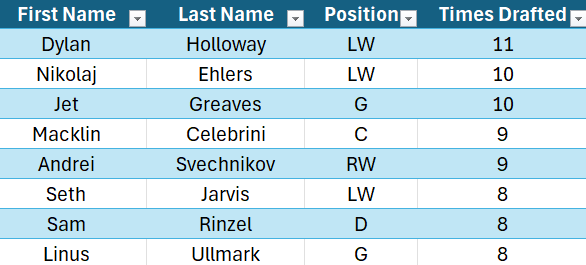
I also drafted Seth Jarvis on eight teams, and both Tyler Toffoli and Will Smith on seven teams. This is why I targeted those franchises. (apr21)
10. San Jose Sharks
First, I felt that Celebrini was a true unicorn, and it showed in my projections. In this format, I had him as my 14th overall forward and 16th overall skater, based on 82 games played:
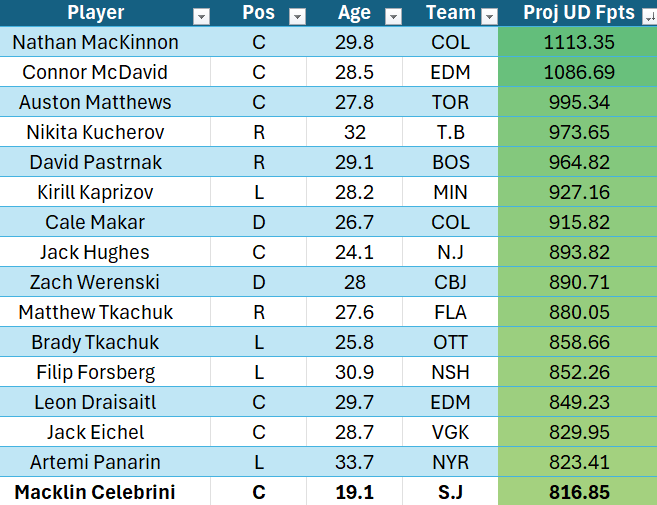
One of the names ahead of him was Matthew Tkachuk, but again, that is based on 82 games played, and Tkachuk was going to miss a few months, so Celebrini was my 15th overall skater. At the start of the draft season, Celebrini was going somewhere between picks 25-40, and that made him the player with the highest potential draft value on my board.
The second reason was the Sharks’ schedule in the two-week final from March 30th – April 12th. San Jose was 1 of 6 teams with at least eight games in those two weeks, and they had what looked like a good run of opponents: Anaheim (2), Vancouver, Chicago, and Nashville were among the eight games. It gave the Sharks what I thought was the best schedule in the two-week final. That, combined with my perceived value on Celebrini, led to me often drafting him and San Jose’s top wingers. (apr21)
11. Carolina Hurricanes
The reason for focusing on Hurricanes skaters, and particularly their wingers, wasn’t the schedule but the value. Ehlers was my 56th overall skater, and assuming maybe 15 goalies drafted in that span, worth a seventh- or eighth-round pick. I was able to take him between picks 73-96, or the seventh/eighth round, each time I selected him.
Svechnikov, meanwhile, was my 70th overall skater. Assuming maybe 20 goalies drafted in that time, he was worth drafting anytime in the ninth round or later. I was able to grab him between picks 96-120 each time I drafted him.
After slow starts from both Ehlers and Svechnikov – they combined for 2 goals, 5 assists, and 46 shots through 20 games (10 each) in October – they were immensely valuable the rest of the way.
Stacking San Jose and Carolina worked out well. What also worked well was getting Jet Greaves as my third goalie on nearly half my rosters. I believed Greaves was (and is) a good goalie playing behind a competitive Columbus roster, and that turned out to be true.
Things didn’t go my way in the final, and one thing that really hurt was Carolina sitting players in Chicago on April 9th. My one entry that reached the final had Svechnikov, Ehlers, and Jarvis, and they all sat in that 7-2 win over the Blackhawks. If they had played and got a few points, I would have doubled my winnings. If they have a big game, my winnings probably increase somewhere between 4x and 6x. That is the double-edged sword of stacking top players from top squads, but it is a reminder that team decisions are out of your control and you just have to live with that.
Overall, I’m happy with the season. I think I had the right read on Carolina and San Jose, given how many of my entries made it as far as they did, but the cards just didn’t fall my way in the final. Such is the nature of the game we play, and I’m already excited for next season. (apr21)
12. In Tuesday’s Ramblings (above), I started my fantasy hockey season review by going over the small success I had doing best ball teams. For more on names like Macklin Celebrini, Seth Jarvis, Jet Greaves, and others, go check that out.
Today’s Ramblings continues that season review and we’re starting with players I missed on. These are guys who, for one reason or another, I was relatively high on before the season and they did not pan out as anticipated. These will focus specifically on forwards before moving to defencemen tomorrow. We are also going to exclude players that missed significant time due to injury, and that will be players who missed more than 20 games (over 25% of the season).
Jonathan Marchessault – Vegas Golden Knights
We will start by going easy on myself and say that there was an article in mid-September that covered arbitrage opportunities. Basically, the idea was searching for players with average draft positions whom I thought could perform similarly to players with draft positions going several rounds earlier. The first pairing in that article was Jordan Kyrou (ADP of 80) and Marchessault (ADP of 147).
That Kyrou didn’t have a good season doesn’t absolve Marchessault’s year. He finished with 12 goals, 31 points, and 132 shots in 62 games, the lowest goal-, point-, and shot-per-game marks of any season where he’s played at least 50 games. That he skated a 10-year-low 16:42 per game doesn’t matter, either, because his rate of goals, points, and shots per minute were all career-low marks as well.
Even worse was that things looked bad under the hood. Per 5-on-5 tracking data from All Three Zones, some key areas for Marchessault are the worst of the last five years by a wide margin:

To explain those stats:
- SCA/60 is his 60-minute rate of scoring chance assists, or how often a player assists on a teammate’s scoring chance.
- SCC/60 is the rate of scoring chance contributions, or the chance assists plus his individual scoring chances.
- Entries/60 is simply how often he’s responsible for an offensive zone entry.
- Carry Entry% is how often he carries the puck into the offensive zone on a zone entry.
The big problem is that all the declines are anywhere between 20-45%. He showed declines in 2023-24 and 2024-25 compared to the two years prior, but he was still good enough to score well. Now, they’re at levels where true bottom-6 producers reside.
Whether Marchessault can bounce back is another question, but he is going into his age-36 season, and he’s on a team with an aging core but has young players like Luke Evangelista, Zachary L’Heureux, and Brady Martin pushing for prominent roles. It doesn’t paint a rosy picture for Marchessault’s fantasy hockey future. (apr23)
13. Dylan Larkin – Detroit Red Wings
This is another odd case where Larkin had a career-high 34 goals, saw an improvement in goals and shots per game when compared to 2024-25, but still came up short in my projections. In an early September article, I wrote about players with ADP’s I thought were too generous, noting that Larkin was my 10th overall centre. In standard Yahoo! leagues, he finished as the 17th centre and was 12th on ESPN. He wasn’t awful, but he didn’t live up to my expectations.
The problem was Detroit’s 5-on-5 play. They finished 22nd in the league by 5-on-5 goals per 60 minutes and Larkin was on the ice for 2.1 goals per 60 minutes, a five-year low and the lowest rate in any season where he’s played 50 games since 2016-17. That led to 1.45 points per 60 minutes at 5-on-5, in range with Jordan Martinook, Michael Bunting, Ben Kindel, and Yakov Trenin (from Evolving Hockey):
It raises the problem that Larkin’s points/60 rate at 5-on-5 has now declined in back-to-back seasons, and after posting a 67th percentile rate from 2022-2024, he’s produced at a 45th percentile rate over the last two seasons. He turns 30 years old in July and has over 800 NHL games to his name. Is this the start of a true decline or a blip while skating on a team still trying to find the next level? (apr23)
14. Sean Monahan – Columbus Blue Jackets
In that same article referencing Larkin, I brought up Monahan. He was my 29th overall centre and his various ADPs had him somewhere between the 40th and 50th centre off the board. With 13 goals and 36 points, it’s safe to say that he did not live up to the billing of a top-30 centre.
This one is kind of tilting because my expectation is Monahan would skate on the top line with Kirill Marchenko while Adam Fantilli skated on the second line. That is how the season started as Marchenko/Monahan was the top-line duo for the first month, and they were extremely good together, outscoring the opposition 11-1 in the team’s first 13 games. However, the second line duo of Fantilli and Boone Jenner was getting annihilated with 5 goals for and 11 against (from Natural Stat Trick):

The team moved Fantilli to the top line, the third line of Cole Sillinger, Charlie Coyle, and Mathieu Olivier became the team’s second line, and Coyle was eventually moved to the top PP unit for the second half of the season. Monahan went from top line/top PP in October, to third line/top PP in November and December, to third line/second PP for the second half.
There are months to figure out what Columbus’ roster will look like in the fall and where Monahan stands, but Fantilli is now the clear top-line centre. If Monahan is a middle-6 centre without a top PP role, his days of fantasy relevance in most formats may be over. (apr23)
15. Mason McTavish – Anaheim Ducks
In a September article that was searching for late-round values (outside the top-120 picks), McTavish’s name was listed. The reasoning felt sound at the time because his four-year 60-minute goal rate compared to Tim Stutzle, his assist rate compared to J.J. Peterka, and his shot rate compared to Seth Jarvis. Add decent hit totals to that production, McTavish turning 23 years old with over 200 career games, and an Anaheim roster I believed was going to take a big leap, and I thought McTavish was in line for a career year. He responded with three-year lows in goals, assists, and shots per game.
Perhaps his contract situation played a factor here – he signed his extension 10 days before the season started – and maybe he needs time to get situated under a new coach, but no matter the cause, McTavish had a down year. Even worse is that with the Ducks roster growing around him, McTavish saw big declines in his share of power-play and even-strength time compared to the year prior (from Frozen Tools):

Things got even worse for McTavish in the second half as his even-strength usage from January 1st onward was that of a fourth-line forward.
We run into the problem that Leo Carlsson is now the team’s top centre of the future, and Mikael Granlund assumed top-6 centre duties with McTavish falling off. McTavish won’t overtake Carlsson, and if the team can’t trust him over Granlund, then McTavish is a bottom-6/second PP centre now. I still believe in his offensive talents, but his defensive impact has been awful for years and that will keep any coach from trusting him with big minutes. (apr23)
16. Ville Koivunen – Pittsburgh Penguins
Before the season started, I wrote an article looking at deep draft targets. A few of them were successes (Jimmy Snuggerud, Philip Broberg, K’Andre Miller), but most were misses, and Koivunen was one of them. What is worse is that Koivunen had a real shot at making an impact as the Penguins finished second in the league in 5-on-5 goal scoring and he started the season in the NHL. However, he posted just 5 points in 27 games through early January and was demoted to the AHL for two months.
The silver lining I’ll take away is that the Penguins easily controlled the play when Koivunen was on the ice with his most-common line mate, Ben Kindel (from HockeyViz):
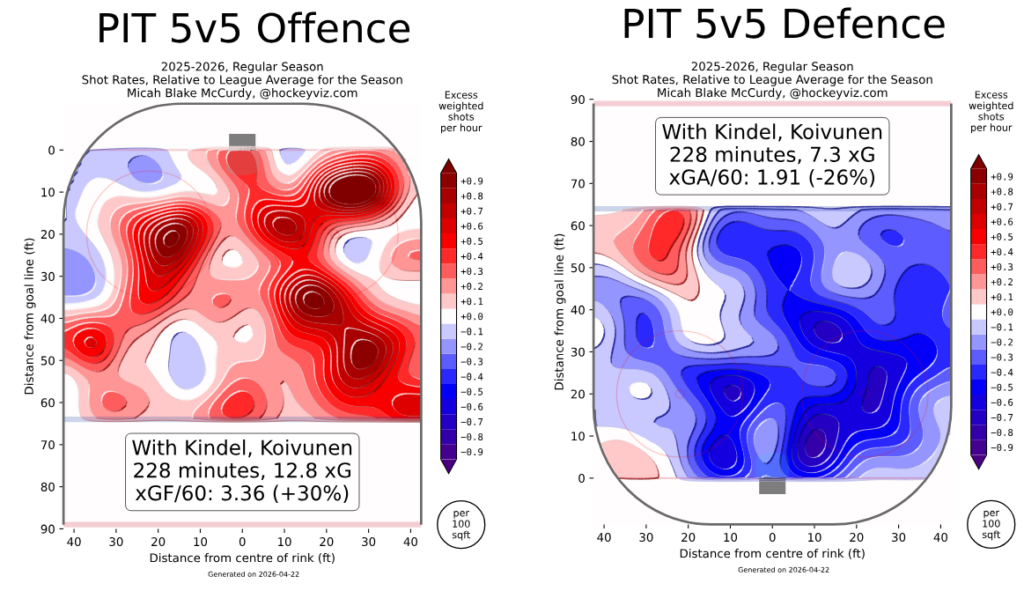
On the left is Pittsburgh’s expected goals-for rate at 5-on-5 with Koivunen and Kindel on the ice. Red areas are good and indicate above average xG rates from that spot. On the right is Pittsburgh’s expected goals-against rate at 5-on-5 with that duo on the ice. Blue areas are good and indicate below-average rates by the opposition. That is dominant, they just couldn’t finish on their chances, hence Koivunen’s lack of production. It does give me hope for Koivunen’s future, though.
What also gives me hope is that Koivunen had 41 points in 34 games in the AHL this season, and over his last two AHL campaigns, he’s been a point-per-game player. The Finn doesn’t turn 23 years old until June, and the Penguins are clearly going to have some turnover to younger players. There is still hope for next season and beyond, but this was a big miss for 2025-26. (apr23)
17. On Tuesday, these Ramblings covered some small success I had in Best Puck formats this season, talking about players like Macklin Celebrini, Andrei Svechnikov, and Jet Greaves. Yesterday (above), we covered some forwards I missed on projections-wise, including Dylan Larkin, Jonathan Marchessault, Sean Monahan, Mason McTavish, and Ville Koivunen.
Today, we’re reviewing more projections misses, but moving to defencemen. As with the forwards, defencemen with serious injury issues, or anyone who missed more than 20 games, will be excluded.
MacKenzie Weegar – Calgary Flames
In August, when I started previewing my projections for the season, one name included was Weegar’s. It might be my biggest miss of the season because his 82-game projection (59 points) was more than double what he actually produced (28 points in 79 games).
The shooting percentage was a problem – 2.6% is a three-year low and less than half his average of 5.8% across the prior three seasons – but adding five goals doesn’t get us anywhere close to what his full-season point projection.
It wasn’t as if I was high on the Flames, either. Looking back at my preseason projections, Weegar was at the top of the point list with no one on the team projected for at least 60 points in 82 games:

My expectation was that with Rasmus Andersson likely to be traded at some point, Weegar would be a major minute-eater for Calgary, and that did not come to pass. In fact, he lost over a minute per game in TOI when compared to 2024-25. The extra minute wouldn’t have changed a lot, but it didn’t help.
The big issue was the Calgary power play. After posting 21 power-play points in 81 games in 2024-25, Weegar managed just five PPPs in 60 games with the Flames, or seven PPPs over a full 82-game campaign. Similar PP production to 2024-25 would have pushed him well past the 40-point plateau, and though shy of the lofty projection, it wouldn’t have been this bad. Regardless of why, the Flames were barren of point production this season, and Weegar was a big part of that. (apr24)
18. Dougie Hamilton – New Jersey Devils
On September 5th, I wrote about some players whose early ADPs looked like good value to me. Among them was Hamilton, who was going somewhere around the 17th – 18th defenceman off the board and he was the 10th defenceman on mine (assuming multi-cat formats). Hamilton didn’t have an awful year – 12 goals, 26 assists, 202 shots, 87 hits, 77 blocks – but it was far shy of the 58-point/82-game projection I had for him.
One reason for the lack of production was what happened at even strength. Among 137 defencemen who skated at least 2000 even-strength minutes across the 2022-2025 seasons and also had at least 700 minutes in 2025-26, Hamilton had the second-largest drop in assists per 60 minutes (from Natural Stat Trick):

If Hamilton averaged 1.21 EV assists/60 minutes in 2025-26 as he had averaged across the prior three seasons, he’s a 50-point defenceman. He didn’t, which is why he landed where he did, but it helps highlight the variance that can happen to any player in any season.
The Devils were very bad offensively at even strength right up until the Olympic break as their rate of goals per 60 minutes (2.2) was 30th in the league, and slightly ahead the absolute worst teams in Vancouver (2.18) and Calgary (2.19). Knowing this, it makes sense that Hamilton didn’t do a lot at that strength but imagine going back to September and telling yourself that through three-quarters of the season, the New Jersey Devils would be 30th in offence. Hamilton was a big miss for me, but the entire New Jersey roster was a big miss. (apr24)
19. Vince Dunn – Seattle Kraken
In a late-August Ramblings looking at some preseason projections for each team, Dunn was on the list. Given that we just saw his name in the graphic above for largest drops in even-strength assist rate this season, it is safe to say that Dunn’s final point total (44 points) came nowhere close to his 82-game projection (60 points). Not nearly as bad of a season as Weegar or Hamilton, but still a miss, nonetheless.
What makes this particular miss frustrating is Dunn had a career-high 21 power-play points. If his even-strength assist rate is the same as it was across the prior three seasons (1.12), he posts 59 total points and is nearly bang-on his projection. He didn’t produce at that rate, so he missed the projection by a wide margin, and that’s what ultimately matters. (apr24)
20. Kris Letang – Pittsburgh Penguins
This one is truly something else. Imagine we go back to early September with some knowledge of the future. We go back and tell ourselves that Letang will play 74 games, that the Pittsburgh Penguins will be the third-highest scoring team in the league, and that they’ll make the playoffs. If we knew all that in September, where does Letang get drafted?
Despite all this, Letang only posted four more points (34) than he did the year prior (30) in as many games played. One reason for this was a large shot drop. Looking again at even strength, and the same group of players highlighted in the section Hamilton, Letang had the eighth-largest drop in shot rate at even strength in 2025-26:
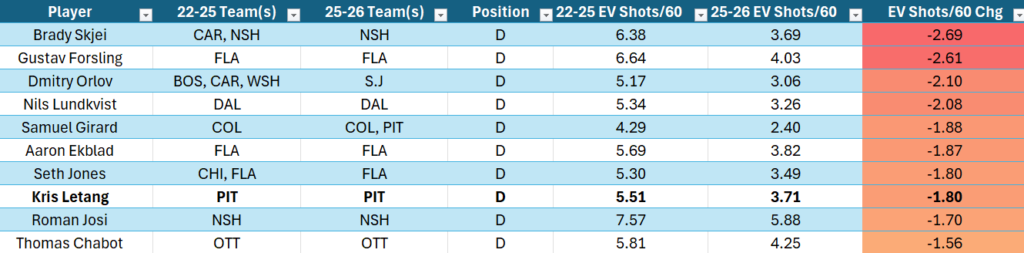
Shooting 2.9%, or nearly half his three-year rate of 5.7%, did not help. Losing nearly 50 even-strength shots also did not help. A normal shooting season from him would probably have tripled is goal production, but he didn’t, so he didn’t.
Anyone who watched Letang in the regular season, or has watched him in the postseason, probably understands this already: He struggled to drive the play for his team, making it two years in a row where this has been an issue. With 20 NHL seasons and nearly 1400 total NHL games under his belt, this very much looks like the end of his fantasy-relevance in most formats. (apr24)
21. Sam Rinzel – Chicago Blackhawks
In a Ramblings looking at later-round values, Rinzel was highlighted. The hope was that if he played close to a full season, he could push near the 40-point mark as a rookie blue liner. He didn’t play a full season – just 54 games – but it wouldn’t have mattered as he posted just 14 points in those 54 games. It isn’t as if he didn’t get a chance, either. In the first month of the season, here are the defencemen who played at least 10 games and averaged between 60-70% of their team’s PPTOI and between 30-35% of their team’s EVTOI:
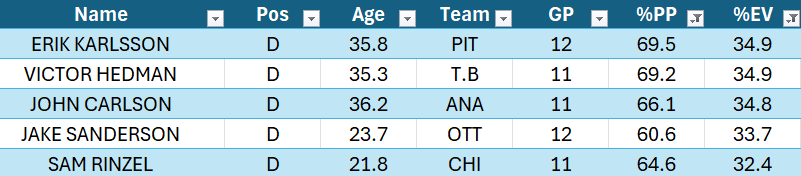
Rinzel wasn’t getting quite as much ice time as Jake Sanderson or John Carlson, but Rinzel’s offensive usage was not far behind some of the top offensive defencemen for their respective rosters. However, Chicago’s power play went 6/36 in October, which was 24th in the league. Rinzel was eventually supplanted by Artyom Levshunov (and even Matt Grzelcyk at times) at both even strength and the power play, and though he would have a couple opportunities later in the year, Rinzel never could find that next gear as an offensive blue liner.
It is hard to put a lot on Rinzel because Chicago’s power play never really found consistency and the team finished with the seventh-worst scoring rate at 5-on-5. All the same, he didn’t come close to being the breakout player we hoped he could be, and if Levshunov becomes the go-to guy moving forward, Rinzel might never reach his true fantasy ceiling. (apr24)
—
Have a good week, folks!
Thanks for continuing to support the website and if you’re bored and need a fantasy hockey fix – visit the gang in the forum here.
Related Posts
Starting Goalies





Top Skater Views
 PHI
 T.B
 N.J
 L.A
Top Goalie Profile Views
| Players | Team | |
|---|---|---|
| JACOB FOWLER |
 MTL | |
| DANIIL TARASOV |
 DET | |
| DYLAN GARAND |
 NYR | |
| DEVON LEVI |
 EDM | |
| ALEX NEDELJKOVIC |
 S.J | |
LINE COMBOS
| Frequency |
 MIN Players | |
|---|---|---|
| 29.8 | KIRILL KAPRIZOV JOEL ERIKSSON EK MATT BOLDY | |
| 19.3 | RYAN HARTMAN BLAKE COLEMAN BOBBY BRINK | |
| 16.3 | DANILA YUROV YAKOV TRENIN MAXIM SHABANOV | |
DobberHockey Podcasts

Keeping Karlsson: Never Tell Me the Podz
Elan and Brian do a wellness check on the Maple Leafs, lament Chicago and Buffalo snoozers, wonder whether and which Flyers have figured it out, and pick out the Capital standing out from the crowd.

Fantasy Hockey Life: Ep 505 Prospects With Plenty to Prove Part 1
Victor and Jesse return to talk about prospects with plenty to prove. This week it’s: Tij Iginla, Berkly Catton, Konsta Helenius, Zayne Parekh, Igor Chernyshov, Jett Luchanko, Axel Sandin-Pellikka, Artyom Levshunov, Michael Hage, and Carter Bear. Have a listen! Our show is part of the Dobber Podcast Network and sponsored by Fantrax.com. Email [email protected] and […]
Keeping Karlsson: Matchup Maximizer 2026/27 Week 4
Elan takes a look at the schedule for the upcoming weeks of NHL action and recommends players with good schedules that you should consider streaming in to win your head to head matchups.
Keeping Karlsson: Short Shifts – NHL Frozen Frenzy Recap
Elan and Lewis recap the Frozen Frenzy as well as two big returns and more!
Keeping Karlsson: Delusions of Garandeur
Elan and Brian dive into the latest NHL hot streaks, cold streaks, line changes, outjuries, injuries, buy-lows and sell-highs to give you top notch tips in your fantasy hockey league