

21 Fantasy Hockey Rambles
Dobber Sports
2026-07-19
Every Sunday, we share 21 Fantasy Rambles from our writers at DobberHockey. These thoughts are curated from the past week’s 'Daily Ramblings'.
Writers/Editors: Ian Gooding, Michael Clifford, Alexander MacLean, Puneet Sharma, and Dobber
___
1. It feels like we have hit a dead spot in the summer, where all the insiders and hockey accounts have gone quiet, and there’s no news to speak of other than arbitration dates and further speculation on previous reports.
Well, today let’s take a look at some of the players remaining on the FA pile and the trade block, and see if we can forecast how the fantasy landscape may shift between now and the end of September.
With each passing day it feels more likely that Jason Robertson, Matthew Knies, Morgan Rielly, Elias Pettersson, and Jordan Binnington are going to stay put – at least until the start of the season for those latter two, who might be more suited to an in-season deal when a team needs to shake things up.
Robertson sticking around in Dallas keeps most of their outlook the same, with Seguin likely either on LTIR or filling in Mavrik Bourque‘s ice time from the end of the season. Knies’ outlook in Toronto remains consistent, while the rest of that lineup undergoes a massive shift. For Rielly that shift means a step back from any power play exposure, though perhaps some easier minutes help him more in the transition game. Pettersson and Binnington are more volatile assets, and while a trade could unlock their potential, I am not going to be bumping them up my draft lists based on a hope. It does feel like Pettersson will be moved at some point before the deadline, whether to Detroit, Ottawa, Philadelphia (much cheaper to acquire than Carlsson and maybe could still be a #1C anyways), or somewhere else for fantasy managers to get excited about, but don’t expect it to be a fast process, or an immediate turnaround either. (july15)
2. That does still leave us with quite a few names who will likely be on the move in trades. Dylan Larkin and Connor Hellebuyck are both similar in that it feels like they should be traded, but the lack of available landing spots is a sticking point. If stubbornness prevails, then neither has a new team by Christmas, but if something changes then they could be on a plane to a new home within 24 hours.
Both would make a big impact on a new squad. For Larkin it feels most likely that he ends up in Minnesota, while Hellebuyck to Buffalo almost feels inevitable now. That would negatively affect the value of incumbents at the same position like Alex Lyon (also assuming Ukko-Pekka Luukkonen is part of the return), Danila Yurov, and Joel Eriksson Ek, while bringing up the ceiling on most of the rest of the team. For Helle and Larkin themselves, the change in production may be seen more in their attitude, because if they aren’t moved then there may be some resentment, as well as a lot of heavy media coverage, leading to a sag in numbers this year. (july15)
3. Alexander Nikishin is also rumoured to be shopped, which seems like Carolina would be letting a stud go, but we also don’t know his contract ask and Carolina doesn’t seem to make mistakes with defensemen that they let walk. It would be a risk for whoever takes him on, but the upside is huge, and that would be the case for fantasy managers as well. If he is traded, he would likely be brought in as someone who could help with a power play, whereas in Carolina he only received 30% of the available man advantage ice time. He could be in for a big jump in production in the right scenario. He’s also a multi-category stud.
For the remaining Canes, if Nikishin is moved then Joel Nystrom would have a path to regular, everyday minutes, but not much else would change. (july15)
4. Among the remaining free agents, there aren’t a lot of options left. The big names are mostly offensive wingers with one flaw or another, some risk/reward depth defensemen, and a couple of backup goalie options.
Up front, Vladimir Tarasenko, Eeli Tolvanen, Anthony Mantha (who signed with New Jersey later in the week – see further below for more on that signing), and Patrick Kane, are all likely to be fantasy relevant next year, and unless they land in Calgary or Winnipeg, their perceived fantasy value is likely to receive a boost just based on the potential lineup and an impact they could have. For example, it seems like Tarasenko’s heaviest rumoured landing spot is Edmonton. If he lands there everyone immediately pencils him next to McDavid, where maybe he recaptures his magic and is a 70+ point scorer again – especially after his hot streak to end last season. However, Tank likely wouldn’t be on PP1, leaving him as likely in the 45- to 50-point range at even strength, and a couple more on the second power play unit, and that’s what he would be on most teams at this point. If you own any of these guys, then you can either hold, or sell after they sign, but don’t bother selling yet, as their value is likely going to spike between now and September.
Looking around the league, the Canadiens (ideally a 2C) and Blackhawks (as a Connor Bedard fill-in) could both use another forward, but both of them are looking for centers. New Jersey (Stefan Noesen) and Anaheim (Troy Terry) could both look at wing fillers for injured players, but aside from that most teams look fairly set. (july15)
5. If I had to lay out my best guesses on landing spots, it would be Tarasenko in Edmonton, Tolvanen in New Jersey, and Mantha signing with the Rangers.
Patrick Kane may end up home in Buffalo, but that feels like it would only work if Jack Quinn is shipped out and Kane took his place. Otherwise there just isn’t space in the lineup for Kane’s homecoming. Since Kane looks to be moving on from Detroit, it likely is with an eye to get back to the playoffs. His best bets there would be Edmonton (who could maybe fit both him and Tarasenko – like the Rangers tried a few years ago), or looking to usurp Max Shabonov for the third-line wing spot in Minnesota before Shabonov even plays a game for the team.
With the rest of the bunch, only Nick Blankenberg, John Klingberg, and Connor Ingram look to have much name value to start, and could have some standard league draft value depending on the landing spot. For Blankenberg and Klingberg that would look like a roster where they could see second-pairing minutes and some PP2 time to boot. For Ingram, there really aren’t many goaltending tandems that aren’t locked in for the start of the year (if any) so he might see his best bet in Vancouver, expecting another Thatcher Demko injury – it could work for the Canucks on a cheap deal too where he would pass through waivers at the start of the season, and could be traded if there is a goalie injury or opening that crops up elsewhere. (july15)
6. There’s also the remaining RFA group, and the question of whether we will see another offersheet. Does Philly take the $18M allotted for Leo Carlsson and offer 90% of it to Adam Fantilli? Or maybe they only need half of it to target Connor McMichael with a $9 Million cap hit to pry him out of St. Louis for a first, second, and third? He wouldn’t be the top line centre they desperately need though, so the latter feels unlikely, at least from Philly. Adam Fantilli seems like the most likely target at this point, though wouldn’t he have signed one by now if there was something out there? It feels like we may be done with offersheets for this summer.
Putting that all together, I would love to suspend reality for a minute and outline the five-way deal that I had to stitch together to solve a lot of issues all in one deal. None of this is simple, and none of it is going to happen exactly like this, but it will hopefully highlight just how convoluted it can be sometimes to make everyone happy.
Minnesota ends up with Dylan Larkin (partially retained) and Elvis Merzlikins (half retained), Carolina ends up with Connor Hellebuyck, Detroit ends up with Cayden Lindstrom, Danila Yurov and Alexander Nikishin, Winnipeg ends up with Ryan Hartman, firsts from Carolina and Winnipeg, and Pyotr Kochetkov, while Columbus nets Jesper Wallstedt. (july15)
7. Now bring your disbelief back in, and explain to me how complicated this all is. Teams don’t always line up with what a team has, wants, and is willing to part with to make a deal. When players like Larkin and Hellebuyck control their destinations and limit things down to three or four teams, sometimes it means that other teams need to be looped in to help balance the ins and the outs to get things across the line. Either someone is going to have to give in, trades are going to have to get complicated, or they just won’t get done until something changes. All the hypothetical armchair GM deals are fun, but they hardly account for every angle. (july15)
8. With the NHL draft now completed, many keeper leagues are starting to think about their entry drafts. By the term “entry draft”, I mean drafts involving 2026 draft-eligible players. My deepest keeper league recently completed one of these drafts, so I’ll share the results (here) so that you can get an idea of how keeper leaguers view this year’s draft crop.
I drafted picks #9 and #28 – here's my thinking behind my two picks:
Tynan Lawrence (#9): I was targeting Rudolph in this spot for his offensive upside, but he was selected one pick before me. This happens to me a lot for some reason. I have one player at the top of my list about 5-6 picks before mine, but that player is selected in the pick right before mine and I’m left to make a harder choice between my other options. Funny how that works!
I had a few players considered in this spot, as well as a trade offer to move down in the draft and add another player for doing that. I couldn’t make the trade work, but I then decided that Lawrence was my guy. Smits was still available, but I decided to consider what Victor Nuno wrote in his latest Journey about Smits being a better real-life player than fantasy option. I also had Wyatt Cullen in mind, who happened to be picked next.
I like Lawrence here because earlier this season, he seemed like a sure top-5 pick and the top center to be picked. Even though he fell from there in both the real-life and fantasy draft, Lawrence still profiles as the third-best center after Viggo Bjorck and Caleb Malhotra, both of whom were selected earlier. His game should also work in multicategory leagues, which is what this league is. Lawrence struggled a bit once he reached the NCAA, but he will have some more time to work on his game at that level. Plain and simple, I need scoring for my team, and Lawrence seemed like the best player available for that.
Adam Novotny (#28): I thought I would spend more time thinking about who to pick here than I would my first-round pick, but the opposite turned out to be true. When I saw Novotny’s name there and the names below, it didn’t take me long to make up my mind. Novotny profiles to be a power forward (6-1, 205 lbs.), which works out well with this league’s bangers categories. He also has goal-scoring upside. It doesn’t hurt that my favorite team drafted him too!
Drafting 18-year-old prospects is more difficult than drafting players for a typical fantasy league. Players can take many different paths following the draft. There won’t be as much excitement about many of these players five years from now. I don’t mind differences of opinion when it comes to prospects, but I put very little stock into absolute statements (ie. I will guarantee Player X will be a star, or I know Player Y will be a bust). Unless we’re talking about a generational talent or something not far from it, the future is largely unknowable when it comes to NHL prospects. Not every player you pick or I pick will pan out. Part of the fun is waiting and seeing how these players turn out.
[Follow the link for the full pick-by-pick "entry draft"…] (july18)
9. If you’re looking for some real longshots to make the NHL right away out of the draft, the best indication is how early the player signs their ELC. We had Oliver Suvanto (WAS) and Malte Gustafsson (NYI) sign their first contracts yesterday. Both are likely too far down the depth chart to have a real shot this year, but they are two of the more polished players, and could be in the NHL sooner than the usual development timeline for mid-first-round players. (july15)
10. The Philadelphia Flyers announced an extension for forward Trevor Zegras, signing him for four years at $9.125-million per season, a substantial raise on the $5.75-million AAV deal he just completed. Even with the rising cap, he goes from a 6% cap hit to an 8.8% cap hit, being paid as a top-50 player.
For fantasy managers in salary cap leagues, this is a tough pill to swallow. It isn’t that this makes him instantly droppable, but if he’s being paid as a top-50 player, it gives us a barometer for what he needs to do in fantasy to be worth it. To be a top-50 fantasy player, he needs to be a top-45 skater, assuming a half-dozen goalies (give or take) finish in the top-50. To be a top-45 skater in multi-cat formats, a forward who doesn’t hit or block much like Zegras needs an 82-game pace approximating 35 goals, 55 assists, 25 power-play points, 260 shots, 60 PIMs, and 400 FOWs; the only threshold he’s reached in any season of his career is the PIM total. Even in points-only leagues, a forward needs to be a 40/40 or 30/60 option to get into that range. It is a high bar.
It isn’t hard to see some cap league managers hanging onto Zegras if they are saving a bunch of cap space elsewhere with entry-level deals or guys who signed a contract 3-4 years ago in a depressed salary cap era. Those will be infrequent situations though, and a 30-goal, 50-assist season may not be enough to recoup his cap hit. (july17)
11. The Flyers also signed Jamie Drysdale to a four-year extension with a cap hit of $6.5 million. Drysdale tied his career high with 32 points in 78 games in 2025-26. His nine power-play points was tied for fourth on the Flyers, a team that finished dead last in the NHL with a 15.7 PP%. Drysdale has reportedly been working on his shot this offseason, so it seems like he is being given the chance to improve his power-play output.
You may recall that Drysdale was acquired by Philadelphia from Anaheim for Cutter Gauthier. The Ducks still have to sign Gauthier and currently have only about $9 million in cap space. Meanwhile, the Flyers have over $13 million in cap space and only Nikita Grebenkin to sign as an RFA. The Flyers took care of Trevor Zegras‘s contract earlier in the week, signing him to a four-year deal with a cap hit of just over $9 million. It will be interesting to see what the Flyers do next. (july18)
12. Work continues on Dobber’s 2026-27 Fantasy Hockey Guide, which is available now for pre-order in the Dobber Shop. This edition will include player projections, team-by-team outlooks, call-ups/rookies to monitor, category-specific draft targets, and a whole lot more. The best part is because it is a digital edition, it is constantly updated right until the start of the regular season due to injuries, trades, role changes, or anything of the sort. Get a headstart on your league mates and help support what we do year-round by pre-ordering your copy today! (july17)
13. BTW, the NHL season is scheduled to begin on Sept 29, as the full schedule was released on Thursday July 16. I’ll be breaking down the H2H schedule need-to-knows in the DobberHockey Fantasy Guide again this year, noting all the key points I look out for when planning my route to a championship in H2H leagues. (july15)
14. Rick Roos is looking for a few more mailbag questions to be answered in next week's article. To get your questions to him, private message “rizzeedizzee” via the DobberHockey Forums or email [email protected] with “Roos Mailbag” as the subject line. No one does a deeper dive on your questions than Rick, and now is the time to get those keeper and draft questions in before it's too late.
15. The New Jersey Devils signed winger Anthony Mantha to a two-year deal worth $4.75-million per season, as reported by Elliotte Friedman. Alex had his take on the trade here.
Mantha is coming off a career year and has all the tools – shooting, playmaking, size – to be a 30-goal, 60-point winger. It was the first time he put it all together, but the tools are still there, and he’s now going to a team with a very talented top-6 group.
As with all secondary scorers, the crux is the power play. All of Nico Hischier, Jack Hughes, and Jesper Bratt will be top PP fixtures. Mantha is in the mix with names like Timo Meier, Dawson Mercer, and even Connor Brown. If Mantha stays healthy – last year was the first time he played at least 75 games since 2017-18 – he can be a 25-goal, 50-point guy as he’s moved between PP units, but I am not expecting him to repeat his career-best output.
16. Nick Robertson avoided arbitration with the Penguins, signing a two-year deal worth $3.25M per season. It was higher than I was expecting for someone who has been at best a third-line winger to this point, playing for a team that already has 10 options for its four middle-six wing spots. (july15)
17. The Buffalo Sabres avoided arbitration with forward Peyton Krebs by signing him to a four-year deal worth $4.5-million annually, as reported by Elliotte Friedman. Krebs had a career-year with 12 goals and 39 points during a season where he got an extended look on the top line. I am dubious he repeats that performance as there is a lot of forward depth on the Sabres roster, especially with the breakout of Noah Ostlund, the emergence of Konsta Helenius, and the return of Jiri Kulich. (july14)
18. We’re back with Part 2 of our power-play quarterback series, taking a closer look at the defensemen expected to run each team's man advantage heading into the season. For fantasy managers, power-play deployment can often be the difference between a breakout season and a disappointing one, making these roles some of the most important to track before draft day.
Western Conference
Cale Makar – Colorado Avalanche
Makar remains the gold standard when it comes to NHL power-play quarterbacks and should once again be one of the first defensemen drafted in fantasy leagues. While he didn't quite match his 92-point performance from 2024-25, he still posted an outstanding 79 points in 75 games while pacing for 86 points, including 29 on the power play. Surrounded by one of the league's most talented forward groups, his role on PP1 is as secure as it gets, making him one of the safest and most valuable fantasy defensemen in the NHL.
Miro Heiskanen – Dallas Stars
Heiskanen bounced back with an excellent season, finishing with 63 points in 77 games and reclaiming his spot as Dallas' top power-play quarterback. Thomas Harley is an outstanding offensive defenseman and has proven he can step into that role when needed, but Heiskanen remains the clear first choice on PP1. Dallas also iced one of the league's most dangerous power plays, ranking second at 28.6% powerplay efficiency, while leading the NHL with 71 power-play goals. If that unit continues to produce at the same level, Heiskanen has a realistic shot at returning to the 70-point range and climbing back up fantasy draft boards this fall.
Quinn Hughes – Minnesota Wild
Much like Makar, this is an easy lock, Hughes to quarterback the top power-play unit in Minnesota. Few blueliners can dictate the pace of a power play the way he can, and back-to-back 76-point seasons show just how reliable his production has become. His presence gives the Wild's power play a significant boost while cementing Hughes as a safe and dependable fantasy defensemen to draft.
[Follow the link for more…]
19. In a Ramblings last week, we discussed forwards who saw improvements in their fantasy value on a 60-minute basis. Today, we will go in the other direction and discuss forwards whose per-60 fantasy value fell in 2025-26 compared to 2024-25, and whether they can rebound.
The fantasy categories used for the evaluations are goals, assists, power-play points, shots, hits, blocks, penalty minutes (PIM), and face-off wins (FOW). For wingers, we may exclude FOW just to get an idea of what they produced without a category where most of them will garner a low score. All evaluations are relative to other forwards and replacement-level fantasy value. Generally speaking, replacement value for this write-up is around the 185th-ranked forward, or the top of the waiver wire list.
Data is from Evolving Hockey and Natural Stat Trick. Only players who played at least 41 games in both seasons will be included, giving us 337 forwards to sort through. Positions are from Yahoo.
Sean Monahan (Columbus Blue Jackets – C)
Whether we include the FOW component or not, there was no forward who lost more value on a 60-minute basis than Monahan:
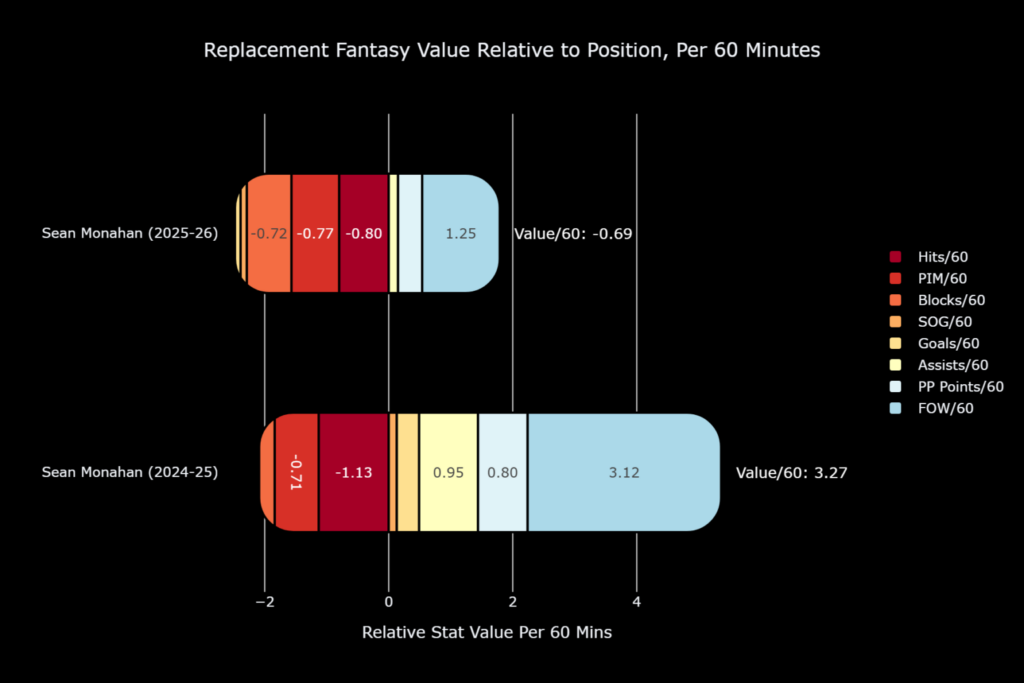
That will happen when you go from over a point-per-game player to under a half-point-per-game player.
Anyone who was relying on Monahan knows that he lost his top-6 role as the season wore on; Adam Fantilli became the locked-in top-line centre and Charlie Coyle‘s checking line took precedence over Monahan’s second scoring line in terms of ice time. That change only got more severe as the season wore on: 14 of Monahan’s 78 games played saw him skate under 15 minutes,12 of those 14 games came after American Thanksgiving.
It is hard to see Monahan regaining the magic he had a couple years ago. Assuming that Fantilli is re-signed, he will remain the top-line centre, and as long as Coyle’s checking line remains effective, Head Coach Rick Bowness will, at best, split the ice time between that line and Monahan’s line, if not outright favour Coyle. Without a top power-play role, which Monahan lost last year, he has no fantasy value outside of deep leagues.
[Follow the link for more…] (july14)
20. Over my last few Ramblings, we have gone over some declines in fantasy value on a 60-minute basis last season compared to the year before. We have reviewed:
- Forwards who increased their value.
- Forwards who decreased their value.
- Defencemen who increased their value.
Today, we’ll finish off our skaters by covering defencemen with less fantasy value in 2025-26 than in 2024-25.
As always, these evaluations are made by relating production to other defencemen, and to a replacement-level fantasy blue liner. In this instance, replacement-level is the average production for roughly the 85th most valuable fantasy blue liner, or the top waiver wire option in a 14-team league. We are only including defencemen who played at least 41 games in both seasons, giving us 159 blue liners to sift through. The fantasy stats used are goals, assists, power-play points, shots, hits, blocks, and penalty minutes (PIM).
Data is from Evolving Hockey or Natural Stat Trick, unless otherwise indicated. Remember that this is all evaluated on a 60-minute rate to help put everyone on equal footing.
Shea Theodore (Vegas Golden Knights)
The largest decline in our sample was Theodore, and it wasn’t even close as his 60-minute fantasy value drop was 27% more than the next-closest player. Anyone who had Theodore on their roster knows where things went wrong, and it also shows how one stat can affect so much:
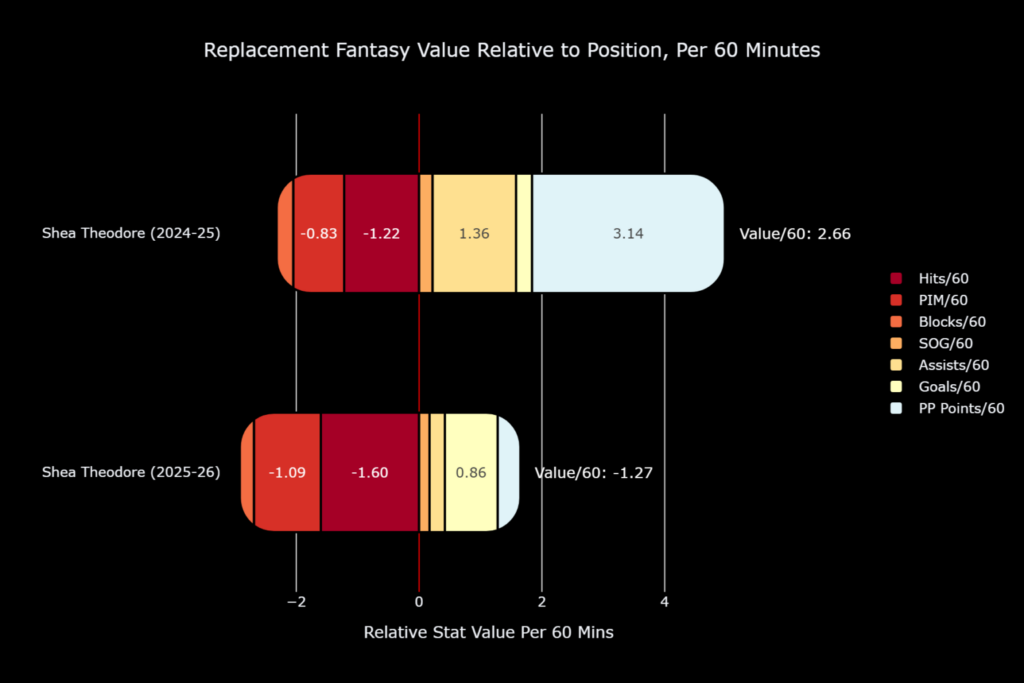
Losing the top PP role in Vegas as the team moved to a five-forward unit is what killed Theodore’s fantasy output; roughly 70% the total drop came from the decline in power-play points. If he had the same PP output as the year before, and everything else stayed the same, he goes from a fringe top-80 defenceman to a fringe top-30 defenceman. However, it wouldn’t stay the same as he would have added a lot of assists, so losing that PP role was the difference between being a top-80 defenceman or a top-25 defenceman.
The good news is that Pavel Dorofeyev was traded to the New York Rangers and no one was really brought in to replace him. It isn’t hard to see the remaining four forwards from last year’s vaunted power play return to that role and Theodore being the quarterback. That puts a 50-point season back on the menu for him, but there is a gnawing feeling in my stomach that Vegas brought Victor Olofsson back into the fold for the specific reason of having a shoot-first left-handed winger to replace Dorofeyev.
[Follow the link for more…] (july16)
21. My last four Ramblings have covered skaters who had a sizeable gain or drop in fantasy value on a 60-minute basis in 2025-26 compared to 2024-25, and whether they’ll decline or rebound in 2026-27. To this point, we have reviewed:
- Forwards whose fantasy value increased.
- Forwards whose fantasy value decreased.
- Defencemen whose fantasy value increased.
- Defencemen whose fantasy value decreased.
Today, we’ll wrap up this series by evaluating forwards and defencemen with substantial improvements or declines that I didn’t get to cover yet. There is only so much room in each article to write meaningfully about a player, and these are the interesting ones that just missed the cut in various categories.
A reminder that this is based on production per 60 minutes, is compared to players at the same position (forwards to forwards and defencemen to defencemen), and relative to the league-average replacement-level fantasy value. That would be roughly the overall fantasy value of a top waiver wire option in a 14-team league.
Among forwards, the stats are goals, assists, power-play points (PPP), shots, hits, blocks, penalty minutes (PIM), and face-off wins (FOW), though we may exclude FOW for wingers to put them on a bit more level playing field. The stats for defencemen are the same without FOWs, and all listed positions are taken from Yahoo. Data for evaluations is from Evolving Hockey or Natural Stat Trick, unless otherwise indicated.
Let’s start with the improvements.
Evgeni Malkin (Pittsburgh Penguins – C/RW)
It is unfortunate that Malkin missed 28 games because he had his first point-per-game season in three years. The missed time made him an unreliable fantasy asset despite such a large increase in his 60-minute fantasy value:
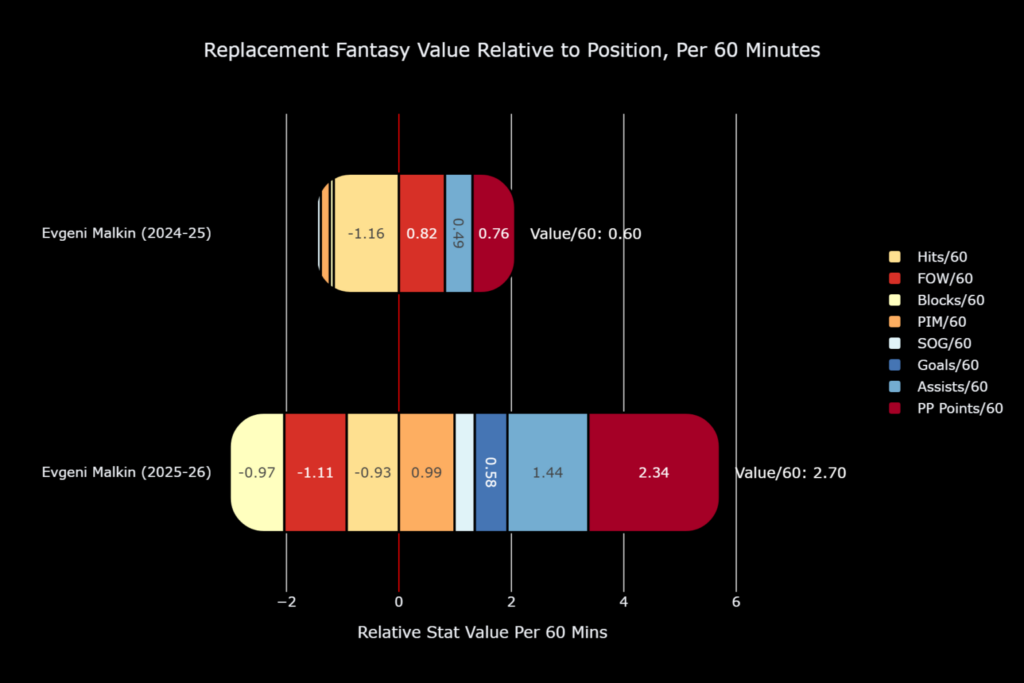
One of the reasons Pittsburgh had such a successful year was the power play, finishing top-10 in the league in PP goals per 60 minutes for the first time since 2022-23. Malkin managed 22 power-play points in just 56 games, another indicator of just how much fantasy value he could have had if he had played 75-80 games.
The big question is whether Pittsburgh will replicate last year’s success or whether it was a last-gasp surge from their Hall-of-Fame core. All their key forward pieces, save Anthony Mantha, are returning, but there has been a lot of turnover on the blue line. How it all works together is an open question, and Malkin turns 40 years old in a couple of weeks. There should be faith that this team can keep up their offensive performance, especially if Ben Kindel takes another stride, but Malkin’s inability to stay on the ice is a concern again. It makes it hard to draft him as a top-100 player.
[Follow the link for more…] (july17)
***
Reminder: Dobber's 2026 Fantasy Hockey Prospects Report is available in the Dobber Shop! Both Dobber and the Prospects team highlight the prospects you need to know. It has an in-depth look at each team's current prospect pipeline and estimated arrivals for their top, young (hopeful) stars. Head on over to the Dobber Shop and grab a copy of the Prospects Report!
***
Have a good week, folks!
Thanks for continuing to support the website and if you’re bored and need a fantasy hockey fix – visit the gang in the forum here.
Related Posts
Starting Goalies











Top Skater Views
| Players | Team | |
|---|---|---|
| JACK QUINN |
 BUF | |
| ARSENY GRITSYUK |
 N.J | |
| KENT JOHNSON |
 CBJ | |
| FRASER MINTEN |
 BOS | |
| QUINTON BYFIELD |
 L.A | |
Top Goalie Profile Views
| Players | Team | |
|---|---|---|
| DYLAN GARAND |
 NYR | |
| JACOB FOWLER |
 MTL | |
| ADIN HILL |
 VGK | |
| YAROSLAV ASKAROV |
 S.J | |
| CAM TALBOT |
CBJ
| |
LINE COMBOS
| Frequency |
 OTT Players | |
|---|---|---|
| 14.7 | FABIAN ZETTERLUND RIDLY GREIG WARREN FOEGELE | |
| 13.9 | TIM STUTZLE STEPHEN HALLIDAY DRAKE BATHERSON | |
| 12.2 | SHANE PINTO NICK COUSINS MICHAEL AMADIO | |
DobberHockey Podcasts

Keeping Karlsson: Never Tell Me the Podz
Elan and Brian do a wellness check on the Maple Leafs, lament Chicago and Buffalo snoozers, wonder whether and which Flyers have figured it out, and pick out the Capital standing out from the crowd.

Fantasy Hockey Life: Ep 505 Prospects With Plenty to Prove Part 1
Victor and Jesse return to talk about prospects with plenty to prove. This week it’s: Tij Iginla, Berkly Catton, Konsta Helenius, Zayne Parekh, Igor Chernyshov, Jett Luchanko, Axel Sandin-Pellikka, Artyom Levshunov, Michael Hage, and Carter Bear. Have a listen! Our show is part of the Dobber Podcast Network and sponsored by Fantrax.com. Email [email protected] and […]
Keeping Karlsson: Matchup Maximizer 2026/27 Week 4
Elan takes a look at the schedule for the upcoming weeks of NHL action and recommends players with good schedules that you should consider streaming in to win your head to head matchups.
Keeping Karlsson: Short Shifts – NHL Frozen Frenzy Recap
Elan and Lewis recap the Frozen Frenzy as well as two big returns and more!
Keeping Karlsson: Delusions of Garandeur
Elan and Brian dive into the latest NHL hot streaks, cold streaks, line changes, outjuries, injuries, buy-lows and sell-highs to give you top notch tips in your fantasy hockey league