

Analytics Advantage: Using Plus/Minus Adjustments to Find Good Fantasy Draft Values
Stas Pupkov
2026-09-04
In last week’s edition of ‘Analytics Advantage’, there was analysis on how plus/minus can have a massive, and understated, impact on fantasy hockey value. There was also an analysis on how plus/minus fluctuates when a player changes teams. This week will pick up where we left off and apply what we discovered a week ago to the 2026-27 season. Which players' plus/minus rating is set to improve or decline, whether they stayed with the same franchise or moved to a new location? How does the new 84-game schedule affect things?
The 2026-27 Board
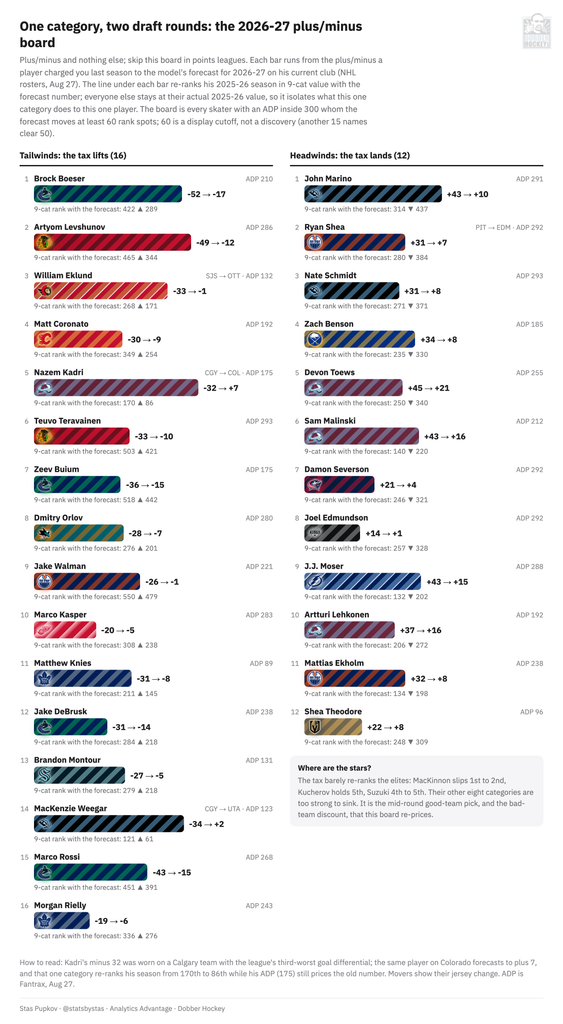
Figure 2
The board holds every skater with an ADP inside 300 whose forecast moves him at least 60 spots of 9-cat rank: 16 tailwinds and 12 headwinds. Sixty is a display cutoff rather than a discovery; another 15 names clear a 50-spot bar.
The tailwind side splits into two kinds of buy. The movers are cashing a jersey trade: Nazem Kadri to the Colorado Avalanche, MacKenzie Weegar to the Utah Mammoth, and William Eklund to the San Jose Sharks, whose season corrects from 268th to 171st at a cost of 132. Their old plus/minus is the number your league mates remember and, per Figure 1, nearly the worst possible forecast of their new one. Two more movers land under the board’s cutoff and still merit a sentence: Vincent Trocheck‘s trade to Utah lifts him from 48th to 29th, and Brayden Schenn‘s to the New York Islanders moves him from 128th to 83rd at an ADP near 289.
The stays are reversion buys, led by the familiar name from the section above: Brock Boeser was July’s cautionary example of a category-league casualty, a top-160 points season dragged to 422nd in 9-cat by a minus-48, and a number that extreme has nowhere to live but closer to the team’s base rate. His forecast lands at minus-17.
The cheap seats of the tailwind side are where the board pays off in deeper leagues. Artyom Levshunov, Matt Coronato, Marco Kasper, and the rest of the figure’s tail each correct 60 to 120 spots at prices between 175 and 295. None of those corrections makes anyone a star; in the rounds where those names go, a correction that size is the whole decision.
The headwind side clusters on good teams, Colorado three times over (Devon Toews, Sam Malinski, Artturi Lehkonen), Utah and the Edmonton Oilers twice each. The names to actually act on are mid-round helpers whose rank leaned on a plus-40: John Marino, Toews, Malinski, J.J. Moser, Mattias Ekholm, Shea Theodore. None of them became worse defensemen over the summer. The category that floated them is scheduled to shrink.
How much to trust a single forecast: these are directional bets with real error bars. In the same out-of-sample archive, when the model forecast a swing of at least 15 units, the player’s realized plus/minus the following season moved in the forecast direction about 90 percent of the time, by 20 units on average, but the miss on any individual forecast averages 11 to 12 units. Weegar’s plus 2 means the jersey no longer works against him, not that he is guaranteed a plus season.
Beyond the error bars, three caveats belong in plain text. The rank column replays last season with the field frozen, so read it as the size of one lever, not a projection. The jersey forecast is last season’s differential regressed, so it knows nothing about summer roster moves beyond where each player now works; Colorado’s fade would only deepen if you believe the roster got worse, and would soften if you believe it got better. And rookies plus sub-20-game seasons are out of scope by construction, because the model needs a prior season to price.
The Calendar, Priced
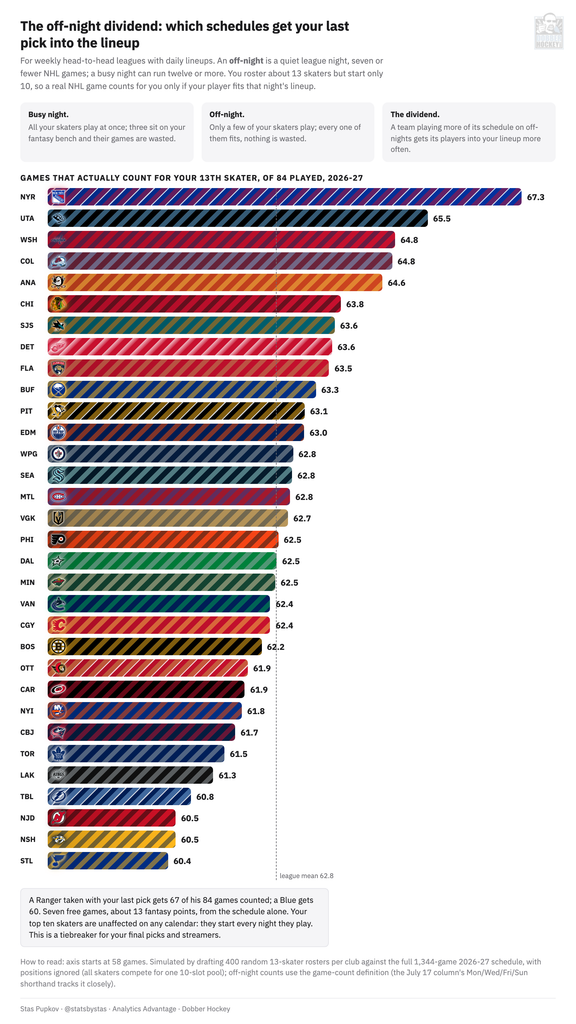
Figure 3
The other tax July mapped without pricing is the schedule, and it belongs to weekly head-to-head leagues with daily lineups. An off-night is a quiet league night, seven or fewer NHL games; a busy night can run 12 or more. You roster about 13 skaters and start 10, so a real NHL game only counts for you if your player fits into that night’s lineup. On a busy night your whole roster plays at once and somebody rides your bench while his real-life game evaporates. On an off-night, everyone fits.
Simulate that mechanic across the full 1,344-game 2026-27 schedule, drafting 400 random 13-skater rosters per club, and the dividend comes out in started games. Your 13th skater gets 67 of his 84 games counted if he is a Ranger and 60 if he is a Blue, with the Rangers, Utah, and Washington owning the three best calendars at about three started games over the league average. At a marginal skater’s scoring rate, the end-to-end spread is worth roughly 13 fantasy points.
The number that keeps this section honest is zero, which is what the calendar is worth to the top 10 skaters on your roster. They start every night they play, on any schedule. The off-night dividend prices your last two or three picks and your streamers, nothing above them. It is also worth re-checking every single draft season: the median team moved 4.9 points of off-night share year over year, and half the league moved at least five. One definitional note, since July’s piece counted Monday, Wednesday, Friday, and Sunday as the off-nights; this board counts actual slate size instead, and the two track each other closely, but the slate is what causes lineup conflicts, so the slate is what gets priced.
The playbook
1. Know your format. The plus/minus tax exists only where plus/minus is a category; points-league drafters can keep rule 6 and discard the rest.
2. For any player in a new jersey, throw out his old plus/minus (it forecasts at 0.09) and read his new team’s goal differential instead (0.34).
3. Fade last year’s number at both extremes: skaters staying on basement teams gained about eight units per 82, and skaters staying on juggernauts gave about eight back.
4. Buy the board’s tailwinds at their current prices – Kadri, Weegar, Eklund, and the Boeser class of reversion – and fade the mid-round good-team helpers, Marino, Toews, Moser, and the Hagel tier.
5. Leave the first round alone. MacKinnon’s tax costs him one rank spot; his other eight categories pay it easily.
6. Spend the calendar only on your final picks: a New York Rangers, Utah, or Washington Capitals skater in your last roster spot buys about three extra counted games, and your core gains nothing from any schedule.
The broader habit is worth keeping past this one category. Draft markets price what sits on a player’s page, and some of what sits there belongs to his environment: the jersey in plus/minus, the schedule in started games. Whenever the environment changes and the page has not caught up, a trade, a rebuild turning, a new calendar, the gap is free, and it stays free only until your league mates read the standings instead of the stat line.
Related Posts
Starting Goalies







Top Skater Views
 PHI
 T.B
 N.J
 L.A


Top Goalie Profile Views
| Players | Team | |
|---|---|---|
| JACOB FOWLER |
 MTL | |
| DANIIL TARASOV |
 DET | |
| DYLAN GARAND |
 NYR | |
| DEVON LEVI |
 EDM | |
| ALEX NEDELJKOVIC |
 S.J | |
LINE COMBOS
| Frequency |
EDM Players
| |
|---|---|---|
| 26.1 | VASILY PODKOLZIN CONNOR MCDAVID LEON DRAISAITL | |
| 25.1 | KASPERI KAPANEN ZACH HYMAN COLTON DACH | |
| 17.9 | OWEN MICHAELS MATHIEU JOSEPH ALEX FORMENTON | |
DobberHockey Podcasts

Keeping Karlsson: Never Tell Me the Podz
Elan and Brian do a wellness check on the Maple Leafs, lament Chicago and Buffalo snoozers, wonder whether and which Flyers have figured it out, and pick out the Capital standing out from the crowd.

Fantasy Hockey Life: Ep 505 Prospects With Plenty to Prove Part 1
Victor and Jesse return to talk about prospects with plenty to prove. This week it’s: Tij Iginla, Berkly Catton, Konsta Helenius, Zayne Parekh, Igor Chernyshov, Jett Luchanko, Axel Sandin-Pellikka, Artyom Levshunov, Michael Hage, and Carter Bear. Have a listen! Our show is part of the Dobber Podcast Network and sponsored by Fantrax.com. Email [email protected] and […]
Keeping Karlsson: Matchup Maximizer 2026/27 Week 4
Elan takes a look at the schedule for the upcoming weeks of NHL action and recommends players with good schedules that you should consider streaming in to win your head to head matchups.
Keeping Karlsson: Short Shifts – NHL Frozen Frenzy Recap
Elan and Lewis recap the Frozen Frenzy as well as two big returns and more!
Keeping Karlsson: Delusions of Garandeur
Elan and Brian dive into the latest NHL hot streaks, cold streaks, line changes, outjuries, injuries, buy-lows and sell-highs to give you top notch tips in your fantasy hockey league