

Analytics Advantage: Early Top Power Play Usage Tells Us Which Players are Worth Rostering
Stas Pupkov
2026-10-16
This week’s analysis covers the last 10 seasons, 2016-17 to 2025-26, and one question. After seven games, which signals identify a waiver pickup who will be a fantasy starter the rest of the way?
The answer is the first power-play unit. Forwards who were not fantasy starters the year before but were on PP1 after seven games became 12-team starters 34 percent of the time. Without PP1 the rate was 6 percent, and the gap held in all 10 seasons. A minutes increase on its own added little. Forwards whose ice time rose 1.5 minutes or more without a PP1 spot became starters 10 percent of the time. These are historical associations. Coaches also give PP1 to better players, so part of the gap is talent, but the unit is still the clearest early sign of which jobs last.
This week’s boards are built on that finding: who is on the first unit, who just lost it, and how often players in each spot have held their value.
The highest odds adds are Viktor Arvidsson and Kyle Palmieri. The upside adds are Jack Quinn and Ryan Leonard. The largest warning sign among rostered players is Matvei Michkov.
Who to add this week
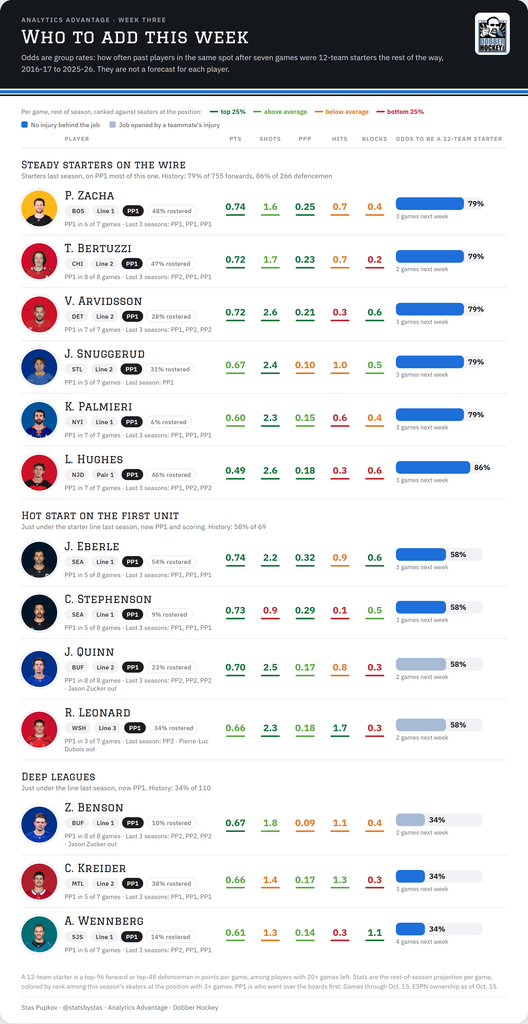
Figure 1: who to add this week, with the history odds for each player’s spot
The bar on the right is the odds, a group rate from past seasons and not a forecast for each player: how often a player in the same spot after seven games was a 12-team starter for the rest of the season, defined as a top-96 forward or a top-48 defenceman in points per game. The numbers are rest-of-season stats per game, the preseason projection blended with each player’s games so far, colored green to red against every player at the position. Under each name is the player’s PP1 games this season and power-play role in each of the last three seasons.
The highest-odds group is players who were fantasy starters last season and have been on the first unit for most of this one. 79 percent of players in that spot stayed starters, and the rate held between 71 and 86 percent in every season.
Arvidsson leads that group. Detroit has Arvidsson at about 19 minutes a night and 20 over the last three games, up from 14.6 last season, and on the first unit in every game. The 0.78 points per game last season came on the second unit. Arvidsson is on 28 percent of ESPN rosters.
Palmieri is on 6 percent of rosters. Palmieri was out first on all eight of the Islanders’ last eight power plays and had 65 percent of the team’s power-play time last season, so the role is established. Jimmy Snuggerud spent two games on the second unit in St. Louis and is back on the first unit for the last two.
Pavel Zacha and Tyler Bertuzzi are in the same group. Chicago plays twice next week, which limits Bertuzzi in weekly leagues. Luke Hughes is the defenceman in this group at 46 percent rostered, and defencemen in that spot stayed starters 86 percent of the time.
Anthony Cirelli also qualifies on paper at 25 percent rostered and 79 percent odds, but is left off the card. Cirelli has been on the first unit in three of Tampa’s seven games, trading the spot with Brandon Hagel, and had 24 percent of the power-play time last season.
The upside group is players who finished just under the starter line last season and are on the first unit with a hot start. 58 percent of players in that spot became starters. Quinn and Leonard both qualify, and both jobs are partly injury-driven. Quinn has been on PP1 since game one, and Jason Zucker, who held that spot last season, has not played. Leonard moved onto the first unit on Oct. 11, the first game after Pierre-Luc Dubois got sick, and Dubois is day-to-day. Both bars are the lighter blue for that reason. Buffalo and Washington both play twice next week. Chandler Stephenson in Seattle is the deep-league option at 9 percent.
The deep-league group is Zach Benson, Chris Kreider and Alexander Wennberg, all on the first unit after finishing just under the starter line last season. About a third of players in that spot became starters. A hot start would move any of them into the 58 percent group.
The lighter bars mark injury fills. Forwards who got the first unit because a teammate was hurt became starters 26 percent of the time, against 38 percent when nobody was hurt. Kreider took Ivan Demidov‘s spot in Montreal on Oct. 6, but Kreider held the first-unit job last season, so the card does not discount it. Off the card, Tyler Seguin is the clearest short-term fill. Seguin was on the second unit in Dallas until Wyatt Johnston got sick, and Johnston is listed back Saturday.
Who just moved on the power play
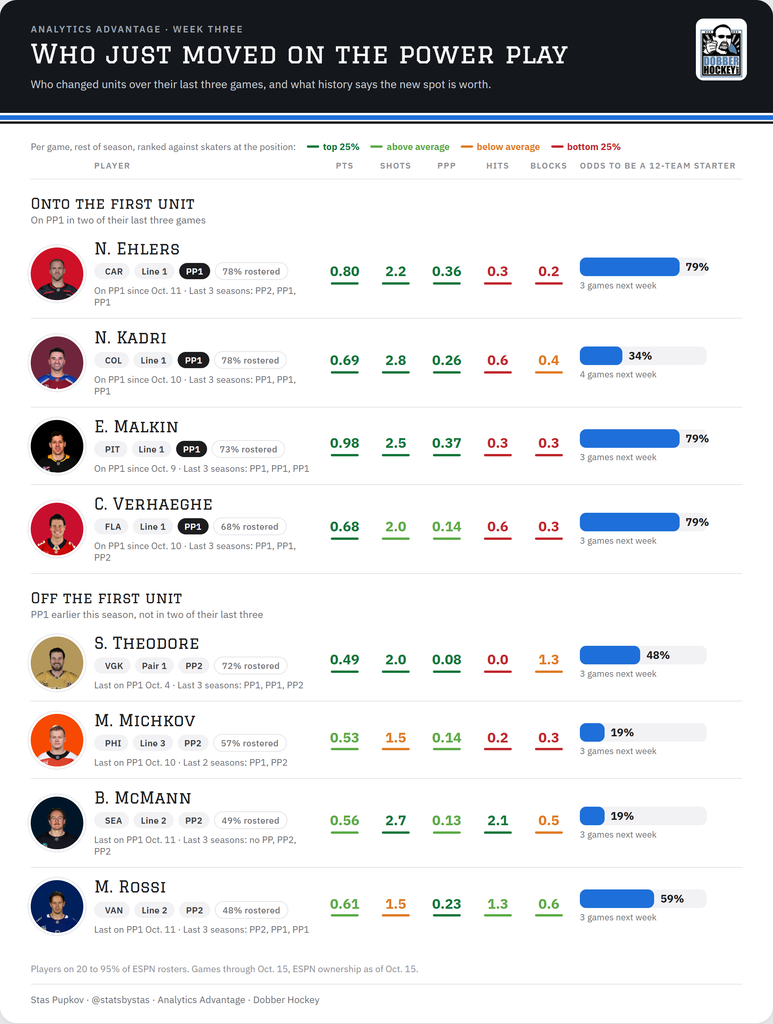
Figure 2: who moved onto or off the first unit, with each player’s power-play role over the last three seasons
Evgeni Malkin is back on Pittsburgh’s first unit for the last three games, out first on 10 of the last 11 power plays, after starting the season on the second unit. Malkin had 54 to 71 percent of the Penguins’ power-play time in each of the last three seasons, so this is a return to the usual role. Bryan Rust held the job last season, missed the first three games, and has been on the second unit since. Rust played 25 seconds of power-play time in Pittsburgh’s last game. Starters who lost PP1 this early stayed starters 59 percent of the time, against 79 percent for those who kept it.
Michkov carries the biggest drop. Michkov was on the first unit for Philadelphia’s first six games and on the second unit for the last three, with the spot rotating between Denver Barkey and Michael Bunting. On Thursday, Porter Martone, Tyson Foerster and Trevor Zegras went out first on both power plays. Michkov finished just under the starter line last season at 0.63 points per game, and players in that spot without PP1 became starters 19 percent of the time. Michkov is on 57 percent of rosters. Martone took Travis Konecny‘s spot on Oct. 10, but Martone plays on the fourth line at about 12 and a half minutes, and first-unit players who were not near the starter line last season and had no hot start became starters 20 percent of the time.
Marco Rossi moved to the second unit for Vancouver’s last two games, and Sam Bennett has been on the second unit in six of Florida’s eight games with Aleksander Barkov out. Both held the first-unit job last season, which puts both in the 59 percent group with Rust.
Injuries, and who benefits
The teams below lost a first-unit regular from last season to an injury longer than day-to-day. Each line shows who has the power-play spot now.
• Philadelphia, Travis Konecny, no timeline. Martone took Konecny’s spot on Oct. 10. Foerster has been on the first unit all season, with and without Konecny, and is on 3 percent of rosters.
• Los Angeles, Kevin Fiala and Mats Zuccarello. Alex Laferriere moved up the game after Zuccarello went out. Quinton Byfield has been on PP1 all season. Both are around 60 percent rostered.
• Winnipeg, Josh Morrissey. Neal Pionk moved onto the first unit on Oct. 7, the night Morrissey got hurt, and has held it with a hot start at 7 percent rostered. The history has too few comparable defencemen for reliable odds.
• Buffalo, Jason Zucker. Zucker has not played. Quinn and Benson have been on PP1 all season, and Ostlund since Oct. 6.
• Montreal, Ivan Demidov. Kreider took the spot on Oct. 6. Demidov’s timeline runs to about Oct. 20.
Anaheim, Carolina (Seth Jarvis), Calgary, Edmonton and Ottawa also lost one. The players who moved up there are either already on most rosters or were not starters last season and have not started hot, a spot with 20 percent odds.
The crease
Dylan Garand has started all three Rangers games since Igor Shesterkin‘s season-ending injury, and Joonas Korpisalo is out about three more weeks. Garand’s save percentage in those starts is .883, and Garand was pulled Thursday. Garand is on 54 percent of rosters. In Winnipeg, Stuart Skinner has five of the seven starts and Connor Hellebuyck has not played.
Season log
Week one’s add list has six of 12 players still in the role they were added for. The week-one power-play watch list held three of 10. Week two is at 10 of 12 after three games. The running list of every name and whether the job held is updated weekly.
The rule also holds year to year. Players who had PP1 the season before kept it into games 21 to 40 between 83 and 96 percent of the time in every one of the ten seasons. Players who had never held the first-unit job kept it between 41 and 69 percent of the time.
The injury clock
Dahlin could return Saturday in Montreal. Jacob Markstrom is likely back Wednesday in Ottawa. Samuel Montembeault’s timeline runs out next week. William Eklund is out 10 to 12 weeks in Ottawa, Ryan Poehling six to eight weeks in Anaheim, Jordan Staal one to two months in Carolina and Matt Duchene about three months in Dallas.
This week
• Add first: Arvidsson and Palmieri, starters last season on the first unit, in the 79 percent group.
• Add for upside: Quinn and Leonard at 58 percent, both partly injury jobs, both with two games next week.
• Deep leagues: Benson, Kreider and Wennberg at 34 percent.
• Watch if rostered: Michkov at 19 percent, Rust, Rossi and Bennett at 59 percent.
Method
PP1 and PP2 come from the NHL’s shift charts. For every power play of 15 seconds or more, the first unit is the five skaters most often on the ice when it starts, read over each player’s own last three games. The odds apply the same idea to every player from 2016-17 through 2025-26, as of each team’s seventh game, using each player’s share of the team’s power-play time. A player counts as a starter if they finished as a top-96 forward or a top-48 defenceman in points per game the rest of that season. Only players who played 20 or more of the remaining games count, so the odds assume the player stays healthy. The per-game numbers are the preseason projection blended with this season’s games, weighted by how fast each stat stabilizes. Ownership is ESPN’s percent rostered, injury notes are from Daily Faceoff, and next week’s games are from the NHL schedule. Weeks one and two measured value in Yahoo fantasy points. This week’s starter line uses NHL points per game.
Freshness sweep: 2026-10-16 (games through Oct. 15, injury news pulled after Thursday’s finals, ESPN ownership Oct. 15).
Related Posts
Starting Goalies







Top Skater Views
 DET
DET STL
STL CHI
CHITop Goalie Profile Views
 EDM
EDM NYR
NYR MTL
MTL S.J
S.J WSH
WSH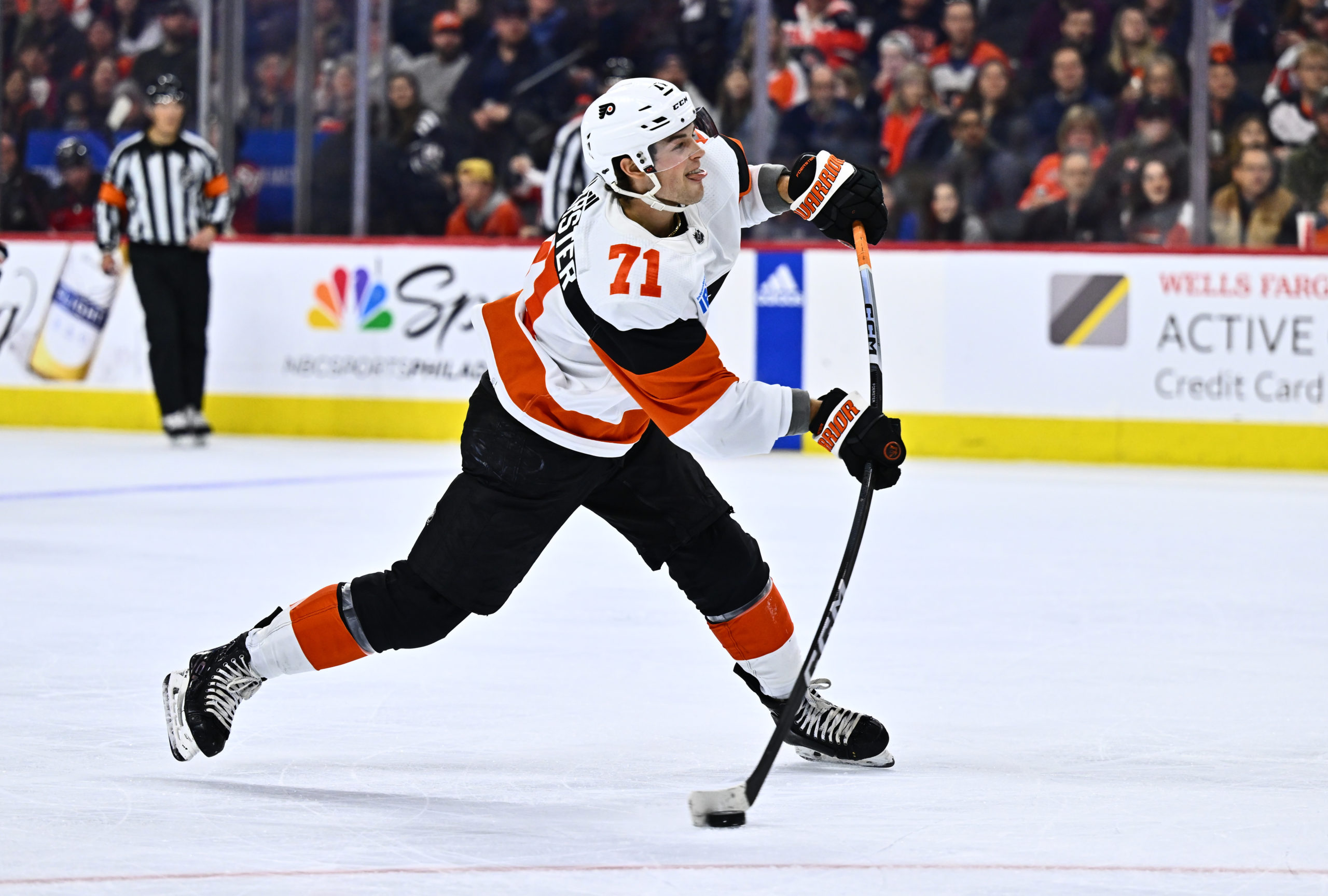


LINE COMBOS
| Frequency |
 BOS Players BOS Players
| |
|---|---|---|
| 26.1 | PAVEL ZACHA DAVID PASTRNAK MORGAN GEEKIE | |
| 20.2 | JJ PETERKA FRASER MINTEN MARAT KHUSNUTDINOV | |
| 15.9 | CASEY MITTELSTADT ELIAS LINDHOLM JAMES HAGENS | |
DobberHockey Podcasts

Keeping Karlsson: Short Shifts – NHL Frozen Frenzy Recap
Elan and Lewis recap the Frozen Frenzy as well as two big returns and more!
Keeping Karlsson: Delusions of Garandeur
Elan and Brian dive into the latest NHL hot streaks, cold streaks, line changes, outjuries, injuries, buy-lows and sell-highs to give you top notch tips in your fantasy hockey league

Fantasy Hockey Life: TiDy Takes Part 2
Last week, Victor Nuno and Ryan Downey broke down trades from our top tier dynasty league. This week, they consider some dynasty trades from other divisions. Have a listen! Our show is part of the Dobber Podcast Network and sponsored by Fantrax.com. Email [email protected] and ask to join our free discord. Join our Patreon at […]
Keeping Karlsson: Matchup Maximizer 2026/27 Week 3
Elan takes a look at the schedule for the upcoming weeks of NHL action and recommends players with good schedules that you should consider streaming in to win your head to head matchups.
Keeping Karlsson: Short Shifts – Sharks Looked Like Celebweenies
Elan recaps the major injuries, outjuries, game results and changed line combos that we’ve seen since Sunday’s mega-show.