

21 Fantasy Hockey Rambles
Dobber Sports
2026-11-29
Every Sunday, we share 21 Fantasy Rambles from our writers at DobberHockey. These thoughts are curated from the past week’s 'Daily Ramblings'.
Writers/Editors: Ian Gooding, Michael Clifford, Alexander MacLean, Puneet Sharma, and Dobber
___
1. Before the Philadelphia Flyers’ game against the Vancouver Canucks Friday, Elliotte Friedman reported that Matvei Michkov would miss the game due to a violation of team rules. Friedman did not disclose the nature of the team matter, but Daily Faceoff contributor Anthony Di Marco later mentioned that Michkov was scratched because of an altercation with teammate Porter Martone. (nov28)
On Saturday, one day after being scratched due to a team disciplinary matter, Michkov was not in the Philadelphia lineup with what the Flyers described as an illness. It’s easy to assume this is a coverup given the current situation with Michkov and the Flyers, but for now we have to take the team’s word on this. We’ll see if this is the end of this saga or if things continue to spiral out of control. (nov29)
2. It finally happened as the Detroit Red Wings traded Dylan Larkin to the Montreal Canadiens late on Sunday night. For a breakdown on the trade, you can read Ian’s take on the trade here.
As the resident Montreal fan among the editors at Dobber Hockey, I thought I’d weigh in here. It isn’t wholly surprising that Montreal took a big swing for the 2C they desperately needed, and I have no issue with trading prospects for impact players (more contenders should do trades like this), I just thought if Montreal traded Michael Hage, it would be for a genuine superstar like Jason Robertson or Robert Thomas. Then again, players have to be available in a trade to trade for them, and with so many no-move clauses across the league, the Canadiens’ options were probably limited.
From a fantasy perspective, this helps a lot of people. Per Evolving Hockey, Larkin had a 90th percentile expected goals-for impact on the power play from 2021-2026, and an 85th percentile impact on actual goals-for on the power play. It puts him among so very good company as far as driving shot quality and goals on the power play:

Montreal’s top PP unit has struggled greatly this season, and Larkin should be able to help with that immediately. (nov24)
3. To that end, someone is going to get the short end of the stick. Along with Larkin, Nick Suzuki, Cole Caufield, and Lane Hutson are automatics for a top PP unit role. That leaves one of Juraj Slafkovsky or Ivan Demidov on the second unit. Larkin typically played a bumper/net-front role on the power play in Detroit. Caufield and Demidov typically play on the flanks of Montreal’s power play setup, so that likely means one of Suzuki or Slafkovský is getting bumped off the power play. It won’t be Suzuki, so this means Slafkovský is a prime candidate to be moved to the second PP unit.
For his career, Slafkovský has gotten 37% of his goals from the power play. Last season, a full half of his goal total was with the man advantage. For sake of argument, let’s say that Slafkovský was going to score 30 goals this season. If we remove his likely PP goal total, that drops down to 20 goals or fewer. That doesn’t even get into the drop in assists, either. He might skate with Larkin at 5-on-5, and that’s a big improvement over Jake Evans or Alex Newhook, but it’s not near enough to make up for the (likely) drop in PP production. For posterity, one-third of Demidov’s career goal total is on the power play, so he’s not much better off than Slafkovský if Demidov is the one that loses top PP status. (nov24)
4. Assuming it is Slafkovský who loses the PP role, there might be no bigger winner here than Demidov. Not only would he keep his spot on the man advantage, but he also gets a huge upgrade at centre. Just for reference, since the start of the 2024-25 season, here is the 5-on-5 point production for Lucas Raymond with Larkin on the ice and then without Larkin on the ice:

Not saying that Larkin will boost Demidov’s 5-on-5 production by one-third, but it should rise, and that’s important. We will say what the lineup looks like and whether Slafkovský is moved back to the top line or stays on the second line, because if someone like Zach Bolduc or Alex Texier lines up with Larkin/Demidov, they should be in for a boost, too.
Lastly, Kirby Dach being sent to Detroit should open a spot on the 23-man roster for either Florian Xhekaj or Owen Beck. Whomever remains is likely to be a healthy scratch with some frequency, but only when the entire lineup is healthy. Beck has 70 hits in 38 career NHL games and Xhekaj has 40 hits in 15 career games. Fantasy managers in banger formats keep an eye out for who sticks around. (nov24)
5. There were several big returns on Wednesday night, starting with the Florida Panthers. Both Aleksander Barkov and Brad Marchand returned to the lineup after both missing several weeks due to injury. The Panthers did an excellent job staying firmly in the playoff race with those two key players out, and now they’re at full strength and ready to go.
Florida was victorious in their return, taking a 5-3 win at home to Ottawa. Barkov scored the empty-netter, while Marchand was a difference-maker in his return with three assists (one PP), six shots, two PIMs, and two hits. He did skate just 14:09, though.
Meanwhile, the Avalanche put the boots to the Canadiens in Cale Makar‘s return on Wednesday night by a 6-0 margin. Makar had a trio of assists, one of them on the power play, to go with four shots. (nov26)
In an injury-related matter earlier in the week, it was announced late Monday night that Chicago forward Connor Bedard would undergo shoulder surgery and is expected to be out for four months. In the first post-Bedard game, Frank Nazar skated nearly 20 minutes, over three minutes more than the next-closest forward. That includes top PP time, PK time, and he had the most EV time of all their forwards. (nov24)
6. With the NHL being off for Thanksgiving, there was no news or fantasy performance to write about. However, it is Black Friday, and we are now 30% of the way through the season. Fantasy managers on the fringes of head-to-head playoffs or championship contention need to make moves that can help push them over the hump. To help out those managers, let’s take a spin around the league and look for some good Black Friday deals, or skaters with less value now than they did two months ago, making them good trade opportunities.
We will be using data from Evolving Hockey or Frozen Tools unless otherwise indicated. We are using three stats to help guide us:
- Change in Individual Points Percentage (IPP) compared to the last two seasons. That is how often a player registers a point when they’re on the ice for a team goal.
- Change in points per 60 minutes.
- The size of the team logo refers to the change in shots on goal per shot attempt. The smaller the logo, the fewer SOG per attempt than normal.
Here are some players to think about trading for.
Adrian Kempe (Los Angeles Kings)
Kempe headed into the Thanksgiving holiday on a serious cold streak with zero goals and two assists in his last eight games. He is down to 9.8% shooting after posting six straight seasons of at least 11% with a three-year average of 14%. There is always a concern that losing Anze Kopitar as his centre has changed his value, but Kempe has also been on the unfortunate side of some luck here:
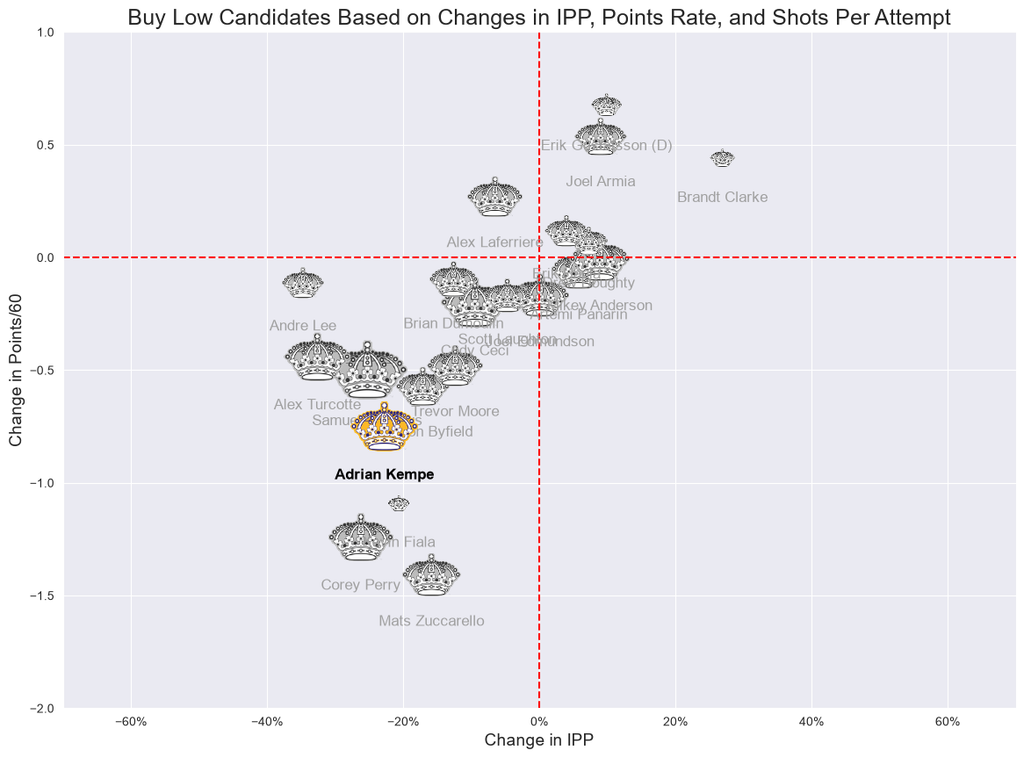
To this point, the Kings’ winger has registered a point on just 48.3% of goals scored with him on the ice. He has never played at least 60 games in a season with an IPP below 60%, and averaged 72% over the last three seasons. If his IPP were 70% this season, he would have 20 points in 21 games and would not be on our list.
Over the next five weeks, the Kings have the easiest schedule in the league by opponent points percentage (.497) with those teams giving up the most goals against per game. It seems reasonable that after an unlucky start, Kempe starts to look more like himself as the Kings work their way through a very favourable portion of the schedule. The buy-low window that exists today probably won’t exist a month from now, so this is the ideal time to check in on Kempe’s price in a trade. He should be acquired as if he will be a top-50 forward in multi-cat formats the rest of the season but shouldn’t cost that in a swap. (nov27)
7. Porter Martone (Philadelphia Flyers)
One month ago today, I had a Ramblings listing Flyers forward Tyson Foerster as a buy-low opportunity. Since then, Foerster has 10 points in 14 games with 30 hits and 9 blocks. Even the Flyers can give us profitable trade opportunities.
There was a lot of hype around Martone heading into the season, but it’s taken him 27 games to register 10 points, or his total in just nine games last year. He has a much smaller sample to work with, but he is registering a point on fewer than 46% of goals scored with him on the ice compared to 84% at the end of last season:
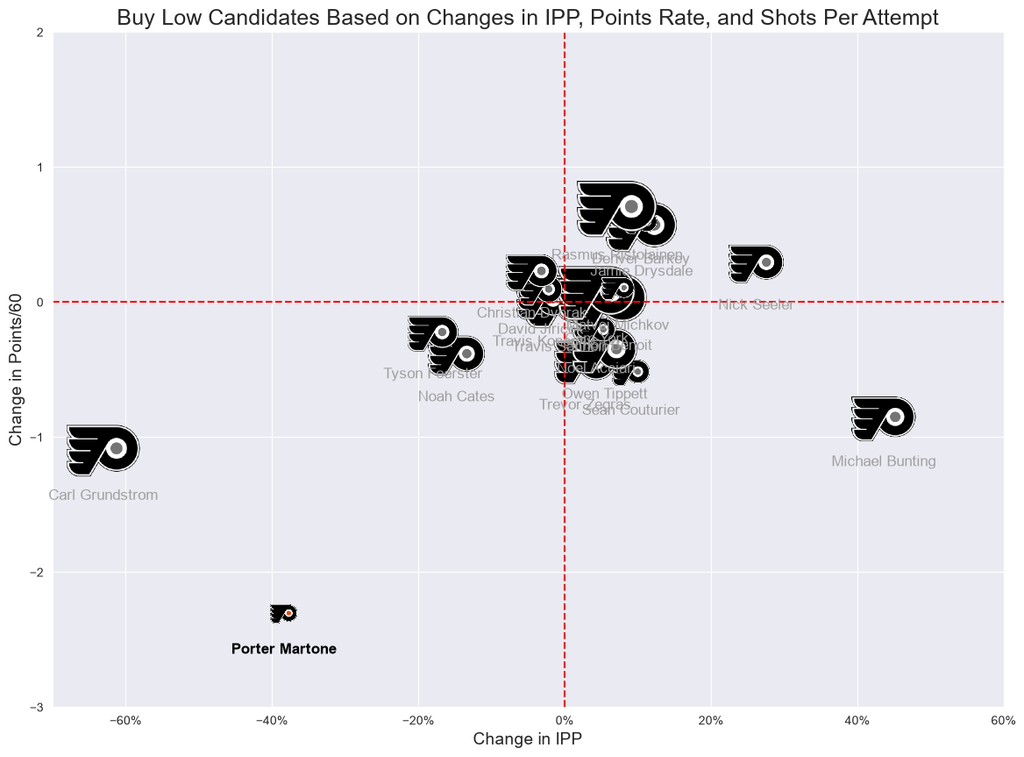
The reasons for acquiring him are two-fold here:
- 246 forwards skated 1000 minutes last season and just 10 of them (or about 4%) finished with an IPP under 50%. Martone is on pace for nearly 1200 minutes.
- He has landed just 43.5% of his shot attempts on target – the league average among forwards is about 51%.
We do have to admit there’s just a chance he got hot at the right time last season and won’t come close to replicating that value this season. Also, the Flyers aren’t a very good offensive team. Regardless, he won’t stay this unproductive as long as he’s an NHL regular and the Flyers have the third-easiest schedule in the league over the next five weeks. (nov27)
8. Oliver Moore (Chicago Blackhawks)
This is a guy who can probably just be had on the waiver wire, and he is an acquisition aimed at deep leaguers (his ownership is 0% on both Yahoo/ESPN and 24% on Fantrax). However, he has a point on just 50% of the goals scored with him on the ice compared to 76.6% across his first two partial seasons, and a career average of 69%:
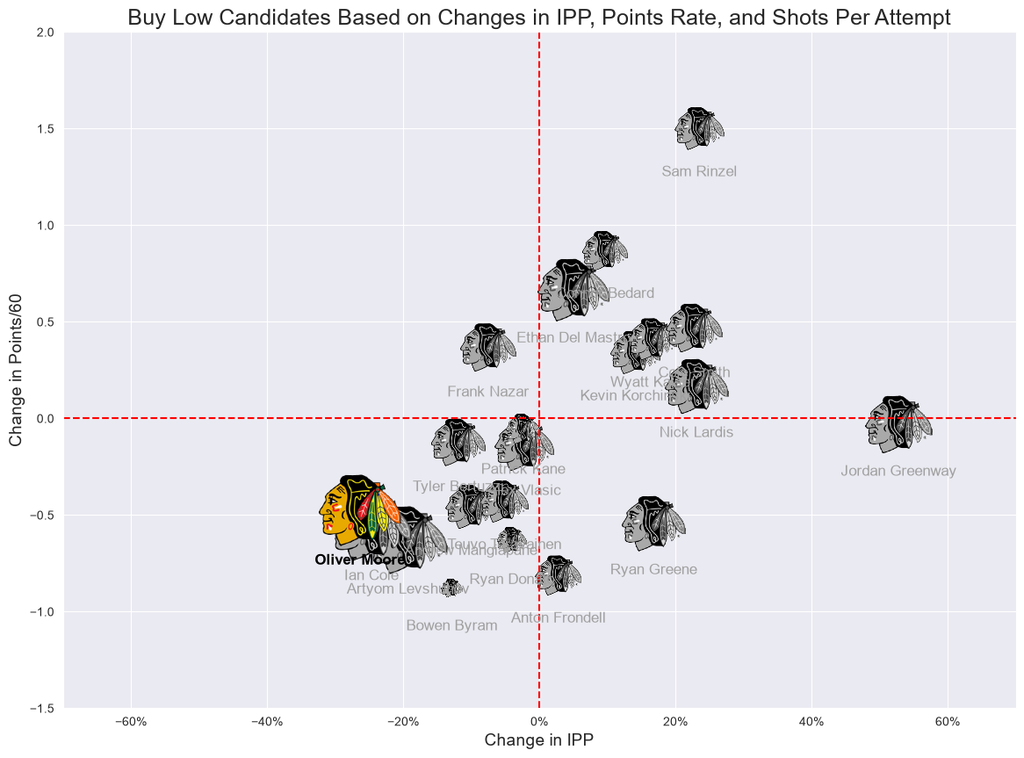
He should probably have 8-9 points rather than six.
That isn’t heavy production, but his ice time has increased over the last month, and he’s found a home on a good second scoring line with Patrick Kane and Frank Nazar. That trio leads all Blackhawks forward lines this season in shots and expected goals per 60 minutes (per MoneyPuck).
The additional ice time leaves Moore around 14 minutes a game and he’s still on the outside of the top PP unit looking in. However, he now has a role and the line mates to be a 0.5 points per game player, and he can even add a half-hit per game (or more). Deep leaguers should take notice here. (nov27)
9. Shea Theodore (Vegas Golden Knights)
Without top power-play time, Theodore’s offensive upside is capped. For a guy with five hits in his last 118 regular season games (seriously), that lack of offensive upside really hurts his multi-cat value. Keep that in mind when poking around for a trade.
With that said, there should be a huge turnaround coming from the talented blue liner. To this point of the season, he has registered a point on fewer than 23% of the goals scored with him on the ice at even strength. He has been above 44% for eight straight years prior to this and has a two-year average over 51%. The changes are obvious:
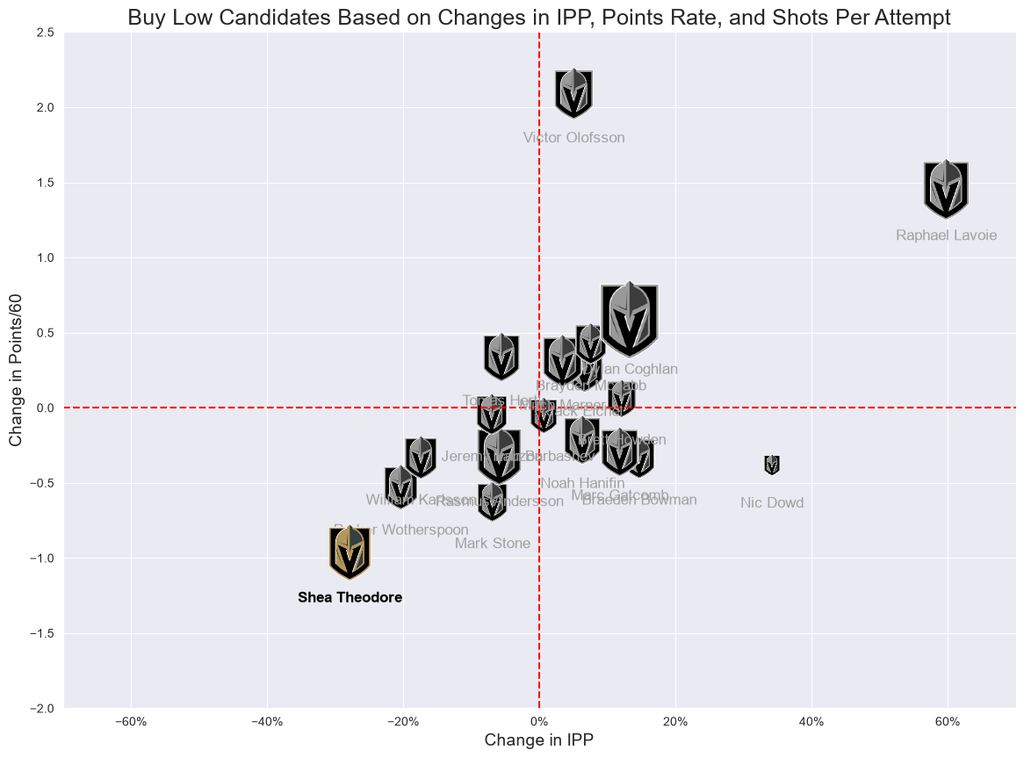
Even without the top PP time, there is a good case that his points total (10 in 26 games) should be twice as high as it is. Theodore typically averages one primary assist at even strength every four games, but he has zero such assists in 26 games this season. There is just a lot of bad luck going on and he should be considerably more productive over the balance of the season.
For even more good news: Vegas’ remaining 58 games have an average opponent points percentage of .548, tied for the fifth-easiest schedule on the board. (nov27)
10. Jordan Spence (Ottawa Senators)
The peripherals for Spence have been solid this season with 22 shots, 23 hits, and 33 blocks in 26 games. There is room for improvement in the shot rate though as he’s managing a shot on goal on less than 28% of his shot attempts against a two-year average of 36%. It has probably cost him about 6-7 shots, or about 20 shots over a full season.
Then there is the point production. In his three full seasons, Spence has registered a point on at least 41% of goals scored with him on the ice in each campaign, giving him a two-year average near 45%. So far this season, that is a paltry 17.8%:
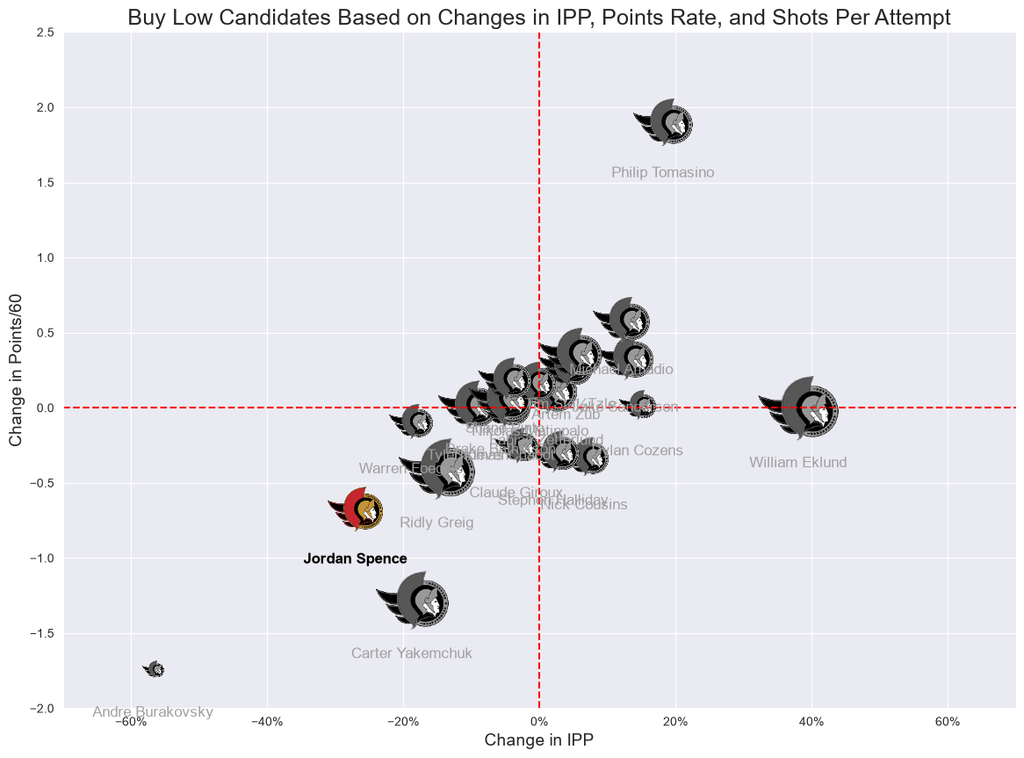
An IPP more in line with his career production would have him around 13 points in 26 games, or over a 40-point pace. That highlights just how much room there is to grow in his point total in addition to some more shots heading his way.
Spence has added nearly two minutes per game to his average from last season and is routinely in the 18- to 21-minute range. With solid peripheral production and more points in the offing, he makes a very solid buy-low option. (nov27)
*
As a bonus, managers needing a goalie should at least consider Darcy Kuemper from Los Angeles. To this point of the season, he has a .724 save percentage on the penalty kill. He has never had a season with a PK save percentage under .815 and the only regular starter in the league last season under .810 was Vancouver’s Kevin Lankinen (.777).
Across his first two seasons with Los Angeles, Kuemper’s PK save percentage was .854. If he had that PK save percentage this season, he would have allowed 6-7 fewer goals. That would push his overall save percentage from .891 to .907 and drop his Goals Against Average from 3.05 to 2.61. Once his penalty kill turnaround hits, Kuemper should be a viable second goalie in most fantasy formats and, as mentioned in the section on Kempe, the Kings’ upcoming schedule is very favourable. (nov27)
11. At time of writing: We’re just about at the American Thanksgiving break, and it's a good time to take a look at the team stats, and see what we can learn and adjust from our own expectations based on a sample size that has started to normalize. Typically, U.S. Thanksgiving is also used as a barometer for playoff teams, where at least 75% of teams on any given year that are in the playoffs at this stage in the season, end up making the playoffs at the end of the year. If your team is on the outside looking in right now, it might be time to panic.
Starting in the East, we have a pretty clear line between the haves and the have-nots. There is a three-point gap between ninth and 10th in the standings, where every team above that line has a positive goal differential mark, while every team under it has a double-digit negative goal differential.
The defending champ Carolina Hurricanes are still rolling, with an 18-3-3 record, a goal differential of +45 (100GF and only 55GA) to go with a per-game shot difference of +12.0. That’s more than an average full period’s worth of offence that the Canes are outplaying teams by in the same 60 minutes. Just running most groups completely out of the building. When they inevitably add a top-line winger to supplant William Carrier on the top line, they are going to be nearly impossible to stop. (nov25)
12. The Bruins are a bit of an interesting team to try and figure out in the top half of the conference. They are the only team in the top seven with a negative shot differential, but they also hold the second-best goal differential in the conference. They have received excellent goaltending paired with some high shooting luck, and despite that the goal difference hasn’t quite translated into the number of wins that one might expect. There’s a decently easy case to make that the Bruins deserve to be higher or lower in the conference, which usually means they’re in about the right spot, and momentum should help keep them right there.
If one team is likely to jump from the bottom group to the top one, it would be the Washington Capitals who have been running on a string of bad luck, with a below average shooting and save percentage. They are almost fully healthy, and getting Rasmus Sandin back soon should also help stabilize things in net where Logan Thompson has taken a big step back from last season. They are seven points out of a playoff spot at the moment, however part of that is due to having played only 21 games, while the teams immediately above them have played anywhere from 23 to 26 games. (nov25)
13. Moving over to the West, where there is a larger range between the extremes in the standings, as Minnesota sits atop the NHL with 41 points (though still behind Carolina by win percentage) and Vancouver trails behind the rest of the league by a decent margin, with only 13 points through 26 games. In the middle, the playoff bubble line of 27 points is exactly the same as in the East, with an identical gap of three points down to the 10th place team at 24 points.
Like Washington in the East, Seattle has played only 21 games, which puts them on par with the playoff bubble teams by winning percentage, so they’re surprisingly still in the race as well despite sitting 11th in the conference at the moment. They could be a nice team to stack a few players from to A) add some game volume, and B) because they may be playing meaningful games later into the season than most people expect. (nov25)
14. Looking at the goal differential column, the top seven teams are positive, and the bottom nine teams are in the negatives. Pretty much as it should be. However, there are some quirks when it comes to the Colorado Avalanche and San Jose Sharks. The Avalanche are plus-22 across 23 games, but they only hold a 13-7-3 record. That means that they have somehow achieved a record that is barely above .500 despite averaging a full extra goal per game than their opponents. To me that says that they are due for more wins, but it doesn’t account for Nathan MacKinnon missing the next three months, so that may balance out.
For the Sharks, they’re in the opposite boat, with an 11-13-2 record (again reasonably close to .500) yet they are minus-23 across their 26 games. Either their goaltending is going to find some consistency, or it is going to be their downfall through the remaining two-thirds of the season.
In the West, four of the top eight teams are operating with a negative shot differential, and other than for the Oilers, that is a pretty clear line between those with Cup aspirations (those with positive ratios) and those without. The Utah Mammoth are in an interesting spot though, with a negative goal differential, but the best shot differential in the conference. They have some solid systems, that just haven’t translated fully into goal differential results yet. Now that they’re getting back to full health, they may be able to climb up the standings. (nov25)
15. Mitch Marner‘s season so far still feels a little disappointing, but after a slow start he has gotten back on track to the tune of a 103-point-pace (28 points in 21 games). He is also shooting more than he did last season too. His shot rate is actually the highest it has been since his career-high scoring pace season when he was on track for 113 points in 82 games. Most of the jump in production this year can be attributed to his power play production, where he already has 15 points (pacing for over 50 on the season. That will slow down, but as he’s seeing four minutes per game with the man advantage, a season total of over 40 PPPs is still very possible. In fact, the high PPPs are masking that Marner has been extremely unlucky thus far, and should be due for a few more even strength points the rest of the way. Not quite a buy-low, but maybe still a buy option. (nov25)
16. Still with Vegas, defensemen Rasmus Andersson and Jeremy Lauzon are both getting absolutely caved in and they’re not even the ones taking the heavy or difficult minutes (that would be Shea Theodore and Brayden McNabb who are thriving with the responsibility). It will be hard to do anything with Andersson’s contract, so I wonder if Lauzon gets shipped off or otherwise replaced by the trade deadline as Vegas looks to shore up one of their weaknesses. (nov25)
17. Frederik Andersen is due back for the Oilers in the next month or two, which may complicate things for a short time, but it may also make one of the three goalies expendable. The easiest answer is that Tristan Jarry isn’t as needed, as Andersen brings the playoff experience, while Devon Levi brings the youth and should be a 50+ game starter for the Oilers in a couple of years (maybe as early as next season).
Moving Jarry’s contract out could also free up some very useful cap space for the Oilers to take advantage of at the trade deadline. He only has this year and next on the deal, which pays him a bit more than $5 million a season, and that amount is certainly moveable as a camp dump return in a trade. However, as we entered Saturday action, while Levi held the better record of 10-4-0 compared to Jarry who was at 6-2-4, Jarry’s numbers were noticeably better, with a higher sv% and GSAA number. This shows that Jarry has been better in his minutes than Levi, but just hasn’t received the same timely offensive support to go with it. He’s a risky hold at this point, but at the same time most GMs also aren’t going to want to pay for his risk and inconsistent history either. (nov25)
18. Keeping up with his weekly take, these players were Puneet Sharma's Monday Waiver Wire Targets:
Adam Fantilli (C) – 47% owned
Normally, I'd be hesitant to start Adam Fantilli based on how his season has gone so far. However, his underlying numbers have been pointing toward a turnaround, and it felt inevitable that the production would eventually follow, especially with Kent Johnson, who I also mentioned in my waiver targets a few weeks back in my Ramblings, skating alongside him. Through 21 games, Fantilli has seven goals and four assists for 11 points, putting him on a 44-point pace after finishing with 59 points last season. The encouraging signs are there, with increased 5-on-5 ice time, prime power-play deployment and a shooting percentage below his career average, all pointing toward some positive regression. He's finally starting to turn the corner with four points (2G, 2A) over his last two games. Now is a good time to grab him before the production catches up. (nov23)
19. Logan Mailloux (D) – 15% owned
Logan Mailloux is starting to make some noise in St. Louis and is worth keeping an eye on as a potential waiver-wire addition, particularly in deeper leagues. Mailloux has put up a strong stretch recently with eight points (2G, 6A) in his last five games including a pair of three-point performances. His 19 minutes of ice time per game is encouraging for a young defenseman looking to establish himself at the NHL level. The power-play production is also limited, with just one power-play assist, so I wouldn't expect him to suddenly become a major offensive contributor especially with Broberg ahead of him. That said, the increased ice time and recent offensive involvement make him someone worth looking at. He's more of a speculative add for now, but there could be more here to keep him on your radar. (nov23)
20. Berkly Catton (LW/RW) – 7% owned
Don’t look now, but Berkly Catton has been promoted to Seattle’s top line alongside Jordan Eberle and Bobby McMann. While he's still skating on the second power-play unit, the move to the top line is certainly worth noting, and you really can't ask for much more from a waiver-wire pickup. He hasn't played a ton of NHL games yet, but that should not stop you from riding the wave while the opportunity is there. Clearly, Seattle sees him as someone capable of handling the increased deployment, otherwise he wouldn't be getting the opportunity in the first place. Most of Catton's underlying numbers suggest some regression is likely to come, but that doesn't mean you can't take advantage of the situation while it lasts. (nov23)
21. Danila Yurov (C) and Maxim Shabanov (RW) – 5% and 10% owned
Before getting into Danila Yurov, I'll quickly revisit Maxim Shabanov, who I've already included as a waiver-wire pickup before. He’s still worth a look, especially for managers looking for some power-play upside. Shabanov has nine goals and five assists for 14 points through 24 games, including five power-play goals, while skating on Minnesota's top unit alongside Kirill Kaprizov, Matt Boldy and Quinn Hughes. That kind of power-play deployment is hard to pass up, and he's already shown he can take advantage of the opportunity. His 25% shot rate is certainly high and will likely come down, but the role alone makes him worth a shot especially with Minnesota being the only NHL team playing on all off-nights this week.
Danila Yurov is another Minnesota forward to monitor, although he's more of a deeper-league option for now. He has nine goals and two assists for 11 points through 25 games, averaging just over 15 minutes of ice time per game. The goal scoring is encouraging, but the lack of assists and limited power-play involvement are holding back his fantasy value. He's primarily been in a middle-six role and hasn't cracked Minnesota's top power-play unit, which is difficult to break into given the talent ahead of him. There is still room for his offensive game to develop, and increased deployment could make him more appealing. (nov23)
——-
Have a good week, folks!
Thanks for continuing to support the website and if you’re bored and need a fantasy hockey fix – visit the gang in the forum here.
Related Posts
Starting Goalies



Top Skater Views
| Players | Team | |
|---|---|---|
| STIAN SOLBERG |
 ANA | |
| JIRI KULICH |
 BUF | |
| SIMON NEMEC |
 CGY | |
| T.J. HUGHES |
 COL | |
| RYAN LEONARD |
 WSH | |
Top Goalie Profile Views
 MTL
 NYR
 PIT
LINE COMBOS
| Frequency |
 CAR Players | |
|---|---|---|
| 21.1 | JORDAN STAAL JORDAN MARTINOOK SETH JARVIS | |
| 20.9 | LOGAN STANKOVEN TAYLOR HALL JACKSON BLAKE | |
| 17.7 | ANDREI SVECHNIKOV WILLIAM CARRIER SEBASTIAN AHO | |
DobberHockey Podcasts

Fantasy Hockey Life: Prospect Stock Watch
The Journey features 10 rising prospects this week. Jesse and Victor discuss Ryan Roobroeck, Vladimir Dravecky, Beckett Hamilton, Jack Berglund, Markus Ruck, Adam Novotny, Chase Harrington, Alex Elofsson, Egor Shilov, and Owen Griffin. Have a listen! Our show is part of the Dobber Podcast Network and sponsored by Fantrax.com. Email [email protected] and ask to join […]

Keeping Karlsson: Matchup Maximizer 2026/27 Week 10
Elan takes a look at the schedule for the upcoming weeks of NHL action and recommends players with good schedules that you should consider streaming in to win your head to head matchups.
Keeping Karlsson: Short Shifts – Thanksgiving Episode
Ryan Downey romps through the league after a busy Wednesday night of NHL action on this Thanksgiving episode of Short Shifts.
Keeping Karlsson: Dylan Goes Québectric
Elan and Brian serve up their instant takes on the live-breaking Dylan Larkin deal; also, IR stashes gone wrong, a mess of new injuries, and everyone puts up numbers against Anaheim.
Fantasy Hockey Life: Scout’s Tout
On today’s Scout’s Tout, Jesse and Victor give reports on draft eligibles: Landon DuPont, Dima Zhilkin, Nazar Privalov, Sergei Skvortsov, Carter Meyer, Sammy Nelson, and Diego Gutierrez. Then we turn to Michael Misa, JP Hurlbert, Ryan Brown, Viggo Bjorck, Xavier Villeneuve, and Michael Hage. FHL Scout reports by: Sasha, Kara, Tomer, Mike M, and Kendrick, […]