

Eastern Edge: Power-Play Problems for Marchand, Verhaeghe, Knies, and DeAngelo; Goaltending Competition in New Jersey and Pittsburgh
Khurram Sher
2026-07-07
Honored to be getting the chance to share fantasy hockey insights here. I’m a long time DobberHockey reader, so getting the call up to the big leagues is very exciting for me. In grade 2, I got in trouble with Mrs. Hirsch because the only topic I ever wrote about in my journal entries was what happened in the NHL. It took a few decades but I finally found my safe space here.
I also incurred the anger of Mrs. Hirsch when I lost my pencil and was using a black pencil crayon to write in my journal for weeks before she finally noticed. I would say it was an ingenious life hack, but she would disagree.
Enough of the traumatic life stories, there are important matters at hand. There is a lot to unpack from the bustling summer activity in the NHL including a plethora of signings and trades.
Before free agency even began, Florida Panthers GM Bill Zito stole the spotlight with the sudden acquisition of winger Brady Tkachuk. The lineup here looks to be set as the Panthers have just $372k in cap space remaining. Much has been made of this daunting forward group and how this will be a great situation to harvest fantasy production. However, I will suggest a couple of forwards that will do the opposite and disappoint.
The first one is a winger that was over a point per game last year. Brad Marchand had a sudden resurgence producing 54 points in 52 appearances before an injury forced him to miss games sporadically in January, February, and March. Ultimately, Marchand didn’t end up requiring surgery and is on track to be ready for training camp.
Marchand is now 38 years old, but that is not the only reason a decline is expected:
- His shooting percentage of 19.6% was well over his career average of 15.3%.
- Due to all the injuries amongst the forward group, Marchand got more power play time than expected: 61.5% to be precise. This year, that number should drop to below 50%, as the top unit will likely be composed of the Tkachuk brothers, Aleksander Barkov, Sam Reinhart and a defenseman (likely Seth Jones).
- His secondary assist percentage (48.1%) was his highest in nine years.
- His average time on ice (17:44) was his lowest in 11 years. That doesn’t look like it will improve either, as he is pencilled in on the third line with Eetu Luostarinen.
- Usually he averages over one hit per game; however, that too fell off last year to 0.69 hits per game.
Before his sudden jump to 1.04 points per game, he was slowly declining each season from 1.14 to 0.92 to 0.82 to 0.72 points per game. The impending statistical drop off might be significant for this Olympian.
The other forward who appears to be banished to the second power play unit is Carter Verhaeghe. He already had a difficult time gaining the trust of coach Paul Maurice but at least he is slated to start the season on the second line with Sam Bennett and Matthew Tkachuk. Maurice also doesn’t deploy Verhaeghe on the penalty kill, something the Panthers might do a lot of considering their roster includes the likes of Gudas, Bennett, Marchand, and the Tkachuk brothers. Florida was 3rd in the league in PIM (912) and that was without this summer’s bellicose additions of Radko Gudas and Brady Tkachuk. Though, to be fair, AJ Greer has departed west to Anaheim. He was sixth in the league in PIM (113).
Another right-handed defenseman that received $9 million – but over 2 years, instead of 6 years like Gudas – was Tony DeAngelo, who re-signed on Long Island. With Matthew Schaefer ahead of him on the depth chart, DeAngelo will get to quarterback the second power play unit.
Expect the former Max Kaminsky Trophy winner (most outstanding OHL defenseman) to hover between 0.45-0.50 points per game. In the 2026 calendar year, DeAngelo upped his scoring to the tune of 22 points in 36 games (0.61 ppg), and almost matched Schaefer's PTS/60 (1.8 vs 1.9).
Speaking of Max Kaminsky Trophy winners, Darren Raddysh strangely left a warm weather, no-state-tax team and headed north to join his hometown Toronto Maple Leafs. (The last time he played for Toronto it was with the Marlboros U-18 AAA team in 2012-13.) Raddysh started the season with just three points in his first 11 games, meaning that in the last 62 regular season games he was actually above a point per game (1.08), recording 67 points. Leaving the team that had the fourth most goals for (Tampa Bay, 290) will undoubtedly hurt Raddysh, but joining the likes of William Nylander and Auston Matthews on the top power play will cushion that blow. Emil Andrae looks like he will man the second power play unit.
It is still early to speculate, but if John Tavares and Gavin McKenna round out the rest of that power play, then it is Matthew Knies that will see a less productive fantasy deployment. This could be why Knies’ name continues to swirl in trade rumours because GM John Chayka foresees Knies’ reduced offensive opportunities, and wants to improve other areas on the Leafs.
Other than losing Maxim Shabanov, David Rittich, and Anders Lee (and adding Matias Maccelli, Matt Kessel, and Vitek Vanecek) the Islanders come back with essentially the same team as last year. None of these additions and subtractions appear to be of significant fantasy relevance. The bigger upheaval will be next season when the Isles have at least $30 million in cap space opening up.
One player who gained value after coming to the Islanders last year is Brayden Schenn. He got power play one usage in New York that he wasn’t getting in St. Louis. Schenn’s points per game jumped from 0.46 (Blues) to 0.58 (Islanders). If you need a center in deeper leagues, he could be a player of interest in the later rounds of your draft.
After dealing Jacob Markstrom to Florida, I was under the impression that the New Jersey Devils would be looking for a No.1 goalie. New GM Sunny Mehta, however, has expressed confidence in 26-year-old Nico Daws, saying that Daws has been “a pretty big prospect” and that “he hasn’t really had the path to develop”. Daws already has 5 seasons with the Utica Comets (AHL) under his belt, and his NHL career spans 55 games with a record of 24-24-1-1, a save percentage of 0.898%, and a GAA of 2.96. Mehta added “we’re pretty excited about the potential opportunity in front of him”. His crease competition will be veterans Jake Allen (0.904%) and David Rittich (0.894%). Just keep in mind that goalies are unpredictable: Allen’s GSAx fell to +6.3 from +18.4 the year before. Rittich meanwhile improved his GSAx from -11.4 to +4.2.
It is possible that Mehta’s bright outlook on Daws could be posturing to show other GMs that he in fact is not in need of a more proven goaltender.
Other than John Chayka, who spent $21M over three years for Sergei Bobrovsky, the two other analytically inclined general managers (Sunny Mehta in New Jersey, and Eric Tulsky with the Carolina Hurricanes) have chosen not to invest big money in goal. This may be a potential strategy to emulate for fantasy managers. Both the Hurricanes and the Devils are spending $3.9M on their goaltending.
In Carolina it is split between Pyotr Kochetkov ($2M) and Brandon Bussi ($1.90M), while in New Jersey it is split in three: Jake Allen ($1.8M), Nico Daws ($1.1M), and David Rittich ($1.0M). These could be great targets if you are attempting a zero G draft strategy, as other fantasy GMs will likely fade these goalies. Pyotr Kochetkov has been all but forgotten after missing most of the year.
The Pittsburgh Penguins just signed Arturs Silovs ($2.8M x 1 year) and Joel Blomqvist ($875k x 2 years). They also have Sergey Murashov ($886k x 1 year), who is viewed as part of the future in Pittsburgh. He handled himself well in the AHL regular season (0.919%) and played even better in the Calder Cup playoffs (0.931%). Blomqvist and Murashov are both waiver exempt, but both should get a taste of NHL action in 2026-27.
Goaltenders potentially available in a trade include Connor Hellebuyck, Samuel Montembault, Jordan Binnington, Elvis Merzlikins, and Adin Hill. These experienced goalies come with a not so insignificant cap hit, and at this point I don’t really see any team in the East that needs goaltending enough to give up assets for them or to take on their cap hit.
The more likely fantasy relevance might come from goalies that are still unsigned on the free agent market: Connor Ingram and to a lesser degree Cam Talbot. Talbot turned 39 on Sunday (July 5) and had a terrible season (-13.1 GSAx). From October to December inclusive, his save percentage was 0.889%. January onwards it cratered further to 0.872%. He was stapled to the bench in 2026, starting only 7 games. As hard as it is to imagine him getting an NHL contract, there is hope, because….
The Ottawa Senators may have been looking at the GSAx chart upside down as they signed both Sam Ersson (-17.3) and Leevi Merilainen (-16.5). Moreover, both got a salary raise. Neither is worth owning in fantasy unless Linus Ullmark has health issues. With Ersson backing up Ullmark, the Minnesota Wild won’t be the only team with a Swedish tandem.
***
Goals Saved Above Expected numbers from MoneyPuck. Player usage data from Frozen Tools.
Follow me on X/Twitter here: @KmanHockey_DH
Related Posts

Starting Goalies













Top Skater Views
 WPG
WPG S.J
S.J OTT
OTT ANA
ANATop Goalie Profile Views
 PHI
PHI T.B
T.B UTA
UTA EDM
EDM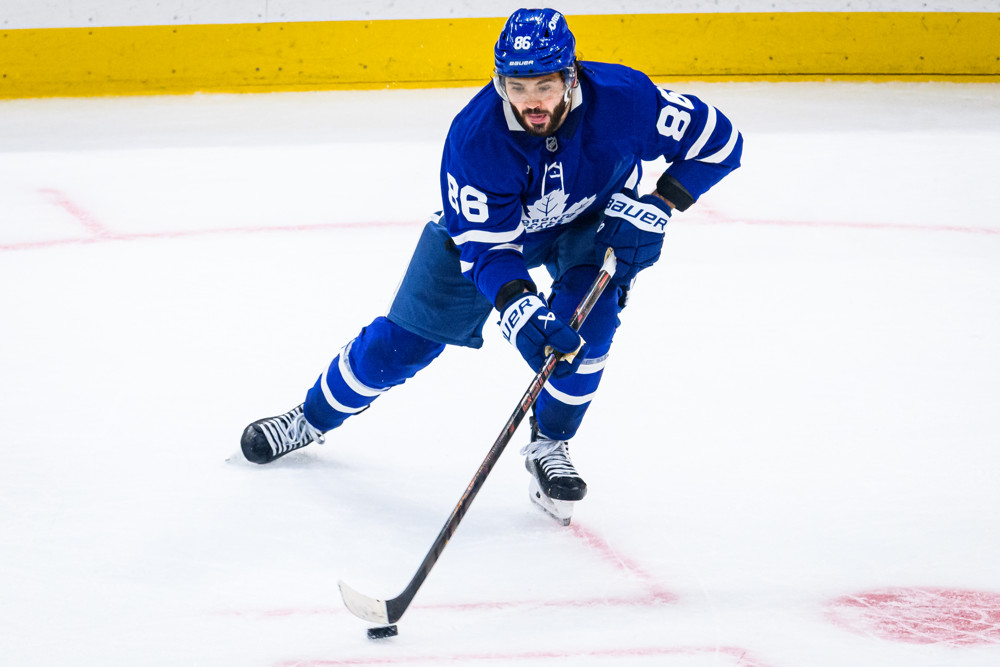

LINE COMBOS
| Frequency |
 SEA Players SEA Players
| |
|---|---|---|
| 23.4 | MACKIE SAMOSKEVICH JARED MCCANN MATTY BENIERS | |
| 22.5 | CHANDLER STEPHENSON BOBBY MCMANN JORDAN EBERLE | |
| 20.6 | SHANE WRIGHT KAAPO KAKKO BERKLY CATTON | |
DobberHockey Podcasts

Keeping Karlsson: Cole, There’s No Time!
Elan and Brian cover all the action from the first week of the NHL season, and identify our earliest must-adds, can-drops, sell highs and buy lows in your fantasy hockey leagues.
Keeping Karlsson: Matchup Maximizer 2026/27 Week 2
Elan takes a look at the schedule for the upcoming weeks of NHL action and recommends players with good schedules that you should consider streaming in to win your head to head matchups.

Fantasy Hockey Life: Tidy Takes Part 1
TiDy Admiral Ryan Downey and Victor Nuno break down recent trades in the FHL Tiered Dynasty’s top division, the Lord Stanley division. Tune in to consider trades between some of the best dynasty sharks we know, including patron polls on the trades and Victor’s analysis. Have a listen! Our show is part of the Dobber […]
Keeping Karlsson: Short Shifts – I Tried to be Like Parker Kelly
Elan is joined by Ryan Downey for the premiere of season 8 of Short Shifts! — KKUPFL late registration is ongoing! We’re still filling new divisions in the world’s greatest fantasy hockey league. Details at https://www.kkupfl.com/. Join the Keeping Karlsson patron community! Patrons get access to all our perks all year round, including KKUPFL […]
Keeping Karlsson: Shabanov Ranks
Elan and Brian fly through the final preseason lines for every NHL team ahead of opening night, and share their guys to watch– or look away from– in your fantasy hockey leagues.