

Analytics Advantage: The Plus/Minus Effect on Fantasy Value and the Impact of Players Changing Teams
Stas Pupkov
2026-08-28
MacKenzie Weegar finished last season at minus-33, and 9-cat drafters are pricing it: his ADP sits at 123 as August closes. That minus-33 was worn on a Calgary team that finished with the league’s third-worst goal differential. The defenseman who wore it now plays in Utah, and when you forecast his plus/minus from the jersey he will actually wear, the same line comes back at plus 2.
Swap that one number into his season, leave every other category exactly where it was, and Weegar’s 9-cat value climbs from 121st to 61st. Sixty spots of draft position, riding on the category he had the least to do with.
In July, this column showed that team context is a tax collected almost entirely through one line item: across eleven seasons, the team explains 30 to 53 percent of a skater’s plus/minus and under eight percent of every other category. That piece was the diagnosis; this one prices the tax for 2026-27, name by name, because the jersey turns out to be forecastable in September, and a forecastable tax is one you can draft around.
Three definitions before we start
The tax is plus/minus, the one category where the jersey does the scoring.
The jersey forecast starts from one stable fact: team goal differential repeats. Year over year, across 552 team-season pairs since 2007-08, it correlates at 0.55, and a team keeps roughly 56 percent of last season’s differential. So, the forecast for any skater begins with the goal differential of the club he will play for in 2026-27, regressed by that amount, and then adds his role (minutes and position) and his own plus/minus history.
The swing is the forecast minus what he charged you last season. To translate a swing into draft position, I replay 2025-26 with only that player’s plus/minus swapped to the forecast, leave everyone else untouched, and re-rank the 9-cat player pool. That isolates what one category does to one player. It is not a full 2026-27 projection; his goals and shots stay at last year’s totals on purpose.
The résumé and the jersey
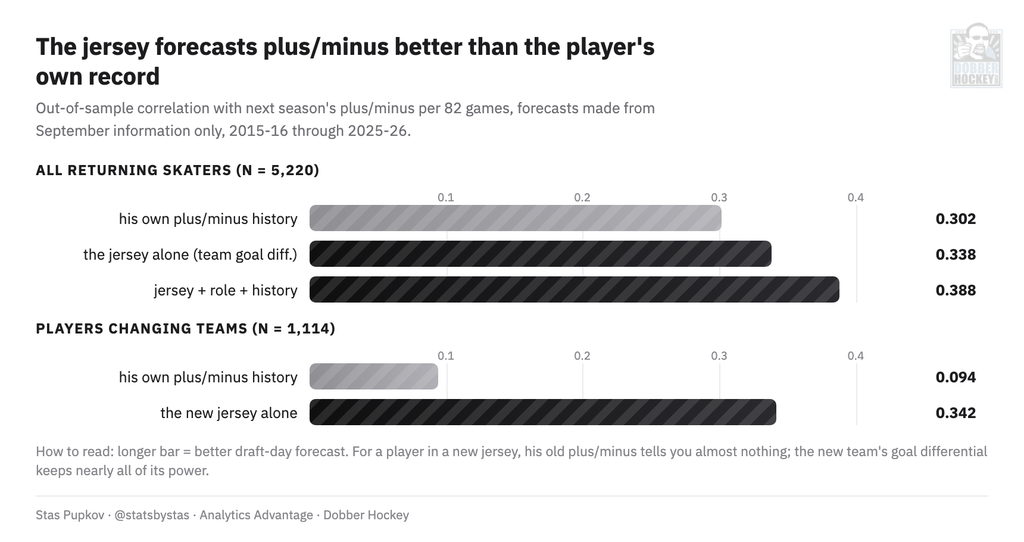
Figure 1
The natural way to forecast a player’s plus/minus is to look at his plus/minus. Tested honestly, that approach is the weakest tool on the shelf. Honestly here means out of sample: for each of 11 target seasons, 2015-16 through 2025-26, the model’s coefficients were fit only on the seasons before it, predictions were made from information a drafter would hold that September, and the correlations below are pooled across all 5,220 predictions against what actually happened. No season was ever predicted by a model that had seen it. A player’s own plus/minus history predicts his next season at a correlation of 0.302. The jersey alone, meaning the prior goal differential of the team he is about to play for, predicts it at 0.338. The full model with jersey, role, and history reaches 0.388.
The gap blows open for players who change teams. For the 1,114 movers in the sample, the résumé collapses to 0.094, close to useless, while the new jersey holds at 0.342. A skater’s plus/minus does not travel with him; it stays with the team that produced it, and the sooner your draft prep treats it that way, the cheaper players like Weegar become.
The same conclusion falls out of a different cut. Strip the team-season average out of every player’s plus/minus and ask how well the leftover, the part that is personal rather than laundry, repeats the next year. Raw plus/minus repeats at 0.29. The jersey-stripped residual repeats at 0.17 for players who stay put, and at 0.08 for players who move. A small personal component exists, mostly deployment (penalty-kill minutes, matchup usage), but the portable part is close to zero.
One more number pair, with a caution attached. Skaters who stayed on a team coming off a bottom-decile goal differential gained 7.9 units of plus/minus per 82 the following season; skaters who stayed on a top-decile team gave back 8.1, and the ladder between those endpoints is monotone. The honest reading is reversion, not magic: the player’s own number drifts back toward what his jersey ordinarily produces. For the drafter the distinction changes nothing, because the forecast is the forecast, but it does mean the Colorado fades later in this piece are mean-reversion claims, not scouting reports on Colorado’s roster.
What one category buys
A 9-cat season is nine dials, and plus/minus is the only dial the jersey turns to a degree worth pricing; July’s piece put every other category’s team share under eight percent. So, the re-ranking in this piece does one thing, the same way every time: take a player’s full 2025-26 season, turn that single dial from where it sat to where the jersey forecast says it will sit in 2026-27, leave his other eight dials and every other player untouched, and read his overall rank again. The distance between the old rank and the new one is the size of the tax on that specific player, measured in the currency a draft actually uses. Turned by a typical forecastable amount, 11.5 units of plus/minus per 82, the dial moves a top-200 skater about 20 spots, two rounds of a 12-team draft; turned by the amounts on this year’s board, it moves players 60 to 130.
Nazem Kadri makes the machine concrete. His 2025-26 season, carrying the minus-32 he wore in Calgary, ranked 170th in 9-cat value. Turn the one dial to the Colorado forecast of plus 7 and the identical season ranks 86th. His ADP is 175. Every pair of ranks in the rest of this piece reads the same way: the first number is where the season actually finished, the second is where the same season lands once the jersey’s dial turns, and when a player’s ADP hugs the first number, the market is still anchored to the season as it looked. Kadri’s is, almost to the digit, which is what a buy looks like here.
The same rule sorts the other names in a sentence each. J.T. Miller‘s season re-ranks from 130th to 79th, but his ADP is already 71: the market caught him, no edge left. Brandon Hagel is the mirror image of Kadri: drafted at 41, right on his 46th-place season, and the dial turns him down to 68th; Mark Stone (ADP 89, corrected to 132nd) and Robert Thomas (ADP 81, corrected to 136th) fail the same way. And Brock Boeser shows the rule’s limit: his ADP of 210 already sits far above his 422nd-ranked season, a bet on his shooting bouncing back. The dial alone corrects him to 289th, so a third of that bet is covered by the jersey’s category before anyone projects a single extra goal.
The elites are a different case, and the piece would be dishonest without them. Nathan MacKinnon carries the largest downward forecast swing in the pool, minus-36 units off a plus-58 season, and it moves him from first to second. Kucherov holds fifth; Suzuki slips from fourth to fifth. When eight of the nine dials are set that high, the ninth barely matters. The tax never re-prices the first round; it re-prices the middle of your draft, where one category is a meaningful share of a player’s value.
Next week, we will look ahead to the 2026-27 season, focus on players who changed teams through the offseason, and the impact on their fantasy value via the expected plus/minus change.
Related Posts


Starting Goalies













Top Skater Views
 VGK
VGK SEA
SEA STL
STL S.J
S.J


Top Goalie Profile Views
| Players | Team | |
|---|---|---|
| DYLAN GARAND |
 NYR NYR | |
| DANIIL TARASOV |
 DET DET | |
| JOSEPH WOLL |
 PHI PHI | |
| ARTURS SILOVS |
 PIT PIT | |
| JACOB FOWLER |
 MTL MTL
| |
LINE COMBOS
| Frequency |
NYR Players
| |
|---|---|---|
| 25.6 | MIKA ZIBANEJAD GABE PERREAULT PAVEL DOROFEYEV | |
| 23.7 | J.T. MILLER ALEXIS LAFRENIERE TYE KARTYE | |
| 18.1 | EELI TOLVANEN NOAH LABA WILL CUYLLE | |
DobberHockey Podcasts

Keeping Karlsson: Delusions of Garandeur
Elan and Brian dive into the latest NHL hot streaks, cold streaks, line changes, outjuries, injuries, buy-lows and sell-highs to give you top notch tips in your fantasy hockey league

Fantasy Hockey Life: TiDy Takes Part 2
Last week, Victor Nuno and Ryan Downey broke down trades from our top tier dynasty league. This week, they consider some dynasty trades from other divisions. Have a listen! Our show is part of the Dobber Podcast Network and sponsored by Fantrax.com. Email [email protected] and ask to join our free discord. Join our Patreon at […]
Keeping Karlsson: Matchup Maximizer 2026/27 Week 3
Elan takes a look at the schedule for the upcoming weeks of NHL action and recommends players with good schedules that you should consider streaming in to win your head to head matchups.
Keeping Karlsson: Short Shifts – Sharks Looked Like Celebweenies
Elan recaps the major injuries, outjuries, game results and changed line combos that we’ve seen since Sunday’s mega-show.
Keeping Karlsson: Cole, There’s No Time!
Elan and Brian cover all the action from the first week of the NHL season, and identify our earliest must-adds, can-drops, sell highs and buy lows in your fantasy hockey leagues.