

21 Fantasy Hockey Rambles
Dobber Sports
2026-09-20
Every Sunday, we share 21 Fantasy Rambles from our writers at DobberHockey. These thoughts are curated from the past week’s 'Daily Ramblings'.
Writers/Editors: Ian Gooding, Michael Clifford, Alexander MacLean, Puneet Sharma, and Dobber
___
DobberHockey’s 2026-27 Fantasy Hockey Guide is now available in the Dobber Shop! Team-by-team overviews updated through to the start of the regular season to reflect injuries, trades, or other pertinent information.
The French version, le Guide des Poolers, is also available. You can pre-order it here.
___
1. Connor Hellebuyck has been suspended by the Jets after not reporting to camp. Hellebuyck, who has five years remaining on his contract, has requested a trade.
With the possibility of missing the start of the season and a potentially long holdout, Hellebuyck places fantasy teams in a difficult situation – particularly those that have retained him as a keeper or have already drafted him in single-season leagues. Hellebuyck currently has an ADP of 24.8 in Yahoo leagues, which will surely fall in upcoming drafts with this latest news. His high draft position means that fantasy teams have no choice but to retain him in the hopes that a trade can be consummated quickly. The absence isn’t injury-related, which also means that teams can’t even use an IR slot.
In the meantime, Stuart Skinner is worth targeting in single-season leagues. Fortunately, he has experience with a heavy workload, having appeared in at least 50 games in each of the last four seasons. Given how his time in Edmonton unfolded (particularly in the playoffs), Skinner isn’t everyone’s idea of a goalie that can carry the mail. But he is at least a worthwhile stopgap option who is only being rostered in 10 percent of Yahoo leagues.
Beyond that, the backup job is probably a battle between Thomas Milic and Domenic DiVincentiis, who have a combined three games of NHL experience. The current backup situation necessitates a goalie as a return in a Hellebuyck trade, which is entirely possible but likely a downgrade from Hellebuyck. One option for the Jets might be claiming a goalie off waivers as training camp cuts occur.
If and when a Hellebuyck trade is made (a trade is not a 100% certainty but the chances are very high), Hellebuyck’s value may improve on a new team. Three possible destinations:
– Carolina: A move to the defending Stanley Cup champions would definitely improve his value. I would assume that the Canes would part with either Brandon Bussi and Pyotr Kochetkov to make the deal, so the remaining goalie would likely lose starts to Hellebuyck.
– Buffalo: A team on the rise, Hellebuyck’s value could also improve here. Ukko-Pekka Luukkonen could move to Winnipeg. If that happens, Hellebuyck on the Sabres would likely mean less work for Alex Lyon and Colten Ellis.
– New Jersey: Hellebuyck would certainly improve the Devils, but I am less certain that his fantasy value would improve on a team that has been hit or miss the past few seasons. The Jets might target Nico Daws here. If Jake Allen remains, he will definitely lose starts. (sept19)
2. We got an update on New York Islanders forward Mathew Barzal as Stefen Rosner reports that Barzal may still be ready for the first game of the regular season. It still isn’t a great sign that a player with Barzal’s injury history is missing training camp, but the news certainly could be a lot worse.
On the bright side, both Kyle Palmieri and Pierre Engvall were full participants in the first day of training camp, so two guys who missed most or all of the 2025-26 season look ready to go. (sept18)
3. With all the changes the Washington Capitals made in the offseason, what their lines would look like was a hot topic, and we got a bit of clarity:
@sammisilber:
Lines for group A:
Ovechkin-Strome-Leonard
Tuch-Dubois-Wilson
A. Protas-I. Protas-Kyrou
Jenner-Sourdif-Beauvillier
Then a fifth line of Miroshnichenko-Brodzinski-Frank
This makes sense as Pierre-Luc Dubois/Tom Wilson have been a consistent duo, as have Alex Ovechkin and Dylan Strome. There is going to be changes all through the season, but if all goes well, I imagine those pairs stay fairly regular. (sept18)
4. Quinton Byfield, Adrian Kempe, and Artemi Panarin were a line at the first Los Angeles Kings training camp practice. Additionally, it looks like their second scoring line, for the time being, will be Mats Zuccarello, Alex Laferriere, and Alex Turcotte. It is certainly giving Turcotte the chance to prove he should be an NHL regular. (sept18)
Luke Evangelista was with Nico Hischier and Timo Meier for the New Jersey Devils’ camp opener. Anthony Mantha was alongside Jack Hughes and Jesper Bratt. This is a great spot for both offseason acquisitions, though I wait to see who will be the regular fourth forward on the power play. That will be the real determinant of fantasy upside. (sept18)
5. With Jason Zucker injured and Jiri Kulich returning, the Buffalo Sabres’ lineup looked like this for the first day of training camp:
@engelheather:
Looked like we have some first-day lines and pairings:
Krebs-Thompson-Doan
McLeod-Norris-Helenius
Benson-Östlund-Quinn
Kulich-Carrick-Malenstyn
Kozak and Danforth rotated in.
Samuelsson-Dahlin
Zellweger-Power
Timmins-Crevier
Gilbert-Metsa
I am still very skeptical that Peyton Krebs stays in the top 6 all season – I imagine that when Zucker returns, or if Kulich regains his pre-blood clot form, then Krebs is back on the fourth line, but this is what they’re doing with for now. (sept18)
Back to Zucker, he had sports hernia surgery and will not be ready for the start of the season:
@ByMHarrington:
GMJK said Jason Zucker (sports hernia) is not going to be ready for the regular season. Louis Crevier (shoulder surgery) is coming back from that. Status uncertain.
That isn’t great for Zucker, but it is for the Buffalo Sabres’ young wingers like Jack Quinn, Josh Doan, and Zach Benson. It frees up some ice time both at 5-on-5 and on the power play, giving those guys an early-season boost. (sept17)
6. Elsewhere:
– Chris Kreider‘s first day of training camp with the Montreal Canadiens saw him skating on the top line with Cole Caufield and Nick Suzuki. Juraj Slafkovsky was down on the second line with Oliver Kapanen and Ivan Demidov.
– The Chicago Blackhawks had Roman Kantserov skating on Chicago’s top line with Frank Nazar and Patrick Kane for their first day of camp, according to Charlie Roumeliotis. The second line was composed of Tyler Bertuzzi, Anton Frondell, and Nick Lardis. (sept18)
Still with the Blackhawks, Connor Bedard was named captain, to the surprise of absolutely no one. He has been skating, and while I haven’t heard anything real to this effect, I do wonder whether he returns a little earlier than expected from his shoulder surgery. Something to keep in mind for fantasy drafts anyways. (sept16)
– The Tampa Bay Lightning announced that forwards Yanni Gourde and Dominic James are going to miss some time, the former with a hip surgery and the latter with a broken hand. Gourde is expected out until December and James will miss a couple of weeks of the regular season.
Both Gourde and James are centres who sometimes play the wing, but it leaves a couple holes in the bottom 6. It is a good chance for Conor Geekie to break camp with the team and establish himself as a full-time NHLer.
– Vancouver Canucks goalie Thatcher Demko will not be a full participant in training camp. He has been battling injuries for years and it seems they’ll be very patient with getting him back to 100%, or as close as he can get. (sept17)
7. Martin St. Louis signed a four-year contract extension a few days ago, supplanting the existing one year he had remaining. The Habs recognize that they have a good coach here and they don’t want to give him any reason to look elsewhere, bumping up his current salary to something likely more in line with his top peers.
St. Louis now gets to slot one of his former teammates into the lineup card after the Chris Kreider signing over the weekend. St. Louis played with Kreider in New York, adding a nice bit of familiarity for the coach with his new player.
One other noteworthy tidbit from the team press conference, was that Montreal isn’t planning to start the season with three goalies. That means Jacob Fowler should begin the season in the minors, with Sam Montembeaut getting another NHL chance behind Jakub Dobes. At least, that’s what it seems to indicate. However, if Montembeault doesn’t have a great camp, then there’s a very real possibility he is waived to play in the AHL with Fowler getting at least a 35% start share behind Dobes. (sept16)
8. John Hynes was also locked up on a multi-year deal in Minnesota as well. It does sound like the duos of Ryan Hartman/Kirill Kaprizov and Joel Eriksson Ek/Matt Boldy will be penned into the lineup, and the quartet of Danila Yurov, Max Shabanov, Blake Coleman, and Bobby Brink will be tried as the final pieces on those two lines to see who fits best in each slot. Those could be moving pieces throughout the year though, so I wouldn’t spend too much to jump on the first name you see slotted in beside Kaprizov.
In less impactful management news, the Red Wings have named Shawn Horcoff as an interim GM, while they finish their search. This doesn’t mean much from a fantasy perspective, except for whether he has the power to sign Simon Edvinsson to a contract or negotiate a Dylan Larkin trade. If not, then it’s likely status quo into the season (otherwise the Wings wouldn’t have nominated an interim filler). (sept16)
9. NHL teams can no longer sign players to eight-year extensions, as the new CBA came into effect this morning (Wed Sept 15th). With it, the max term for contracts has been shortened to seven years when re-signing with your current team, or six years for UFA deals.
– Noah Ostlund signed with the Sabres for eight years on Monday, and I think he turns out to be a solid second line guy. The situation reminds me a bit of Jackson Blake and Logan Stankoven in Carolina. Those guys look like steals already on their eight year deals that were locked in right before their big playoff breakouts, paying them between $5-6 Million per season. Seems like a smart move for Buffalo to try and match that kind of deal on a player with similar upside.
– Drake Batherson and Ryan Leonard also signed big eight years deals with $10.75 and $10.5 Million cap hits respectively. Leonard is closer to Ostlund in terms of current career trajectory, but is a step ahead of him and has a higher upside, thus the higher cap hit. Batherson is much more proven, but the contract eats many more years in his 30s, which likely keeps the cap hit down for the Sens. Both should be reasonable if not in year one of the contract, then in very short order.
– The Capitals also locked up Justin Sourdif to an eight-year contract with a $6.35 Million cap hit. He likely won’t be anything more than a third line player, but it should still be reasonable for the team moving forward. The Capitals now have 12 players locked in until the summer of 2030, with most of their big names included on that list. They’re in great shape cap-wise.
– The biggest pre-deadline deal didn’t actually end up being an eight-year contract, but Cutter Gauthier‘s new six-year pact likely got pushed through because of the bonus structures that were tighter in the new CBA rules that are now in place. Gauthier’s $13.5 Million cap hit comes in well above what was expected prior to this offseason, but still well below Leo Carlsson‘s new deal as well. Gauthier’s deal now sets the likely high bar for Beckett Sennecke’s next contract too. (sept16)
– One guy who was signed early Wednesday morning (at least in my time zone) was Luke Evangelista. The New Jersey Devils signed him for five years at $7.25-million per season. He is in the final year of his two-year bridge contract, so he now has six seasons signed with the Devils, carrying him to his age-30 season.
For cap league managers, this seems like one of the more reasonable deals. With the expected rise in the salary cap to roughly $113.5-million next year, that would be about 6.4% of the cap. That is the cap hit of a top 150 skater, which is what makes it palatable. He needs more goals (and likely a top PP role) to really be worth the rise in price for fantasy managers, but he has the skill and now the teammates to do it. (sept17)
– On a related note regarding contracts, the Columbus Blue Jackets signed veteran goalie Cam Talbot to a one-year deal. He is coming off a poor season in Detroit but had generally been pretty steady for several years before that. He will be the backup to Jet Greaves, and that makes it seem like Elvis Merzlikins won’t be returning anytime soon from his shoulder surgery. (sept15)
10. Continuing on from my last week’s article covering the Metropolitan Division. We are now moving on to the Western Conference in the Central Division. Let’s get right into it!
Chicago Blackhawks – Anton Fondell
The expectation is that Anton Frondell will take on a significant role down the middle although playing on the wing is still an option once Bedard comes back from injury. Chicago has also added some additional offensive talent with Patrick Kane returning and Bowen Byram joining the defence. That should give the Blackhawks more weapons around their younger players and potentially create better situations for Frondell as he adjusts to a full NHL schedule. There is obviously more risk here, with Frondell having only 12 games at the NHL, so we can’t assume that his early production will automatically carry over to a full 82-game season. However, his pedigree is already well established, but the limited NHL sample could keep his draft cost from getting too high. Another thing I’ll be watching is the power play, as Frondell and Frank Nazar could both be in the mix for that top-unit spot. If one of them can separate himself there, it could have a pretty big impact on their fantasy value. For now, I am going with Fondell. (sept14)
11. Colorado Avalanche – Sam Malinski
Sam Malinski could easily get overlooked on a team like Colorado, where Cale Makar and his defensive partner Devon Toews naturally get most of the attention on the back end. Malinski took a pretty significant step forward last season, going from 15 points in 76 games to eight goals and 40 points in 82 games, 39 of those 40 points came at even strength. He also saw his average ice time jump from 15:57 to 17:37. I wouldn’t expect another massive jump in his goal total, especially after shooting just 4.9% last season, but I don’t think he needs one. The 32 assists are more encouraging, particularly on a Colorado team that creates plenty of offense from the back end. The Avalanche’s top-six forwards will likely be drafted well before their ADP, and while players like Jaden Schwartz or Fedor Svechkov may be available later, I think Malinski offers more value as a depth option. He doesn’t need to become a 50-point defenseman to help your roster. If he can maintain 17-18 minutes per game and continue contributing offensively, another season around the 35–40-points is where the value lies. (sept14)
12. Dallas Stars – Thomas Harley
There may be some bounce-back appeal with Thomas Harley, especially if his draft cost has dropped after a 36-point season. Just a year earlier, Harley put up 16 goals and 50 points in 78 games, so we already know there is legitimate offensive upside here. What makes Harley interesting is that this isn’t a case of hoping a young defenseman suddenly breaks out. He has already shown he can produce and Dallas clearly believes in him as well, handing him an eight-year, $84.7 million extension. The biggest concern is his situation. Harley remains behind Miro Heiskanen for the top power-play role. That limits his ceiling for now, but if he ever gets a full-time opportunity on PP1 again, I think there is 55-plus-point upside. For now, I’m more interested in what he can do at 5v5. If Dallas gives him more freedom to use his skating and transition game, I could see him getting back into the 40-point range. Harley is the type of defenseman I’d be willing to take a chance on. (sept14)
13. Minnesota Wild – Danila Yurov
Yurov is probably one of my favourite picks on this list. He finished his first full NHL season with 12 goals and 27 points in 73 games, but he did that while averaging just 13:18 per game. After moving on from Mats Zuccarello, Marcus Johansson and Vladimir Tarasenko, that could give Yurov a chance to move into a more consistent top-six role and take on more responsibility at 5v5 and potentially on the power play. Now, if Yurov stays around 13 minutes a night, another season around 30 points shouldn’t be surprising, however, if Minnesota starts pushing him closer to 16-17 minutes, gives him better linemates and increases his power-play opportunities, I think his production could take a pretty significant jump. You’re betting on the opportunity arriving before the fantasy market fully catches up. (sept14)
14. Nashville Predators – Mavrik Bourque
Bourque was acquired by the Predators this offseason and then signed to a six-year, $33 million extension, showing that Nashville clearly sees him as more than just another depth forward. Prior to that Bourque was playing behind an established group in Dallas, while Nashville has more room for him to take on a bigger offensive role. With the Predators trading Luke Evangelista to New Jersey, it opens up another top-six spot that will likely need to be filled. Bourque should be one of the players in the mix for that opportunity. He also doesn’t need to completely change his game to take a step forward, he scored 20 goals on 147 shots last season, so the production wasn’t built around an unsustainable shooting percentage. If his ice time increases and he gets better offensive deployment, I think there is room for his production to climb. The level of talent around him isn’t quite the same as what he had in Dallas, but if Nashville gives him a bigger role in the top six, I think we should see an uptick in production. (sept14)
15. St. Louis Blues – Mason McTavish
We know that 41 points in 75 games last season isn’t exactly what we expected from Mason McTavish given the role he was supposed to have in Anaheim. His even-strength ice time dropped from 13:45 to 12:38, while his power-play time fell from 2:22 to 1:55. It was pretty clear he wasn’t fitting into Anaheim’s long-term plans. We also know he can produce more with increased opportunity and with the Blues reshaping their forward group after trading Jordan Kyrou to Washington and bringing in McTavish and Connor McMichael, there may be an opportunity. The top line should remain Robert Thomas, Jimmy Snuggerud and Dylan Holloway, which leaves McTavish with a clear opportunity to take over the second-line center role. That first line will also likely stay together on the top power-play unit, giving McTavish an opportunity to push for some PP1 time. If everything falls into place and McTavish earns consistent top-six minutes while seeing an increase in power-play usage, we could see him get back to the player we expected him to become. (sept14)
16. Utah Mammoth – Vincent Trocheck
This may be one of the more obvious choices as there isn’t much mystery surrounding what Trocheck can do. He has consistently been a 50-plus-point player over the last five seasons and now he moves to Utah, where he should have an opportunity to play a significant role with an up-and-coming team. The biggest thing I’ll be watching is his deployment. Trocheck averaged 20:33 per game last season, and if Utah continues to use him in a top-six role, I think there is a pretty easy path to another productive season. He also brings a strong track record of driving offense through his assist totals and his FOW% is the highest of any player on the team. Obviously, age is going to be the concern. Trocheck is 33, and we shouldn’t expect his best offensive season to suddenly appear in Utah, however, you’re essentially betting on a proven 50-point player maintaining a similar role in a new environment. (sept14)
17. Winnipeg Jets – Cole Perfetti
The more realistic scenario with Perfetti is simply getting him into a consistent offensive role and allowing his skill set to translate into production more regularly. The biggest factor is the power play. Perfetti has seen powerplay time, in fact last season was the highest PPTOI he’s ever had at 2.16 minutes per game. If Perfetti can lock down PP1 while maintaining a consistent top-six role at even strength with stronger linemates, I think there’s a realistic path back to the 50+ point season. His stats also look skewed from last season as he had been dealing with the effects of an ankle injury suffered during the preseason. Without that setback, there is a reasonable chance he could have reached 20 goals. We’re still waiting for that breakout season, but Winnipeg’s offensive depth drops off pretty quickly after the top line, and Perfetti looks like the next forward in line to take on a bigger offensive role. (sept14)
18. Over the last couple of weeks, my Ramblings have covered my personal projections and the best fantasy draft values. These projections are my own, but anyone looking for Dobber’s projections, draft list, and draft guide, head on to the Dobber Shop to pick up your copies! The Fantasy Guide has a slew of articles to give you the edge for your fantasy drafts, and a purchase includes a Draft List, which has Dobber’s projections for skaters and goalie. Help support what we do year-round and grab the Fantasy Guide!
With that brief preamble out of the way, these are the draft value discussions my recent Ramblings have included:
- Shallow League Forward Draft Values (link)
- Deeper League Forward Draft Values (link)
- Shallow League Defence Draft Values (link)
- Deeper League Defence Draft Values (link)
- Rookie Draft Values (link)
Today, we’ll look at individual NHL team fantasy values to see where we should, or should not, stack some players from the same franchise. My projections use Z-Score values, which determines how far a player’s projection in each category is above/below a replacement level player. So, if a replacement level forward in a 12-team league averages 20 goals, and I have Matt Boldy for 41 goals, the ‘Z-Score’ gives him a value based on the difference. We do that within each position for each player in each stat. The fantasy stats used are goals, assists, shots, blocks, hits, and power-play points.
Data for my projections come from Evolving Hockey, Natural Stat Trick, All Three Zones, and Frozen Tools with ADP data from Fantrax. I am focusing on the skaters and goalies with the 250 highest Z-Score totals, which is roughly the number of players drafted in a 12-team league.
To start with, let’s look at the teams that stood out. These are the teams whose total fantasy value is above the middle of the league and whose combined projection rank is higher than their combined ADP rank at each position. For example, I have Sam Reinhart as the 18th overall fantasy forward this season and his Fantrax ADP rank among forwards is 30th. It gives him a +12 positional rank. I do that for each player and then add up each team’s total. Using those parameters, here are the seven teams that stood out for stacking purposes:
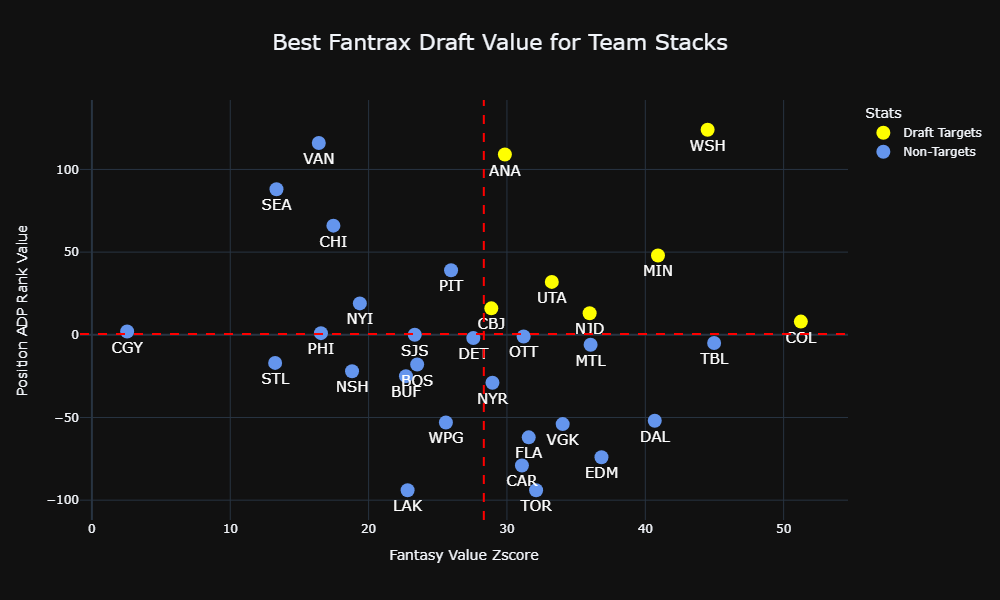
We won’t cover them all, but first up is the team that made a lot of key offseason changes.
Washington Capitals
The Capitals have the highest Position ADP Rank, which means their skaters and goalies have combined for the best draft value. They also have the fifth-highest Fantasy Z-Score Value, which means they not only provide draft value, but also have a lot of fantasy impact. There are players who provide good draft value based on their ADP but won’t bring great stats; that is not the case with the Caps:
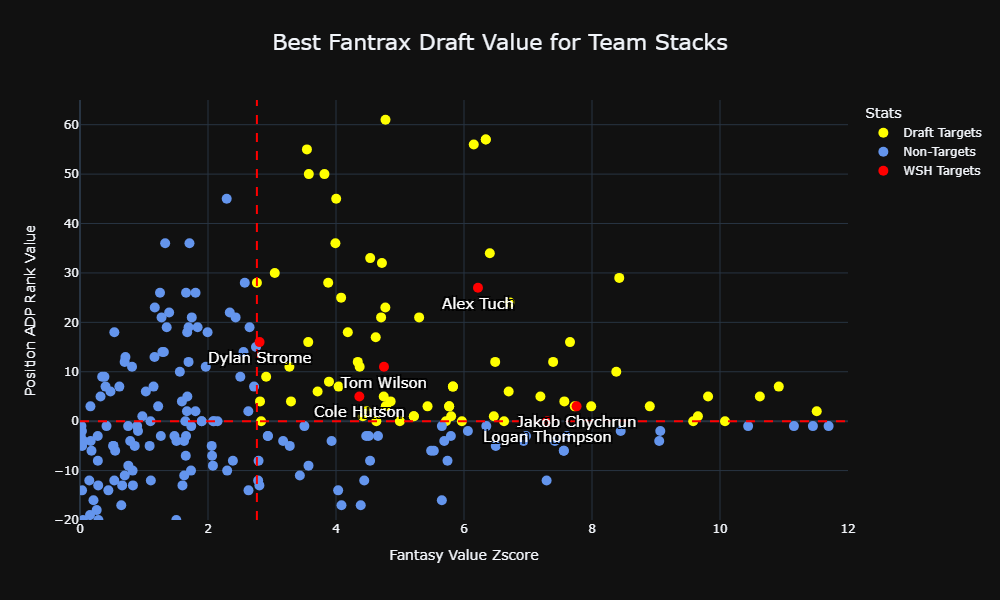
Among their forwards, three names stood out:
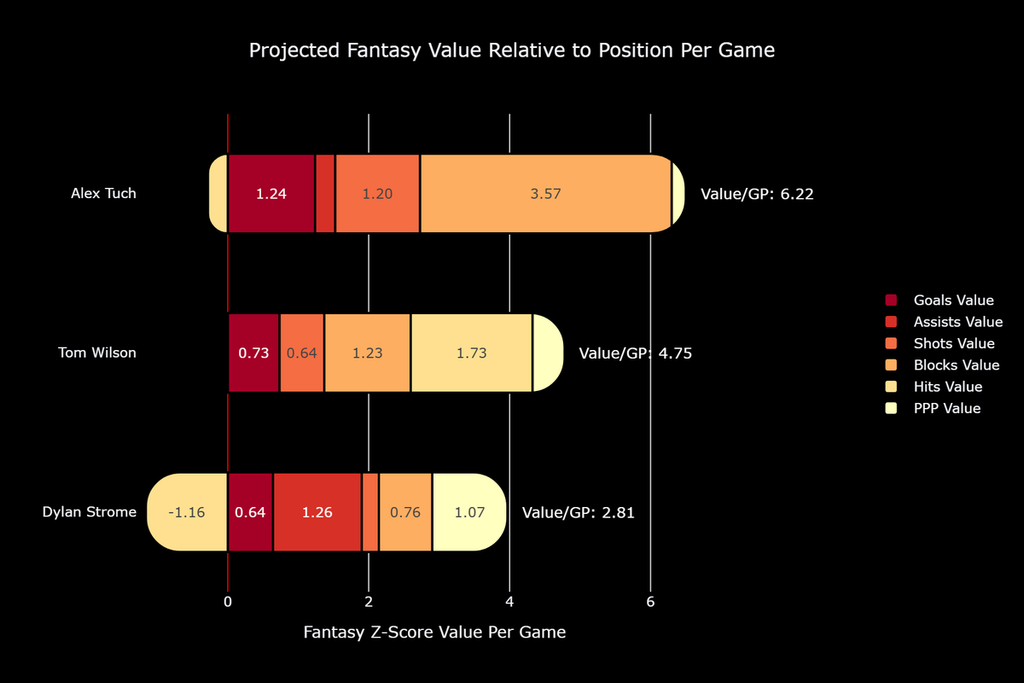
Alex Tuch joined the Caps in the offseason and is a prime example of contributing across the board as he’s averaged 35 goals, 32 assists, 196 shots, 78 hits, 102 blocks, and 10 power-play points per season over the last two years. A huge chunk of his value comes from blocks, but even if we cut his block projection by 30%, he still comes out as a positive draft value. On Fantrax and Yahoo, he’s being drafted somewhere between the 80th and 100th pick; my projections have him around the top 50. In multi-cat leagues, Tuch looks like a great option.
With the influx of so many good forwards, my projections assume Tom Wilson‘s ice time will fall, and with it his production. He should still be a 25/25 player with roughly 2 shots, 0.75 blocks, and 2.5 hits per game, and that kind of across-the-board coverage still makes him valuable. His draft value is not in Tuch’s tier, but still good.
Finally, Dylan Strome fell to 59 points in 2025-26 following his point-per-game 2024-25 campaign. That is depressing his ADP and giving him good draft value. He probably loses a bit of ice time if Pierre-Luc Dubois and Boone Jenner stay healthy, not to mention if Ilya Protas establishes himself, but Strome’s point-per-game season came with 17:23 per game. He is still the Caps’ best playmaker and their top centre. If the team is as good as they look on paper, Strome is in for a big rebound.
It isn’t just the forwards giving good value, though. Both Jakob Chychrun and Cole Hutson are solid draft values from the blue line:
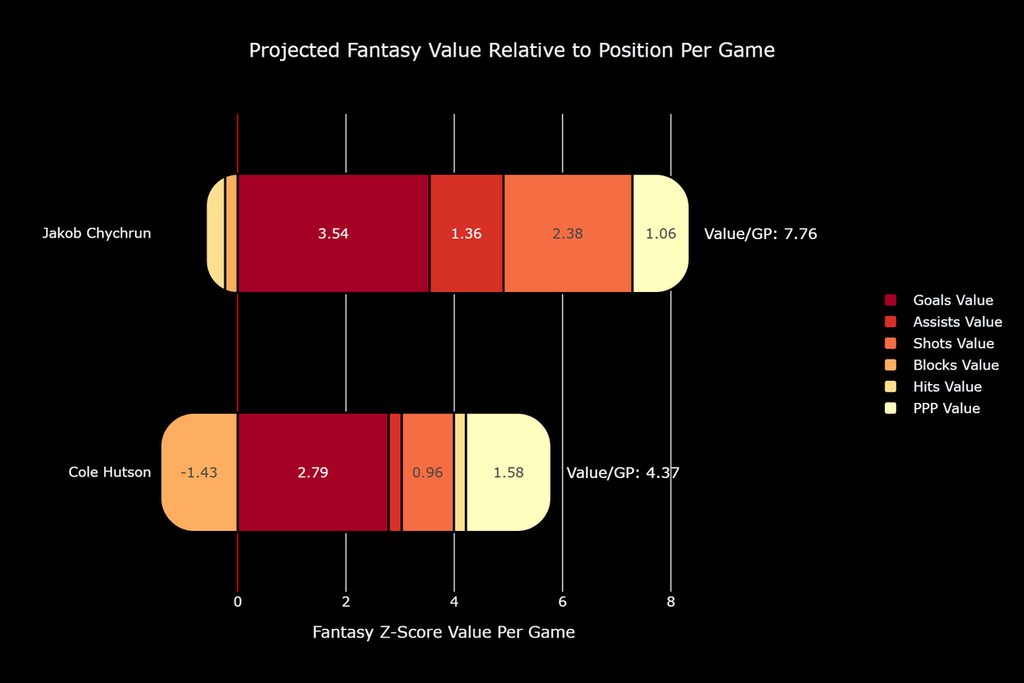
Neither is providing immense value like Tuch, but both have positive draft values. There is (and should be) concern about which defenceman takes top PP minutes, but the Capitals haven’t been shy about splitting PP time somewhat evenly among both blue liners, and my projections assume both skate between 40-60% of the team’s PPTOI. Fantasy managers might not want to pick one or the other, so I say: Why not both?
As a quick note, goalie Logan Thompson comes out as a break-even draft value. He is fine to target as part of a stack, but not someone I would reach for. If managers aren’t comfortable taking him as a top 5 goalie, then it’s fine to pass on him.
[Follow the link for more…] (sept15)
19. In Tuesday’s Ramblings (above), I went over individual teams that fantasy hockey managers will want to target if they’re looking to stack a handful of players from the same franchise. It was a continuation of my Ramblings covering good fantasy draft values this season. Included in that article are links to a bunch of write-ups covering individual players, so go check that out for a lot more fantasy draft coverage.
Today, we’ll get to my least favourite subject, and that’s fantasy goalies. Nothing against the position, it’s just that goalies are the most important players on a fantasy roster and simple randomness can bring a potential championship team to its knees – just ask the Edmonton Oilers.
For projections, we are using total wins, saves, and goals against.
As with prior Ramblings, we are using a ‘Z-Score’ measurement, which is a value that tells us how far above or below a specific goalie’s projection in a particular stat is to a replacement-level goalie in that stat. So, if a replacement-level goalie has 15 wins, and Jake Oettinger is projected for 35 wins, he gets a big Z-Score value for that category. We do that for each goalie in each stat, add up all their separate values, and it gives us an overall rating. Then we compare where goalies are ranked in my projections, where they rank by Fantrax ADP, and the difference between the two gives us our draft values.
In the graphs below, the red horizontal line is the cut-off for being a positive or negative draft value based on Fantrax ADP and the goalie’s rank in my projections, and the vertical line is the cut-off for the projected fantasy value of a top 25 goalie. So, the goalies furthest to the right are expected to be the top fantasy performers overall, and the goalies towards the top are the draft values based on that performance.
Scott Wedgewood (Colorado Avalanche)
Last season, Wedgewood was a league-winning goalie, especially considering his performance after the Olympics with 11 wins, 293 saves, and just 17 goals against in 12 starts. It will depend on format, but he finished anywhere from the top fantasy goalie to a top 5 netminder. It is curious to see him with such a low Fantrax ADP and that makes him arguably the best goalie value on the board:
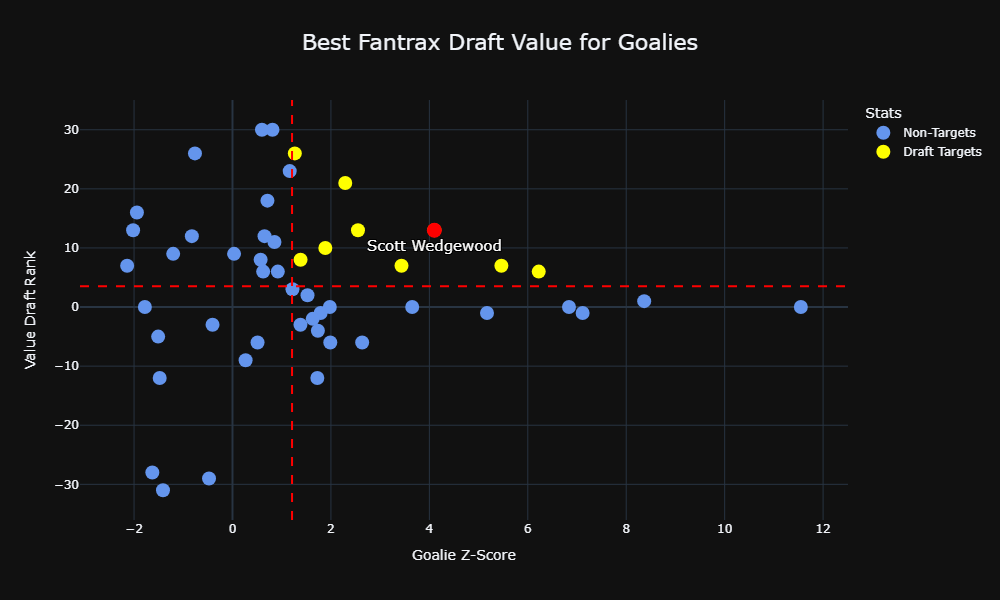
This is an aberration. He is seventh by Yahoo’s ADP while ESPN has him fourth. In my projections, he comes out as the eighth overall goalie. So, a great value on Fantrax, a fine option on Yahoo, and being taken too high on ESPN. Act accordingly.
Fantasy managers in leagues that count ratios (SV%, GAA) rather than total saves/goals against should rate Wedgewood a bit higher. If Colorado’s goalie tandem stays healthy, it’s hard to see him reaching 50 starts. He was probably the best goalie in the league last year and he finished 27th in total saves. League settings matter, and a good chunk of Wedgewood’s value is derived from having very good ratios, not necessarily having a lot of volume.
[Follow the link for more…] (sept17)
20. Starting today and across my next few Ramblings, we are going to split the forwards into their C/RW/LW positions. For these positional ranks, we are using Fantrax designations. They will differ from Yahoo or ESPN but Fantrax’s ADP data is also used, so we want to be consistent here.
The fantasy stats used for evaluation are goals, assists, shots, blocks, hits, and power-play points. The data for the projections is from Evolving Hockey, Natural Stat Trick, All Three Zones, and Frozen Tools.
The projections are based on something called ‘Z-Score’, which is how much better (or worse) a player’s projection is compared to a replacement-level player at their position. So, if a replacement level fantasy right winger is projected for 23 goals, and Jimmy Snuggerud is projected for 30 goals, the gap between the two provides our ‘Z-Score’ value. We do that for each player at each position in each of our six fantasy stats, add up all the values, and see who the top options are.
Before going too much further, it is important to know the projected production differences by position. Separating all the forwards I have projected for positive draft value in a standard 12-team league by their individual positions, here are the average projections per 84 games in each fantasy category:

Centre and right wing aren’t too different. Centres are projected for more assists and blocks, right wings for more hits, but goals, shots, and PPP are fairly close. It is left wing that is much different from the others, projected for fewer goals, assists, shots, and power-play points than either C or RW, but also projected for far more hits. In other words, if you have a player who is LW/RW eligible, and they can be a 30-goal, 40-assist, 20-PPP option, that production is more valuable at LW than RW. (sept18)
21. So, our positional overview will start with centres who are eligible at left wing. We are going to look for those who are more valuable at LW and are good draft values based on my my projections and their Fantrax ADP.
The yellow dots are the draft targets, and the red dot is the specific player we’re discussing. The red lines are the cutoffs for above-average fantasy value and above-average draft value.
Alex Laferriere (Los Angeles Kings – C/LW/RW)
There are players I think are better overall draft values at other positions, but there’s a good argument that Laferriere is the best value centre on the board:
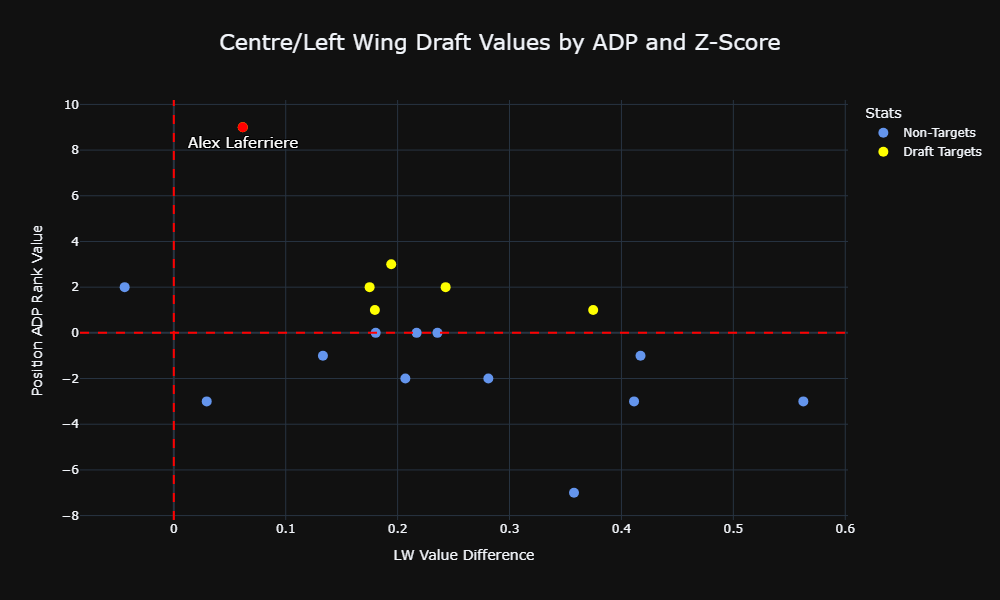
The simple reason for this is that his value on the wing is higher than at centre, that he’s projected to bring pretty good overall fantasy value in banger leagues, and that he’s triple-position eligible. There are only five of those kinds of players inside the top 250 picks by Fantrax ADP, and Laferriere looks primed to be a genuine second-line centre for the Kings; he nearly doubled his face-offs taken per game in the second half of last season and Anze Kopitar retired this summer.
All this depends on league settings, of course, because a lot of Laferriere’s value comes from his hit rates, but there are very few players who can give 20 goals, 20 assists, 200 shots, 200 hits, and 200 face-off wins. He is one of them, and he can do it from any of the three positions.
[Follow the link for more…] (sept18)
Have a good week, folks!
Thanks for continuing to support the website and if you’re bored and need a fantasy hockey fix – visit the gang in the forum here.
Related Posts
Starting Goalies



Top Skater Views
 S.J
S.J L.A
L.A ANA
ANA SEA
SEA

Top Goalie Profile Views
| Players | Team | |
|---|---|---|
| DAN VLADAR |
 PHI PHI | |
| CARTER HART |
 VGK VGK | |
| JOEL HOFER |
 STL STL | |
| SERGEI MURASHOV |
 PIT PIT | |
| LOGAN THOMPSON |
 WSH WSH
| |
LINE COMBOS
| Frequency |
 CBJ Players CBJ Players
| |
|---|---|---|
| 21.1 | KIRILL MARCHENKO ISAC LUNDESTROM ADAM FANTILLI | |
| 20.1 | COLE SILLINGER CONOR GARLAND CHARLIE COYLE | |
| 14.0 | MASON MARCHMENT BOONE JENNER DANTON HEINEN | |
DobberHockey Podcasts

Fantasy Hockey Life: Nashville Predators with Emma Lingan
Emma Lingan joins the program to discuss the Nashville Predators

Keeping Karlsson: The 2026-27 Keeping Karlsson Breakfast Club
Don’t you forget about them! Elan and Brian remind you of at least one player on each NHL team whose name you might forget to consider at the draft table.
Fantasy Hockey Life: Tampa Bay Lightning with Erik Erlendsson
Erik Erlendsson joins the program to discuss the Tampa Bay Lightning. Jesse and Victor ask about pros Nikita Kucherov, Jake Guentzel, Brandon Hagel, Brayden Point, Anthony Cirelli, Ilya Mikheyev, Gage Goncalves, Conor Geekie, Benjamin Rautiainen, John Carlson, Victor Hedman, Charle-Edouard D’Astous, Andrei Vasilevskiy, Jonas Johansson, and Dennis Hildeby. In Cat’s instincts, Cat Silverman of InGoal […]
Fantasy Hockey Life: New York Rangers with Colin Stephenson
Colin Stephenson joins the program to discuss the New York Rangers.
Keeping Karlsson: Matchup Maximizer Schedule Deep Dive
Elan is joined by the Keeping Karlsson Accountability Czar Trev to take a deep dive into the NHL schedule for next season and how it should affect our drafting decisions.