

21 Fantasy Hockey Rambles
Dobber Sports
2025-11-02
Every Sunday, we share 21 Fantasy Rambles from our writers at DobberHockey. These thoughts are curated from the past week’s 'Daily Ramblings'.
Writers/Editors: Ian Gooding, Michael Clifford, Alexander MacLean, Puneet Sharma, and Dobber
—
The 2025-26 Fantasy Guide is available for download! Projections by team and by point totals, sleepers, drafted players, rookies, goalies, advanced stats, and much more!
The French-language version of the Guide can be purchased here.
—
1. The Colorado Avalanche extended winger Martin Necas for eight years with an average annual value of $11.5-million. Necas was set to hit free agency this coming offseason but is another big name off the board along with the likes of Jack Eichel and Kirill Kaprizov. This will make him a top-25 player by cap hit, so cap-league managers will have a big decision to make here. He has never reached 80 hits or 40 blocks in a single season, and his first 41 games with the Avalanche have produced 103 shots on goal. Those aren’t huge peripheral totals. (oct31)
Said Dobber: I see a lot of Internet rage about Martin Necas signing an extension for what amounted to just $500k less than what Mikko Rantanen got (AAV). But all I’m seeing is a guy who is producing just as well as Rantanen is. At a cheaper price, and they got a free third-liner in Jack Drury. And don’t forget Rantanen wanted around $14M initially. The two players they got for Rantanen were in on all four goals in Colorado’s 4-2 win, so I’d say they did alright.
Entering Saturday, Necas was on pace for 104 points. I doubt he’ll get it (never say never though), but I had him projected for 86 points (89-pace) in the Guide and I’m inclined to bump that up to 90, which is actually right where I said he’d be when I did a TikTok post on it in the summer. (nov1)
2. The Utah Mammoth extended centre Logan Cooley for eight years. The value is $10-million per season and will start in the 2026-27 campaign after Cooley finishes his entry-level deal.
Since November 1st of 2024, a span of 75 games, Cooley has posted 32 goals and 37 assists for 69 points (at time of writing). The caveat there being those 32 goals were on 163 shots, or a 19.6% conversion rate. That is probably a little high, but he doesn’t turn 22 years old until May and won’t cross the 200-game threshold until January (provided he stays healthy). It seems likely that as he matures, his shot volume will increase, and concerns about shooting percentage will subside.
Of course, he has to show that increased peripheral value, first. Over those same 75 games, Cooley has posted 66 hits and 32 blocks. At $10-million per season, even in an elevated salary cap era, fantasy players in multi-cat salary cap leagues will want more than a centre who is far from a lock to reach 200 shots and posts under 1.0 hits and 0.5 blocks per game. If he truly elevates his production and can approach Clayton Keller levels (and he can), it probably won’t matter much, and Keller provides a nice template for a player who can be valuable in cap formats even without much in the way of hits or blocks. (oct30)
3. Entering Saturday's matchup against Toronto, the Philadelphia Flyers were 6-3-1 after losing their first two games of the season., Trevor Zegras had four goals and 12 points in 10 games on the season, and his last game against Nashville (Thursday) was his third straight skating at least 18 minutes. He was shooting 25% and won’t total 60-something assists, but this is a great start after a couple of down years and a lot of injuries. Hopefully he can stay healthy and be just 80% of what he’s done so far.
Meanwhile, Dan Vladar has been great. He's allowed two-or-fewer goals in each of his six games, giving up just 10 in total. With the injury to Samuel Ersson, it’s Vladar’s net now, and the Flyers have generally been a pretty good defensive team so far. For the non-believers, it may be time to start believing. (oct31)
4. The Pittsburgh Penguins finished October with an 8-2-2 record thanks to a 4-1 win in Minnesota on Thursday night. Rookie Ben Kindel scored on the power play as he was moved to the top unit with Rickard Rakell out of the lineup. That was Kindel’s 10th game of the season, so it seems like he’ll stick with the Penguins for a while. It is no guarantee he doesn’t get sent down at some point, but the team has now burned the first year of his ELC. (oct31)
Still with the Pens, Filip Hallander was recalled and moved to the Sidney Crosby line in Rickard Rakell‘s absence. Rakell, as you know, underwent surgery and is out until probably the New Year. A Penguins’ second-round pick who is in his prime at 25, and who finished second in SHL scoring last year, Hallander is a player worth watching these next couple of games. In fact, if you can spare the transaction, he’s worth grabbing for your bench to wait and see how he does here. (oct29)
5. Darnell Nurse has three goals, seven points, 29 shots, 34 blocks, and 22 hits in what has been a marvelous start to his fantasy campaign. Entering Saturday, Nurse was the only defenceman with at least eight games played who was averaging at least 0.5 points, 2.0 shots, and 3.0 hits+blocks per game (Nurse was at 4.7 hits+blocks per game, far ahead of anyone else with at least 0.5 points and 2.0 shots). (oct31)
6. John Tavares became the 49th player in NHL history to ever reach 500 goals Wednesday. He was up to six goals, eight assists, and 31 shots in 11 games to start the season. (oct30)
7. Brock Faber is a great defensemen in the higher echelon, no question. But his problem in fantasy hockey is that he’s ‘too’ good. At both ends of the ice. I remember seeing the same thing with Alex Pietrangelo, who was usually a 45-point player who could have been a 55-point player were it not for Kevin Shattenkirk. Shattenkirk was more one-dimensional, so he grabbed 30-40 seconds more PP time with the better unit, and the better zone starts, while Pietrangelo faced the tougher minutes and killed penalties.
Pietrangelo had a couple of 54-point seasons, when Shattenkirk was hurt or the year after Shattenkirk was traded. He even had a 51-point season with Shattenkirk playing the full year, so you can imagine how well he would have done had he been given the offensive opportunities that Shattenkirk had. But when you’re so good that you can thrive at any task, and the team has a guy who thrives only on offense – then you’re stuck in the defensive role. And that’s where we are with Faber. Zeev Buium is getting all the PP minutes. Faber is getting all the PK minutes. At least in the case of Pietrangelo, he still got PP minutes, albeit on the second unit. With Faber, he’s barely getting third-unit scraps.
Faber is what he is. A lesser Pietrangelo. He’ll get his 35 to 40 points, eventually eking that up to 45. And some time over the next few years, when or if Buium spends extended time on the IR, Faber will pop for 50 or 55. If only we had a way of knowing when that will happen so we can draft accordingly. (oct29)
8. Announcement: Dobber Sports is now active on TikTok and YouTube (and reels). Our writers, such as Rick Roos, Victor Nuno, Flip Livingstone, Andrew Santillo, and myself, are posting quick one-minute thoughts on players and events. Both DobberHockey and DobberProspects will have news and info on there.
9. A quick run-through on the top (and bottom) early trends, and my thoughts on sustainability. (At time of writing:)
Jack Eichel, on pace for 146 points:
The metrics say: He’ll slow, with his pace bringing him in at around 115-120 over a full season. His 5on5 S% of 14.5%, his high PPIPP and his very high %PP indicate a slowdown.
End result: The term “over a full season” doesn’t apply to Eichel. He’s coming off a 77-game season, which is promising, but generally speaking you should assume closer to 70-73 games, which puts him in closer to 105 points. The presence of Mitch Marner nullifies some of the potential metrics drag. (oct29)
10. Nick Schmaltz, on pace for 131 points:
The metrics say: Weird thing – when I click to see his metrics, it just has a laughing sound on my PC. In all seriousness, his 5on5 S% is extremely high for what he usually comes in at (14.4% instead of around 10%, or even below 9% the last two seasons). His expected goals sits at 6.5 when he’s on the ice at ES, but the actual goals are 11. His S% of 19.4% is high. His career average is 13.8%, which is higher than most, but 19.4 is nutty. His shot volume is way up, too. I like Utah a lot and have said multiple times that the team this year is underrated (and to pick up and value Karel Vejmelka). That second line is huge (thanks to JJ Peterka) and it’s making the first line better. But not that much better.
End result: Schmaltz will still have himself a career year, which was set last year at 63 points. I think he gets over 70 with a reasonable chance at 80. (oct29)
11. Evgeni Malkin, on pace for 131 points, 40 on the PP:
The metrics say: A big decline at ES and small decline on the PP. His 15.6% 5on5 S% nearly doubles what he usually sees, and is most definitely a career high. It’s very early in the season so this number is out of whack for a lot of players.
End result: Much of this depends on the health of Anthony Mantha. Right now, that line is like a modern-day Pittsburgh version of the Legion of Doom. Each member is at least 6-5, with Justin Brazeau at 6-6 and 232 pounds. How do you stop them? And if their showing this kind of chemistry with Malkin, that’s just what the doctor ordered. Not since James Neal has he had someone (let alone two!) as such a nice fit. So far. It’s early. Mantha is one of the most fragile players in the entire league. In fact, I would submit that he is the most fragile player. Him getting hurt would change everything. It would probably stop Brazeau’s nice production in its tracks. Basically, if Mantha can somehow play even 75 games (don’t hold your breath), I think Malkin will at least match what he did three years ago (83 points). If Mantha plays 50-70 (the more likely scenario), that pushes Malkin down into the high-60s. If Mantha plays less than 50 (also a likely scenario), Malkin will slow to the low-60s. Brazeau, who has over a point-per-game so far, will see similar declines based on the health of his line. His career high is just 22 points, but he’s a huge player and they generally take until they are in their mid-to-late 20s to break out. His fortunes are 100% tied to his talented linemates. (oct29)
12. Macklin Celebrini, on pace for 137 points, 48 on the PP:
The metrics say: His shot volume is down, but his S% is way up (25%). His 5on5 S% of 14.5% is high, but much of that is obviously his own shooting. He’s opening my eyes to his upside (higher than I thought – I am starting to reevaluate my stance that he is not better than Connor Bedard), but this year he’s not getting 137 points.
End result: Last year he was consistent throughout the season, each quarter producing at a similar rate. No big spikes and no big slumps. But 15 points in nine games this year has to be a spike, no? He’s on pace for about 49 goals and 88 assists. He’s going to be a 30-goal scorer this year, but will he make it to 40? I wouldn’t bet against it. But I’ll say 32-35 is more reasonable, a 10-goal gain from last year. I think that not only will he crack 80 points for the first time, but I say he reaches 90 if he plays the full season. (oct29)
13. Andrei Svechnikov, on pace for 0 points:
(update: Svechnikov finally recorded his first points of the season late in the week)
The metrics say: Surprisingly, at even strength, they only indicate a slight increase. So that’s not great news. But the PP metrics indicate quite an unlucky gap so there’s that. His shot volume is way down, his ice time is down, his PP time is about the same. The metrics indicate that he’ll come in around 40 points. Which is not the news any of us wanted to hear.
End result: I think his line alongside Logan Stankoven and Jackson Blake drives a lot of possession. But Taylor Hall gets time on that line too, either replacing Blake or replacing Svechnikov. Possession-wise, the line is best without Hall, though it’s still quite good with Hall – and that’s a testament to Stankoven and Blake. I do admire a coach who sticks to his lines for this long, even when the production isn’t happening. I don’t think this line is going to take off this year. I like Stankoven’s upside more than most, but he’s still a full year away from his production spike and for now, his lower totals will pull down Svechnikov’s at even strength. All that being said, Svechnikov’s solid postseason numbers (12 in 15) playing mostly with Stankoven, tells me not to give up on him. But you’re probably going to see just a 50-point year before his line (if it stays together) sees a bump. (oct29)
14. I’m going to look at some of the rookies and where I think things are going this year for them (entering Saturday action).
I’ll start with Emmitt Finnie, who was a prospect who caught my eye when putting together the Fantasy Prospects Report. I really liked him and even had him on my list in a deep dynasty. In the end, I didn’t think he’d make the team this year and as a seventh-round pick I felt he needed to show more progress as a pro. Prospects drafted late like that, who don’t show a lot of (relatively speaking) offense in junior hockey but suddenly spike in their final year are a dime a dozen. But I know the Wings were very happy with his progress and I felt I should grab him NEXT year. Whoops.
Finnie is for real. He has made the team, is playing on the top line, seeing secondary PP duties and staying consistent. They’ve even put him on the PK a little! He plays hard, blocks shots, dishes out Hits. He leads the team currently in terms of toughest Quality of Competition faced and is second in defensive zone starts. His scoring luck is extremely high right now and not sustainable so a slowdown is inevitable. But he’s shown us that he is definitely a player to own in dynasty. In the Fantasy Guide, I projected he would play 15 games, get four points and dish out 30 Hits. I thought he would play a few games to start the season, but then get sent down until a February callup gives him a few more.
I think that although his luck will slow down and his numbers will drop and probably have him finish up at closer to 45 points (less if he plays his way off the top line), and that his xG% 5v5 is just 45.5%, I think he sticks for good. That low xG% is due to, as noted, his high QofC and tough minutes at ES. His future is very bright though, this is only the beginning. (nov1)
15. Berkly Catton
After being scratched for five games, he has stuck in the lineup for five and has done very well (three points in five games). His metrics are quite strong, he drives possession very well (leads the team, in fact, though in half the games). Everything points to him sticking beyond the nine-game mark. He seems attached at the hip with Matty Beniers, and that’s a good thing for both players, especially in the long run as he finds his footing. I don’t see prolific numbers out of him this year, but he’ll have hot spurts and I think we’ll see close to 50 points and a Top 7 or 8 rookie scorer. Down the road I can see him being a point-per-game player. A lot of potential from the Killer B’s (Berkly-Beniers). (nov1)
16. Michael Misa
A potential superstar and if he sticks he’s going to be a Top 5 Calder nominee. But I’m still 50-50 on him sticking. His ice time is limited, his production is good, but modest, and he’s still getting the occasional healthy scratch. I feel like the Sharks are keeping him as long as they can, stretching out those nine games, before sending him down. A trick I’ve seen before is – the team sends their player down to the AHL on a “conditioning stint” to stretch things out even longer, and then gets sent back to junior to play for a month before the WJC. On the positive side, his metrics are pretty good and he’s facing some of the toughest Quality of Competition on the team. (nov1)
17. Sam Dickinson
Dickinson is stuck at the nine-game mark. If he plays Saturday, then he’s burned a year off his ELC. But he’s an offensive defenseman and has zero points. He’s not being used on the power play (silly!) and is a minus-4. But his metrics are solid and he’s been the best on the team at driving possession. I can see why they are agonizing over this decision. I’m leaning towards his being sent down, especially with Luca Cagnoni around. Cagnoni has three points in five AHL games, and so far has shored up his defensive game (in that limited window). He’s shooting a lot more, too. It makes more sense to hold onto Dickinson’s cheaper ELC for that extra year, and push it next year. Let him experience winning with the London Knights and Team Canada, while at the same time giving opportunity to Cagnoni, who is a year-and-a-half older. They both shoot left, but as a team most of their defensemen do, so these two have potential to form a lethal pairing in the future.
18. In evaluating the early portions of the season, one thing that seemed to be occurring was that defencemen were not as productive as most of us expect. When looking at a similar point of last season – 332 team games by the end of October of 2024 compared to 328 team games as of Wednesday afternoon for this season – that does seem to be the case.
Using data from Natural Stat Trick, I went and looked at goals, assists, points, shot attempts, shots on goal, and individual expected goals across the league so far this year, at this point of the season last year, and what share of those stats were coming from defencemen. Rather than looking at raw totals, we are looking at what percentage of those stats are being produced by defencemen only. The decline is across-the-board:
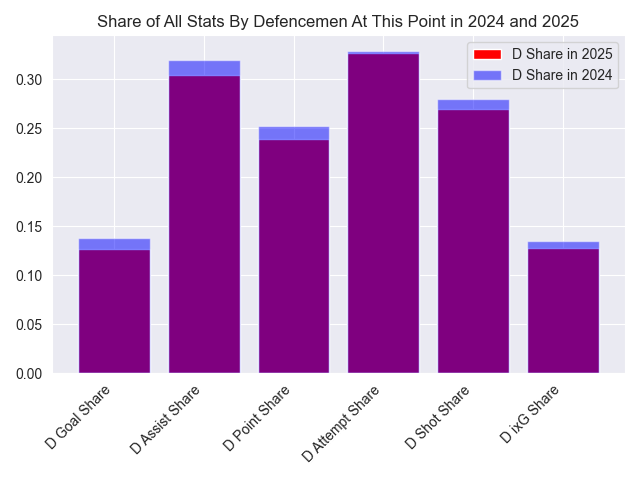
19. The purple bars above are the percentage of each of those six stats that have come from defencemen this year, and the blue part at the top of each bar shows how much extra came from rearguards at this time last year. Whether goals and assists, or the stats related to shooting, defencemen are responsible for a lower percentage in each category compared to October of 2024. When looking at the top of the leaderboards, the problem for fantasy managers becomes obvious:
- Seven defencemen with at least three goals so far in 2025 compared to 14 defencemen at the same time in 2024.
- Three defencemen with double-digit points so far in 2025 compared to six defencemen at the same time in 2024.
- Twenty-four defencemen with at least 20 shots on goal so far in 2025 compared to 37 defencemen at the same time in 2024.
- Five defencemen with at least 2.0 individual expected goals so far in 2025 compared to eight defencemen at the same time in 2024.
This is both a bit of a surprise but also not… (oct30)
[Follow the link for more…]
20. While thinking about top-end defencemen, here is a bit about Jackson LaCombe‘s production that I mentioned on Twitter:
@SlimCliffy: I know fantasy managers are freaking out about LaCombe, but he’s fourth among defencemen in TOI/game and has a point on less than 19% of goals scored with him on the ice. That number was 52.3% across the prior two seasons. He’ll be fine.
At time of writing, LaCombe was on the ice for 16 Anaheim Ducks goals this season. If he participated on just 45% of those goals, he’d have seven points in nine games. Instead, that 18.8% participation rate had him with three points in nine games. His goal participation rate will rise significantly over the course of the season, and his production along with it.
Just be a bit careful here. The Ducks were shooting over 12% with him on the ice. Last year, of the 164 defencemen to skate at least 1000 minutes, just 29 of them reached 12%. It isn’t to say he can’t do it – especially as a top power-play defenceman – just that it’s not a guarantee he stays there. A drop in this regard would mitigate a bit of the rebound in goal participation. (oct30)
21. At the other end of the spectrum, Thomas Harley was figuring in on 80% of Dallas Stars goals scored with him on the ice, helping him to eight points in 10 games. That's a good start, but no defenceman with at least 1000 minutes played last season figured in on two-thirds of their team’s goals, and only 4/164 of those defencemen even reached 60%. To make matters worse, with Dallas currently converting over 31% of their power-play opportunities, it is unlikely that top PP minutes will be a part of his fantasy profile anytime soon. Once that goal participation rate drops for Harley, he’ll be closer to a 40-point defenceman than the 50-point defenceman he was last year, or the 60-point defenceman he's pacing to be so far this year. If he can ever get back to the top PP unit, then the equation changes, but until then, there’s a sizable production decline on the horizon. (oct30)
—
Have a good week, folks!
Thanks for continuing to support the website and if you’re bored and need a fantasy hockey fix – visit the gang in the forum here.
Related Posts

Starting Goalies












Top Skater Views
| Players | Team | |
|---|---|---|
| COLE PERFETTI |
 WPG WPG | |
| LUCA CAGNONI |
 S.J S.J | |
| IGOR CHERNYSHOV |
S.J | |
| TOMMY NOVAK |
 PIT PIT | |
| TRISTAN LUNEAU |
 ANA ANA
| |
Top Goalie Profile Views
| Players | Team | |
|---|---|---|
| DAN VLADAR |
 PHI PHI | |
| JOSEPH WOLL |
PHI | |
| SEBASTIAN COSSA |
 UTA UTA | |
| JAKUB DOBES |
 MTL MTL | |
| ADIN HILL |
 VGK VGK
| |
LINE COMBOS
| Frequency |
 N.J Players N.J Players
| |
|---|---|---|
| 19.4 | TIMO MEIER NICO HISCHIER LUKE EVANGELISTA | |
| 19.2 | ANTHONY MANTHA JACK HUGHES JESPER BRATT | |
| 17.9 | EVAN RODRIGUES DAWSON MERCER ARSENY GRITSYUK | |
DobberHockey Podcasts

Keeping Karlsson: Cole, There’s No Time!
Elan and Brian cover all the action from the first week of the NHL season, and identify our earliest must-adds, can-drops, sell highs and buy lows in your fantasy hockey leagues.
Keeping Karlsson: Matchup Maximizer 2026/27 Week 2
Elan takes a look at the schedule for the upcoming weeks of NHL action and recommends players with good schedules that you should consider streaming in to win your head to head matchups.

Fantasy Hockey Life: Tidy Takes Part 1
TiDy Admiral Ryan Downey and Victor Nuno break down recent trades in the FHL Tiered Dynasty’s top division, the Lord Stanley division. Tune in to consider trades between some of the best dynasty sharks we know, including patron polls on the trades and Victor’s analysis. Have a listen! Our show is part of the Dobber […]
Keeping Karlsson: Short Shifts – I Tried to be Like Parker Kelly
Elan is joined by Ryan Downey for the premiere of season 8 of Short Shifts! — KKUPFL late registration is ongoing! We’re still filling new divisions in the world’s greatest fantasy hockey league. Details at https://www.kkupfl.com/. Join the Keeping Karlsson patron community! Patrons get access to all our perks all year round, including KKUPFL […]
Keeping Karlsson: Shabanov Ranks
Elan and Brian fly through the final preseason lines for every NHL team ahead of opening night, and share their guys to watch– or look away from– in your fantasy hockey leagues.