

21 Fantasy Hockey Rambles
Dobber Sports
2026-01-25
Every Sunday, we share 21 Fantasy Rambles from our writers at DobberHockey. These thoughts are curated from the past week’s 'Daily Ramblings'.
Writers/Editors: Ian Gooding, Michael Clifford, Alexander MacLean, Puneet Sharma, and Dobber
—
1. The Flyers walked into Colorado and did what almost no team has been able to do this season, which is take two points in regulation from the Avalanche. Owen Tippett scored three goals and added an assist, with his hat trick goal coming while the Flyers were shorthanded.
Matvei Michkov entered Friday’s game with just a single point over his last eight games, but he displayed his offensive prowess with two goals and an assist and a plus-3. Coach Rick Tocchet has taken some heat from Flyers fans recently by deploying Michkov on left wing as opposed to switching him back to his natural right-wing position. Tocchet has said that keeping Michkov on the left side boosts his speed through the neutral zone on his forehand while also taking position into consideration. Michkov is on a 45-point pace, which represents a significant downturn from his rookie season, when Tocchet wasn’t the coach. However, Michkov has been knocking on the door recently with 12 shots over his last two games. (jan24)
2. I read something today saying that Ontario would be the coldest place on earth this weekend, possibly dipping down as far as -50 Celsius in one part of the province. Mitch Marner sure felt that frigidness in the air on Friday as he made his return to Toronto as a member of the Vegas Golden Knights.
The Leafs faithful eased up and gave Marner cheers and applause when his video tribute appeared. In the end, Marner was held without a point, but he was still happy with the 6-3 Vegas victory. In his first season with Vegas, Marner is on pace for 85 points, which would be a drop from the 102 points he put up in his final season with the Leafs. Yet it seems like the Leafs miss Marner more than Marner misses the Leafs.
Mark Stone led the way for the Golden Knights with two goals and an assist. My strategy of staying away from the injury-prone Stone in drafts has backfired. Stone is currently on a 14-game point streak in which he has 21 points. Cooling off or encountering another injury seem inevitable, but right now the Vegas captain is absolutely clicking with Jack Eichel. (jan24)
3. The Marner return was hardly the only storyline in this game. Rasmus Andersson finally made his Vegas debut, registering an assist while logging 21:33 while being reunited with Noah Hanifin, who he also partnered with in Calgary. On the one power play that the Golden Knights had in this game, they used five forwards again, with Hanifin and Shea Theodore on the second unit. Although he may have no major issues picking up points at even strength, Andersson’s value could be limited if he is held without any power-play time with his new team. (jan24)
[Fantasy Take: Golden Knights Acquire Rasmus Andersson]
4. The first thing that came to mind when I saw the Rasmus Andersson trade was how this would affect Vegas defensively. Going into Monday night’s game against Philadelphia, the Golden Knights were at 2.51 goals against per 60 minutes at 5-on-5. If they stay at that level (or worse), they will finish with the worst 5-on-5 goals against rate in franchise history. To be clear: that rate in and of itself is not bad – around the middle of the league. But it is unusual for Vegas to be giving up so many goals at 5-on-5.
In my newsletter last week, I wrote about how teams/players have changed defensively this season compared to the prior two years. One of the notable teams was Vegas because they are seeing the fourth-largest increase in shots against off the rush per 60 minutes at 5-on-5 in the league, with only Carolina, Buffalo, and Columbus being worse:
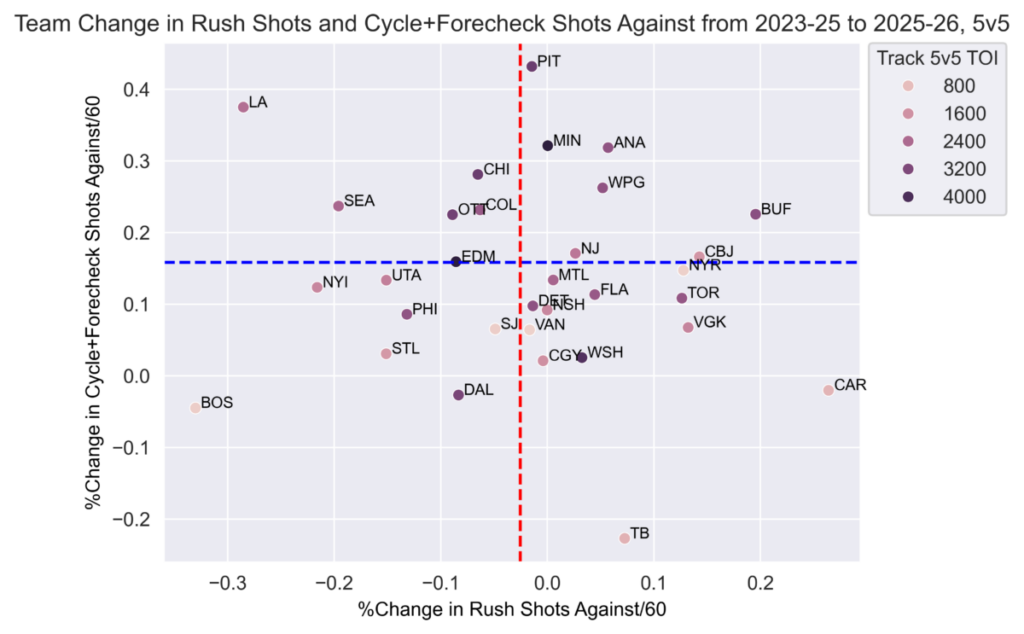
We only need to look at some of the other teams with big increases in rush shots against like Carolina, Winnipeg, Florida, and Washington to see how it can affect goals against rates. Not all teams have gotten worse – Buffalo and Columbus, notably – but allowing a lot of rush shots can lead to a lot of goals against.
That brings us back to Andersson. Over the last 2.5 seasons, Calgary has been league-average-or-worse in allowing rush shots against, and in those 2.5 seasons, Andersson has had by far the worst goals-against/60 rate of regular Flames defencemen at 2.84 (next-worst is Kevin Bahl at 2.53). While we don’t know for certain how responsible he is for allowing those rush shots against, that he had the worst goals against rate on a team that is not good at limiting rush shots against is an indicator here.
The other indicator is some of the tracking data from All Three Zones. Among 143 defencemen with at least 600 tracked minutes at 5-on-5 over the last 2.5 seasons, Andersson has the 10th-worst mark for carried zone entries against at 67.2%. That means when the opposition targets him on a zone entry, the opposition carries the puck in 67.2% of the time. Here are the other defencemen somewhere in the 67-69% range:
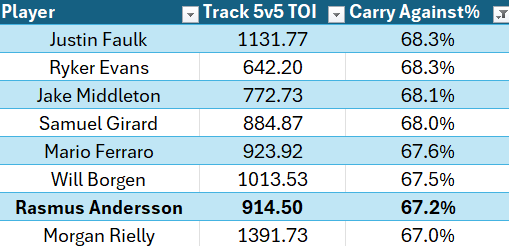
That list does not give us a lot of confidence.
This is important to know because Vegas is a prime spot for our fantasy goalies to rack up wins as the Golden Knights have won over 50% of their games (24/47 heading into Monday night). But none of their goalies have a .900 save percentage and Akira Schmid is the only one with a goals against average under 3.00. Whitecloud had been on the ice for a lot of goals against, so maybe there’s some improvement for the netminders on that front alone, but I’m not sure this will be an upgrade defensively for the Golden Knights. Andersson is the better offensive defenceman by a good margin, but the jury is still very much out as to whether his presence will help Vegas’ goaltenders. (jan20)
5. Going the other way to Calgary is Whitecloud and, as mentioned, he had been on the ice for a lot of goals against in Vegas this season (over 3.0 per 60 minutes at 5-on-5). However, that is unusual for him as his prior four seasons had all seen goals against rates between 2.0 and 2.5 per 60 minutes. Vegas has been getting their defencemen more involved in the offence this year than they usually do, and it’s only a half-season sample, so I wonder if there weren’t some adjustment issues and small-sample noise going on here. On top of that, Whitecloud allows far fewer carried zone entries against than Andersson does, and he’s more in line with other top Calgary defencemen:
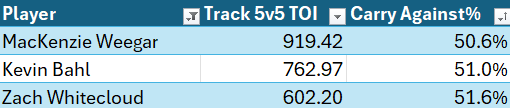
With Whitecloud’s ability to limit carried zone entries, and his usual ability to keep the goals against low, this could be a trade that helps out the Calgary goalies. It won’t help the team offensively, and that’s a problem for the goalies in terms of getting wins, but it wouldn’t be surprising to see Whitecloud help suppress shot volume and/or quantity over Calgary’s final 30+ games and help improve the ratios for Dustin Wolf and Devin Cooley. (jan20)
6. Filip Chytil returned to the Canucks lineup on Friday after missing three months with a concussion. Chytil is a Band-Aid Boy because of the multiple concussions he has had in his career and is thus hard to trust in fantasy despite his talent. There was discussion on Canucks talk radio this week about whether moving him to the wing would help. Chytil was held without a point while centering a line with Brock Boeser and Drew O’Connor in his return. (jan24)
Chytil missed over three months with his latest concussion, which is his sixth documented in his career. At this point we can only hope that he can stay healthy because he can be an impact player for Vancouver when he’s in the lineup, but at a certain point his long-term health has to be at the forefront of any conversation. (jan23)
7. Since his healthy scratch, Dougie Hamilton has points in six consecutive games, including an assist on Friday. The Devils need Hamilton right now with Luke Hughes having recently been placed on LTIR with a shoulder injury. Hamilton is even back on the top power play. Dare I say, Hamilton might even represent a buy-low opportunity while the Devils perhaps showcase him.
Still with the Devils, Jack Hughes has no goals since December 23, the day he returned from his freak hand injury. That’s 15 games ago. Perhaps that hand (finger to be exact) hasn’t fully healed. Despite the lack of goals, Hughes has 11 assists over his last 12 games and is still on close to a point-per-game pace (32 PTS in 33 GP). (jan24)
8. The big news from Monday was that Florida Panthers winger Matthew Tkachuk made his season debut after missing the team’s first 47 games due to multiple offseason surgeries. Going into last Monday night’s game against San Jose, the Panthers sat four points back of the final Wild Card playoff spot and eight points back of third place in the Atlantic. There is more than enough time for Tkachuk to make a difference and get the Panthers to the postseason, though the Eastern Conference playoff race has shaped up as a monkey knife fight. (jan20)
9. William Nylander is dealing with a groin injury, according to David Alter. Toronto coach Craig Berube didn’t know when Nylander would be back on the ice for practice, let alone game play, so this seems like it won’t be on the short-term side.At time of writing, there were just 16 days left until the Olympic break. (jan20)
10. Buffalo signed winger Josh Doan to a seven-year extension worth a little under $7M per season. He is in the midst of a breakout year with 15 goals, 20 assists, and 11 power-play points in 49 games while averaging just 16:04 per game. Once (if) he starts getting more ice time, this is a 30-goal/40-assist winger in the making. (jan22)
11. After Brandon Hagel started the season with one point in seven games, there were many poolies unwilling to wait on him, and those who dropped/traded him early are now kicking themselves. Entering Saturday, he had 46 points in 37 games since October 25, adding exactly three shots per game, and a plus-33 rating to boot. He's now flirting with last year's 90-point pace again. (jan21)
12. Konsta Helenius made his NHL debut Monday, and then found the scoresheet courtesy of primary assists on each of Noah Ostlund‘s two goals. He then potted his own goal before the first period was over for good measure. Helenius probably won’t finish his career as the all-time leader in points-per-game, but his easy transition to the AHL with 30 points in 34 games as a rookie prior to making the jump to the NHL. There’s room for him to stick in the top-six long term, and if this is any indication, he’s not getting sent back down. (jan21)
13. Valeri Nichushkin worked his way back to the lineup Wednesday after being in a car accident on the way to Monday’s game. He is a fascinating case, having shown nearly nothing in terms of breakout signs at the NHL level (previous career high of 29 points) before his 69-point season in 2021-2022, and then suddenly becoming at least a 65-point player every season from his age-26 season up to this year as he turns 31. His recent cold streak of one point in nine games since the calendar flipped to 2026 has dropped his pace this season down to 55, and his shot rate has been terrible over that stretch too. It’s likely a blip on the radar, but certainly something worth monitoring. (jan21)
14. I made a couple of trades over the last week across a few of my leagues. Sometimes I think reviewing more tangible trades and the thinking behind them might be more interesting/enlightening than just giving some boxscore stats and which plays are maybe due for some kind of streak based on underlying numbers. You can let me know if you prefer one or the other.
In the meantime, let’s review some trades:
Chris Kreider for Jonathan Toews
In my cap-league dynasty, I was working around trying to shed a few dollars in order to have room to buy a player or two. Chris Kreider was my weakest cap-to-production ratio player, but none of the GMs shopping the bigger fish were interested in Kreider as part of a return, despite some higher end picks and prospects being tossed out as well. Which meant that I had to find a different home for Kreider so that he didn’t have to be the poison fish included in the return for a better player. In my perusing of some other teams’ rosters I noticed that Jonathan Toews had put together a decent hot streak of late, which put him at least close to Kreider for production, and costing $4.5 million less against the cap. Kreider will be a cap league bargain in two years when he takes a small deal somewhere to go and win a cup, but in the meantime I’ll roll the dice that Toews is getting his legs back under him a little.
Despite Toews’ TOI being virtually the same in Q1 and Q3, he has nearly matched the eight points in 19 games, in just his last eight games. The shot volume is especially
interesting, as it has gone from under 1.5 per game to almost 2.0 per game of late, which also lines up with an uptick in PP minutes. Whether this new production level sticks or not (I’m skeptical), it’s good to see Jonathan Toews back and healthy enough to play at an NHL level. (jan21)
15. Mikhail Sergachev for Sebastian Aho
In my yearly-re-draft Roto league, I swapped my Mikhail Sergachev for Sebastian Aho in what could simply be described as “I needed a center while the other GM had five good ones and needed a defenseman”. I was open to receiving any of Roope Hintz, Nico Hischier, or Aho, but Aho was the one that fit a little better into my team need for more scoring, while also getting a boost in SOG and FOWs.
Sergachev meanwhile was tough to give up, ans his SOG and Blk volume were very solid, but since I also own Miro Heiskanen Vince Dunn, Brandon Montour, and Matthew Schaefer, his skillset was redundant. Sergachev used to provide so many more Hits, but he has really dropped off in that column in recent years. His only two seasons with less than one Hit per game are the two most recent season in Utah, and for what his name commands at the draft table and on the trade market, the peripherals for a 55-point defenseman need to be a little higher. (jan21)
16. Bringing in J.T. Miller, MacKenzie Weegar, and Mikael Granlund for Matt Duchene, Jamie Benn, Trent Frederic, and a bucketload of picks.
This one was for my 12-team H2H partial keeper, where I needed to make a move to keep pace with the other top teams. I targeted peripherals, and had more picks than most other contenders, as well as a few streaming spots that were currently occupied by the three players I sent back.
J.T. Miller is on a Hot streak of six points in three games, which has brought him up to a 60-point pace. He has the upside for much more than that, and in H2H leagues you need your players to be at their best for the end of the season, which is hopefully where Miller is headed. The Rangers also have a fantastic playoff schedule for this H2H league which has the playoff weeks from March 16th to April 5th.
MacKenzie Weegar is in a similar boat to Miller, where the peripherals are strong, but the scoring has really dropped off. Now, I don’t expect Calgary to suddenly become a great team in the stretch run, but even a couple more points would make a big difference now that Rasmus Andersson has left a bit of a scoring void to be filled, Even if the scoring doesn’t go up though, the two Hits, SOG, AND Blks per game is just fantastic and basically not available anywhere else. Bonus: this league doesn’t count plus-minus, so Weegar’s minus-24 rating is of zero concern.
I seem to have a love/hate relationship with Granlund this year, as I owned him in two leagues at the outset, but after dropping/trading him in those two leagues earlier this year, I’m now trading for him in a third league. Context matters though, and in my Cap and Roto leagues, the category coverage just wasn’t what I needed, whereas the volume in a H2H league with the Anaheim off-nights are a lot more useful. After an injury in Q1 and a slower Q2, Granlund’s offence is still dropping a little in Q3, but the peripheral volume has ticked up a little with his ice time. The scoring is reasonable, and the SOG, Hit, and FOW volume really helps, especially since he’s one of those players on Yahoo who is eligible at all three forward positions.
Locking up the peripherals categories, along with some decent goaltending should put me in a great position to win just about any matchup from here to the end of the season. Hopefully worth the cost. (jan21)
17. It happens all the time: a young player enters the league, shows a lot of promise early on, and never really takes that next step forward (just ask New York Rangers fans). However, there are times when the player just needs to work things out under a new coach/system or develop other skills, and then they elevate their performance (Nick Suzuki and Clayton Keller come to mind). With fantasy managers in keeper/dynasty leagues coming up on their Trade Deadline in the next month or so, it is worth reviewing some of the younger players who’ve not taken that next big leap forward, why that’s the case, and whether they’re showing signs of being able to take that step.
Today, we are going to focus only on forwards. Player data is from Evolving Hockey and tracking data is from All Three Zones.
Cole Perfetti (Winnipeg Jets)
From 2021-2025, Cole Perfetti averaged 2.32 points per 60 minutes at all strengths. That isn’t a high-end mark, but it was around a 70th percentile point production rate, which is a top-tier second-line mark in that span. So far in 2025-26, that point rate has cratered to 1.66 points/60 minutes, which is roughly in the 34th percentile, or a mid-level third-liner. With Perfetti crossing the 200-game mark late last season, and turning 24 years old a few weeks ago, this should be a season of ascent, but it’s been one of descent instead.
One clear culprit is he’s shooting 5% against a four-year average of 11.9%. Even still, if he were shooting 11.9%, it’s only four extra goals, and a 42-point/82-game pace. That isn’t what we’re looking for.
The big problem is the power play. In 2025-26, Perfetti is managing a point on just 37.5% of power-play goals with him on the ice. His career average up to this season was 60.4% and he has not been below 55.5% in any single season. The question is whether that will rebound.
To figure this out, we’re going to do the following:
- Find PP goal participation (individual points percentage, or IPP) among regular forwards from 2021-2024, restricting our sample to forwards with at least 400 PP minutes and a PP IPP rate of at least 60%.
- See which players’ PP IPP fell under 60% in 2024-25 (minimum of 150 PP minutes).
- Look at whether it’s rebounded so far in 2025-26 (minimum of 90 PP minutes).
The answer to that final bullet point is: Yes, sort of. Using the above parameters, we get 14 forwards, and here’s their average PP IPP from 2021-2024, the drop in 2024-25, and what’s happened so far in 2025-26:

The reason why it’s a ‘sort of’ is that there has been a rebound, but not back to the level of the three years from 2021-2024. On top of that, only 2 of 14 forwards in the sample have a PP IPP in 2025-26 that is the same as, or larger than, their PP IPP from 2021-2024: Evgeni Malkin and Timo Meier. Over half the forwards (8/14) haven’t gotten back to the 60% mark.
This is a small sample, of course, with just 14 forwards included and this NHL season still with roughly 40% of the games left to play, but Perfetti’s PP performance this year is a bit of a red flag. What would help more than anything is if he got a regular top PP role in Winnipeg, which is a big ol’ TBD. (jan22)
18. Mason McTavish (Anaheim Ducks)
If you told me before the season that we’d get to late January with the Anaheim Ducks being above average by goals per game with a power play scoring 60% more often than last season, I would have drafted Mason McTavish way more often than I did. No one told me that, which is a good thing because McTavish is seeing a per-game declines in goals, assists, shots, and power-play points per game.
The long and short of it here is that there’s nothing really going on with McTavish – the production is down a bit across the board but no massive drop off from the last two seasons. Rather, it’s the rest of the team that has seen a massive change, which is no surprise to anyone that saw what Leo Carlsson, Cutter Gauthier, and Beckett Sennecke did through the first 40-ish games. To make that point, here is the team’s goal-scoring rate and shooting percentage with McTavish on and off the ice across the 2023-2025 seasons:
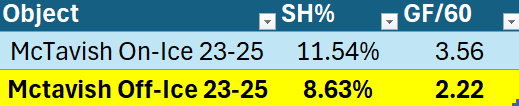
And here is Anaheim’s goal-scoring rate and shooting percentage with McTavish on and off the ice so far in 2025-26:
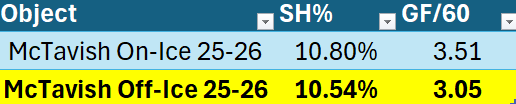
The goal scoring with McTavish is nearly identical to his last couple of years, it’s just what the team is doing when he’s not on the ice that has changed.
In a way, this is a good thing. While McTavish hasn’t taken off production-wise yet, having a higher scoring environment will help in the long run. With the big six-year contract extension he signed a few months ago, McTavish is also clearly a big part of Anaheim’s future, which looks very bright with guys like Carlsson, Gauthier, and Sennecke doing what they’re doing.
All this is to say that it might not be a bad idea to see if the fantasy manger with McTavish on their roster is a bit frustrated, especially if they’re pushing for a league title. There are no red flags here – whether his shot or expected goal rates, his tracking data, or anything else – and this is more about the team around him getting better than anything else. Having much more productive teammates to skate with will only help McTavish in the future and seeing as he’s not even 23 years old yet, the next five years of his fantasy value still hold a lot of promise. (jan22)
19. Quinton Byfield (Los Angeles Kings)
As things stand, Byfield is not pacing for either a 20-goal or 50-point season. It is safe to say that is a big disappointment, and anyone that was hoping for a breakout season from him has been left holding the bag.
It is a wonder how much is on Byfield and how much is on the team around him. When looking at the 5-on-5 tracking data, I limited the sample with the following parameters:
- At least 700 tracked minutes from 2021-2025 and 100 tracked minutes in 2025-26
- A 20% increase in assists on teammate scoring chances
- A 20% increase in contributions off the cycle/forecheck (shots and assists)
- A 10% increase in rate of zone entries
Here are the players that came up:
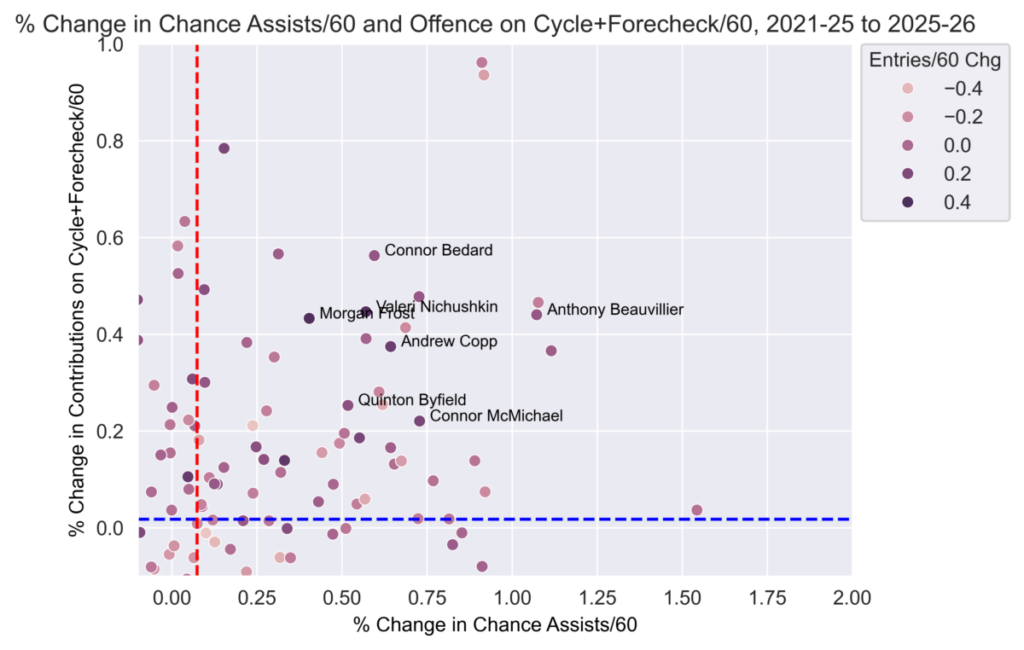
The other six forwards are Andrew Copp, Anthony Beauvillier, Connor Bedard, Connor McMichael, Morgan Frost, and Valeri Nichushkin. Here is how those six forwards fared by points/60 at 5-on-5 from 2021-2025, how they’re doing in 2025-26, and how that compares to Byfield:

Despite across-the-board improvements in tracking data we know can lead to production, Byfield’s production has fallen off a cliff whereas the others have improved by a good margin. With Adrian Kempe having his worst season in a few years and Kevin Fiala‘s assist rate dropping off the map, we have to believe one of two things here:
- Quinton Byfield, despite increasing a lot of key tracking metrics, has somehow gotten worse where others have gotten better.
- The Los Angeles Kings are a poor offensive team and while there is no singular reason, their brilliant general manager intentionally making their blue line considerably worse in the offseason is not doing any of their forwards any favours.
I know where my money is. (jan22)
20. In yesterday’s Ramblings, we covered three young forwards (Cole Perfetti, Mason McTavish, and Quinton Byfield) who’ve yet to really take that next step in their offensive production, why they haven’t, and whether they will. In today’s Ramblings, we’re going to do the same thing, but move to the blue line and see why a couple highly-touted defencemen haven’t taken a big leap forward in their offensive production.
Player data is from Evolving Hockey or Natural Stat Trick with tracking data from All Three Zones.
Cam York (Philadelphia Flyers)
In 2018-19, York put up 65 points with the US National Team Development Program. It remains the second-highest total ever with the three-highest totals after him being Lane Hutson, Adam Fox, and Quinn Hughes. The all-time leader is Cole Hutson, who is currently at Boston University and leads the NCAA in points per game among defencemen. Given that company, we could be forgiven for thinking York would be an offensive force.
At the time, some prospect analysts noted that York’s profile wouldn’t necessarily translate to a lot of points in the NHL, something I dismissed. Well, so far, those analysts have been correct as York’s 82-game pace from 2022-2025 was 27 points every 82 games. He is on a 39-point/82-game pace in 2025-26, but his points/60 minutes rate of 1.24 isn’t that much higher than his career-best mark of 1.13 back in 2022-23. A mark of 1.24 points/60 this season, a career-best, is still outside the top-50 blue liners in the league.
Prior to the 2025-26 campaign, there were two reasons why York wasn’t producing much:
- The Flyers’ power play was dead last in the NHL at 4.44 goals/60 minutes from 2021-25. That mark was 1.39 goals/60 lower than the next-worst team (Anaheim, 5.83), which is a bigger gap than Anaheim and the 10th-worst team (Buffalo, 7.2). Not really a spot to rack up the power-play points.
- York didn’t really get involved in the offence once the puck crossed the red line.
To that second point, here are the two defencemen with rates of zone entries/60 minutes and contributions off the cycle+forecheck/60 minutes (shots and assists) in the four years from 2021-2025:
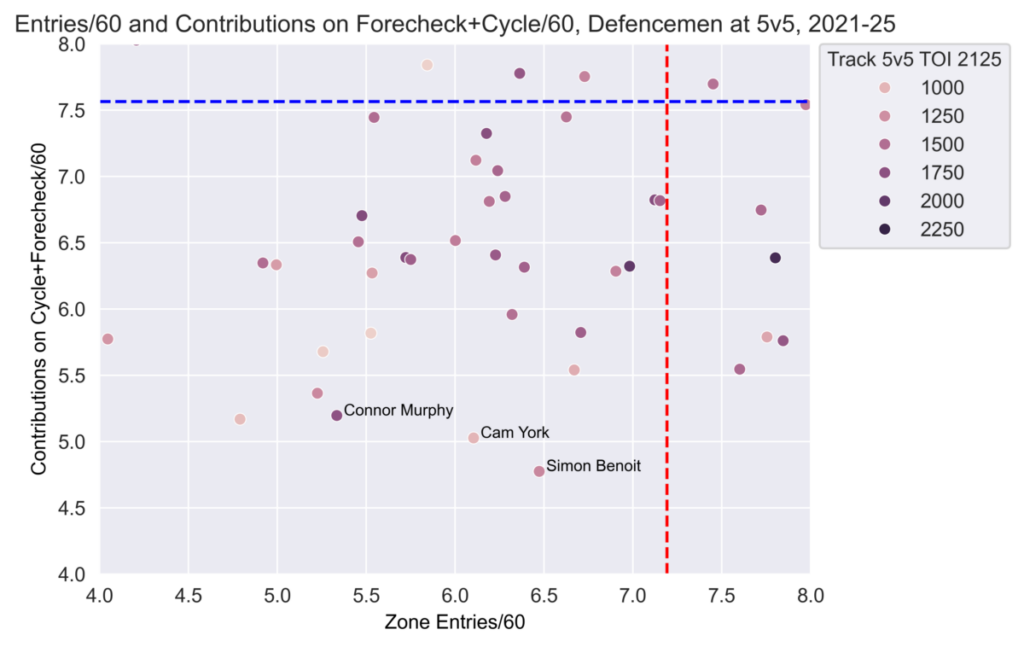
Needless to say, ranking next to Simon Benoit and Connor Murphy in terms of zone entries and getting involved in the cycle is not where a defenceman wants to be if they want to rack up the points. There is a reason why York’s rate of points/60 at 5-on-5 across those four seasons was in the 32nd percentile, or a bottom-pair rate.
Looking at the 2025-26 season, things have improved for York as he sits with 1.01 points/60 at 5-on-5, which is a 63rd percentile mark, or a high-end second-pair option. That still isn’t great, but it’s above-average, and much better than his first four years. With that said, being a 63rd percentile point producer at 5-on-5 on a team with a bottom-3 power play by goals per 60 minutes still isn’t very good. And when looking at the tracking data again, here is York’s closest comparable by percentage drop in both contributions off the rush and off the cycle+forecheck while having a below-average rate of zone entries:
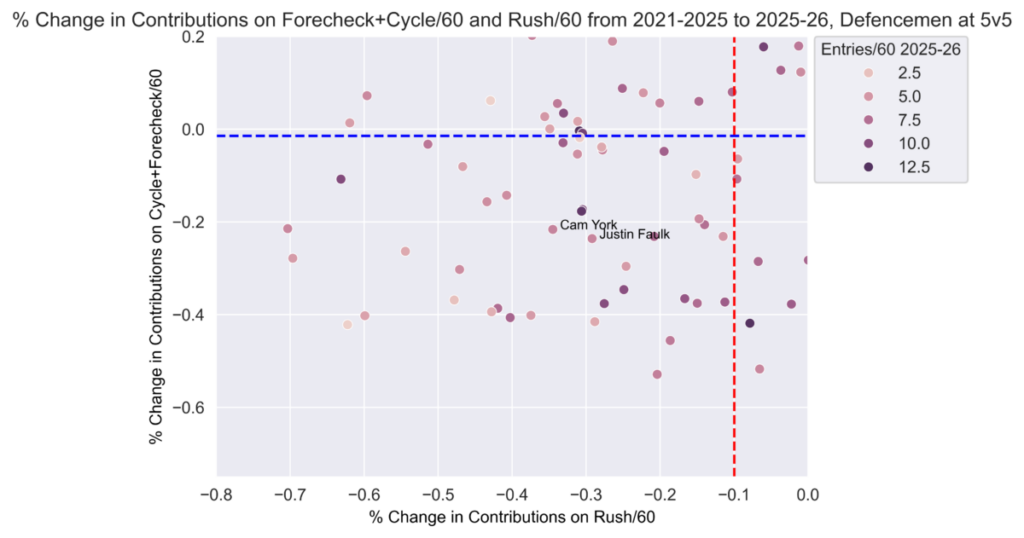
Much like ranking near Simon Benoit and Connor Murphy earlier, ranking near a 33-year-old Justin Faulk is not the place for York to be by rush and cycle contributions combined with zone entries. Faulk is having a decent fantasy season, but it’s also because he’s shooting 11.7% against a three-year average of 3.8%. If Faulk were shooting around 4%, his 82-game pace would be 26 points.
York turned 25 years old earlier this month. Under new coach Rick Tocchet, there has been a change in the team approach to their offence compared to recent seasons as they focus less on offence off the rush. That wasn’t a spot where York ever thrived, so it’s not a big deal for him, but that he’s seeing declines elsewhere is not a great sign. Maybe he finishes close to 40 points, but that may very well be his realistic fantasy upside. York’s saving grace is the team doesn’t have a reliable PP defenceman, and he may be the best option of a bunch of lesser options. Some top PP time, even on a bad PP team, is better than none. (jan23)
21. Owen Power (Buffalo Sabres)
Going into Thursday night’s game in Montreal, Power was sitting with 0.94 points/60 minutes at 5-on-5. That is lower than last year (1.25), the year before (0.99), and the three-year average prior to 2025-26 (1.05). Buffalo’s goals against rate at 5-on-5 with Power on the ice is by far the lowest of his career (2.40), and the team will be happy with that, but the point production is what matters for fantasy managers, and the production has been modest.
To start with, Power is fighting an uphill power play battle. Having Rasmus Dahlin as a teammate provides a significant impediment to top power-play time, and while Power may take that role eventually, it doesn’t seem as if it’ll happen anytime soon (as in years, plural).
Last week, I wrote about how defencemen botching defensive zone retrievals or failing to exit the defensive zone when they have the puck is very detrimental to their team’s offence. However, limiting those botches and failed exits can help a team’s offence. That is exactly what Power did as a young defenceman as he was among the best defencemen limiting those botches and failed exits (red and blue lines are league averages, his bottom-left quadrant is the lowest in both areas):
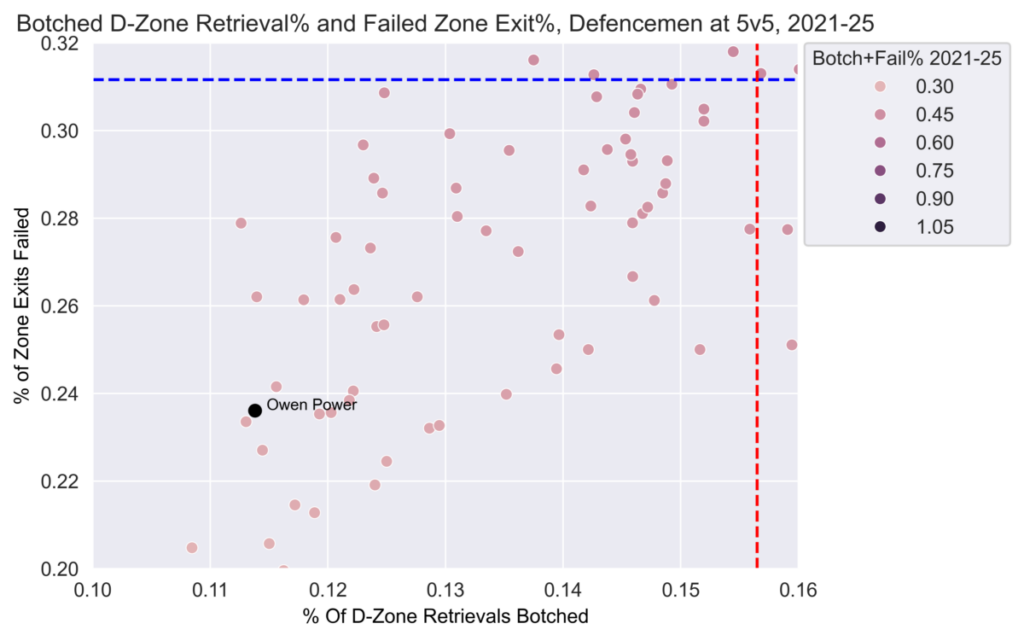
There are a few reasons why Buffalo’s goal-scoring rate with Power on the ice from 2021-2025 (3.1 goals for/60) was tied for 10th in the league among all regular defencemen and in line with names like Cale Makar (3.12) and Erik Karlsson (3.1). That is one of them.
It has been a different story in 2025-26. He has seen one of the largest increases in his botch+fail percentage while also seeing a big decline in his rate of zone entries per 60 minutes. Put it all together, and the decline in those two aspects has him among a very mixed bag of defencemen:
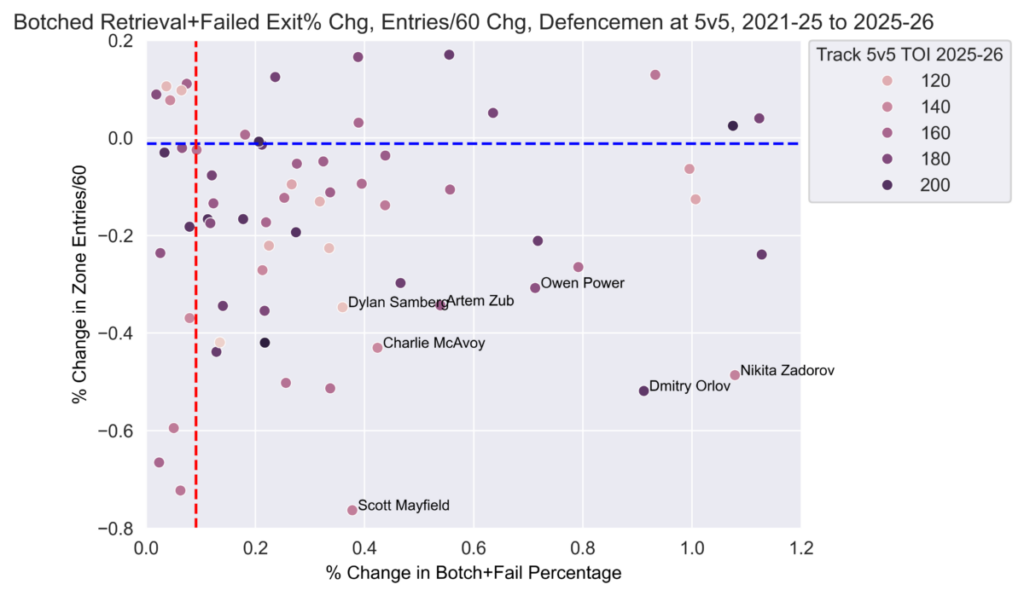
Charlie McAvoy is a fantasy-relevant defenceman in all formats, but that is largely because of his top PP role. Without that, he’d be most viable only in multi-cat formats. Other than McAvoy, these defencemen are streamers, multi-cat guys, or deep-league options. And Power is similar to McAvoy in the sense that if he can get top PP time, then he’s viable in a lot of formats. If he can’t (and Power won’t), then he turns into a streamer/deep league option.
We should give Power some grace as he’s under 300 NHL games and as a 6’6″ defenceman who just turned 23 years old in November, he still has some improvements to come. However, he has yet to take that next step offensively, and even when (if) he does, there is a Rasmus Dahlin-sized roadblock to getting top PP minutes. Considering his limited peripherals – yet to have a season with either 1.8 shots or 0.6 hits per game – and the lack of top PP time, Power may very well end up being one of those ‘Better In Real Life Than Fantasy’ options. (jan23)
—
Have a good week, folks!
Thanks for continuing to support the website and if you’re bored and need a fantasy hockey fix – visit the gang in the forum here.
Related Posts
Starting Goalies













Top Skater Views
| Players | Team | |
|---|---|---|
| TRISTAN LUNEAU |
 ANA ANA | |
| LUCA CAGNONI |
 S.J S.J | |
| ADAM JIRICEK |
 STL STL | |
| MARCO ROSSI |
 VAN VAN | |
| IGOR CHERNYSHOV |
S.J
| |
Top Goalie Profile Views
| Players | Team | |
|---|---|---|
| JOEL HOFER |
STL | |
| NICO DAWS |
 N.J N.J | |
| DYLAN GARAND |
 NYR NYR | |
| ARTURS SILOVS |
 PIT PIT | |
| SERGEI MURASHOV |
PIT
| |
LINE COMBOS
| Frequency |
 T.B Players T.B Players
| |
|---|---|---|
| 20.1 | BRAYDEN POINT NIKITA KUCHEROV GAGE GONCALVES | |
| 16.4 | ILYA MIKHEYEV PONTUS HOLMBERG ZEMGUS GIRGENSONS | |
| 15.5 | BRANDON HAGEL JAKE GUENTZEL ANTHONY CIRELLI | |
DobberHockey Podcasts

Keeping Karlsson: Short Shifts – I Tried to be Like Parker Kelly
Elan is joined by Ryan Downey for the premiere of season 8 of Short Shifts! — KKUPFL late registration is ongoing! We’re still filling new divisions in the world’s greatest fantasy hockey league. Details at https://www.kkupfl.com/. Join the Keeping Karlsson patron community! Patrons get access to all our perks all year round, including KKUPFL […]
Keeping Karlsson: Shabanov Ranks
Elan and Brian fly through the final preseason lines for every NHL team ahead of opening night, and share their guys to watch– or look away from– in your fantasy hockey leagues.

Fantasy Hockey Life: Western Conference Catchup and Mustard
Jesse and Victor are here to Catch Up on everything in the Western Conference that transpired ofter our team previews. We also have our annual spicy mustard competition – two hot takes per team. Our show is part of the Dobber Podcast Network and sponsored by Fantrax.com. Email [email protected] and ask to join our free […]
Keeping Karlsson: Matchup Maximizer 2026/27 Week 1
Elan takes a look at the schedule for the upcoming weeks of NHL action and recommends players with good schedules that you should consider streaming in to win your head to head matchups.
Fantasy Hockey Life: Dallas Stars with Taylor Newby
Taylor Newby joins the program to discuss the Dallas Stars.