

21 Fantasy Hockey Rambles
Dobber Sports
2026-05-03
Every Sunday, we share 21 Fantasy Rambles from our writers at DobberHockey. These thoughts are curated from the past week’s 'Daily Ramblings'.
Writers/Editors: Ian Gooding, Michael Clifford, Alexander MacLean, Puneet Sharma, and Dobber
___
1. It was a panicked Friday for the Oilers the day after they were knocked out of the playoffs. Connor McDavid is getting traded! The Oilers have wasted away all of his prime years! Why can’t they ever find a goalie!
First off, a McDavid trade would have a massive impact in fantasy leagues. I don’t think it will happen this summer, but Edmonton’s window is slowly starting to close. One could very well drop by the time his team control ends in two seasons.
It is very hard to win a Stanley Cup, and with another break or two McDavid and company might have hoisted it after one of their matchups with Florida. As for this season, don’t discount injuries being a factor. Both Leon Draisaitl and Zach Hyman missed games late in the season and may not have been 100 percent for the series.
For the past few years, I’ve said that McDavid will win a Cup sometime in his career like the other greats of hockey, but he may or may not win it for Edmonton. If you think his time has passed, look at how long it took Alex Ovechkin to finally win a Cup. Ovechkin won when he was 32. McDavid is now 29. McDavid’s personal cup window is far from closed.
As for the goaltending, I’m not sure it matters who the Oilers bring in if they don’t fix their defense, unless they can find a truly elite goalie and not just a hot hand from another team. Evan Bouchard was the runaway leader among defensemen in scoring this season, but he was left off Canada’s Olympic team because of concerns about his defensive ability. Mattias Ekholm is a 35-year-old depreciating asset, while Darnell Nurse does not play defense at a level consistent to his contract. Until upgrades are made on defense, Edmonton is a goalie graveyard for the sake of fantasy leagues. (may2)
2. I wanted to look into some players who saw their numbers drop in 2025-26, and see if we could deduce whether these players are in for a bounce-back in 2026-27, or whether it’s a sign of an inevitable decline.
After putting up a point-per-game scoring rate across three seasons from 2020-2023, the next three seasons have seen Hintz average a 70-point pace instead. He is going to be turning 30 this fall, and one does have to wonder if his ceiling is now 75 points. This past season, Hintz began the campaign as a point-per-game player once again, with 16 points in 16 Q1 games. He tailed off a little before losing the back end of the season to injury.
Interestingly, Tyler Seguin‘s injury corresponds to right about where Hintz tailed off, and Seguin was Hintz’s second-most common linemate at the time. It’s tough to pin Hintz’s point-per-game hopes on a 35-year old Seguin who just missed two-thirds of a season, but another hot start from Hintz alongside Seguin would point to just that. He might be someone to sell-high on early next year, assuming Hintz himself is healthy enough at the time.
One other marker to note, is that Hintz’s OZ start percentage was hovering around 60% for the three peak years in his career, but have been trending down and hit 45% this past season. That has likely had a big impact on the scoring numbers as well. The timing lines up with when Matt Duchene joined the Stars, and needed to be more sheltered than Hintz. Something else to keep an eye on. (apr29)
Verhaeghe peaked with two seasons above 70 points, but has been back down in the 50s for the previous two. After being stapled alongside Matthew Tkachuk and Sam Bennett for his peak seasons, the biggest change in over the last two years has been his linemates. He has seen time with Aleksander Barkov, and then more recently while both Barkov and Tkachuk were shelved, Verhaeghe played with Bennett and Brad Marchand, where his shot rate cratered.
The good news for the 30-year-old Verhaeghe is that since Tkachuk’s return after the Olympic break, they were reunited with Bennett and finished the season strong – Verhaeghe had his beast stretch of the year with 12 points in his final 16 games playing with Tkachuk, and his shot rate ticked back up a bit too, though it was still below the 3.0 mark where he was in his 70-point seasons.
I would treat Verhaeghe as a 60-point player going into drafts next year, as a full season with a rested Bennett and Tkachuk should provide value, but it’s likely not worth drafting/acquiring him and expecting him to provide value at the cost of a 70-point player. (apr29)
4. Sam Reinhart
Sticking in Florida, I’m less worried about Sam Reinhart returning at least to his 80-point ways (though the 57-goal season two years ago is something he’s not coming close to again). With common linemate Aleksander Barkov returning in the fall, Reinhart should be able to regain his usual form on Barkov’s right side.
One funny stat though, is that Reinhart’s faceoff numbers hit a six-year-low for faceoffs taken, despite Barkov not being in the lineup and eating up his usual heavy burden. (apr29)
It seems ridiculous to put a 40-year-old on a list like this, and while we know there has been some decline from Ovie from where he was in his prime, he still puts up incredible numbers. On top of that, everyone is going to want to know what to expect of him next year. Diving into his historical numbers and underlying stats, this season’s 64-point pace seems entirely repeatable. Scoring at his career average shooting percentage of 13.2% on 210 shots next year (career-low 2.8 shots per game across 75 games) would be 28 goals, to go with 29 assists (keeping last year’s .39 assists per game mark for 75 games), then that’s above a 60-point pace over a full season. Assuming Ovie returns, then projecting a 60-point player with 210 shots, 20 PPPs, and 120 Hits sounds about right for another kick at the can from an all-time great. (apr29)
6. Jesper Bratt
After two seasons over a point-per-game, Bratt dropping back to being a low-70s scorer was a disappointing development. The Devils overall were a disappointment on offence, which should hopefully rebound naturally next year, especially with some better health from Jack Hughes. The good news is for Bratt, is that the Devils’ lack of ability to score with him on the ice is corrected with some positive regression. If the only underlying number that changes from last season to next season for Bratt is that the team’s 5on5 shooting percentage with Bratt on the ice increases from an incredibly low 7.4% to an NHL average of about 10.0%, then Bratt’s scoring pace immediately jumps to 84 points. If Bratt’s ice time or shot rate tick back up a little as well, then we’re looking at an 85-point season, to go with around 100 Hits from a winger who may fall outside of the top 75 in drafts next season. He’s likely going to end up on a lot of my squads next year. (apr29)
7. A few other quick hits on possible rebounds:
–J.T. Miller‘s first half was terrible, but his second half was the fantastic player he has been the previous four seasons. He’s a point-per-game player and his 64-point pace from last season is going to disguise that.
–Josh Morrissey has seen his scoring rate decline for three straight seasons, and this was despite being lucky at even strength last season. Beware expecting anything over 50 points next season.
–Jordan Kyrou is much more than a 50-point player, but I’m not sure he can hit 75 again without a perfect situation. I would be drafting for 60+ next year, and anything extra is gravy.
–Matvei Michkov is going to hit his breakout threshold halfway through next season, and despite the step back this year, the healthy scratch in the playoffs should light a fire under him for a productive offseason.
-Barring a trade, I’m not holding out hope on Elias Pettersson jumping back up above the 65-point threshold until the Canucks start to turn their team around, which is still many years away. (apr29)
8. Last week, my review of the 2025-26 fantasy hockey season started. First, we covered projections I missed among some key forwards, including Jonathan Marchessault, Dylan Lakrin, Sean Monahan, Mason McTavish, and Ville Koivunen. After that, we went over projection misses on the blue line, including MacKenzie Weegar, Dougie Hamilton, Vince Dunn, Kris Letang, and Sam Rinzel. Today, we’ll finish the three positions by reviewing projection misses among goalies.
Darcy Kuemper over Karel Vejmelka
This one wasn’t an outright projection, but a question during Bubble Keeper Week in August. It boiled down to this: keep Kuemper or Vejmelka?
My answer was that if I was pushing for a league title in the next year or two, it would be Kuemper. The belief is that even with the losses of Jordan Spence and Vladislav Gavrikov (replaced by Cody Ceci and Brian Dumoulin), the Los Angeles Kings would still be no worse than a mid-pack defensive team, and Kuemper was the locked starter for the franchise. Well, by the end of the season, Kuemper lost the net to Anton Forsberg while Vejmelka finished with the second-most wins in the league (38) and had a mid-tier goals against average. Vejmelka didn’t have a great season himself, but he played a lot of games for a good team and never lost his starting gig. That is worth its weight in gold.
As far as Kuemper is concerned, there is always the question of whether he was playing through some kind of injury. Up until December 15th, Kuemper had a .917 save percentage across 23 starts. That save percentage tied him with Andrei Vasilevskiy for third in the league among starters, and his 2.19 goals against average had him in sole possession of third place. It was a great start.
In a game on December 15th, Dallas forward Mikko Rantanen drove across the crease and hit Kuemper in the head with his arm. Kuemper left the game and missed the next two weeks with an “upper-body” injury. After returning on January 1st, Kuemper made 27 more starts and posted an .868 save percentage, fifth-worst among regular starters (and the bottom-5 were closely bunched together in their own tier of sadness). We may never know if Kuemper suffered a head/neck injury that affected the rest of his season, but it certainly seems possible. Either way, keeping Kuemper over Vejmelka clearly did not work out. (apr28)
9. Keep Sam Montembeault
In that same Bubble Keeper Week article, a question was sent in where a person needed to keep two players from a group of eight. While my recommendation was to keep Matthew Knies and Lukas Dostal, the person who sent in the question mentioned that they didn’t have their second- and third-round picks in their league’s draft. So, with 72 players kept across the league, and only one pick in the first three rounds, if the person didn’t keep two goalies, and didn’t take a goalie with their first-round pick, then 108 players (at minimum) would be off the board before getting a chance at their second goalie. It could have worked out if they managed to get someone like Jet Greaves or one of the Minnesota goalies, but it was a risk, so keeping Sam Montembeault instead of Matthew Knies was realistic.
I really hope this person didn’t keep Montembeault because he was one of the worst fantasy goalies that got any meaningful number of starts. As a fan of the Montreal Canadiens, I still don’t know what happened here. Montembeault posted a .902 save percentage across 143 games (139 starts) from 2022-2025, which wasn’t elite, but was very good considering how bad Montreal was defensively across those three seasons. In fact, among 36 goalies who faced at least 3000 shots in those three years, Evolving Hockey had Montembeault facing the third-most expected goals per 60 minutes, and the most outside of any goalie not in Anaheim. Despite that, he required the fourth-fewest shots against per Goal Saved Above Expected:

What that all means is Montembeault faced exceedingly high shot quality, but when taking that shot quality faced into account, he performed similarly to Ilya Sorokin and Igor Shesterkin. Montembeault was great behind the worst defensive team not named the Anaheim Ducks.
That is what makes his 2025-26 season so confounding. He went from one GSAx every 66 shots faced to one GSAx every 383 shots faced. He eventually lost the starting role and has not played a game since March 6th. Given the play of Jakub Dobes, Montembeault has at least lost the starter’s job, and if the team wants to keep Jacob Fowler in the NHL, then Montembeault may have played his last game in Montreal. He was very good for three years, so betting on him finding his way back is a good value bet wherever he lands for 2026-27, but this was a huge miss. (apr28)
10. Jacob Markstrom over Logan Thompson
I have discussed playing Best Ball formats this season, and one of the goalies I bet on a lot was Jacob Markström. He found his way to four of my 22 rosters, and he was going around the 16th goalie off the board. Once we got past the top-12 goalies, Markström and Montembeault were two goalies I drafted quite often, completely eschewing Washington’s Logan Thompson:
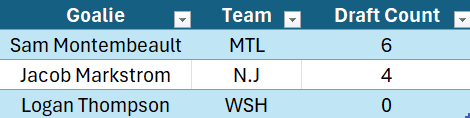
The top-12 goalie by ADP I drafted most often was Linus Ullmark (8/22 teams). That was a rough start but worked well in the second half, which is important for head-to-head playoffs. The goalie I drafted from outside the top-24 most often was Jet Greaves, and that worked well right until the final couple of weeks (10/22 teams). In between those two, though, it was an absolute horror show as both Markström and Montembeault were no-shows basically all season long.
At this point, it’s fair to wonder if this is the end of the road for Markström. He turned 36 years old in January and has an .896 save percentage over the last four seasons. Among 35 goalies with at least 125 starts in that span, that ranks 33rd, with only Elvis Merzlikins and Samuel Ersson ranking worse. By Evolving Hockey’s shots per Goals Saved Above Expected, Markström is 25/32 starting goalies across the last two seasons. He has been vastly out-performed by backup Jake Allen, and the Devils have a hard decision to make this summer about whether they believe in Markström to rebound or not (given that his contract extension kicks in this upcoming season, their decision might be made for them). We have seen older goalies bounce back in recent seasons – Cam Talbot and Darcy Kuemper come to mind – but this is a much more open question than it was 10 months ago. (apr28)
[Follow the link for more…]
11. As mentioned further above, my season review started last week, and this is what we’ve covered so far:
- Forwards whose projections I missed on badly.
- Defencemen whose projections I missed on badly.
- Goalies I missed on.
Today, we’re going to continue the season review, but shifting focus back to the forwards, specifically on younger forwards, and seeing which ones changed their market share of shot attempts.
The term ‘market share’ (or market%) might be unfamiliar to some, so for a bit of clarity, it’s the percentage of a team’s shot attempts (or shots on goal or expected goals) a player takes when they’re on the ice. So, if Edmonton creates 60 shot attempts per 60 minutes with Connor McDavid on the ice, and he takes 20 shot attempts/60 minutes himself, then his market share is 33%.
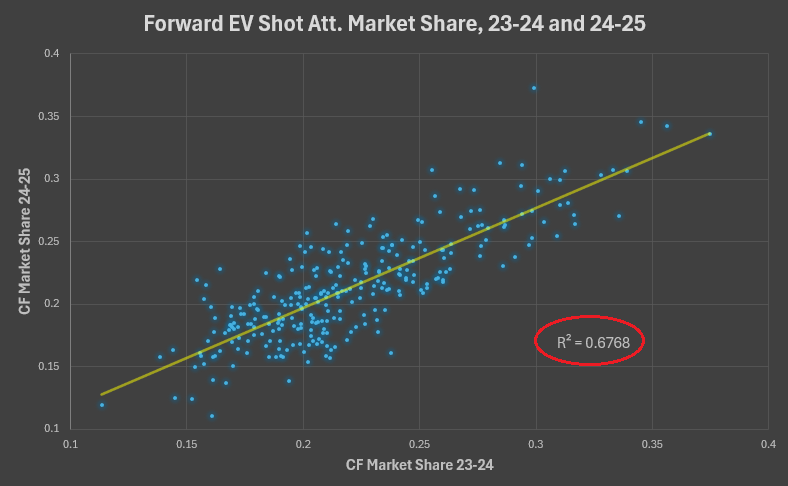
Our focus will be on shot attempts rather than shots on goal because the rate of shot attempts correlates better from one season to the next than shots on goal. For example, of all forwards with at least 600 minutes of even strength ice time in both 2023-24 and 2024-25, here is the correlation (the number in the red circle) of their market% of shot attempts from 2023-24 to 2024-25:
And the correlation of market% of shots on goal from 2023-24 to 2024-25 for that same group of forwards:
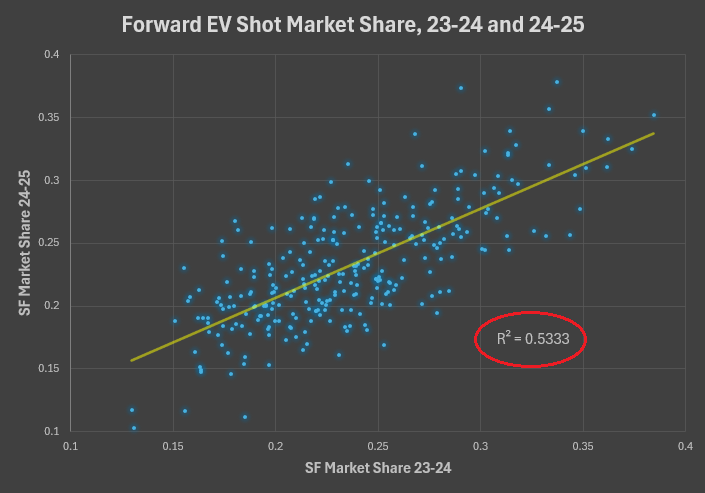
Shot attempt correlation is higher, which means it should be used rather than shots on goal. And just to ensure that the correlations aren’t a one-year blip, these are the correlations for market% of shot attempts and shots on goal among forwards with 600 minutes of even strength time in each 2024-25 and 2025-26:
- Shots on goal: 0.3855
- Shot attempts: 0.6766
Again, shot attempts correlate best from one year to the next, so that will be our focus. We are just looking at even strength rates (per Evolving Hockey) and excluding empty-net situations. Which forwards age-25 or younger saw big improvements in their market share of shot attempts?
Cole Perfetti (Winnipeg Jets)
Anyone banking on Perfetti to improve on his 50-point season from 2024-25 was bitterly disappointed in 2025-26, but it wasn’t a complete loss. Of the 246 forwards in our sample, he had the 10th-largest improvement in his market%, and the largest of any player under the age of 26:

He scored just 12 total goals in 68 games but did so shooting 8.8%. If he had shot 12% and played 82 games, he would have scored 20 goals. Including playoff appearances, Perfetti has over 300 career NHL games to his name, and next season is his age-25 campaign. It feels like a make-or-break year for him, and that he showed a big upswing in his shot rate is a good start. (apr30)
12. Shane Pinto (Ottawa Senators)
It was a weird year for Pinto, who scored 8 goals in 9 games to start the season and then scored just 15 times in the next 63 games. It did lead to a career-high 23 goals, though, and in the three seasons he’s played at least 70 games, he managed at least 20 tallies in each campaign. That consistency is underscored by Pinto coming in 13th by his raw improvement in shot attempt market%, and second highest among forwards in their age-25 season or younger:

Being responsible for about 25% of Ottawa’s shot attempts when he’s on the ice puts Pinto at a low-end, top-line rate similar to Lucas Raymond‘s and William Nylander‘s. It isn’t to say Pinto’s offence is on the level of those players overall (it’s not), but it does describe the security in goal scoring that Pinto has if he keeps skating around 17:30 – 18:30 per game. (apr30)
13. Connor Bedard (Chicago Blackhawks)
With 3.28 shots per game, Bedard’s 82-game pace for shots on goal was 269 shots – the average across his first two seasons was 219. Adding an additional 50 shots to that 82-game pace is a huge leap in his age-20 season, and that is backed up by his shot attempt market% having a big increase as well:

Put it all together and Bedard’s 82-game paces from 2025-26 were for 36 goals, 54 assists, and 269 shots, and that is as a 20-year-old skating on a team tied for the second-fewest goals scored. Another increase in market% anywhere close to the one he just had and Bedard will be among the elite volume shooters like Auston Matthews and David Pastrnak, and the only limit here is the quality of the roster around him. (apr30)
14. Tim Stützle (Ottawa Senators)
Requiring a lot of minutes for meaningful shot volume is always a concern because if the minutes disappear, so will the meaningful shot volume. We don’t really have to worry about that with Stützle because he’s Ottawa’s top-line centre until further notice, but it’s also nice to see his shot attempt market share rise at a rate that was very similar to teammate Pinto:

The issue is that this simply represents a rebound from a decline in 2024-25, as both his overall rates in 2022-23 and 2023-24 were higher than what he did in 2025-26. All the same, it is better to see a sizable rebound than a continuing decline, and had he played all 82 games, he may have reached the 200-shot plateau. He just turned 24 years old in January so he might be as much of a finished product as he’ll get, but he also might have another shot volume jump in the offing, and that would give us a lot of security in his goal-scoring and shot-rate floor as a high-end fantasy option. (apr30)
15. Aliaksei Protas (Washington Capitals)
People are calling Protas the Nikolaj Ehlers of Brandon Hagels, and by people, I mean me. Or, more simply, the question is, ‘What would Protas’ production look like if he got consistent top power-play time’. That is neither here nor there, it’s just pointing out he’s averaged 64 points every 82 games across the last two seasons and done so with just two power-play points.
The production is accompanied by elevated market% of Protas’ shot attempts:

That overall rate of 23.5% of the shot attempts is of a high-end second line forward, in line with names like Dylan Cozen and Rickard Rakell. That rate of shot attempts, with the ice time that Protas gets outside of the power play, including with the empty net, gives him a 20-goal floor. The ceiling depends entirely on whether the Capitals want to give him regular PP minutes or not. (apr30)
16. Leo Carlsson (Anaheim Ducks) and Juraj Slafkovsky (Montreal Canadiens)
A quick shout out to Carlsson and Slafkovský, both of whom saw a good increase in their shot attempts, if not to the level of the young forwards already listed:

Overall, their shot attempt market shares are those of mid-tier second liners, but both get top line and top PP time, so that helps with their shot volume floor. They also just finished their respective age-21 seasons, so another jump like this is very possible, and it would take them to genuine top-line shooting forwards at even strength. (apr30)
17. In yesterday’s Ramblings (above), we covered young forwards who saw an improvement in their market share (market%) of shot attempts, including Cole Perfetti, Shane Pinto, Aliaksei Protas, Leo Carlsson, and more. To see which rising (potential) stars got more shot-happy in 2025-26, go check that out.
Today, we’re again looking at the market% for young forwards, but this time looking at the declines. Just for some clarity, this is what ‘market share of shot attempts’ means:
Market share of shot attempts is the percentage of a team’s shot attempts taken by a specific player when they’re on the ice. So, if Carolina averages 60 shot attempts per 60 minutes with Andrei Svechnikov on the ice, and he takes 15 of those 60 attempts, his market share is 25% (15/60).
We use market% because sometimes a player will be shooting a lot but are stuck on a team (or with line mates) that don’t generate a lot of shots. Identifying players who take the shots can help find undervalued goal scorers in the fantasy hockey realm.
The focus of this article is on young forwards, or those who were 25 years old or younger in 2025-26. It is only at even strength (excluding empty net situations) and considers only those with at least 600 minutes of EV time in each of the last two seasons.
Matias Maccelli (Toronto Maple Leafs)
Two things can be true about Maccelli:
- He had a good rebound season going from Utah to Toronto by increasing his goals per game and nearly doubling his assists per game.
- There are signs of concern with that rebound.
That is why it’s worth highlighting that in our sample of 246 total forwards, he had the eighth-largest decline in market% of shot attempts, and the largest of any forward age-25 or younger:

Taking 18.2% of the shot attempts puts Maccelli near a fourth-line rate, and that is the concern. If he remains in Toronto, he is no higher than the third winger on the depth chart, and likely no higher than fourth if Easton Cowan continues his ascension. If Maccelli is skating under 15 minutes a game with secondary PP time, we cannot expect much more than a 15-goal, 45-point season with very low peripherals. That is not a valuable fantasy option. (may1)
18. Jack Drury (Colorado Avalanche)
When Drury was traded to Colorado, the hope was that he could turn into a middle-6 shutdown centre the team needed for future Stanley Cup runs. Since trading for Drury, the Avalanche have also traded for Brock Nelson, Nazem Kadri, and Nicolas Roy, which gives us a clear indication that the Avalanche do not believe that to be the case.
What is notable for Drury is that he has seen a big decline in shot volume since coming over for Carolina, and it’s led to him having the 11th-largest drop in market% of our 246 forwards:

The good news for Drury is that he shot 11.4% overall as a member of the Avalanche against a 6.2% conversion percentage in Carolina. That helps with racking up goals, but he played all 82 games this season and finished with 99 shots on goal. Without hyper-elite finishing talent, this kind of shot volume puts 20-goal seasons out of the question. He could have some depth fantasy value in leagues that count face-off wins (he had 563 this past season), but that’s about as far as it goes. He turned 26 years old in February, so the hope of further offensive upside is wearing thin. (may1)
19. Brady Tkachuk (Ottawa Senators)
For fantasy production, there were a lot of red flags for Tkachuk this season. He skated 16:58 per game, his lowest rate since his rookie season and 1:16 less per game than in 2024-25. He did not improve his finishing, shooting under 10.5% for the eighth straight season, and to top it off, his market% declined as well:

That drop in market% takes him from Jason Robertson/Tage Thompson territory to Jack Eichel/Dylan Holloway territory. This is a big problem for Tkachuk because his 30-goal seasons have been predicated on extremely high shot volume. He had 22 goals in 60 games, and that pro-rates to 30 goals in 82 games, so he can still get there, but it is not automatic in this new market%. And if the team’s shot volume when he’s on the ice declines, the problem gets much worse.
This is a precarious situation because if Tkachuk skates under 17 minutes a game at this shot rate, the potential for 40 goals becomes less likely, barring a shooting percentage spike. As fantasy managers, we will exchange some shot volume for better finishing, but without better finishing, we have to be more realistic about what we can expect. (may1)
20. Peyton Krebs (Buffalo Sabres)
With career-highs in goals (12), assists (27), shots (93), hits (201), blocks (41), and PIMs (78), I’m sure that fantasy managers in deeper multi-cat formats were not complaining about Krebs’ season.
The first thing to say about that is 5/12 goals and 8/39 points came on an empty net. Relying on a guy to get 20% of his production from the empty net is asking a lot.
The second thing to say is that Krebs saw a market% decline, and it was the 22nd-largest decline of our 246 forwards:

If we exclude the empty-net goals, Krebs’ goal-scoring rate at even strength actually declined when compared to 2024-25, and that came in a season where his most-common line mate was Tage Thompson. It isn’t unreasonable to think that playing with Tage means that there are fewer shots for Krebs, but it brings us back to the empty-net conundrum: how much can we rely on Krebs being 1 of 17 players with at least five empty net goals year after year? (may1)
21. Connor Zary (Calgary Flames)
I am hesitant to ascribe too many skill changes/declines to Flames forwards because they started clearing out their top skaters and kickstarted the rebuild, and that was part of the reason the Flames finished last in goal scoring. At the same time, Zary has not typically been a big volume shooter to start his career, and that got even worse in 2025-26:

Taking 18.4% of the shot attempts is a borderline fourth-line rate, and in line with names like Yanni Gourde and Parker Kelly. The difference between those two and Zary is that Tampa Bay and Colorado are elite offensive teams that can boost the scoring of secondary and tertiary players. That is… not the case in Calgary.
Sometimes, players can fall into a ‘better in real life than in fantasy hockey’ bucket and that may be the case with Zary. He has fewer than 200 NHL games and can still improve, but it is going to take a few years (at least) for Calgary to turn the ship around, and even if he earns more ice time as other veterans leave the roster, the Flames being so poor offensively will keep him from meaningful production; 20 goals and 40 points would be a good season. (may1)
Quickly, I also want to touch on Adam Fantilli of the Columbus Blue Jackets because it was a bit of a weird year. In my weekly newsletter, I covered how Fantilli’s playmaking numbers took a leap in 2025-26. One issue is that it came at the expense of shot volume as he saw his market% decline:

It is true that his shots per game increased, but a big part of that was because of the power play. He had 51 shots on goal with the man advantage in 82 games, more shots than he had in the first 131 games of his career. If his power-play shot rate had stayed constant to what he did in 2024-25, his rate of shots per game would have slightly declined.
To me, this isn’t a big concern yet. Fantilli doesn’t turn 22 years old until October, did not hit the 200-game plateau until March, and seems to be adding other dimensions to his game. Even with the market% in shot attempts, his rate in 2025-26 was still that of a low-end top-line forward. Assuming he gets additional ice time and has further growth to his game, this is one of those situations where a declining market% doesn’t concern me. (may1)
—
Have a good week, folks!
Thanks for continuing to support the website and if you’re bored and need a fantasy hockey fix – visit the gang in the forum here.
Related Posts
Starting Goalies













Top Skater Views
 S.J
S.J COL
COL ANA
ANA CHI
CHI
Top Goalie Profile Views
| Players | Team | |
|---|---|---|
| DEVON LEVI |
 EDM EDM | |
| JOSEPH WOLL |
 PHI PHI | |
| FREDERIK ANDERSEN |
EDM | |
| AKIRA SCHMID |
 FLA FLA | |
| KAREL VEJMELKA |
 UTA UTA
| |
LINE COMBOS
| Frequency |
 BOS Players BOS Players
| |
|---|---|---|
| 22.7 | JJ PETERKA DAVID PASTRNAK ELIAS LINDHOLM | |
| 21.1 | PAVEL ZACHA CASEY MITTELSTADT MORGAN GEEKIE | |
| 19.2 | SEAN KURALY MARK KASTELIC TANNER JEANNOT | |
DobberHockey Podcasts

Keeping Karlsson: Short Shifts – I Tried to be Like Parker Kelly
Elan is joined by Ryan Downey for the premiere of season 8 of Short Shifts! — KKUPFL late registration is ongoing! We’re still filling new divisions in the world’s greatest fantasy hockey league. Details at https://www.kkupfl.com/. Join the Keeping Karlsson patron community! Patrons get access to all our perks all year round, including KKUPFL […]
Keeping Karlsson: Shabanov Ranks
Elan and Brian fly through the final preseason lines for every NHL team ahead of opening night, and share their guys to watch– or look away from– in your fantasy hockey leagues.

Fantasy Hockey Life: Western Conference Catchup and Mustard
Jesse and Victor are here to Catch Up on everything in the Western Conference that transpired ofter our team previews. We also have our annual spicy mustard competition – two hot takes per team. Our show is part of the Dobber Podcast Network and sponsored by Fantrax.com. Email [email protected] and ask to join our free […]
Keeping Karlsson: Matchup Maximizer 2026/27 Week 1
Elan takes a look at the schedule for the upcoming weeks of NHL action and recommends players with good schedules that you should consider streaming in to win your head to head matchups.
Fantasy Hockey Life: Dallas Stars with Taylor Newby
Taylor Newby joins the program to discuss the Dallas Stars.