

21 Fantasy Hockey Rambles
Dobber Sports
2026-05-17
Every Sunday, we share 21 Fantasy Rambles from our writers at DobberHockey. These thoughts are curated from the past week’s 'Daily Ramblings'.
Writers/Editors: Ian Gooding, Michael Clifford, Alexander MacLean, Puneet Sharma, and Dobber
___
1. A last minute switch had Dobber cover the Ramblings last Monday, so he went to X and BlueSky for your fantasy hockey questions.
@GLaSnoST9 asked: Who does Edmonton target for goaltending? I've seen some stuff about a prospect from Detroit or Buffalo to pair with Jarry. That seems risky at best, and the Jarry trade was horrible to begin with.
Dobber: The Oilers have two more years to win a Cup or they lose Connor McDavid, and frankly I think if they don’t win one next year they’ll lose him – they’ll trade him, knowing that he won’t stay, and try to get some return for him. So next year counts. Also, goalies don’t grow on trees. You have eight or 10 legit top goalies that can regularly steal wins. You have another 15 goalies who are good enough to backstop a good team to a Cup, such as Adin Hill did with Vegas (and don’t shoot me Detroit fans but I’m putting Chris Osgood here as well).
And then you have the goalies that the Oilers have been trotting out. I think Stuart Skinner was very very close to that latter category. They got close with him in net – twice. I think Connor Ingram is in that category too. Bear with me on this. I liked Ingram as a prospect with Nashville, I watched him steal the starting goalie job from my dynasty goalie Karel Vejmelka. Then he had some time off, addressing his OCD. He returned, the Oilers acquired him, and I liked that move. I felt he needed a full year in the AHL and then a full year as a backup in the NHL. No pressure. Ease in. Instead – he was called up too quickly, thrown to the wolves, and was just as bad as the others (maybe marginally better). Whether or not the damage is done with his psyche remains to be seen, but it doesn’t look good. I hear that they will re-sign him. I hope they do, but I hope it is as a backup (and buy out Tristan Jarry). (may11)
2. So what does that leave for starters?
Of the UFA’s this summer, we have Sergei Bobrovsky, Frederik Andersen, Cam Talbot, Matt Murray and David Rittich. They will obviously look closely at Bobrovsky. He’s 37 now, and coming off a 0.877 SV%. That being said, he’s won Cups and the league average SV% was down to 0.896. So a sub-.900 SV% is no longer horrible. That’s tough to wrap your mind around, if you’ve been playing fantasy hockey for long (10 years ago it was 0.915). Still, that’s worse than Ingram – but that’s the beauty of re-signing Ingram as a backup. To me, that’s Option 2.
Do they try Andersen? I wouldn’t. He’s hurt way too much – and if he wins a Cup next month, the Canes will probably keep him. I don’t think this is an option.
Do they bring back Talbot? I don’t see it. He’s 39 soon and declining as quickly as Bobrovsky. To me, this is the Last Resort Option.
David Rittich? I think he’s been “okay” throughout his career. He’s only 33, and could be a 1A option that would work with a hot offense. His max for games played in his career is 48 games, so again they would need to sign and lean on Ingram. Make this Option 3.
Matt Murray? This one is intriguing. Murray has been hammered by injuries, which resulted in declining numbers. However, he had a strong AHL season a year ago, and had five great appearances with Seattle this year. A great No. 3 to sign, but too risky to bring in as your savior. This can go with any option I review here.
Option 1 for me is to go hard after Filip Gustavsson from the Wild. Or Jesper Wallstedt. Whoever is cheaper, which I’m thinking is Gustavsson. The Wild can’t sit on two elite goalies. I don’t know if the Oilers have enough assets to trade, unless they move Draisaitl or something crazy. But if they can scrape together whatever top picks, prospects and players they can to make this happen, they need to do this. It would take them as close as they can to a Cup. (may11)
3. @kjazz asked: Thoughts on Peyton Krebs next year?
Dobber: Krebs is having his Sean Couturier moment. That is to say, he has high-end offensive talent, but was unable to find that touch in the NHL but was nonetheless very good defensively and so he stuck – but then the offense came after five or six years. I think he’s locked in as Tage Thompson‘s linemate, and has 28 points in his last 43 regular season and playoff games. That’s about a 54-point pace. But I think he’ll improve on even that, much like Couturier did when he finally broke out. I think he can get 60-65 points next season and go one more step further the season after that.
However, there is a caveat. It’s not a sure thing and not without it’s risk. That being – the Sabres will be welcoming back Jiri Kulich from injury, plus Konsta Helenius will be a regular next season (mark it!). If Krebs gets bumped off the Thompson line, which could happen because he is so strong defensively, then he won’t get that chance to reach the numbers I floated above. I’m only 60-40 on him hanging onto his spot, which is about as good as you can predict in fantasy hockey! (may11)
4. It was announced on Wednesday that New York Islanders defenceman Matthew Schaefer won the Calder Trophy as the rookie of the year. It shouldn’t have come as much of a surprise to anyone as he was unanimously voted because he had one of the greatest seasons for an 18-year-old defenceman the NHL has ever seen.
There was a cool moment when he found out about it as his family and Matt Martin‘s family came out to present him with the award on Good Morning America. Good stuff. (may14)
5. Some managerial moves:
After news surfaced that the Oilers had asked Vegas about interviewing Bruce Cassidy (and were declined), Kris Knoblauch was officially let go as Oilers head coach on Thursday. Since the Oilers haven’t hired a new head coach yet, we don’t completely know how Connor McDavid and other Edmonton players will be affected fantasy-wise. However, the clock is ticking on the McDavid era with just two more years left on his contract. McDavid moving on from the Oilers could have enormous fantasy implications.
The Canucks have ushered in a new era of management, drawing from the team’s most successful era. Daniel Sedin and Henrik Sedin have been named co-presidents of hockey operations, while Ryan Johnson has been named the new general manager. The new brass will need to make a decision on head coach Adam Foote, who guided the team to a 32nd place finish during the first season. It’s worth mentioning Johnson won a Calder Cup last season with Manny Malhotra as head coach. The Canucks will need a head coach that can focus on guiding young players as they start their rebuild.
And, in case you missed it, the Maple Leafs fired Craig Berube earlier in the week, so they may also have their eye on their former assistant coach Malhotra. With a new GM in John Chayka and the Leafs having a disappointing season by every measure, Berube being let go is not surprising at all. The Leafs are in an unusual position, as they could still try to compete if Auston Matthews is on board with sticking around, but they also just won the draft lottery and could also try to build around their new first overall pick. It’s hard to speculate which direction they will go, but there should be no shortage of discussion about it. (may16)
6. Charlie Coyle got signed to a six-year deal with a $6 Million cap hit, which sounds crazy at first, but the cap hit is exactly what we should be expecting for players that can shift between the second and third line, especially with term as the later years they will be closer to third-line money. In Coyle’s case, he is 34, so it’s certainly a risk getting him for that long. (may13)
On that note, I’m working on my contract projections for the upcoming summer silly season, and there are some fascinating cases to look into. Let me walk you through a few of the more interesting negotiations we will see this summer.
Darren Raddysh (D), Tampa Bay Lightning
Projected 2026-27 Cap Hit: $6,860,000
The big blueliner had one of the biggest late breakouts we have ever seen at the NHL level, and it’s just in time for him to possibly increase his annual pay eight-fold. Everyone has an opinion on how legit his breakout is, and to some extent having produced at a point-per-game rate for half of a season shows that there should be some higher production floor associated, but he’s a hard player to project moving forward. Will he be able to keep up the point-per-game scoring with Tampa, or even somewhere else? Will the minutes drop off, or will the luck finally run out?
The underlying numbers show that he was lucky this past year, but not to the extent that we should expect him to drop back to the 40-point threshold while also being the occasional healthy scratch again. This time around he should have the big contract and be a staple in the lineup. A 55-point pace is how I would start to evaluate him, putting him into a similar range as Josh Morrissey, Seth Jones, and Filip Hronek. Hronek signed his deal most recently of that bunch, and he was given an eight-year deal at $7.25 million per year. Hronek had more of a track record at the time, but didn’t reach the same height that Raddysh did, plus the cap was lower. It’s a reasonable comparable at this point, and maybe the best we’ll get for Raddysh and his unicorn season. (may13)
7. Connor Bedard (C), Chicago Blackhawks
Projected 2026-27 Cap Hit: $11,175,000
After a breakout year that was overshadowed by another rising superstar, the Blackhawks will have to sort out what their internal limit is of what they’re willing to give their franchise player, as this will set the bar for all those getting re-signed in later years, including Anton Frondell, Roman Kantserov, Artyom Levshunov, and more. On that note, Kantserov might be crossing the pond very soon, and with Chicago's AHL affiliate still playing in the Calder Cup, it's possible we see his North American debut this month.
Getting Bedard signed for the next eight years while making less than the William Nylander/David Pastrnak tier seems a little unlikely, but it should be at least eight figures, and will need to be low enough that the rest of the team can fall in behind it like we have seen with successful internal growth from Colorado, Pittsburgh, and Tampa Bay over the last few years, with the team cap being set by the superstar. (may13)
8. Jason Robertson (LW), Dallas Stars
Projected 2026-27 Cap Hit: $13,250,000
After being on one of the best bargain contracts in hockey for the last four years, and carrying a large part of the offence for Dallas in spite of that, Robertson is up for a big pay bump. His best comparable is Mikko Rantanen‘s recent $12 Million cap hit, signed last summer. This past season Robertson scored at a nearly identical rate to Rantanen, and put up much better defensive numbers to boot, despite starting more often in the defensive zone.
Dallas will be fairly cap strapped, so this one might take a little while to get done, but expect it to come in at least above Rantanen’s $12 Million mark. (may13)
9. Pavel Dorofeyev (RW), Vegas Golden Knights
Projected 2026-27 Cap Hit: $5,800,000
The Golden Knights two summers ago elected to bridge Pavel Dorofeyev, and they are paying the price now. Dorofeyev has made steady progress, moving from a 42-point pace two years ago, and on to his most recent 52- and 64-point seasons. His third-quarter was especially strong for some reason, scoring 22 points in 23 games, with the most notable linemate change being the addition of Reilly Smith to his line. Under the surface though, that pushed Mitch Marner from the opposite wing to centre, where it might just be a better connection between the two.
Regardless, this feels like one of those situations where Dorofeyev could get a long-term deal along the lines of an $8 Million cap hit over eight years, or be signed for four more years at $5.5 Million before cashing in again before the age of 30. Vegas’ tight cap situation could push the club to look more at the latter shorter term option here. (may13)
[Follow the link for more…]
10. We generally have a good idea of which players will be high-end power-play producers – we know Nikita Kucherov and Connor McDavid, if healthy, will rack up the PP points. But how can we look for players who might be able to rack up PP points other than just simply plugging in guys who are getting power-play time? Who should we avoid?
The tracking data from All Three Zones includes tracking data at 5-on-4. Among the various categories, there are zone entries and individual chances. Because there are more zone entries than chances, we will weigh a single entry less than a single chance, but there is a positive relationship between the percentage of a team’s tracked entries and chances at 5-on-4 by an individual player, and that player’s points/60 rate:
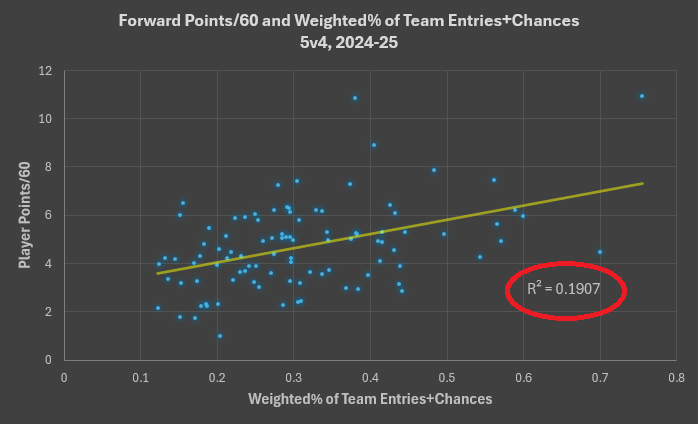
Essentially, players that have a big share of starting the play (the entry) or ending the play (the scoring chance) tend to put up more points than those who don’t. That is intuitive, and while the correlation (red circle) isn’t strong, it isn’t that bad compared to many other power-play measures we use.
Knowing that forwards who gobble up a big share of their team’s entries and chances on the power play can typically put up more PP points, which forwards stand out (either good or bad)? Glad you asked.
Connor Bedard (Chicago Blackhawks)
Bedard had 21 PP points in 69 games this past season, an 82-game pace of 25 PP points. The year before, he had 29 in 82 games. He clearly is the engine of the young Blackhawks’ man advantage unit, and that shows up when we look at his percentage of the team’s tracked entries and chances at 5-on-4 from this past season:

At the top, we see Connor McDavid, which should be a surprise to no one, but then Bedard is in second place behind him. While McDavid has a sizeable gap ahead of Bedard, there is a bigger gap between Bedard and the next player (Macklin Celebrini) than there is between McDavid and Bedard. It isn’t anything ground-breaking that Bedard is a significant part of Chicago’s power play, but there’s a difference between being a big part of the power play and being the focal point.
Think of it like a car. There are a lot of separate pieces responsible for a car functioning properly, but if the engine doesn’t work, the rest doesn’t matter. McDavid is the engine for the Edmonton Oilers, and Bedard is the engine for the Blackhawks. The difference is one guy also has Leon Draisaitl and Evan Bouchard on the ice with him and the other does not. If options like Frank Nazar and Anton Frondell can take steps forward next season, Bedard can take another leap in PP production, and thus his overall production. (may12)
11. Adam Fantilli (Columbus Blue Jackets)
It is funny how expectations work. Compared to 2024-25, Fantilli improved his total assists (+12), points (+5), shots (+23), hits (+26), and power-play points (+9). And yet, it still feels like his season was a bit of a disappointment, right? We do have to keep in mind he just crested the 200-game plateau in March, and he won’t turn 22 years old until October.
Fantilli’s power-play production, even if it was an improvement, was a big letdown. At 5-on-4, he had 10 points in 201 minutes, a rate of 2.98 points per 60 minutes. Among 86 forwards with at least 200 minutes at 5-on-4, he ranked 82nd in points rate. When we see his percentage of team entries+chances, that kind of makes sense:

That percentage is a little more than half the percentage we just saw for Bedard. He splits entries and chances with Kirill Marchenko, and then Zach Werenski gets a big chunk of time with the puck, too. Fantilli isn’t the go-to guy on the power play; instead, he is one cog among many. That should change as he and the team around him matures, but it does raise questions about how high his PP production upside is in 2026-27. (may12)
12. Nick Schmaltz (Utah Mammoth)
At 19:43, Schmaltz led the Mammoth forwards in overall ice time per game and was 2:20 higher than the third-most used forward. He became a big part of the team getting back to the playoffs, and when we look at the power play, he is one of the more intriguing names in our data:

Notice the gap in entry+chance% between Schmaltz and Kirill Kaprizov. There is a glut of forwards all around 54-59%, including Jack Eichel, Nathan MacKinnon, Sam Reinhart, Jack Hughes, and Schmaltz. That he was so heavily involved in the Mammoth power play is a bit surprising when we consider that Clayton Keller led them in PP points (27), but it was Schmaltz who led them in PP goals (11). It probably won’t be long until Dylan Guenther takes that distinction, but Schmaltz showed out very well here.
There are concerns. In between the entry and the chance, it’s clear that Keller gets a lot of touches on the puck. Then we have Guenther turning into one of the top goal scorers in the league, and Logan Cooley establishing himself as a top-line centre. However, as long as Schmaltz is getting 19-20 minutes of total ice time with a top PP role, he will continue to threaten for 70+ points. (may12)
13. Mathew Barzal (New York Islanders)
Just from a strict production standpoint, I think one of the greatest ‘what ifs’ of the last 15 years is what if Barzal had been drafted by Colorado, Florida, Dallas, or Boston – the four teams who picked right before the Islanders in 2015 – rather than the Islanders? Assuming everything else occurs as it has, imagine what we might think of Barzal if he spent the last 5-10 years as the winger for Nathan MacKinnon or the centre for David Pastrnak. But I digress.
Once we get past that glut of forwards we mentioned in the Schmaltz section, there are several forwards in the mid-40% range, and Barzal is one of them:

The Islanders are an interesting team because among their forwards, Barzal had as many entries himself (48) as the next five highest forward totals combined. He improved his 60-minute PP points rate by 30% when compared to his shortened 2024-25 season, and the Islanders improved their team PP goal rate by 38%. Having a healthy Barzal (and drafting Matthew Schaefer) helped the power play a lot, even if they weren’t very good overall.
A big problem here is what happens when Barzal doesn’t have the puck. Not only was he responsible for a lot of the team’s entries and chances, but he also had by far the highest passing totals on the roster. Among their forwards, he was a one-man show, and the top power play teams – think Edmonton, Dallas, or Vegas – have several options who can make plays once the puck is in the zone. That isn’t the case with the Islanders, so Barzal might be able to put up 20 PPPs because he’s so heavily involved in everything, but until the forwards around him improve dramatically, he won’t reach the 30+ plateau; opposing penalty kills are too good to have 1-2 players responsible for everything. (may12)
14. Elias Pettersson (Vancouver Canucks)
Quickly, I want to highlight Pettersson because he did have a very tough production season overall, but he was clearly still a key piece of the Vancouver power play:

It doesn’t feel like it, but Pettersson’s 5-on-4 points rate of 6.1 per 60 minutes was a four-year high, and the second highest of his career (6.4 in 2021-22). Putting up that kind of PP production on a roster that was tied for the second-lowest overall goal total is one positive to take away from his season.
I am a believer in Zeev Buium and the Canucks still have Brock Boeser and Jake DeBrusk. The ingredients are there for the Canucks power play to hover around league average again, or at least not be awful. If Pettersson can keep up this involvement, he can flirt with 25 PP points in a full season. The question for his fantasy value is if things can improve at 5-on-5, and that’s a horse of a whole different colour. (may12)
15. The offseason reviews continued in these Ramblings this past Tuesday (above) as we covered some of the 5-on-4 contributions. Today, we’re going to stay with contributions at 5-on-4 but direct our attention to defencemen. Again, we are going to use tracking data from All Three Zones for much of this write-up, but will have some player production data from Evolving Hockey.
When we covered the forwards, what we noticed was that players who started their team’s offence at 5-on-4 (zone entries) and ended their team’s offence at 5-on-4 (scoring chances) tended to produce higher points rates. Given that level of involvement in the play, that makes some sense.
For defencemen, we’re considering passes. Defencemen just don’t shoot nearly as much on the PP as the forwards do, so we’re going to view this from a facilitator perspective rather than a dual-threat perspective, and highlight a player’s percentage of his team’s 5-on-4 passes. We are going to limit the sample to defencemen with at least 100 minutes played at 5-on-4.
Keep in mind that this is a guide, not a hard-and-firm rule – the talent a defenceman has in front of him matters a lot. For example, Darren Raddysh wasn’t a key facilitator on the Tampa Bay power play, but the Tampa Bay power play also has Nikita Kucherov and Jake Guentzel.
Adam Fox (New York Rangers)
It is a wonder how many fantasy hockey managers or New York Rangers fans realize that Fox produced 7.9 points per 60 minutes at 5-on-4, the second-highest rate of his career, the highest in four seasons, and 35% higher than his two-year average. He had 24 power-play points in 55 games, an 82-game pace of 36 PP points.
The other surprising factor is just how heavily involved in the team’s power play he was. Of the 33 defencemen in our sample, he was responsible for the highest percentage of his team’s passes at 5-on-4, even surpassing names like Evan Bouchard and Zach Werenski:

Keep in mind that this is all of a team’s tracked passes at 5-on-4, and Fox missed one-third of the season. If we exclude the few games that were tracked without Fox in the lineup, that percentage increases even more. Also, nearly all the tracked games came from the first two-thirds of the season, so nearly every game in the sample is with Artemi Panarin in the lineup. This isn’t a case of where Fox got more touches after the Panarin trade – this all happened with the Breadman in the lineup.
It will be interesting to see Fox’s ADP when September rolls around. He was nearly a point-per-game defenceman but missed 27 games, and the Rangers are a team caught between the past and the future. Regardless, if this is his new gear on the power play, it is tremendous news for his fantasy value. (may14)
16. Rasmus Dahlin (Buffalo Sabres)
Buffalo scored 8.4 goals per 60 minutes at 5-on-4 with Dahlin on the ice, by far its highest mark over the last three seasons and 22% higher than the two-year average from 2023-2025. Josh Norris and Josh Doan seem to have helped the Sabres turn their PP around to be around league average, and that is one of the reasons why the team found the regular season success they did.
Here is the curious part: Dahlin posted 4.9 points per 60 minutes, which was a three-year high. The improvement is nice, but even though the Sabres’ power play scored 22% more often with him on the ice, his points/60 rate improved by less than 8%. That is also despite having the fourth-highest percentage of his team’s passes:

This seems like very good news for the future. For next season, Tage Thompson will be 29 years old, Josh Norris 27, Jack Quinn 25, Josh Doan 24, and Zach Benson 21. Dahlin will be 26 years old, so every key piece of this team’s offence (except Alex Tuch) will be under 30 years old with most of them in their mid-20s primes. If Dahlin stays involved like this and guys like Benson, Doan, and Quinn take another step in their offensive development, Dahlin can push for 30 power-play points in a full season. (may14)
17. Mikhail Sergachev (Utah Mammoth)
With 26 power-play points, Sergachev improved on his total from the year before (23) and did so on a Utah team whose power play was around league average. He is now averaging 26 PPPs every 82 games through his first two seasons with Utah. Like Dahlin, a lot of Utah’s top forwards are either in or approaching their respective primes – Nick Schmaltz is the ‘old man’ at 30 years old – and that is good news for Sergachev’s PP reliability moving forward.
What is also good news is just how heavily involved in the team’s power play he was. Despite having some high-talent forwards like Clayton Keller and Dylan Guenther, Sergachev had the fifth-highest percentage of his team’s PP passes in our data:
This is the first name that surprised me, especially when we see Rasmus Dahlin just above him and Cale Makar just below him. Just above Dahlin is Zach Werenski. When discussing how often a defenceman was passing the puck on the power play, Sergachev keeping company with those names is truly next-level.
If Utah’s young forwards take another step and their veterans keep up their high-end offensive play, Sergachev’s 2026-27 season could be even better than the one he just had, and that means pushing for a career-high 65 points (or more). (may14)
18. Jakob Chychrun (Washington Capitals)
Highlighting Chychrun here serves a dual purpose: it shows what he did as a defenceman who is one of the higher-volume PP shooters in the league, and it also highlights a name right above him in Lane Hutson:

We probably can’t get two more different defencemen. Out of 52 blue liners with at least 100 minutes at 5-on-4, Chychrun had the sixth-highest shot attempt rate while Hutson was dead last. Yet, they both had roughly the same percentage of their team’s passes, and that helps underscore how teams run their power plays differently. Washington funneled their PP through shots from the point (Chychrun) or from the left circle (Alex Ovechkin). Montreal focused on seam passes and rarely shot the puck from beyond 40 feet.
We can’t really discuss Chychrun and the Washington power play until Ovechkin makes a decision about whether he’s going to play next season. If he doesn’t, the Capitals’ power play is going to look much, much different in terms of how it has been run. There are players who both shoot and pass a lot on the man advantage – Makar and Schaefer come to mind. If Ovechkin isn’t around, might it help Chychrun’s PP production by getting him more shots and other avenues for passes? We’ll cross that bridge when we come to it, but it’s an intriguing notion. (may14)
19. Brandt Clarke (Los Angeles Kings)
Clarke was bounced on and off the team’s top PP unit through the season as Drew Doughty got some run on the first unit, and the Kings also ran a 5-forward top PP setup about 20% of the time (per Frozen Tools). The defencemen in our sample averaged around 18% of their team’s passes, and Clarke was not very far below that:

Even if we just include the games where he was the top PP quarterback, he still was around league average, which isn’t great. However, it highlights how much room for growth there is here. The Kings do not have another defenceman capable of running a top PP unit, and unless they get one in the offseason, this is Clarke’s role to grow into. With Anze Kopitar retiring, there is a real opportunity for Clarke to become a key piece of the Kings’ power play, playing second fiddle to Panarin. Whether the Kings’ PP is any good is another matter, but with a (hopefully) locked top PP role and more growth from him as a player, getting to 20 PPPs is very doable. (may14)
20. The season review continues in today’s Ramblings. Recently, we have covered a lot of ground. In yesterday’s Ramblings (just above), we discussed the involvement of defencemen for their respective teams’ power play, and that was after going over the forwards. Also contained in that Ramblings are links to the four articles where we discussed shot volume changes:
- Forward improvements from names like Connor Bedard, Shane Pinto, and Leo Carlsson.
- Forward Declines from names like Brady Tkachuk, Jack Drury, and Connor Zary.
- Defence improvements from names like Mattias Samuelsson, Bowen Byram, and Darren Raddysh.
- Defence declines from names like Quinn Hughes, Noah Dobson, and Nils Lundkvist.
Today, we’re again looking at just the forwards, and searching for players who are, or could be, under-valued in your fantasy leagues. These are players who did not have a great 2025-26 season, but their raw production is masked by improvements under the hood. We are going to once more use tracking data from All Three Zones and player/team data from Evolving Hockey. This is all at 5-on-5 unless otherwise indicated.
Dmitri Voronkov (Columbus Blue Jackets)
It was a bitterly disappointing season for Voronkov who became a frequent healthy scratch in the final quarter of the campaign once head coach Rick Bowness took over, playing just 7 of the final 26 games of the season. Here is the funny thing: Voronkov scored 1.16 goals per 60 minutes at all strengths, a rate higher than his average across the prior two seasons (1.07), leading to a slight increase in his points rate. His season decline didn’t come from worse production, but a diminished role.
That is why it’s also important to highlight what he did under the hood. Here are a few 5-on-5 tracking stats we look at:
- Scoring Chance Assists Per 60 Minutes (SCA/60) – How often a player assists on a teammate’s scoring chance.
- Rush Contributions Per 60 Minutes (Rush/60) – How often a player assists on a teammate’s shot off a rush play or that player takes the shot themselves.
- Cycle+Forecheck Contributions Per 60 Minutes (Cycle+Forecheck/60) – The same type of contributions as the rush, but this time off the cycle or forecheck.
- Attempts Per Expected Goal (iCF/ixG) – How many shot attempts a player needs to generate one expected goal. Lower numbers are better because they show efficiency.
Those stats help show a player’s playmaking ability, how he can contribute to the two styles of offence, and how efficient his shot selection is. That is why we’re highlighting what Voronkov did in 2025-26:

The tracking sample from this season isn’t big, but that there are improvements across all the key areas, and fewer shot attempts per expected goal generated, indicates a player who took some steps forward.
Voronkov will be going into his age-26 season, and he crossed the 200-game threshold back in January. With Bowness getting an extension in Columbus, it is an uphill climb for the winger because for whatever reason, he clearly does not have the coach’s trust. Maybe we see Voronkov traded because Bowness just does not believe in him, but the scoring winger’s fantasy hockey value has taken a massive hit. He wouldn’t be expensive to acquire in a trade, and he brings multi-cat value with career rates of 47 blocks and 101 hits every 82 games. (may15)
21. Anton Lundell (Florida Panthers)
This feels like a ‘two things can be true’ situation for Lundell:
- Putting up 44 points in 64 games despite skating over 19 minutes a game isn’t very good production.
- The injuries the Panthers sustained hurt the production of all the healthy players.
Lundell saw a much bigger role with Aleksander Barkov missing the entire season, but Matthew Tkachuk missed 51 games, and both Brad Marchand and Seth Jones both missed 30 games each. By the time Lundell and Sam Reinhart were shutdown for the final month, the damage had been done. With that said, it is important to note that not only was Lundell one of the players who saw a sizeable improvement in his shot volume, and he paired that with a big increase in his scoring chance assists:

Here we run into a similar problem as we saw with Voronkov. Where Voronkov has to earn his coach’s trust, Lundell will head into the 2026-27 season with a healthy Panthers roster, so it seems nearly impossible he skates 19 minutes a game again. If he’s back to the 16- to 17-minute mark, with secondary PP time, the best we can hope for is a 60-point season.
All that said, it might be worth checking out what the manager with Lundell on their roster wants for him. He just had a disappointing season and that owner will know that Lundell is going to have to deal with a healthy Panthers roster. If he can be had for cheap, it is worth taking a chance that he can leapfrog Sam Bennett on the depth chart. It is unlikely, but as a cheap gamble, it might be worth it. (may15)
[Follow the link for more…]
—
Have a good week, folks!
Thanks for continuing to support the website and if you’re bored and need a fantasy hockey fix – visit the gang in the forum here.
Related Posts

Starting Goalies







Top Skater Views
 DET
DET STL
STL CHI
CHI BOS
BOSTop Goalie Profile Views
 EDM
EDM NYR
NYR MTL
MTL S.J
S.J WSH
WSH

LINE COMBOS
| Frequency |
 L.A Players L.A Players
| |
|---|---|---|
| 26.2 | ARTEMI PANARIN ADRIAN KEMPE QUINTON BYFIELD | |
| 18.2 | TREVOR MOORE SCOTT LAUGHTON JOEL ARMIA | |
| 14.9 | COREY PERRY ALEX LAFERRIERE ERIK HAULA | |
DobberHockey Podcasts

Keeping Karlsson: Short Shifts – NHL Frozen Frenzy Recap
Elan and Lewis recap the Frozen Frenzy as well as two big returns and more!
Keeping Karlsson: Delusions of Garandeur
Elan and Brian dive into the latest NHL hot streaks, cold streaks, line changes, outjuries, injuries, buy-lows and sell-highs to give you top notch tips in your fantasy hockey league

Fantasy Hockey Life: TiDy Takes Part 2
Last week, Victor Nuno and Ryan Downey broke down trades from our top tier dynasty league. This week, they consider some dynasty trades from other divisions. Have a listen! Our show is part of the Dobber Podcast Network and sponsored by Fantrax.com. Email [email protected] and ask to join our free discord. Join our Patreon at […]
Keeping Karlsson: Matchup Maximizer 2026/27 Week 3
Elan takes a look at the schedule for the upcoming weeks of NHL action and recommends players with good schedules that you should consider streaming in to win your head to head matchups.
Keeping Karlsson: Short Shifts – Sharks Looked Like Celebweenies
Elan recaps the major injuries, outjuries, game results and changed line combos that we’ve seen since Sunday’s mega-show.