

21 Fantasy Hockey Rambles
Dobber Sports
2026-06-21
Every Sunday, we share 21 Fantasy Rambles from our writers at DobberHockey. These thoughts are curated from the past week’s 'Daily Ramblings'.
Writers/Editors: Ian Gooding, Michael Clifford, Alexander MacLean, Puneet Sharma, and Dobber
___
The Fantasy Prospects Report is now available!
If you don’t have yours yet, get it at the Dobber Sports Store.
___
1. The Carolina Hurricanes captured their second Stanley Cup in franchise history and first since 2006 with a convincing 3-0 victory over the Vegas Golden Knights in Game 6. After trailing 3-0 midway through Game 3 of the Final, Carolina responded by winning four of the next five games to secure the championship. The Hurricanes finished the postseason with an impressive 16-3 record, with Frederik Andersen notching 13 of those wins before being pulled in Game 3. That opened the door for Brandon Bussi, who quickly emerged as one of the biggest stories of the playoffs. The rookie netminder delivered three consecutive victories to close out the series, including a 22-save shutout performance in the Cup-clinching game.
Jordan Staal was awarded the Conn Smythe Trophy as playoff MVP after leading Carolina's championship run. At 37 years old, he became the oldest player ever to win the award. He finished the Finals with six goals against Vegas and was arguably the backbone of the Hurricanes throughout the postseason. In a great moment after lifting the Cup, he proceeded to hand the Cup off to Fredrik Andersen who then also passed it on to Taylor Hall.
Along with Jordan Staal's dominant playoff performance, Carolina's second line of Taylor Hall, Jackson Blake, and Logan Stankoven played a massive role in the team's championship run. The trio was once again at the center of the offense in Game 6, with Hall opening the scoring, Blake adding a goal and an assist, and Stankoven contributing a helper. That line consistently drove play at even strength and created scoring chances throughout the series. Their ability to generate offense gave Carolina a dangerous secondary attack and prevented opponents from focusing solely on slowing down the first line. As the playoffs progressed, Hall, Blake, and Stankoven established themselves as one of the most effective lines in the league and were a major reason behind Carolina's postseason success. (june15)
2. Despite being shutout, Vegas generated enough quality chances to make Game 6 far more competitive than the score suggests. The Golden Knights finished with just 22 shots on goal, but there was no shortage of chances for Vegas. Jack Eichel came inches away from cutting into the lead when he blasted a one-timer off a Mark Stone feed on a 2-on-0 rush, only to ring the shot off the crossbar with much of the upper half of the net open. Late in the third period, Tomas Hertl appeared destined to score after collecting a rebound from a Shea Theodore point shot with Brandon Bussi down and scrambling, but the Hurricanes netminder made one of the biggest saves of the night to preserve the shutout.
Mitch Marner cooled off at the worst possible time, going pointless over the final two games of the Stanley Cup Final and finishing Game 6 at minus-three. Even with that late dip in production, he still wrapped up the playoffs as the league’s leading scorer with 29 points, narrowly edging out Jack Eichel, who finished second with 22.
There’s a real conversation to be had about how that closing stretch may have impacted his shot at the Conn Smythe Trophy. For most of the run, Marner looked like the clear front-runner given his play-driving, power-play impact, and consistent point production, but a quiet finish in a Cup-clinching series tends to stick out. Had Marner posted a few points in the last two games, it may have kept the door open for him to secure the award. In the end, Carolina controlled the spotlight when it mattered most, and that usually tilts individual hardware toward players on the winning side who close strong. (june15)
3. After a trade with the Flyers earlier in the week, new Toronto Maple Leafs general manager John Chayka was busy again on Friday, acquiring Darren Raddysh from the Tampa Bay Lightning for a 2026 fifth-round pick. Raddysh also agreed to terms on an eight-year contract with an $8.5 million AAV with the Leafs. Mike Clifford wrote more about the trade in the Fantasy Take.
The emergence of Raddysh was a complete surprise in 2025-26. So much so to me that I identified him as one of two players that completely caught me off guard (Matthew Schaefer was the other). Make no mistake: Raddysh is a sizable gamble for the Leafs. He is 30 years old and has only one standout season in which he jumped from six goals and 37 points to 22 goals and 70 points. Raddysh shot at a 10.4% rate in 2025-26, which was below the 4-6% that he averaged in previous seasons. For the term and cap hit being invested in him, Raddysh doesn’t exactly have a proven track record of success.
However, this signing has the potential to pay off in a big way for the Leafs. Raddysh and his booming right shot from the point could pay dividends on a power play that also includes Auston Matthews, William Nylander, and perhaps even Gavin McKenna. To compare, Morgan Rielly has seven power-play goals over the last six seasons. Raddysh had 10 power-play goals last season alone. If Raddysh was no fluke last season, then that’s an upgrade for everyone on the Leafs’ top power play.
With a bit of luck (the draft lottery) and some quick changes, the Leafs are pushing for a minor retool to win now instead of a total rebuild. They’re probably not done either. The trades this week signal that Morgan Rielly is even more likely to be on his way out of town. At age 32 and averaging just under 40 points for the past two seasons, Rielly might be better suited to be a supporting power-play piece as opposed to a PP1 quarterback. Rielly was held to just 6 power-play points last season while shifting on and off the top power play (leaning toward off later in the season). Rielly had the same number of power-play points as rookie Easton Cowan and fewer power-play points than Matias Maccelli or Max Domi. (june20)
4. As for Tampa Bay, I doubt they’re done either. Charle-Edouard D’Astous could be a name to watch, as Cliffy mentioned in the Fantasy Take. John Carlson should pop up on their radar, as he is not expected to re-sign with the Ducks. Alex MacLean expects Carlson to command nearly $8 million per season in his salary projections, and that number could go even higher with Raddysh now off the market. However, Carlson is coming off a 60-point season, is a right shot like Raddysh, and was an active contributor on Anaheim’s power play. The fact that he is 36 might be viewed as a problem, but Tampa is trying to keep its window open, so Carlson could make sense on a short-term deal. Carlson should have plenty of interest in the free agent market. (june20)
5. Jonathan Toews officially announced his retirement from the NHL on Friday. Toews returned for the 2025-26 season with his hometown Winnipeg Jets after his career was paused for two seasons. Prior to that, Toews spent 15 seasons with the Chicago Blackhawks, where he won three Stanley Cups, a Conn Smythe Trophy, a Selke Trophy, and numerous All-Star Game appearances. Toews was also named one of the 100 Greatest NHL Players in 2017 as an active player. Adding in his contributions to Canada in the World Juniors and the Olympics, Toews will likely be nominated to the Hockey Hall of Fame once he becomes eligible.
With such a storied career, Toews often seemed like a better real-life player than fantasy league option. His career highs of 35 goals and 81 points were set in 2018-19, after he won his three Stanley Cups. Toews only exceeded 70 points twice in his career, which never made him an elite option at the deep center position. In his prime, Toews would have been universally rostered. Any fantasy league discussion should not take away from his accomplishments captaining a Chicago team that won three cups in the span of six seasons. However, the distinction between “real life” and “fantasy” is important for fantasy leaguers, especially for beginners. Understanding a league’s scoring system is key.
How quickly time passes. I was in attendance for the 2006 NHL draft when Toews was drafted third overall by the Blackhawks (the only NHL draft that I have ever attended in person.) The player that was picked second overall in that draft has also been in the news recently: Jordan Staal. That draft was a memorable one for me because it featured a very solid top 5: Erik Johnson, Staal, Toews, Nicklas Backstrom, and Phil Kessel. That draft happened 20 years ago, when the Stanley Cup champion was… the Carolina Hurricanes. (june20)
6. In case you missed it, Troy Terry is expected to miss the start of the 2026-27 season, as he underwent hip surgery to address an impingement and labral tear. With a recovery time of 5-6 months, Terry would likely return sometime in November or early December. Terry managed to gut it out during the playoffs with 11 points in 12 games and even five hits – three more than he had during the entire regular season!
In terms of players who could see an increase in icetime, fellow right winger Beckett Sennecke could be one player to target in drafts. Sennecke will have an early opportunity to build on his 60-point rookie season. Icetime and power-play time are divided up fairly evenly in Anaheim, but the Terry injury should at least prevent Sennecke from falling down what is becoming a deep Ducks lineup. (june20)
7. Congratulations to the Toronto Marlies, the winner of this year’s Calder Cup! The Marlies downed the Chicago Wolves 4-3 and win the final 4 games to 1. The Stanley Cup hasn’t been won by a Canadian-based team in over 30 years, but the Calder Cup will remain in Canada for the second year in a row (the Abbotsford Canucks won last season). Between the Raddysh acquisition and the Marlies Calder Cup win, Friday was a nice day to be a Leafs fan.
Goalie Artur Akhtyamov has been named the Calder Cup playoff MVP. Akhtyamov has a 2.22 GAA and .923 SV% during the playoffs (I don’t think that includes Friday’s game). Akhtyamov has an outside chance to be the Leafs’ backup goalie next season, but he’ll need to compete with Samuel Ersson and Dennis Hildeby for that spot. For more on Akhtyamov, see his Dobber Prospects profile. You can also purchase the Prospects Guide at the Dobber Sports store to view information such as his upside, 3-year probable, expected NHL arrival, draft advice, and more. (june20)
8. The NHL has concluded its investigation into Mike Babcock and in a released statement, has deemed him eligible to return to head coaching duties. The expectation is that he will be the next coach of the Edmonton Oilers, though an official announcement has yet to be made. (june19)
9. The Toronto Maple Leafs have hired Jim Hiller to be their new head coach. Hiller was last with the Los Angeles Kings and will now be tasked to not only get the Leafs back into the postseason, but to win some playoff rounds. Alex had his take on the hiring here.
As Alex mentions in his write-up on the hiring, Hiller’s calling card is stifling defence. That should help the Leafs win some more hockey games, but I’m dubious it’s going to help anyone’s fantasy value outside of the goaltenders. (june18)
10. As it’s my first Ramblings since the Cup was awarded, I’ll say a quick congrats to Carolina and the many wonderful stories that team has as winners of the Stanley Cup this year. Also, congrats to any of you who rode the Carolina wave to a playoff pool win this year too!
Along with many of the other DobberHockey writers, I managed to pick the Canes in six correctly prior to the finals starting. I did only go seven for 15 through the playoffs, mainly because the only picks I made correctly in the Eastern half of the bracket was where I had the Canes winning. Every non-Canes pick of mine in the East was wrong.
The fun note to look back on though was the pre-season expert’s predictions, where I had the Canes and Golden Knights in the finals, though in September I had Vegas taking the series. Re-opening the file prior to writing this, I even see that I put a little note to the side that said “Marner Conn Smythe”. That story line almost came true, but Mitch Marner wasn’t quite up to the task in the Finals and was ultimately outdueled for the Cup and the Conn Smythe by Jordan Staal.
Marner did still lead the playoffs in scoring, which is a feather in his cap, and hopefully quiets the doubters that said he couldn’t win in the playoffs. He’ll be back deep in the playoffs again soon, no doubt about that. (june 17)
11. I thought this week, as there are no games, and I still have my Rambling next week for the pre-draft thoughts, that I would go through each of the other 14 playoff teams that didn’t make the post-season for a bit of a post-(season-)mortem.
Montreal Canadiens
The Canadiens might have the brightest immediate future of any team in the NHL, and that includes the Avalanche who are coming off of a President’s Trophy win with a core in their prime. The Habs have their core pieces locked up, lots of help on the way, and some flexibility this offseason to either stay the course, or go big-game hunting if the price is reasonable. They’re going to be a top team in the Eastern Conference, if not the outright favourite to win the division on opening day of the 2026-2027 season (which is tentatively scheduled for Sept 29th).
Colorado Avalanche
Speaking of the Avs, they are in a great spot overall, but their problem is that they have won their Cup already and are trying to find the best way to extend their competition window. Cale Makar is in need of a monster extension, and most of the value of assets in the franchise is concentrated in the NHL lineup already, meaning that trades for impact players are a lot tougher to come up with at this stage. The Avs should still be in good shape moving forward, but they don’t have as much room for error anymore with their attempts to reload.
They began with that yesterday, moving Ross Colton to Nashville for a pair of third round picks. Colton will be missed as someone who could help drive a line in the middle six, though he didn’t always put up the points to get the public recognition for it.
Colton should be able to get back up to the 14-minute mark with the Preds, which would give him the ice time he had back when he was putting up his best production years with the Avs, around 40-points in an 82-game season. If his ice time goes even higher than that, the points may follow.
Buffalo Sabres
Buffalo is in a similar state to the Canadiens, however there are a few more questions in goal than Montreal has. The starter with money and term on his contract would be more difficult to move or bury, while the surprise leader in the playoffs only has a year left and has been a journeyman up to this point. The future of Colten Ellis and Devon Levi isn’t on as straight a path as Jacob Fowler for Montreal, which muddies the water as well.
I do wonder whether Connor Hellebuyck would accept a trade to Buffalo, because with the core or Tage Thompson and Rasmus Dahlin in their prime, the time is now for the Sabres to make a big push towards a Cup in the near future. The Sabres are likely now in the best spot to land Hellebuyck if the Jets move in that direction, as the Canes winning the Cup likely takes the edge off their need for a big splash this offseason. (june 17)
12. Minnesota Wild
Despite the Wild only playing two rounds, they had two players tied for 12th in playoff scoring, with a third in the top 20. This team is top-heavy with star power, but it will be the depth management that defines the offence (even if Dylan Larkin is brought in, filling in the bottom-six forwards will be key). This team can hang with top teams in the league all season and could have conceivably come out of the West this year if they were healthy. Expect another long run next year, but with Quinn Hughes‘ UFA status looming large.
Anaheim Ducks
The Ducks showed that they are building a core that is going to be a playoff powerhouse for years to come. They were undone this year by poor goaltending and a need for more depth. Those will both come with time, as Lukas Dostal can be the leader in net, but he only turns 26 next week. As for the rest of the roster, the top-end pieces are mostly already in place, with the need just for them to grow into their prime years with the depth growing in around them. The second round was a good step but may still be their ceiling for the next couple seasons, especially with how heavy the West is.
The Ducks will be moving forward without John Carlson, who has noted his preference to play in the Eastern Conference, and he will be testing free agency in two weeks.
Philadelphia Flyers
The Flyers were a surprise playoff team that has a young core and still a lot of roster construction questions. Dan Vladar showed well in his first season as a starter, but the added wear and tear of the extra games did seem to affect him. The Flyers are rumoured to be looking at a five-year extension for him, which could pay off, or as many goalie contracts do, it could massively backfire. It seems the Flyers could take any direction from here with the roster, which often means the team is about to get stuck in the mushy middle of the standings again.
The first hint though was yesterday’s trade with the Leafs, spending a 3rd round pick to add what in theory is more proven talent (and cap) to the roster. Joseph Woll should slot in nicely behind Vladar, while Simon Benoit ideally fills in as a 7th defenseman. (june 17)
You can read Cliffy’s fantasy take on the trade here.
13. Tampa Bay Lightning
The Lightning have most of their core locked up on long-term deals, but Nikita Kucherov is only one year away from free agency now, which I would expect to be addressed in July as other than with Steven Stamkos, the Bolts have generally gotten these things done early. They should be a lock for the playoffs again, and a common selection to come out of the East again next year.
Dallas Stars
As one of the most cap-strapped teams coming into the offseason, there will need to be at least one big move from the Stars, shipping out a large amount of cap dollars elsewhere. Many believe that will be Roope Hintz, but moving out the team’s top center is not often a road to better playoff performances, which is why it wouldn’t surprise me to hear discussions between the Stars and Tyler Seguin about whether he would waive his no-trade clause or not. If not, it might have to be Jason Robertson who gets shopped, as it is his new contract (along with Mavrik Bourque‘s) causing the cap crunch. Dallas will still be a top team next year, but their makeup could be different.
Edmonton Oilers
Can Tristan Jarry regain some form for the Oilers next year? Will Connor McDavid start to open the front door and look around for greener pastures? Will a Darnell Nurse trade actually make the team better (addition by subtraction)? These and plenty of other questions will dog the Edmonton offseason, and there won’t be answers until the season starts. We know that with Connor McDavid and Leon Draisaitl around the team is going to make the playoffs, it’s again just whether they can win four rounds in the spring that really matters. (june 17)
Pittsburgh Penguins
At least one more year of Evgeni Malkin means that the trio of Malkin, Kris Letang, and Sidney Crosby plays together for the 21st season, with the contracts of both Crosby and Malkin expiring in 2027, while Letang is signed until 2028. The Penguins have some work to do if they want to be considered realistic contenders, but they should be on the playoff bubble until Crosby retires.
The Penguins also made a minor trade over the weekend, shipping out prospect Emil Pieniniemi for winger Oliver Okuliar, who until this point was best known for calling the Tkachuk brothers “scumbags”. Not really a surprise Florida traded his rights after that, and then just days later the Penguins signed Okuliar to a one-year two-way deal. Odds are he doesn’t make the Penguins out of camp next year, but he’s another possibility for the Penguins as they look to reload once again. If he gets a game against Ottawa or Florida, then expect some PIMs too.
14. Boston Bruins
I don’t really have much to say about the Bruins here. They should be much the same next year as we saw this year. They have $15 million in cap space though, which they could weaponize to make some additions, as only Viktor Arvidsson is a notable UFA. Massachusetts native John Carlson could be a big addition that puts the Bruins back into real playoff contender territory…
Utah Mammoth
Utah’s roster is young but fairly well constructed right now, and they’re in a similar spot to Anaheim, except they only made it to the first round of the playoffs this year. Like Anaheim, they need the forward depth to fill in, and some more consistency from their young core. They will also be a force in a few years, but they aren’t there yet, and they’re maybe a step behind the Ducks at the moment. (june 17)
LA Kings
The Kings’ season is really going to hinge on Quinton Byfield taking a big step forward to be a top-line center on a playoff contender. If he doesn’t – and it’s very possible that big jump doesn’t come until the fall of 2027 when he hits his 400-game breakout threshold – it might be a long season.
Ottawa Senators
The Sens are at a bit of a crossroads, having a young core that looks like it’s growing towards being a Cup contender, however they also have one of the worst prospect pools in the NHL, and Brady Tkachuk is a flight risk to leave for an American-based team as soon as his current contract expires in 2028. Quinn Hughes was dealt with 1.5 years left on his deal for much the same reason, and if the Senators get off to a slow start this year, the chatter surrounding Tkachuk is really going to explode. (june 17)
15. Continuing from last week’s article tracking power-play usage, there are a few more players worth digging into, so let’s get right into it.
Jake DeBrusk posted some of the best power play numbers of his career despite playing on a Vancouver team that saw significant regression from several key players. DeBrusk's powerplay production profile is backed by legitimate offensive involvement. He historically averaged between 2.3 and 2.8 shots per game while maintaining a S% generally between 13% and 18%. His fantasy value has always been tied to goal scoring, and that remained true this season in Vancouver, where his role was supported by strong shot generation and finishing ability – two areas that have remained remarkably consistent throughout his career.
What makes next season particularly interesting is obviously the removal of Quinn Hughes. Hughes was not just Vancouver's best defenseman, he was the team's best player. When a team loses a defenseman capable of producing 70-plus assists while controlling over half the puck touches on a power play, there are ripple effects throughout the entire lineup. So, before I go on, I want to stress that Quinn Hughes‘ departure is a big deal but the question is whether the environment around DeBrusk can continue supporting the production he saw this past season. Interestingly enough, DeBrusk's specific role may be less affected than many of his teammates. Here me out here. DeBrusk is not the player responsible for creating offense. He is the player responsible for finishing it. Historically, net-front and bumper players tend to be less dependent on who quarterbacks the power play because their production comes from high-danger opportunities around the crease. Yes, the situation may be different now that Quinn Hughes is not there however, I also expect to see a bounce-back season from Elias Pettersson after being limited to just 51 points, which should help elevate the overall effectiveness of the Canucks' power play and create more opportunities for everyone involved. What I would question is whether the overall environment can support another career-best power play season by Jake Debrusk. Without Quinn Hughes driving the attack, expecting significant growth beyond his recent production may be optimistic; however, DeBrusk's power play value appears to be role-driven rather than quarterback-driven. However, without Hughes elevating the entire unit, expecting another career-best power play season may be optimistic. The production looks largely sustainable, but the team context likely caps his upside more than his individual talent does. (june15)
16. Luke Hughes
Powerplay production was nearly even between Luke Hughes and Douge Hamilton last season, with Hamilton averaging 2:04 of power play TOI per game and Hughes averaging 2:02. Hamilton recorded 14 power play points in 77 games and Hughes finished with 13 in 68 games. The case for Hamilton retaining the role begins with his offensive profile. Even at 33 years old, he remains one of the league's more active shooting defensemen, finishing with 200 shots and 2.6 shots per game compared to Hughes' 149 shots and 2.2 shots per game. That shooting ability remains a valuable weapon on the power play as it forces penalty killers to respect the point shot, creating additional space for players like Jack Hughes, Nico Hischier, Jesper Bratt, and Timo Meier to operate. Hamilton's offensive game remains built around direct scoring threats, while Hughes functions more as a puck transporter and facilitator.
At the same time, the long-term trend points increasingly toward Hughes. While Hamilton's raw production remains solid, Hughes' underlying involvement on the power play continues to climb. His 72.2% PPIPP was significantly higher than Hamilton's 56%. Hamilton's injury history also creates another layer of uncertainty. While he played 77 games last season, he appeared in just 20 games during 2023-24 and 64 games in 2024-25. The injuries have not completely derailed his effectiveness, but they are becoming increasingly difficult to ignore as he moves further into his thirties. New Jersey has every reason to gradually increase Hughes' responsibilities rather than waiting for Hamilton's play to decline.
Looking ahead, we may see a scenario where Hamilton enters the season as the favorite to begin on the top unit simply because he has not played poorly enough to lose the job. Let’s also not forget that new GM Sunny Mehta may have a different outlook on how things look on the backend. For now, however, if Hughes continues developing and maintains his current level of offensive involvement, there is a very realistic path for him to become New Jersey's primary power play quarterback by the end of the season. The real question is not whether Hughes eventually surpasses Hamilton on the depth chart. Based on the current trends, it feels less like a matter of if and more like a matter of when. (june15)
17. Sam Reinhart
When looking at Reinhart's production, it's important to remember just how much adversity Florida dealt with throughout the season. Aleksander Barkov missed the entire year, Matthew Tkachuk appeared in just 31 games, Brad Marchand played only 52 games, Seth Jones was limited to 52 games, and Reinhart himself missed 18 games. Despite all of that, Reinhart still produced 61 points in 64 games, a 78-point pace, while recording 11 power play goals and 25 power play points. On a per-game basis, his 0.39 PPP/GP was nearly identical to the 0.38 PPP/GP he posted the previous season and only slightly below the 0.41 PPP/GP from his 94-point campaign in 2023-24. This season's 4:10 PPTOI per game was the highest mark of his career and his PPIPP came in at 65.8%, which was slightly below the 68.0% he posted during his 57-goal season but remains well above league average. His shot generation also remained extremely strong at 7.3 SOG/60, continuing a four-year stretch where he has consistently operated between 7.3 and 8.4 SOG/60. Players producing power play goals at Reinhart's level typically need strong shot generation, and his numbers show no meaningful decline.
Reinhart converted on 24.5% of his shots during his 57-goal campaign and his S% has dropped year-over-year since then. While nobody should expect another 24.5% season, the current number is much closer to his career norm. More importantly, his shot volume remained intact. He still generated 165 shots in just 64 games, which translates to a 211-shot pace over a full season. The opportunities remain there. Reinhart's best power play linemate this year was actually Brad Marchand, who was involved in 20 of his 25 power play points despite playing only 52 games. A fully healthy group featuring anyone of Matthew Tkachuk, Brand Marchand, Sam Bennett, Carter Verhaeghe, Aleksander Barkov, and Seth Jones along with Sam Reinhart would provide more than enough offensive support than he had this season.
Reinhart’s deployment is still elite, the shot volume continues to be there, and his involvement in Florida's man-advantage offense remains at an elite level. Assuming the Panthers stay healthy, there's a strong chance Reinhart pushes back above the 30 power-play point mark and finishes among the NHL's top fantasy producers with the extra man. (june15)
18. Mika Zibanejad
Mika Zibanejad's 35 power-play points were the second-highest total of his career and a reminder that he remains one of the Rangers' primary weapons with the man advantage. He averaged over three minutes of power-play ice time per game, consistently saw 70-75% of the team's available power-play opportunities, and continued to operate as the top shooting threat on PP1. His PPIPP remained strong, his shot generation held steady, and, as has been the case throughout his career, most of his value came from goal scoring rather than playmaking.
The concern is not the role. The concern is the environment around it. Artemi Panarin's departure removes one of the league's premier power-play facilitators and the player who helped create a significant portion of Zibanejad's opportunities. While the Rangers will continue to funnel chances through Zibanejad as their primary finisher, expecting another 35-point season without that level of playmaking support may be unrealistic. During most of his prime, Zibanejad has typically landed in the 20-30 PPP range, only pushing beyond that when the Rangers' power play operated at an elite level.
There is still plenty of talent on the top unit. Alexis Lafreniere should take on a larger offensive role, Adam Fox remains one of the NHL's elite power-play quarterbacks, Vincent Trocheck continues to provide a net-front presence, J.T. Miller is a strong bounce-back candidate after a disappointing 53-point season, and Gabe Perreault could eventually add another layer of skill. The Rangers should still ice a quality first unit, but replacing Panarin's ability to drive possession and create offense will not be easy. The role remains highly sustainable but the elite production is less certain. A regression from last season's 35 power-play points is the most likely outcome, with a return to the 25-30 PPP range appearing far more realistic. Zibanejad should still provide above-average power-play value, but the margin for error is considerably smaller without Panarin driving the attack. (june15)
19. Over the last several Ramblings, we have been reviewing the 2025-26 fantasy output of specific players and comparable seasons from recent history. On Friday, we covered the seasons of Matthew Knies, Dylan Holloway, Cole Caufield, Adam Fantilli, and Marco Rossi. Today, we’ll cap off the comparisons by focusing on defencemen outside of the upper-end tiers.
As a reminder, for this article, fantasy value is determined on a per game basis and relative to the player’s position. That means we are only comparing forwards to forwards and defencemen to defencemen. Also, we are relating fantasy value to a “replacement level” player, which is the average value in each fantasy stat for a top waiver wire option. How replacement value is determined is discussed more at length here.
We are only considering seasons where a defenceman played at least 41 games, the comparison campaigns are from 2021-22 through 2024-25, and the stats are goals, assists, power-play points, shots, blocks, hits, and penalty minutes.
Player data for fantasy evaluations is from Evolving Hockey.
Alexander Nikishin (2025-26) and Darnell Nurse (2021-22)
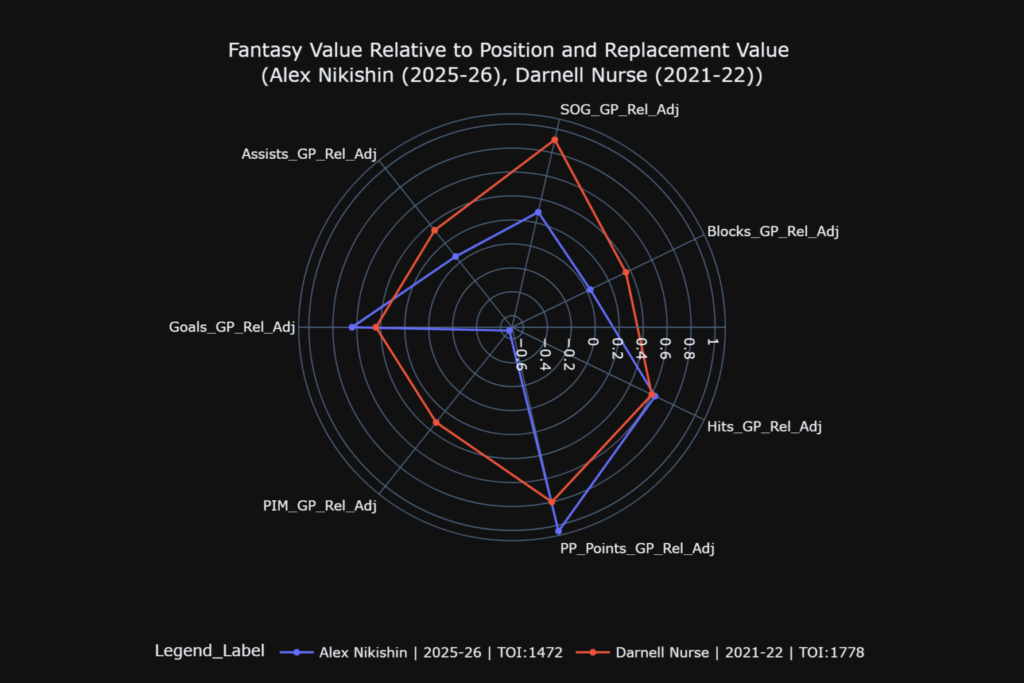
There are three reasons why this is an apt comparison. First, Nikishin’s 2025-26 was his rookie season, but as an older rookie, he turns 25 years old in October. The comparison season from Nurse was his seventh full year in the league but it was his age-26 season. Despite the large gap in games played at these respective points in their careers, the ages weren’t that far apart.
What is also apt is that as a member of the Edmonton Oilers, Nurse has not had a season where he’s earned more than 40% of his team’s power-play time since 2018-19, and his 2021-22 campaign saw him finish with 25.1% (per Frozen Tools). Nikishin took 30.6% of the available PPTOI as Shayne Gostisbehere took the lion’s share of time on the top PP unit. That 30.6% for Nikishin is also in a season where Gostisbehere played just 55 games.
The final reason this is a fair comparison is Nikishin got a lot of his fantasy value from goals and peripherals. Nurse has typically done the same: over the last six seasons, 29% of Nurse’s points have been goals, the third-highest rate of 38 defencemen with at least 200 points in that span. Nikishin’s rookie season saw him get 33% of his points from goals, to go with the solid peripheral production.
There are two differences. The first is Nurse played over 25 minutes a game in 2021-22 while Nikishin skated just 18:11 in 2025-26. More ice time should elevate his peripheral production.
The second difference is Nikishin does have a chance to be the top PP defenceman for the Carolina Hurricanes sometime soon. Gostisbehere has one year left on his contract, and he’ll be 34 years old at the end of next season. At that point, Nikishin could elevate his fantasy value past anything Nurse has done in his career. Until that time, Nikishin will be a solid multi-cat fantasy option, but with a ceiling.
[Follow the link for more…] (june16)
20. The NHL offseason is now in full swing with the buyout window open, trades brewing, and the Draft just over a week away. Coming up shortly is free agency, set to start in fewer than two weeks. This could have been a star-heavy free agent class, but Jack Eichel, Kyle Connor, Martin Necas, Adrian Kempe, Nick Schmaltz, Kiefer Sherwood, Jake Walman, and Mike Metheson all signed extensions during the season. It doesn’t mean there aren’t some potential gems left on the board, though, and keeper/dynasty managers may want to scoop them up before the signing happens – the acquisition cost may go up if they land in Florida, Tampa Bay, Colorado, Dallas, Minnesota, Buffalo, Carolina, or Vegas. Before that happens, this is what fantasy managers need to know about these players.
Player data is from Evolving Hockey, Natural Stat Trick, and All Three Zones. Contract data is from PuckPedia.
Alex Tuch – LW/RW
In three of the last four seasons, Tuch has reached at least 30 goals, 30 assists, 190 shots, 82 blocks, 10 power-play points, and 45 PIMs. He has been one of the better, and more consistent, across-the-board multi-cat fantasy wingers that we’ve seen in recent memory. As the top free agent winger (and likely just top forward) on the board, he is set to cash in big.
Where Tuch lands will be of interest for two reasons, and they’re intertwined. The first reason is that Tuch hasn’t been a frequent top PP option in Buffalo recently as Frozen Tools has him with 33.1% of the PPTOI in 2025-26, and 50.1% the year before. Because of that, we should look to see what kind of shooter he’s been at 5-on-5 rather than at all strengths. This past season, Tuch was a rush-heavy shooter, with his 60-minute rate being more than 75% above the league-average forward, while his 60-minute rate of shots off the cycle or forecheck being below league average:
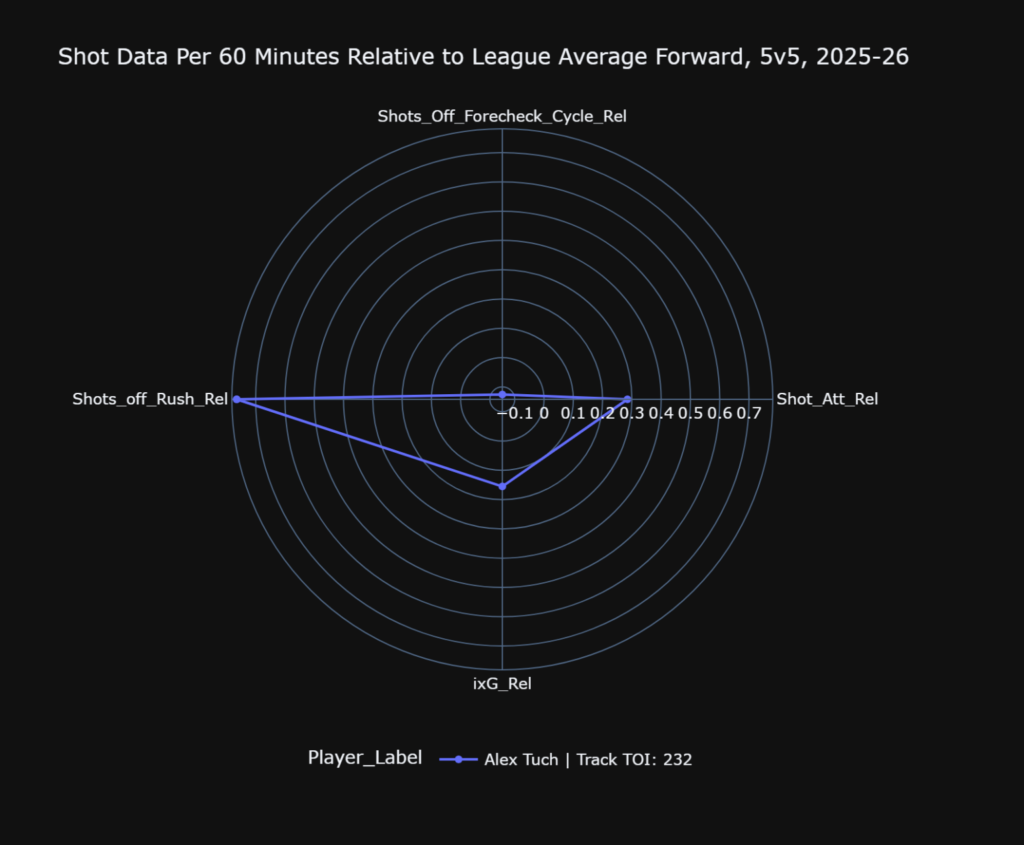
That is just one season, but back in 2024-25, relative to a league average forward, Tuch shot off the rush over twice as often as he did off the cycle/forecheck. It is important to mention that because in 2024-25, Buffalo wasn’t really a rush-heavy team – their forwards took rush shots about 6% more often than the league-average forward. It is higher, but not extreme, and Tuch was nearly 6x higher than Buffalo’s average. In short, Tuch likes to create a lot off the rush, and that can be a high risk/high reward style. Teams have moved away from that style over the last couple of seasons, though the Stanley Cup-winning Carolina Hurricanes leaned more into rush shooting this past year, and this is a league of copycats.
The second reason the lack of PP usage is notable is because it shows what his upside can be. In multi-cat formats without faceoff wins, and on a per-game basis, Tuch was a fringe top-50 fantasy forward this past season. Even if we count faceoff wins, he was a top-85 fantasy forward. The year before, he was between the 40th and 60th forward regardless of counting FOWs. Neither season was elite, but both indicate a pillar of fantasy value in any kind of multi-cat format, and that was with Tuch averaging just 10 PPPs a season. If he posts 20 PPPs, that value with the additional goals/assist it brings means he can push towards a top-25 forward.
They are different players, but we’ve seen this with Nikolaj Ehlers and Martin Necas. Whenever they got regular top PP time, regardless of the team they were on, they posted their best seasons, and that speaks to what Tuch can do in the right spot. The pay rise will negate any fantasy value increase for those in salary cap formats, but if he can keep his 19-20 minutes a game, his 30-30 seasons, and add more power-play production? Tuch has the ability to be a top-25 fantasy forward.
[Follow the link for more…] (june18)
21. Let’s finish our review of free agent forwards but shift our focus down the list a little bit:
Mason Marchment – LW
Across the last three seasons, Marchment has averaged 25 goals, 32 assists, 11 power-play points, 157 shots, 63 PIMs, 105 hits, and 32 blocks every 82 games. That is pretty good across-the-board coverage for a guy who averaged under 16 minutes a game in that span. That stretch includes 32 points in 39 games with Columbus, where he skated 17:41 per game with a lot of top PP time. If he skates 17-18 minutes a game with top PP time, he absolutely can be a 30-goal, 30-assist, 100-hit winger, and that’s very good multi-cat value.
Unlike a number of the forwards we saw yesterday, Marchment does not rely on rush offence for his production. In fact, in 2025-26, his contributions off the rush were below the league average forward, whereas his contributions off the cycle/forecheck were above average:
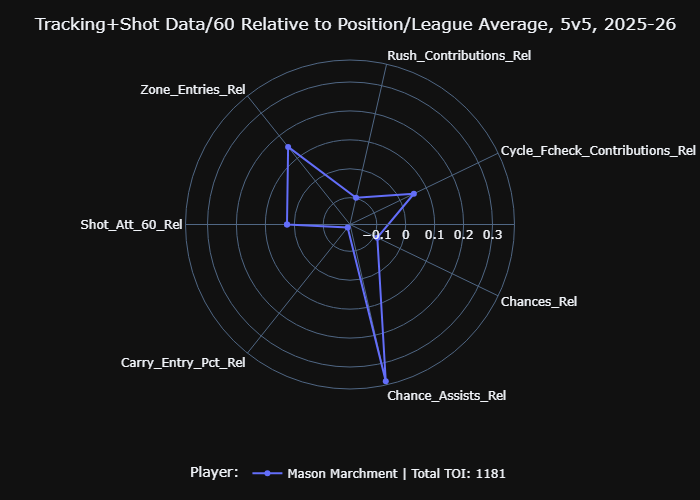
That was not the case the season before when he was still in Dallas, but it didn’t really matter: in 2024-25, he managed 2.24 points/60 minutes at 5-on-5 while playing a rush-heavy style, and in 2025-26 with Seattle and Columbus, he averaged 2.12 points/60 minutes playing a cycle/forecheck-heavy style. That kind of versatility should make fantasy managers a bit more interested in him, because wherever he lands, his fantasy value will be determined by the players he skates with and the role he has rather than how he’s being asked to play.
[Follow the link for more…] (june19)
***
Reminder: Dobber's 2026 Fantasy Hockey Prospects Report is available now in the Dobber Shop! Both Dobber and the Prospects team highlight the prospects you need to know from the upcoming Entry Draft. It also has an in-depth look at each team's current prospect pipeline and estimated arrivals for their top, young (hopeful) stars. Head on over to the Dobber Shop and grab a copy of the Prospects Report!
***
Have a good week, folks!
Thanks for continuing to support the website and if you’re bored and need a fantasy hockey fix – visit the gang in the forum here.
Related Posts
Starting Goalies








Top Skater Views
 VGK
VGK SEA
SEA STL
STL S.J
S.J
Top Goalie Profile Views
| Players | Team | |
|---|---|---|
| DYLAN GARAND |
 NYR NYR | |
| JOSEPH WOLL |
 PHI PHI | |
| DANIIL TARASOV |
 DET DET | |
| ARTURS SILOVS |
 PIT PIT | |
| JACOB FOWLER |
 MTL MTL
| |
LINE COMBOS
| Frequency |
 UTA Players UTA Players
| |
|---|---|---|
| 21.6 | VINCENT TROCHECK DYLAN GUENTHER LOGAN COOLEY | |
| 19.0 | KEVIN STENLUND JACK MCBAIN DANIIL BUT | |
| 19.0 | NICK SCHMALTZ CLAYTON KELLER LAWSON CROUSE | |
DobberHockey Podcasts

Fantasy Hockey Life: TiDy Takes Part 2
Last week, Victor Nuno and Ryan Downey broke down trades from our top tier dynasty league. This week, they consider some dynasty trades from other divisions. Have a listen! Our show is part of the Dobber Podcast Network and sponsored by Fantrax.com. Email [email protected] and ask to join our free discord. Join our Patreon at […]

Keeping Karlsson: Matchup Maximizer 2026/27 Week 3
Elan takes a look at the schedule for the upcoming weeks of NHL action and recommends players with good schedules that you should consider streaming in to win your head to head matchups.
Keeping Karlsson: Short Shifts – Sharks Looked Like Celebweenies
Elan recaps the major injuries, outjuries, game results and changed line combos that we’ve seen since Sunday’s mega-show.
Keeping Karlsson: Cole, There’s No Time!
Elan and Brian cover all the action from the first week of the NHL season, and identify our earliest must-adds, can-drops, sell highs and buy lows in your fantasy hockey leagues.
Keeping Karlsson: Matchup Maximizer 2026/27 Week 2
Elan takes a look at the schedule for the upcoming weeks of NHL action and recommends players with good schedules that you should consider streaming in to win your head to head matchups.