

21 Fantasy Hockey Rambles
Dobber Sports
2026-08-09
Every Sunday, we share 21 Fantasy Rambles from our writers at DobberHockey. These thoughts are curated from the past week’s 'Daily Ramblings'.
Writers/Editors: Ian Gooding, Michael Clifford, Alexander MacLean, Puneet Sharma, and Dobber
___
DobberHockey’s 2026-27 Fantasy Hockey Guide is now available in the Dobber Shop! Team-by-team overviews, a schedule breakdown, players due for positive and negative regression, long-term projects to invest in, and a whole lot more. Also included with the purchase is an interactive draft list that includes point projections, peripheral projections for blocks, Hits, shots, penalty minutes, and plus/minus, as well as goalie projections.
All this is updated through to the start of the regular season to reflect injuries, trades, or other pertinent information. Help support what we do year-round and grab a copy of the Draft Guide!
The French version, le Guide des Poolers, is also available. You can pre-order it here.
___
1. A new formula for success in today’s NHL has teams investing the bare minimum in goalies and moving their chips toward other positions. Just like those who play fantasy hockey, NHL teams are realizing that goalie performance can be volatile from season to season. In addition, a talented goalie can only do so much for a team. If a defense is weak, it will show in the goalie’s numbers.
Here are five potential playoff teams with interesting goalie battles entering the season. These goalies aren’t all bargain basement goalies, but trying to forecast who the starter will be may not be that simple. At least two goalies on each of these teams could hold value this season – perhaps even at the same time. The “How this might play out” analysis is how I personally think the goaltending situation will turn out, which is not necessarily the same as what is mentioned in the Fantasy Guide (Dobber has the final say in what appears there).
CAROLINA
Why this is a debate
Brandon Bussi may have been the goalie of record in Carolina’s Stanley Cup‑clinching win, but context matters for fantasy managers. Pyotr Kochetkov spent most of the season injured, and when you zoom out to the past three years, their numbers are essentially comparable — with a slight statistical edge to Kochetkov (see the Goalie Compare feature on Frozen Tools). More importantly, Kochetkov has logged 40‑plus games in each of the previous two seasons, giving him a normally strong workload profile heading into drafts. Also, did you know Bussi is a year older than Kochetkov?
How this might play out
Bussi will be viewed as the starter by many, but we can’t forget about Kochetkov. This could be a timeshare where both goalies are worth rostering. Bussi faded late in the regular season and was on the bench for the first round of the playoffs until Andersen was injured during the Stanley Cup Final (which seemed inevitable), so he doesn’t have much of a track record of being a full-time NHL starter.
COLORADO
Why this is a debate
Scott Wedgewood outperformed Mackenzie Blackwood last season and even held the starter’s crease for much of the playoffs. But for fantasy purposes, contract reality still matters: Blackwood carries the higher cap hit ($5.25 million) and longer term (four years), while the 33‑year‑old Wedgewood has spent most of his career in a backup role. The Avalanche simply have more invested in Blackwood — even if Wedgewood was the better goalie in the short term.
How this might play out
True to the contract, expect Blackwood to be the starter on opening night. Where this goes beyond that is not exactly clear. Coach Jared Bednar could ride the hot hand all season as the Avalanche attempt to defend their Central Division title in what should be another grueling battle.
EDMONTON
Why this is a debate
Edmonton enters the season with a three‑headed monster, each carrying a very different fantasy profile. Frederik Andersen, now 36, is nearing the twilight of his career and remains an ongoing injury risk. Tristan Jarry has the highest cap hit and term (albeit for only two years) but is trying to rebound from recent struggles and health issues. Meanwhile, 24‑year‑old Devon Levi is pushing to secure a full‑time NHL role and still projects as the organization’s potential goalie of the future. For fantasy managers, this is a depth chart defined by volatility, contract politics, and long‑term upside — all wrapped into one crease.
How this might play out
Andersen starts opening night, but this could go in a lot of different directions after that. If he doesn’t suffer another injury, Andersen’s starts will be load managed. Jarry is probably on a short leash. Levi is no longer waivers-exempt, so he will get his chance here. Unless the Oilers resemble Mike Babcock’s Red Wings during their prime, I’m probably shying away from Edmonton goaltenders until the later rounds of drafts.
MINNESOTA
Why this is a debate
Filip Gustavsson is recovering from hip surgery with no clear timeline, opening the door for Jesper Wallstedt‘s emergence. Gustavsson remains the far higher‑paid option — carrying a $6.8 million cap hit for five more seasons — but Wallstedt’s rise complicates the long‑term picture. Once both goalies are healthy, Minnesota could be headed toward a true timeshare, with Gustavsson’s contract and Wallstedt’s upside pulling the crease in different directions for fantasy managers.
How this might play out
This could be close to 50/50, although Wallstedt has to be the preferred goalie based on being more likely to play more games, especially early on. If no significant news has surfaced regarding Gustavsson’s injury by the time fantasy drafts roll around, he might even be a goalie to stay away from.
VEGAS
Why this is a debate
Carter Hart was signed to a short‑term deal because of the risk of his long layoff, but he delivered when it mattered in the playoffs. Even so, Adin Hill‘s contract — five more years at a significantly higher cap hit — keeps him firmly in the mix for starts. Hill already has a Stanley Cup on his résumé from his run with the Golden Knights, which explains the organization’s investment. For fantasy managers, this sets up a crease where Hart’s recent performance battles Hill’s contract‑driven opportunity for control of the net.
How this might play out
Hill should play in more than 27 games in 2026-27. It is unlikely that he is as bad as he was last season (10-9-6, 2.04 GAA, .871 SV%). However, recency effect favors Hart in this goaltending battle. (aug1)
2. Andrew Santillo had some thoughts last week in his Capped column on some of the new contracts, including MacKlin Celebrini’s. I wanted to expand on those thoughts and offer some insight into the ripple effects we’re likely to see around the league as a whole.
With the $18.8 million deal, Celebrini effectively capped the top star players at $19 million for the next couple of years. There’s no way a team can sign Quinn Hughes to more for next year, nor Matthew Schaefer, and probably not even Cale Makar. Those three are extremely unlikely to end up over a $19 million AAV, though they will probably be close to it.
Connor McDavid‘s next contract will likely reset that, but he’s not eligible for an extension until next summer, as he has two years left on his deal, which means the bar probably won’t be raised until the 2028-2029 season. (aug5)
3. The other main point to make with Celebrini’s extension is noting the term of five years, and how he will be right in his prime as one of the top players in the league, set for UFA, and due a new contract. If the league keeps growing at a similar rate as the cap has been projected over the next couple of years, that it would likely be around $165 or $170 million for the 2032-2033 season where Celebrini’s new contract would begin. If he’s again looking for 16% of the cap on that contract, then we’re talking in the range of $27 million per season. Take that in for a second. (aug5)
4. Now, for the 2032 season, we’re still going to be running out the last few years of some of the recent longer-term deals signed, including Leon Draisaitl‘s last year at $14 million, Jackson Blake and Logan Stankoven at a combined $11.1 million with two years remaining, and the Habs with Juraj Slafkovsky (final year), Lane Hutson (two years remaining), and Ivan Demidov (three years remaining) signed for less than the $27 million Celebrini should be making. It’s going to be a completely different fantasy landscape, with some fantasy leagues having their cap around the $200 million mark by that point.
What the shorter term for Celebrini (and Connor Bedard) also does, is it shows that this is now the standard for how to treat star players, by allowing them to dictate the term in order to walk them to free agency if they don’t like the amount being presented on the next extension. That means we’re likely to see even less term on contracts, and we’ll have far fewer of these deals that are fair value in years one and two, and then a bargain for the next five. If you’re not planning ahead in Cap Leagues already, you’re going to fall behind quickly. As for non-cap leagues, it probably means a bit more player movement, but not too much actionable in terms of changes in team management. (aug5)
5. Injury Ward is returning with a new voice in mid-August to give you the one-off pre-draft update on players and their offseason injuries/progressions. It will return full time in mid/late September in order to keep you fully in the know around training camp and through draft season, where every sliver of an advantage can be compounded the rest of the season.
With that said, I do think it’s worth highlighting a few of the fantasy-relevant injuries and a couple of those ripples that we may see as a result.
Seth Jarvis being out for a few months to start the year as he recovers from shoulder surgery will open up a top-line spot either for Nikolaj Ehlers, or for Bradley Nadeau. It’s going to be one of those two players, and it will depend on how Nadeau does in camp coupled with how much RBA wants to keep Ehlers on the third line as a gamebreaker there. Nadeau getting a foothold in the top-six could be huge for his season and his Calder chances.
The Stars managing their cap in order to fit Tyler Seguin‘s money makes it obvious that he will be returning healthy for the start of the year, which is needed for the Stars as their offence has taken a hit recently. He has only player 47 games over the last two seasons though, pacing for a 50-point year in last year’s 27 games. Outside of the top line, Roope Hintz, Tyler Seguin, and Matt Duchene make up the majority of the Stars’ dynamism on offence, which makes the outlook for them this year a little less certain as they’re all injury prone and on the wrong side of 30 (or at least in Hintz’s case he will be before Christmas).
The Wild have 15 games in the first 29 days of the season, which means that with Filip Gustavsson out until November recovering from his surgery, there will be plenty of volume for Jesper Wallstedt (who could tire out by mid-season) and Calvin Pickard, who was added as depth by the Wild likely because of this exact scenario.
There was an outside chance that Alex Pietrangelo and/or Torey Krug made a comeback, but it doesn’t seem there has been any indication of that for either player so far. All the best to them in their recovery and management. (aug5)
6. The 2025‑26 season produced some statistical swings. But underneath the box scores, unsustainable metrics reveal who’s primed to rebound. These players may seem underwhelming or predictable on the surface, but their underlying shooting percentage numbers show possible positive regression.
The ultra-talented Johnson is an intriguing case study this season. His scoring didn’t just dip in 2025‑26 — it cratered. After posting 24 goals and 57 points the year prior, he managed only seven goals and 22 points this past season. The regression was dramatic, but the underlying reasons paint a clearer picture.
Johnson’s ice time dropped by roughly four minutes per game, including a full minute shaved off his power‑play usage. That’s effectively the difference between regularly appearing on PP1 and being stuck on PP2, and the results showed it: his power‑play production fell from 15 points to just two.
His shot volume slipped slightly (1.8 SOG/GP down to 1.5), but the real damage showed in the advanced metrics. His 5‑on‑5 shooting percentage fell from 13.3% to 8.3%, his PTS/60 was cut in half (2.9 to 1.3), and his PDO dropped from 1031 to 975. The biggest collapse was his individual shooting percentage, which plunged from a career‑high 19.5% to a four‑year low of 6.1%.
All of this suggests Johnson’s true talent level lies somewhere between 22 and 57 points — not at either extreme. He’s a reasonable buy‑low in keeper formats where patience is rewarded, but he’s far from a must‑draft in single‑season leagues. Monitor his deployment closely, especially his power‑play role. If he climbs back onto PP1, he becomes a prime waiver‑wire target. (aug3)
7. Marco Kasper
Kasper didn’t experience the same dramatic collapse as Johnson, but his step back was still significant. After a promising 19‑goal, 37‑point rookie campaign in 2024‑25, he slipped to just nine goals and 19 points in 2025‑26.
The underlying numbers reinforce the decline. His shooting percentage dropped from 13.1% to 6.9%, his PTS/60 fell from 1.9 to 1.0, and his secondary assist rate cratered from 61.1% to just 20%. That’s a massive shift in how often he was involved in scoring plays.
Deployment also played a major role in that. Kasper went from an almost even offensive‑zone start rate of 49.9% to just 42.4% — the lowest among any Detroit skater who played at least 40 games. If the coaching staff views him primarily as a defensive specialist, he may ultimately settle in as a better real‑life contributor than fantasy asset. However, if Dylan Larkin is moved and Detroit doesn’t bring back a true top‑six center, Kasper could be thrust into more offensive situations by necessity.
A modest rebound is likely, perhaps back into the 30‑point range. He’s entering his third NHL season, and there’s still plenty of room for offensive growth. Kasper isn’t a must‑target in most formats, but he’s a name to monitor — especially if his deployment trends upward. (aug3)
8. Timo Meier
Among the NHL’s top 100 goal scorers in 2025‑26, Timo Meier was the only player shooting below 10% — finishing at just 8.9%. That fits his profile as a pure volume shooter: his 266 shots ranked inside the league’s top 10, and he’s topped 300 shots twice in his career.
Historically, Meier lives in the 10–13% shooting range, so last season’s dip was well outside the norm. His 5‑on‑5 shooting percentage collapsed to 6.4%, the lowest mark of his 10‑year career, and his 958 PDO sat far below the typical ~1000 baseline. Put simply, he wasn’t just inefficient, he was unlucky.
A massive rebound isn’t likely, and expecting another push toward 40 goals is unrealistic. But a return to the low‑30s is a reasonable target if his percentages normalize. Combine that with his elite shot generation and strong hit totals, and Meier remains a fixture inside the Top 100 Roto Rankings. (aug3)
Weegar’s 20‑goal outburst two seasons ago in Calgary looks more and more like an outlier. Across his nine‑year career, he hasn’t reached double‑digit goals in any other season, and 2025‑26 brought him back down to earth in a big way.
His power‑play production fell sharply — just six power-play points this past season after posting 21 the year before. His overall scoring has trended downward for three straight years: 52 points in 2023‑24, 47 in 2024‑25, and only 28 in 2025‑26. Before being traded, he occasionally saw time on Calgary’s top unit, but his power‑play role shrank after arriving in Utah. Landing on the Mammoth’s second unit should help stabilize things, but it won’t recreate his Calgary usage.
There’s still room for a mild rebound. Weegar scored only four goals this season, and a jump from his 2.6% shooting percentage alone could push him back toward the 6–8 goal range. Improvements from his 0.9 PTS/60 and a 948 PDO also point toward some positive regression — just not enough to expect another 40‑ or 50‑point campaign.
Where Weegar remains extremely valuable is in multicategory formats. He finished fifth league‑wide in 2025-26 in combined shots, hits, and blocks with 496 — elite volume for banger leagues. And if your format counts plus/minus, his brutal minus‑33 should improve now that he’s out of Calgary’s defensive chaos.
Weegar may never return to his peak scoring totals, but even modest offensive improvement would make him universally rostered again in multicat formats thanks to his across‑the‑board peripherals. (aug3)
10. Sam Dickinson
Imagine scoring 29 goals in junior one season and then just one the next. That’s the reality Sam Dickinson faced. After ripping 29 goals in 55 games with the London Knights in 2024‑25, he managed only a single tally during his rookie campaign with the Sharks.
The underlying numbers explain the collapse. Dickinson fired 72 shots in 2025‑26, but only one found the back of the net — an abysmal 1.4% shooting percentage. Defensemen naturally shoot from lower‑percentage areas, but anything in the 1–2% range is still extremely low. Even modest regression would push his goal total upward.
There are other encouraging signs. His 46.5% offensive‑zone start rate is surprisingly low for a young, offensively inclined blueliner, and he saw just 6.0% power‑play usage. If the Sharks give him more offensive deployment — especially a bump in power-play time — there’s plenty of room for growth.
Dickinson isn’t about to become a goal‑scoring machine overnight, but betting on improvement is reasonable. With better usage and natural regression from his microscopic shooting percentage, he has breakout potential. (aug3)
***
Every offseason here at Dobber Hockey, the entire group of editors and writers go team by team to review their respective offseason moves and what it means for player fantasy values in the upcoming campaign. There is one team posted each day, and we are covering them in reverse alphabetical order this season, having started with the Winnipeg Jets earlier this past week. Go here to check them out.
***
11. Today I’ll examine the other side of the coin, which is players who rode high shooting percentages to successful 2025-26 campaigns. Being listed here doesn’t necessarily mean they will be busts entering the 2026-27 season, but a decline in goals for each of these players should not be a surprise.
Thomas is coming off a season where his finishing spiked well beyond his norms. His shooting percentage jumped from 14.5% to an inflated 24.5% in 2025‑26, despite being a career 16% shooter. That boost alone helped him climb from 21 goals to 25, even though he actually played in fewer games and took fewer shots — dropping from 1.8 to roughly 1.3 shots per game and finishing with just 102 total.
Durability remains a concern as well. Thomas has averaged only 67 games over the past two seasons, putting him firmly in Band‑Aid Boy territory.
A regression in shooting percentage doesn’t mean Thomas is headed for a poor year, but it does cap his goal upside. If his shot volume doesn’t rise, a 25-goal pace over a full season might become a challenge. Fortunately, goals aren’t what drive his fantasy value anyway. He hit 60 assists in both 2023‑24 and 2024‑25, and that playmaking profile remains intact.
With minimal contributions in shots, hits, and blocks, Thomas is far more valuable in pure points formats than in multicategory leagues. In points‑only setups, he’s a reliable engine. In bangers leagues, you’ll need to supplement him with better cross-category options.
At this time last year, the high shooting percentage king was Morgan Geekie, who leaped to 33 goals with a 21.9% shooting accuracy in 2024-25. Turns out that’s the norm for Geekie, whose shooting percentage only dipped to 21.5% to go with 39 goals this past season. Of note: 25 of Geekie’s goals last season were in the first half, with only 14 in the second half, including five in the last 21 games.
Zacha rode an unsustainably hot shooting year in 2025‑26. His shooting percentage ballooned to 22.9%, more than double the 10.7% he posted the season prior and well above his 13.1% career average. That spike pushed him to his first 30‑goal season, a notable jump for a player whose previous career high over a decade in the league was 21.
The underlying numbers point to puck luck as well. His 3.0 PTS/60 was a career best, and his 13% 5‑on‑5 shooting percentage was inflated. He also loses one of his most effective linemates, Viktor Arvidsson, who departed for Detroit in free agency.
Zacha remains the closest thing Boston has to a true No. 1 center, but his name continues to surface in trade chatter as he enters the final year of his contract. He delivered an impressive 2025‑26, yet it’s wise to bet the under on him repeating 65 points.
[Follow the link for more…] (aug8)
12. One of the areas that I contributed to in the DobberHockey Guide was the contract year sections. That involved examining each team’s expiring contracts (RFA and UFA) and what they could mean for both the player and the team. Researching this information provided me with a glimpse into which top players could end up as free agents next summer.
A year ago, the projected 2025 UFA class looked stacked — the kind of group that could produce a chaotic offseason if even one or two big names slipped through without extensions. Instead, almost every major player re‑signed early, leaving Alex Tuch as the unexpected headliner of free agency.
Expect a similar pattern this time around. Most of the notable pending UFAs are central enough to their teams that extensions feel more likely than not. And if a club isn’t planning to contend, the smart play is to trade the player ahead of the deadline and maximize the return rather than risk losing them for nothing. Another factor helping the cause of players re-signing with their current teams is the league’s salary cap ceiling, which is expected to rise from $104 million in 2026‑27 to $113.5 million in 2027‑28.
To frame the landscape, I’ll use a scale ranging from low to high, with gradations in between, to gauge each player’s likelihood of re‑signing with their current team.
Chances of extending: moderate to high
Tampa Bay will need to do some cap maneuvering to get this done, but Kucherov is too important to what they are doing. I doubt he will slip through the cracks the way Steven Stamkos did. The Lightning’s other core forwards (Brayden Point, Jake Guentzel, Brandon Hagel, Anthony Cirelli) are all signed to at least four more seasons, so that could be how GM Julien BriseBois views their window and signs Kucherov accordingly.
Chances of extending: moderate
As I mentioned here, I think Robertson has a decent chance of re-signing with the Stars. Tyler Seguin‘s $9.85 million cap hit comes off the books at the end of the season, while the league’s salary cap is expected to rise (which helps everyone here). As well, Robertson reportedly turned down a more lucrative offer in a sign-and-trade from Seattle to take a $3 million hometown discount from Dallas this coming season. But the one-year contract leaves some doubt. (aug2)
13. Alex DeBrincat
Chances of extending: low to moderate
If a Dylan Larkin trade is completed and the Red Wings don’t get an equivalent player in return, then they could be on a clear path toward missing the playoffs. I’m not sure that they’re a playoff team even now. If the playoffs are not in their future, it would make sense for the Wings to see what they can get for DeBrincat. However, if Larkin rescinds his trade request and the Wings move forward with a core that includes Moritz Seider and Lucas Raymond, signing DeBrincat will become more of a priority. A lot of uncertainty here, which is only compounded by the fact that the Red Wings are looking for a new general manager.
Chances of extending: high
Colorado’s competitive window is always squeezed by the cap, but the Avalanche have made one thing clear: Cale Makar isn’t going anywhere. Joe Sakic has said outright that Makar will finish his career in Colorado, and that’s a promise I’m inclined to believe.
Chances of extending: moderate to high
Even if Minnesota wasn’t his first choice, Hughes seems to like what is happening there. Wild GM Bill Guerin and Hughes are expected to meet soon to discuss a contract extension. According to Michael Russo of The Athletic, the Wild want to sign Hughes long-term – between five to eight years. I think Hughes signs more on the short-term side with the Wild, though. If it’s a three-year deal, then he and brother Jack Hughes can hit unrestricted free agency together in 2030. Hughes extending with Minnesota could mean that they have to move on from Ryan Hartman and Jared Spurgeon, also UFAs next summer. (aug2)
14. Sidney Crosby
Chances of extending: moderate to high
Since Crosby is almost 40, retirement can’t be ruled out. Yet as long as he’s productive, he will want to continue playing for the Penguins. Look for a one-year deal with another $8.7 million cap hit, which will be easy to plan for in salary cap leagues. If that seems too low by today’s standards, keep in mind that Alex Ovechkin just signed a one-year deal worth $4.25 million to help the Capitals stay competitive.
Chances of extending: moderate
This might depend on Nashville’s situation. The Predators are a bubble playoff team at best while shifting toward a younger core, which means that they could be a seller at the deadline again. Yet the bottom-six acquisitions the Preds made this offseason could make them more competitive.
Chances of extending: moderate to high
The impatient Golden Knights can move on from players quickly, and another major injury or two could be the tipping point for Stone. Yet he is still their captain, and he is still a highly productive player when healthy. Jack Eichel took a bit less to stay in Vegas, so Stone could adopt a similar philosophy. Between injury risk and age (34), Stone would most likely sign a short-term deal. (aug2)
15. Drake Batherson
Chances of extending: moderate
The latest on this is that according to Bruce Garrioch of the Ottawa Citizen, the Senators and Batherson are not close on an agreement. The report also mentions that Batherson could receive $10-$11 million per year on the open market. That is more than any current Sens player, including Tim Stutzle and Jake Sanderson, but the market has shifted and salaries are increasing. The loss of Brady Tkachuk could hurt the Senators’ playoff chances, but Batherson is an important core piece. Batherson could fetch a great return if Ottawa’s season goes sideways and they become a seller.
Chances of extending: low to moderate
Karlsson received a salary of over $10 million long before it will become common for a player to earn that much. He is certainly still productive, and more importantly he has remained injury-free. Yet I’m not sure he fits the Penguins’ long-term plan, which was thought to be a rebuild but was delayed by some success last season. With an aged core, the Pens will need to shift to the future sooner rather than later. One big step toward that would be receiving assets from a Karlsson trade this season. Now 36, Karlsson would be a short-term signing wherever he goes.
16. Evgeni Malkin
Chances of extending: moderate
Last summer, the Penguins stated that 2025-26 would be Malkin’s final season in Pittsburgh. Yet on the way to fading out, things went much better than expected and Malkin was suddenly above a point per game again. It wasn’t without injury, though, as Malkin played only 56 games. After signing a one-year extension, Malkin is probably in a “wait and see until the end of the season” situation. Malkin has played for only one team, and he may be more inclined to retire if the Penguins decide to move on from him. (aug2)
17. Drew Doughty
Chances of extending: low to moderate
Kings GM Ken Holland has stated that Doughty will not receive a contract extension this summer. Instead, the plan is for Doughty to play the season and then make a decision at the end of the season. Doughty is a shadow of the player he once was offensively, registering just 23 points in 72 games in 2025-26. Holland may show Doughty loyalty to the only organization he has played for, while Holland also seems partial to older defensemen. Despite the lack of extension talks this summer, don’t rule out Doughty re-signing with the Kings. But they could just as well decide to move on.
Chances of extending: low
With Joel Hofer seemingly taking over as the No. 1 starter, Binnington has been the subject of trade rumors. Unless a team experiences a sudden injury, it seems unlikely Binnington is moved this offseason, although a trade during the season could happen. He’s probably not a pure backup this season, as he could appear in at least 40 games this season. His overall numbers have declined since his rookie season, and the Blues are in the midst of shifting to a younger core.
Chances of extending: moderate
Think the Golden Knights regret signing Adin Hill to a long-term deal? Hart was an unknown after returning from the Canada World Junior trial, but he backstopped Vegas to the Stanley Cup Final. The Golden Knights may need to move a player or two to fit Hart in, but the benefit of his current short-term deal is that they can walk away if his 2026-27 performance happens to be below expectations. (aug2)
18. For fantasy managers, an important annual exercise is updating what you think of players. Most of the time, an opinion doesn’t change much, but sometimes, new evidence shows up and can wildly alter your outlook. That happened with me and Philip Broberg. I didn’t think much of him as a prospect or his early Edmonton Oilers years, but I thought showed some very good puck-moving ability in the 2024 playoffs and it turned my opinion of him. One offer sheet from the St. Louis Blues later, and Broberg is now a genuine top-pair calibre defenceman, and probably a number-1 defenceman. Not in the elite tier with the likes of Cale Makar, Quinn Hughes, and Lane Hutson, but in the next tier with guys like Jackson LaCombe and Josh Morrissey.
However, real-life value doesn’t always translate to fantasy value. There are plenty of great real-life defencemen who are not great, or even good, fantasy defencemen. Think of names like Jaccob Slavin, Damon Severson, and Gustav Forsling. They have provided some fantasy production, but what they do for their franchises far outstrips what they do for their fantasy managers.
That might be the case with Broberg. Using 5-on-5 tracking data from All Three Zones, we will look at assists on teammate scoring chances, high-danger passes, zone exits with possession, and carried zone entries, all of them relative to the league-average defenceman. It basically gives us two groups of stats: playmaking and transition. Over the last two seasons, during Broberg’s breakout, the playmaking side of his ledger is well below average, but the transition side is well above average:
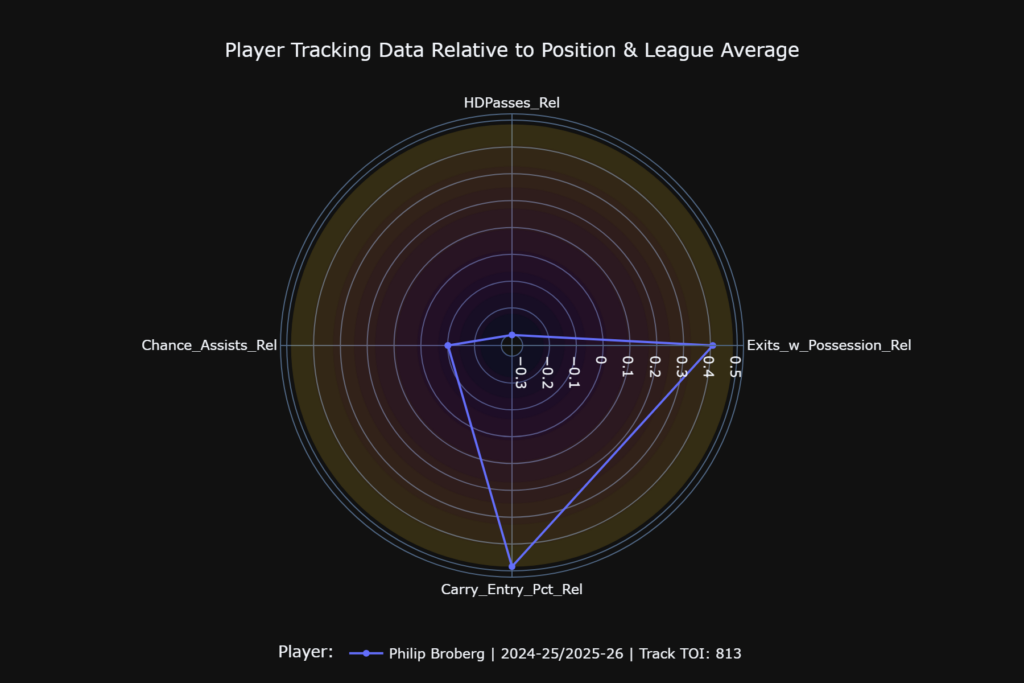
That is worrying for his fantasy value. Broberg is clearly very talented at getting the puck out of the defensive zone and into the offensive zone with control, and that is very valuable in helping his team score goals. But without that playmaking connective tissue between the transition and the goal-scoring, there are going to be some assists missing. Compare that to what LaCombe has done over the last two years:
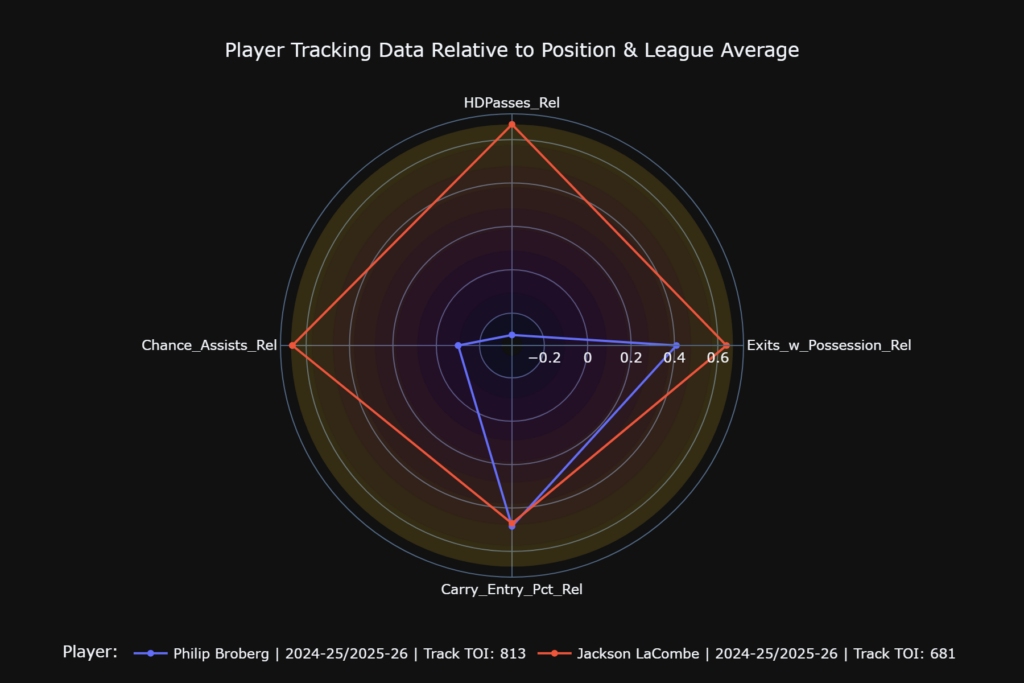
In that span, the St. Louis Blues and Anaheim Ducks have the same 5-on-5 scoring rate. Despite that, LaCombe’s primary assist rate at 5-on-5 is 26% higher than Broberg’s. Given what we see in the graph just above, there’s a reason for that.
This will be a telling season for Broberg. He is now 25 years old, in his third post-Oilers season, and he crossed the 200-game threshold back in January. Everything is lined up for him to take a big step forward. If he can’t add a playmaking dimension to his game, he might be the next Forsling. That is a great real-life player, and reasonable fantasy hockey depth, but unlikely to be a high-end fantasy producer.
[Follow the link for more] (aug4)
19. Over the last couple of weeks, there have been a few notable depth signings that I haven’t touched on yet, so I want to get to that today. Ian wrote about a couple of them over the weekend, so check out what he has to say here. Contract data from PuckPedia.
The first was Novak re-upping with the Pittsburgh Penguins for three years at $4.65-Million per season. After a down year with Nashville in 2024-25, the Predators traded him to the Penguins, and he returned to his 40-something-point level with 16 goals and 26 assists in 82 games. He also set a career-high in shots (130), blocks (34), hits (12), and penalty minutes (24). Those aren’t good peripheral levels, but career-highs are better than career-lows.
One reason I was very high on Novak when he put up 88 points in 122 games across the 2022-23 and 2023-24 seasons was his playmaking. Going back to the 5-on-5 tracking data, his assists on teammate scoring chances was a whopping 124% above the league-average forward while his high-danger pass rate 64% above the league average:
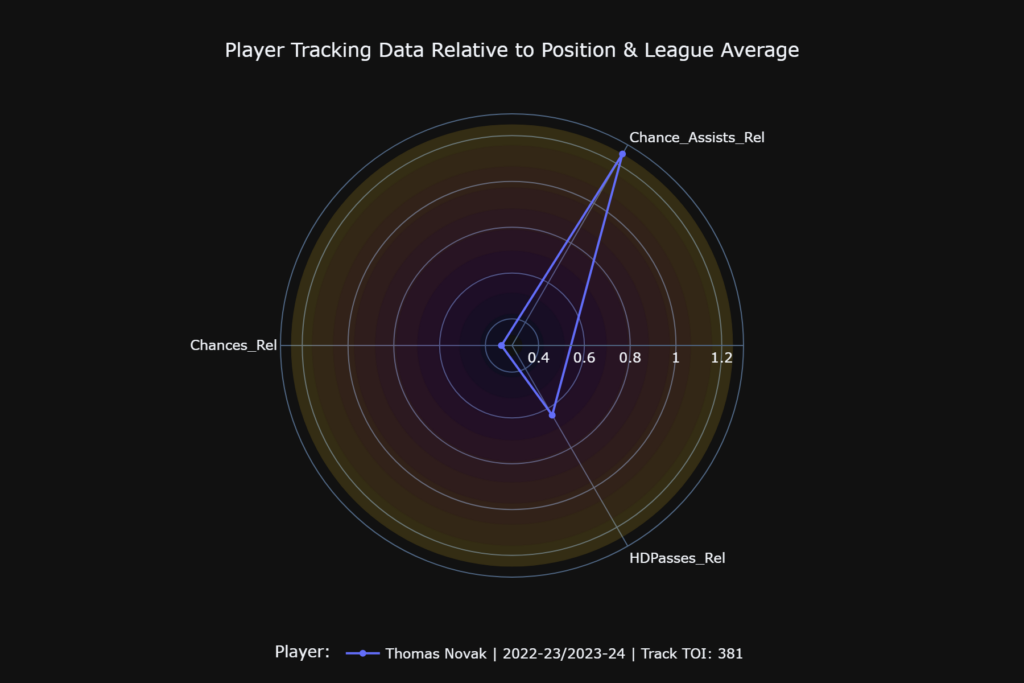
Over those two years, Novak’s primary assist rate at 5-on-5 was that of a mid-tier first-line forward (per Evolving Hockey), and tied with Dylan Larkin, Mats Zuccarello, and Sebastian Aho. He hadn’t put up huge totals yet, but he was very productive in his limited ice time, and that gave me a lot of hope that with the right usage he could turn into a 20-goal, 50-assist forward.
Then he had a genuinely poor 2024-25 season, whether by production rates or tracking data, and concerns mounted. The good news is that after a down year (purple line), his rate of scoring chances, assists on scoring chances, and high danger passes rebounded (orange line):
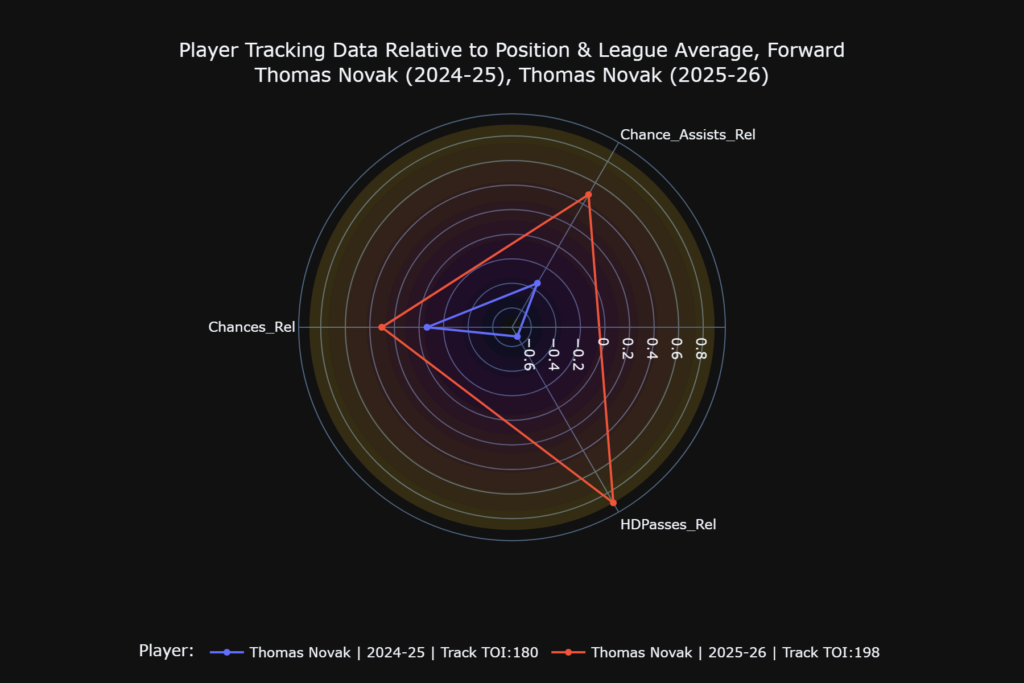
His primary assist rate at 5-on-5 reverted to nearly what it was in that prior two-year stretch, and had his 5-on-5 shooting percentage (9.4%) been more typical for him (around 15%), then he passes the 20-goal mark and pushes towards 50 points.
There are two big roadblocks preventing his next step in the fantasy game. The first is the power-play time as he earned just 25.3% of the team’s PPTOI last season (per Frozen Tools), eighth among their regular forwards. Anthony Mantha is gone, but they brought in Andrei Kuzmenko, so Novak is a long way away from truly meaningful PP production.
The other issue is the trust of his coaches. Pittsburgh had 10 forwards get an empty-net point last season, and none of them were Novak. The team uses their superstars when they need a goal and the superstars or grinder forwards when defending a lead. Novak is neither, so without the PPTOI or empty-net situations, Novak will be hard-pressed to get to the 50-point mark. He truly does have 60-point potential, but not with secondary PP usage and 14 minutes a game.
[Follow the link for more…] (aug4)
20. The Analytics Era of the NHL – or since the 2007-08 season – has seen the game adopt new ways thinking about offence and defence, new ways to evaluate performance, and new ways to predict future results. Many fans don’t care about any of this, and they don’t have to. In the end, any pro sport is an entertainment product, and a lot of people just want to sit on their couch, grab some snacks, and yell about how much the referees suck. It’s universal.
However, if fantasy managers want to figure out what kind of production a player can really provide, it’s important to understand some of the Analytics Era stats, what they mean, and how well (or not well) they can predict future production. We will do this today using tracking data from All Three Zones and player data from Evolving Hockey from the 2023-24 and 2024-25 seasons, and see what happened the following seasons. Between the tracking and standard player data, we are using 18 different (hopefully) predictive stats. All data is at 5-on-5, which excludes a lot of situations where players rack up points, but it points us in the direction of players with good puck skills, and those translate to other areas. We are limiting the sample to forwards with at least 500 overall minutes at 5-on-5 in a season and 100 tracked minutes in the same season.
We are going to split by positions because what is important to forwards and important to defencemen is not always the same thing. For today, we’ll focus on the forwards.
Points
It would be easy to assume that a forward’s point production from one season carries well to the next. Assumptions are a dangerous thing but, in this instance, that is not a bad one to make. Across all our stats, here is where a player’s points per 60 minutes ranks by correlation to point production in the next season:
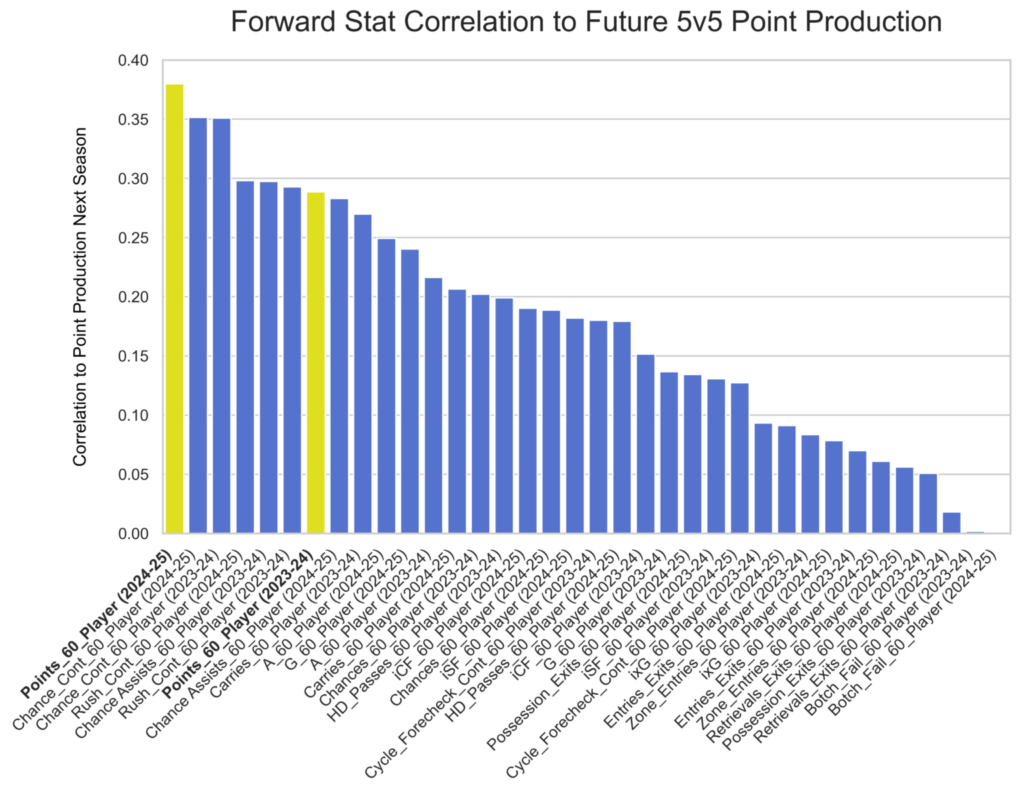
As far as hockey is concerned, getting a correlation between 0.29 and 0.39 in back-to-back seasons is not bad at all. Indeed, if we want to predict how well a forward will produce in the following campaign, seeing how they did the year before is one avenue to explore.
The only players who get points on a goal are those who have one of the final three touches on the puck. There are players who carry the puck with frequency but don’t rack up points (he’s a defenceman, but Philip Broberg has this problem, and I wrote about that on Tuesday), so getting involved in the offensive zone is crucial. To approximate involvement in goals, we are going to again use the tracking data to combine individual scoring chances with assists on teammate scoring chances into one stat: Chance Contributions.
[Follow the link for more…] (aug6)
21. In yesterday’s Ramblings (above), we went over stats that are, or are not, useful when searching for future goal and point production among forwards. There were some surprising results, particularly when it came to the types of stats that were useful, so to get a foundation on these Ramblings, go read that first.
Today, we’ll move to the blue line and do the same type of analysis for defencemen. It is a different position, and one that has been underdoing significant changes over the last 15 years, so what was a helpful stat in 2022 may not be helpful in 2026.
As a reminder, this is only for 5-on-5 production, and we’re looking at stats for the 2023-24 season and production the year after, and then stats for the 2024-25 season and what happened in 2025-26. Production at 5-on-5 is just one portion of how high-end fantasy skaters get their value, but it’s an important one, and it can help identify those with good skills that can translate elsewhere.
The tracking data used is from All Three Zones and the standard player data is from Evolving Hockey. We are going to limit the defencemen used for the analysis to those with seasons where they had at least 500 minutes at 5-on-5 overall and 100 minutes in tracked data. Overall, we are using 18 individual data points in each season to search for predictive value, ranging from things as simple as shot rates to various tracking stats.
Points
One of the interesting parts of the analysis on the forwards is that there was one season where 5-on-5 point production correlated well to point production the following year, and one season where the correlation was much weaker. That isn’t really the case with defencemen as both 2023-24 and 2024-25 points rates had similar correlation values in both seasons:
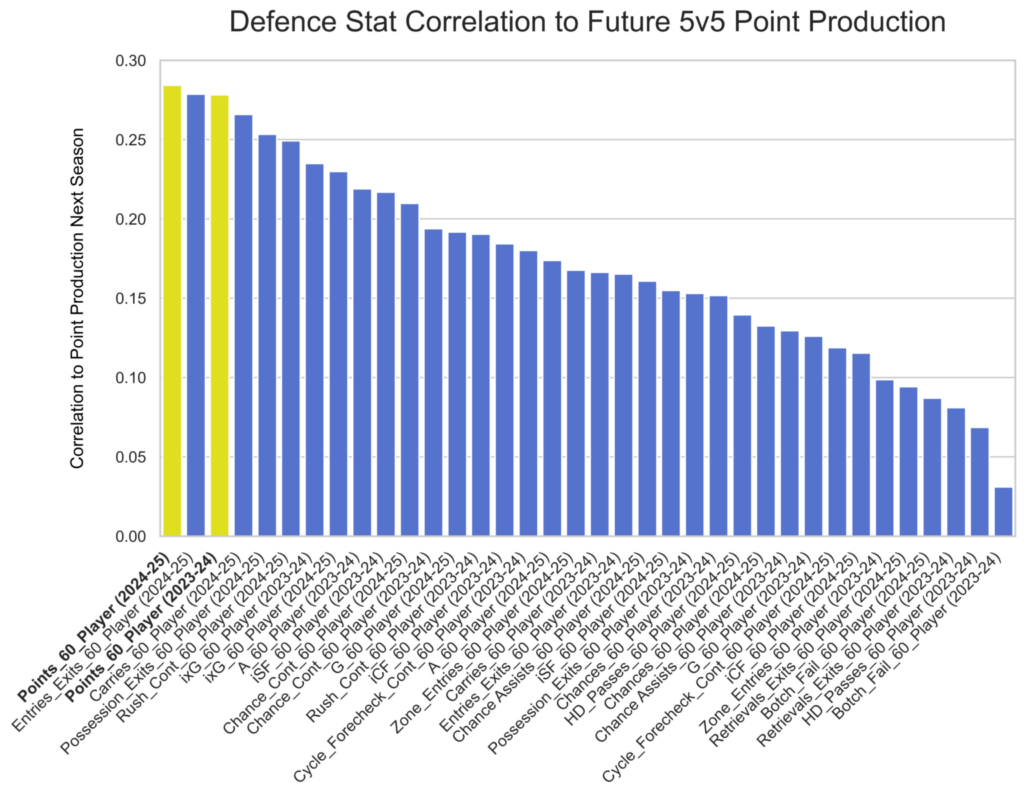
What also stands out is that of the 18 stats we’re using to predict future production, a defenceman’s points rate is one of two stats where the correlation in both seasons is at least 0.2. Fantasy value for defencemen is more complicated than just sorting the points column, but there are worse ideas.
If a blue liner’s point rate is one of the stats that has had two straight years of good correlation to future point production, the other must be a similar stat, right? Maybe assist rate? What about scoring chance contributions? Controlled zone entries? None of the above, actually, and it’s one that really surprised me.
Expected goals are a stat that approximate shot quality. The type of shot, where it was taken, how long after a zone entry it occurred, whether it’s a rebound or not, and other factors determine the expected goal value of any shot. Because it is a direct result of a player taking a shot, we would probably see some correlation to points, but this might be the most incredible finding of the last two days: Aside from points rate, a defenceman’s individual expected goals rate at 5-on-5 (ixG/60) appeared in the top-10 from each of the last two seasons by correlation to future point production.
[Follow the link for more…] (aug7)
___
Have a good week, folks!
Thanks for continuing to support the website and if you’re bored and need a fantasy hockey fix – visit the gang in the forum here.
Related Posts
Starting Goalies



Top Skater Views
 S.J
S.J CBJ
CBJ ANA
ANA CHI
CHI

Top Goalie Profile Views
| Players | Team | |
|---|---|---|
| JAKUB DOBES |
 MTL MTL | |
| JOSEPH WOLL |
 PHI PHI | |
| SERGEI MURASHOV |
 PIT PIT | |
| FREDERIK ANDERSEN |
 EDM EDM | |
| CARTER HART |
 VGK VGK
| |
LINE COMBOS
| Frequency |
 SEA Players SEA Players
| |
|---|---|---|
| 19.8 | JANI NYMAN OSCAR FISKER MOLGAARD JAGGER FIRKUS | |
| 19.4 | MITCHELL STEPHENS EDUARD SALE JON-RANDALL AVON | |
| 15.4 | RYAN WINTERTON CARSON REHKOPF LOGAN MORRISON | |
DobberHockey Podcasts

Keeping Karlsson: KKUPFL Tier 1 Draft Roundtable
Elan and Brian are joined by several KKUPFL Tier 1 managers, to bring you inside their draft table decisions and thought processes in building the teams competing in the top division of the world’s best fantasy hockey league.

Fantasy Hockey Life: New Jersey Devils with James Nichols
James Nichols joins the program to discuss the New Jersey Devils. Jesse and Victor ask about pros Jack Hughes, Jesper Bratt, Nico Hischier, Timo Meier, Connor Brown, Arseni Gritsyuk, Anthony Mantha, Dougie Hamilton, Luke Hughes, Jake Allen, David Rittich, and Nico Daws. In Cat’s instincts, Cat Silverman of InGoal magazine joins to discuss prospect goalies […]
Fantasy Hockey Life: Nashville Predators with Emma Lingan
Emma Lingan joins the program to discuss the Nashville Predators
Keeping Karlsson: The 2026-27 Keeping Karlsson Breakfast Club
Don’t you forget about them! Elan and Brian remind you of at least one player on each NHL team whose name you might forget to consider at the draft table.
Fantasy Hockey Life: Tampa Bay Lightning with Erik Erlendsson
Erik Erlendsson joins the program to discuss the Tampa Bay Lightning. Jesse and Victor ask about pros Nikita Kucherov, Jake Guentzel, Brandon Hagel, Brayden Point, Anthony Cirelli, Ilya Mikheyev, Gage Goncalves, Conor Geekie, Benjamin Rautiainen, John Carlson, Victor Hedman, Charle-Edouard D’Astous, Andrei Vasilevskiy, Jonas Johansson, and Dennis Hildeby. In Cat’s instincts, Cat Silverman of InGoal […]