

21 Fantasy Hockey Rambles
Dobber Sports
2026-01-11
Every Sunday, we share 21 Fantasy Rambles from our writers at DobberHockey. These thoughts are curated from the past week’s 'Daily Ramblings'.
Writers/Editors: Ian Gooding, Michael Clifford, Alexander MacLean, Puneet Sharma, and Dobber
—
Whether chasing a fantasy championship, looking for a run in your head-to-head leagues, or loading up for the future, the 2026 Dobber Hockey Midseason Guide can help fantasy hockey managers of all stripes. It has projections, players to buy or sell, advanced stats, prospects to monitor, and a whole lot more.
Help support what we do and get a leg up over your league mates by heading to the Dobber Shop to pick up your copy!
—
1. As I worked on the “other categories” section for the Fantasy Guide, I spent a lot of time in the Report Generator section of the FrozenTools site, and most of my writing would be infinitely more difficult without it. With 2025 now in the rearview mirror, I decided to plug in some custom dates to the Report Generator so that we could see if there were any standouts in the peripheral categories in 2025.
Unsurprisingly, Nathan MacKinnon led the league by a mile in SOG. However, I was surprised to see the second name on the list. He’s a five-foot-eight player on his third NHL team, and in the midst of his prime years at the moment. Yes, it’s Alex DeBrincat who paced the rest of the pack in SOG in 2025 with 289. Now, he did it in 86 games, compared to the 287 SOG from David Pastrnak (79 games), Tage Thompson (82 games) and Auston Matthews (76 games). Still, schedules matter, and so does health in fantasy hockey. Don’t look down on Alex DeBrincat any longer, because in the SOG column he continues to stand tall. (dec7)
2. The top five plus-minus stats from 2025 are all Colorado Avalanche players, and more specifically their top line and top D-pair. No real surprise there, but it does underline just how dominant they have been, and there’s no sign of them letting up. Again, we look to a surprise player leading the rest of the pack. This time it’s a six-foot-six behemoth whose breakout threshold lined up almost precisely to the calendar flipping to 2025, and boy did Aliaksei Protas deliver. He put up 64 points in 76 games in 2025, with a plus 43 rating, and some reasonable peripherals to boot. Those 64 points were also mainly at even strength, with only two power play points, which is why his plus-minus rating was so high (there’s no plus rating for a power play point). (dec7)
3. In the PIM column, there wasn’t a fair fight. Nikita Zadorov‘s huge December where he racked up 55 PIMs (41 in the final 10 days) put him and his six-foot-seven frame well out of reach. Arber Xhekaj gave Zadrorov a run though, as the only other regular player even close to two PIMs per game. As a defenseman, Xhekaj’s sub-1.0 Blks per game leave something to be desired though. Further down the list we find Curtis Douglas, who has only been a semi-regular player for the 2025-2026 season, but has put up 75 PIMs in 27 games. He’s making it into the lineup when the Lightning have injuries, but he’s not a regular enough player to be universally rostered in PIM leagues. (dec7)
4. In the Hits column, Kiefer Sherwood topped fellow former Nashville Predator Yakov Trenin by exactly 100 Hits, though the latter of the two has been leading the league in the 2025-2026 season. Marc Gatcomb is my pick to be the next one of these players who leads the league in Hits when his ice time suddenly jumps from nine minutes per game into the 13 minutes range. (dec7)
5. I don’t cover PPPs in my Guide column, but I wanted to note that Wyatt Johnston was tops in power play points in 2025 for players not named Connor McDavid or Leon Draisaitl. Not only was he above MacKinnon and Nikita Kucherov, but he was four PPPs clear of each of them. In 42 games in 2025-2026, his 23 PPPS has already nearly matched his previous career high of 25, with an entire three months left in the campaign. (dec7)
6. In the Blks column, Alex Carrier was the only one to put up 200 Blks in 2025, but unfortunately for him, all of his other counting numbers have been going down. Players that put up high Blk (and Hit) numbers, really wear their bodies down and can’t keep it up for multiple years. Carrier’s Blk numbers have been in decline the entire month of December. Other names high on the list that have run into issues: MacKenzie Weegar (terrible season), Mike Matheson (offence and SOG are gone), Jake McCabe (injured), Dante Fabbro (wheels completely fell off), Darnell Nurse (offence is slumping and Hits have dropped too). Be careful not to hold onto the heavy peripherals players for too long. (dec7)
7. Connor Bedard returned to the Blackhawks’ lineup on Friday after missing nearly a month with a shoulder injury. His return didn’t result in a favorable outcome for the Blackhawks, who lost 5-1 to Washington. Bedard was held without a point while taking four shots in nearly 17 minutes of icetime. Bedard was on an even-strength line with Oliver Moore and Nick Lardis, which might be something to watch when it comes to the fantasy value of these two players. Bedard is having by far his best season and needs to be back in fantasy lineups ASAP.
By the way, if you are in a league that counts faceoffs, coach Jeff Blashill has stated that Bedard won’t take faceoffs for the foreseeable future. You may recall that Bedard was injured on a faceoff. (dec10)
8. Thursday, Patrick Kane scored twice in Detroit’s 5-1 home win over Vancouver, once on the power play, and that performance pushed him to 500 career goals. That makes him the sixth American to reach the mark, and was 23 points away from setting the record for most points ever by an American-born player at time of writing. (dec9)
9. A quick update on Buffalo goalie Alex Lyon (lower body), who was seven to 10 days away, according to coach Lindy Ruff at mid-week. Lyon leads the Sabres with 19 starts, so it’ll be up to Ukko-Pekka Luukkonen and Colten Ellis in the interim. The Sabres do not have a back-to-back situation until Wednesday/Thursday next week. (dec8)
10. Auston Matthews was honored for his 421st goal which propelled him past Mats Sundin on the all-time Leafs scoring list. Matthews celebrated by scoring, giving him 11 points and seven goals in his last five games at time of writing. Maybe he’s finally getting over that injury that has been nagging him? (dec7)
11. Recent contract extensions for Alexei Toropchenko, Linus Karlsson, Christian Dvorak, and Alex Wennberg are what we’re going to see from a lot of teams who see they have more cap space than they’re used to, and they don’t know what to do with it. All four are overpayments, and for Karlsson and Toropchenko, they’re filling up spots where you are blocking internal growth candidates on smaller contracts as well. Dvorak’s is less-so about the cap hit than it is about the term, as the five-year contract is about three years too long.
There’s rumors that the next domino to fall could be Sherwood, on a cap hit around $4 million for four or five years. This feels a little too on the nose with the previous two discussion points about excess contracts being signed for middle-of-the-lineup players, and bangers players breaking down faster than others.
Meanwhile, the next two most recent skater contracts signed were both Lightning defensemen, where they locked up a top-pair player for eight years at less than $7 million a season, and then extended their breakout 27-year-old rookie for another year at less than $900K. Tidy business between the Bolts and both J.J. Moser and Charle-Edouard Dastous. It’s exactly why the Bolts are one of the deepest teams in the league – they can just keep adding as the years go on and the cap goes up, thanks to their long-term signings and cheap filler players. They hardly have any of those tweener contracts that fill up space on empty calories. (dec7)
12. Christian Dvorak signed a five-year extension with the Philadelphia Flyers for a little over $5M AAV. He was set to be a free agent after the season, but he’s now secured a long-term deal after an impressive first half of this season. He has found good chemistry with Trevor Zegras that has given the Flyers consistent scoring for most of the year. (dec6)
13. The Florida Panthers announced that Seth Jones is week-to-week, according to reporter George Richards. Their hope is that he can return before the Olympic break, and he likely would have to do so to remain on the Olympic roster. For now, this is a big boost to the fantasy value of Aaron Ekblad, who assumed top power-play duties in Jones’ absence. (dec6)
14. Tuesday, I sent in my section of the 2026 Dobber Hockey Midseason Guide – which can be ordered here – and my section covered the advanced stats from each team. To give a bit of a preview using our Frozen Tools, I want to offer a handful of my observations when going through the Player Usage Charts and Advanced Stats Reports.
I am going to give a short preview of the first half of the teams today, and the other half of the teams on Thursday. Today’s article is using data current as of January 5th, 2026.
Leo Carlsson (Anaheim Ducks)
Production has slowed down over the last few weeks for Carlsson, but he’s still pacing over a point-per-game status and a lot of his early-season red flags for negative regression are well within normal range now. On top of that, he’s driving good shot differentials relative to his team, albeit with a lot of offensive zone starts. All this is to say is that now that the negative regression has hit, we have a better idea of what kind of player he is, and that is a point-per-game guy. He just turned 21 years old two weeks ago and has 171 career games. This is a special, special player in the making.(dec6)
15. Josh Doan (Buffalo Sabres)
As of Monday morning, Doan was pacing for 25 goals, 55 points, 200 shots, 18 power-play points, and 72 hits, and he was doing that skating 16 minutes a game. Believe it or not, he has the same rate of shots per 60 minutes (9.28) as Matt Boldy, and is higher than Kirill Kaprizov, Cole Caufield, and Nazem Kadri. He is also doing all that while driving excellent shot differentials both relative to his team and overall. It is his third (partial) season in a row doing that, and if he can get more ice time, he can be a huge fantasy asset. (dec6)
16. Andrei Svechnikov (Carolina Hurricanes)
Over the last two months, Svechnikov is 25th among regular forwards (at least 250 minutes) in points per 60 minutes at all strengths and inside the top-50 by points per 60 minutes at 5-on-5 only (per Natural Stat Trick). Those last 30 games have seen him average over three shots and two hits per game, and he’s done all this while driving good shot differentials for the Hurricanes. This has been the rebound season his supporters were hoping for, and fantasy managers who believed in that rebound are being rewarded. Let’s hope it holds up in the second half of the season. (dec6)
[Follow the link for more…]
17. In Tuesday’s Ramblings (above), I started a preview of the 2026 Dobber Hockey Midseason Guide by going over players in from half the league and some of their key advanced stats that fantasy managers should know. Today, the Midseason Guide‘s preview of advanced stats will cover the second half of the league. We are going to be using the data available from the Player Usage Charts over on Frozen Tools.
Roman Josi (Nashville Predators)
The hope that Roman Josi could turn back the block to the guy he was 3-4 years ago are probably gone now. He is getting incredibly easy minutes – the most offensive zone starts of any Nashville defenseman and very rarely taking top matchups – and still seeing roughly neutral shot differentials and a team-high rate of goals against (relatively speaking). At 35 years old (36 in June) with an injury history that seems to worsen with each passing month, and unable to drive even above-average shot differentials in very easy minutes, it seems the end of the road is here for Josi. His reputation will keep him skating a lot of minutes, but he’s a shadow of his former self now. (dec8)
18. Shane Pinto (Ottawa Senators
After a very hot start, Pinto has slowed down his production considerably, but what he’s been able to do is drive positive team-relative shot differentials while taking the most defensive zone starts of any skater on the Ottawa roster while taking the toughest opposition matchups of any skater on the Ottawa roster. Playing that kind of role frees up the likes of Tim Stutzle and Brady Tkachuk to skate much easier minutes, and at least for Stützle, we’ve seen the results in his production. Pinto won’t be as productive as Stützle, but he’ll push for 20 goals again with good hit volume so there’s good fantasy value for him while providing great value for the Senators. (dec8)
19. Denver Barkey (Philadelphia Flyers)
It has been just eight games for Barkey in a Flyers uniform, but it’s been a very successful eight games from him. Unlike most rookies, he’s not being thrown all the offensive zone starts he can – those go to Matvei Michkov‘s line – and Barkey is taking some top competition matchups, and yet the play-driving has been very good in those minutes. Skating on a line with Sean Couturier certainly helps, but Barkey would have to be playing well to remain there, and he is. Injuries to Flyers forwards offered Barkey the opportunity to crack the roster at all, and now he’s kicking down the door. Again, it is still just eight games, so let’s see where things stand after 28 games, and the fantasy value is modest, but there are obviously positive signs here. (dec8)
[Follow the link for more…]
20. There was an interesting thread a few days ago from C.J. Turtoro, a public hockey analyst who has done a lot of work with game tracking in the past (and is a suffering New Jersey Devils fan).
Long story short: there is some wonkiness with the public expected goals (xG) models this season. A lot of the ones we use frequently – Natural Stat Trick, Evolving Hockey, Moneypuck – had been overestimating the value of expected goals compared to actual goals. To be more specific, shots with moderate expected goals values – roughly between 0.2 and 0.6 – had been underestimating the actual goal value, whereas shots with high xG values – typically shots from close to the net – had been overestimating the actual goal value. So, shots from mid-range were going in more often than expected and shots from in close less often.
I encourage everyone to read that thread for more complete analysis of what’s going on. This is crucial for us in the fantasy realm. We use those xG indicators to see who has been creating quality, who hasn’t, and who might be due for some regression (both positive and negative). Just as an example, players who live around the net like Anders Lee or Brady Tkachuk might have overinflated xG numbers which would throw off our analysis, and possibly by quite a bit. That matters a lot. (dec9)
21. I thought I would dig in a little bit more to see the year-to-year correlations between a team’s individual xG rate and their actual goal-scoring rate. For today, we are using Evolving Hockey’s data, we’re putting everything on a 60-minute rate, and data is current as of the morning of January 8th.
As of today, there are 1362 individual team games played. Using all-situations data, here is the correlation map between individual team xG per 60 minutes and goals-for per 60 minutes:
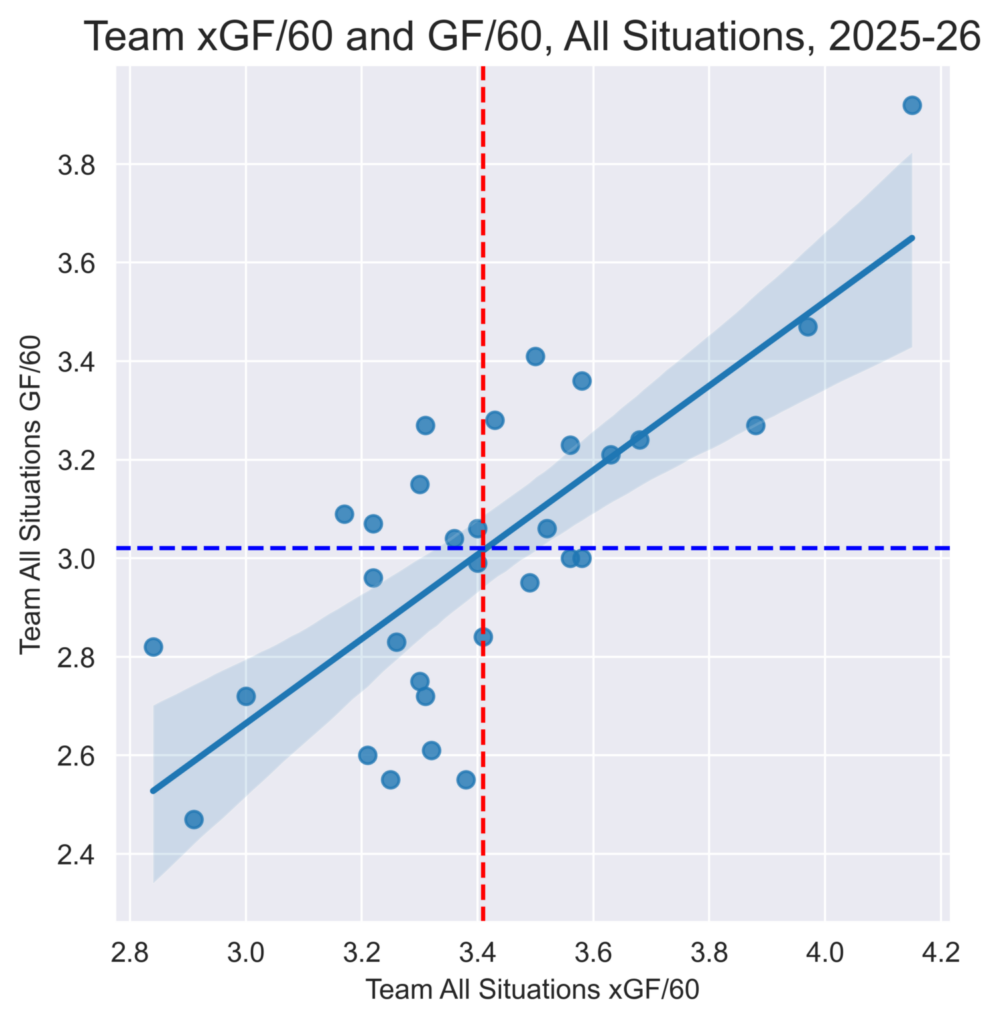
As we can see, that is a pretty strong upward trajectory for teams creating more expected goals. And when we run the correlation analysis, the r-squared is 0.559:

For those who may have pushed their high school math out of mind, a correlation of 0.559 is very high for anything related to hockey. It is a chaotic sport, and it’s an indication that creating a lot of xG is leading to a lot of goals.
But if this season (and last) is different, then what did it look like at this time last year? (dec9)
[Follow the link for more…]
—
Have a good week, folks!
Thanks for continuing to support the website and if you’re bored and need a fantasy hockey fix – visit the gang in the forum here.
Related Posts

Starting Goalies









Top Skater Views
| Players | Team | |
|---|---|---|
| DECLAN CARLILE |
 PIT PIT | |
| COLE PERFETTI |
 WPG WPG | |
| BEN KINDEL |
PIT | |
| JACK QUINN |
 BUF BUF | |
| LUCA CAGNONI |
 S.J S.J
| |
Top Goalie Profile Views
| Players | Team | |
|---|---|---|
| JOEY DACCORD |
 SEA SEA | |
| SERGEI MURASHOV |
PIT | |
| JAKUB DOBES |
 MTL MTL | |
| DAN VLADAR |
 PHI PHI | |
| SAMUEL ERSSON |
 OTT OTT
| |
LINE COMBOS
| Frequency |
 FLA Players FLA Players
| |
|---|---|---|
| 24.2 | CARTER VERHAEGHE MATTHEW TKACHUK SAM BENNETT | |
| 16.3 | SANDIS VILMANIS EETU LUOSTARINEN ANTON LUNDELL | |
| 11.1 | BRADY TKACHUK SAM REINHART BRAD MARCHAND | |
DobberHockey Podcasts

Keeping Karlsson: Cole, There’s No Time!
Elan and Brian cover all the action from the first week of the NHL season, and identify our earliest must-adds, can-drops, sell highs and buy lows in your fantasy hockey leagues.
Keeping Karlsson: Matchup Maximizer 2026/27 Week 2
Elan takes a look at the schedule for the upcoming weeks of NHL action and recommends players with good schedules that you should consider streaming in to win your head to head matchups.

Fantasy Hockey Life: Tidy Takes Part 1
TiDy Admiral Ryan Downey and Victor Nuno break down recent trades in the FHL Tiered Dynasty’s top division, the Lord Stanley division. Tune in to consider trades between some of the best dynasty sharks we know, including patron polls on the trades and Victor’s analysis. Have a listen! Our show is part of the Dobber […]
Keeping Karlsson: Short Shifts – I Tried to be Like Parker Kelly
Elan is joined by Ryan Downey for the premiere of season 8 of Short Shifts! — KKUPFL late registration is ongoing! We’re still filling new divisions in the world’s greatest fantasy hockey league. Details at https://www.kkupfl.com/. Join the Keeping Karlsson patron community! Patrons get access to all our perks all year round, including KKUPFL […]
Keeping Karlsson: Shabanov Ranks
Elan and Brian fly through the final preseason lines for every NHL team ahead of opening night, and share their guys to watch– or look away from– in your fantasy hockey leagues.