

21 Fantasy Hockey Rambles
Dobber Sports
2026-02-08
Every Sunday, we share 21 Fantasy Rambles from our writers at DobberHockey. These thoughts are curated from the past week’s 'Daily Ramblings'.
Writers/Editors: Ian Gooding, Michael Clifford, Alexander MacLean, Puneet Sharma, and Dobber
—
1. As the resident Preds fan, I have a lot of thoughts on the Barry Trotz news. There are some mixed feelings about Trotz stepping down. I loved him as a coach, and he is an icon in Nashville, having carried the team and the identity there for so long. It will be interesting to see who they bring in his place.
As a General Manager… he’s been rather pedestrian. In isolation, he made a lot of moves that looked great on paper, but as a whole, the mix of them didn't point well enough in a specific direction, and as a result the Preds are in a weird spot right now. They are a playoff bubble team yet again, and because of the age of their core they should probably be selling some of those players off. However, they have just gone through the last few seasons with some heavy volume at the draft table, both in quantity and quality, so stockpiling future assets isn’t necessarily the way to go either.
Moving Ryan O’Rielly for example for a late first and a mid-rate prospect seems redundant, and I would rather them just hold those players for the playoff run this year, and then revisit things in the offseason where maybe it’s more likely that an RFA can be pried loose. Those kinds of deals would fit in a lot better for the Preds than stockpiling more future longshots.
As Roman Josi is my favorite player, I hope for his sake that they can push for the playoffs this season, because that 8th seed is ripe for the picking. I know that sets up a matchup against Colorado, but the Avs look like the kind of Goliath team that takes their foot off the gas in the last month of the season and gets kicked out in round one. Maybe wishful thinking, but between Boston, Tampa Bay, and a few other President’s Trophy winning teams in recent years, these kinds of upsets do happen. (feb4)
2. With the NHL season now on pause, I’ll use this time to take a closer look at the top five Frozen Tools searches from the past week. These are the players that fantasy owners are the most curious about, so I’ll share my two cents on each.
(1) Fraser Minten:
(2) Darren Radysh:
(3) Jack Quinn:
(4) Egor Chinakhov:
(5) Charlie Coyle:
Minten is off the Frozen Tools Hot List after failing to record a point over his last two games. That’s unfortunate, because the 21-year-old has averaged over 19 minutes per game over those two games. One major reason for the spike in icetime is that centers Elias Lindholm and Pavel Zacha have both been injured. Prior to that, Minten had a red-hot January with eight goals and 16 points and a plus-15 over 15 games (including December 31).
Minten benefitted from a 30.8 SH% during his January run, while many of his season-long advanced stats look very unsustainable (17.9 SH%, 11.9 5-on-5 SH%, 1052 PDO). When Lindholm and Zacha return, Minten’s icetime could fall and so could his scoring as a result. Minten has shown a glimpse of his upside as a potential second-line forward, but he might be better off as a keeper league option once the NHL season resumes.
Who knew before the season that Raddysh’s season-long fantasy value would far surpass that of Victor Hedman at the Olympic break? You probably know by now that onetime AHL regular Raddysh is suddenly on Tampa’s top power play, scoring at over a point per game. Is the bubble going to burst now that Hedman is back? If it eventually does, it hasn’t yet. In the three games since Hedman has returned, Raddysh has five points (three on the power play), four shots per game, and is still averaging 25 minutes per game. Raddysh played just 19 minutes on Thursday, but that was a game that was one-sided by the second period.
The Lightning appear to be one of the few legitimate top-tier contenders in the Eastern Conference. Hedman, their franchise defenseman, is now 35 years of age, has a ton of mileage with over 1100 NHL games, and just returned from a significant injury. The best way to keep Hedman fresh for a potentially long playoff run would be to limit his minutes. That is in fact what the Lightning have done so far, keeping him to under 18 minutes in each of his three games since returning. Raddysh may cool off in the scoring department anyway, as a 13.2 SH% is rather high for a defenseman. However, the Lightning now know they have unlocked a new PP1 QB who can carry the mail for at least the rest of the season.
Looking among the scoring leaders for forwards and defensemen, Raddysh might be the biggest surprise of the fantasy season. (feb7)
[Follow the link for more…]
4. We had a couple huge pieces of news on Wednesday, and the first was that New York Rangers winger Artemi Panarin would be traded to the Los Angeles Kings in return for prospect Liam Greentree and a conditional 3rd round pick. Alex had the trade breakdown which can be read here. (feb5)
5. The second big piece of Wednesday news was that top draft prospect Gavin McKenna was charged with four offenses including felony aggravated assault. The report from Onward State said that McKenna broke the jaw of another person in the assault, which led to the charges, which were reportedly dropped on Friday. (feb5)
6. In a bit of a surprise, as there had not been any indications it would be the case, Pierre-Luc Dubois returned to the Washington Capitals lineup on Thursday night. Dubois had not played since October following multiple surgeries, and the initial timeline was 3-4 months. The three-month mark would be a couple of days from Friday, so he’s ahead of schedule on even the low end of things. It gives him a bit of time to acclimate himself to game action before the three-week Olympic break when he can get as close to game-shape as he can.
The return of PLD is great news for the Caps but not great news for Justin Sourdif‘s fantasy value. Sourdif averaged 11:50 per game over his first 20 games of the season with just three points in that span. Since the 20-game mark, he averaged 16:19 per game and posted 23 points in 34 games (a 56-point pace over 82 games) entering Thursday's game. With Dubois, Tom Wilson, Dylan Strome, Alex Ovechkin, and Aliaksei Protas, there is just one spot in the top-6, and they could probably use Sourdif as a reliable third-line centre. Sourdif’s run as a roster-able fantasy commodity (in most formats) has come to an end. (feb6)
7. It was announced on Thursday that Tampa Bay Lightning centre Brayden Point would not be attending the Olympics and that Carolina Hurricanes winger Seth Jarvis would be taking his place. Point was injured a few weeks ago and has not played since, so Jarvis will be the replacement for Team Canada. Good for Jarvis as he gets a chance to improve his standing after a very modest performance at the Four Nations Cup. (feb5)
8. Calgary Flames winger Jonathan Huberdeau had hip resurfacing surgery and will be out for the remainder of the season. The only real question is at which point he returns in the 2026-27 season because hip resurfacing surgeries take months of recovery and rehab, let alone be ready for an NHL season. (feb6)
9. Matthew Schaefer scored his 16th of the season this week. That’s good for third among all rookies (behind Beckett Sennecke and Oliver Kapanen) and fourth among all defencemen, only trailing Zach Werenski, Jakob Chychrun, and Darren Raddysh.
It does appear though that Schaefer is losing a bit of steam when it comes to the shot volume though, because he averaged 2.5 SOG per game through the first half of the season, but since passing the halfway mark 14 games ago (entering Thursday), he has only put up 1.5 SOG per game. The scoring is still there, but the lower volume may mean the goal scoring dries up a little in the second half too. (feb4)
10. After Clay Stevenson put up a decent first game for the Caps on January 31st (allowing three goals in a win) he then was tabbed to start both games of the Feb 2nd/3rd back-to-back, and allowed a combined four goals. This is as a result of the injuries to both Logan Thompson and Charlie Lindgren. While Thompson returned on Thursday, Lindgren’s status has less certainty, and it could be that Stevenson continues to get some games as the backup in Washington after the break. Maybe useful for the occasional DFS slate, or those of you in leagues where every goalie start is hoarded. (feb4)
11. Newly-acquired Ondrej Palat was on the top line for the New York Islanders on Monday night, skating with Bo Horvat and Mathew Barzal. All three were also on the top power-play unit together. That is temporarily bad news for guys like Emil Heineman, Jonathan Drouin, and Anthony Duclair, but it’s really good news for Palat. (feb3)
12. Colorado welcomed defenceman Devon Toews back to the lineup on Monday night. He had missed over four weeks with an upper-body injury but is back in time to get a couple of games in before taking off for Italy and the Olympics. (feb3)
13. I was discussing Braeden Bowman with a league mate of mine earlier this week, and he was noting that Bowman had some solid upside because he has shown he can pay with Jack Eichel. While that’s true to an extent, Bowman has 20 points in 41 games, but only six in his last 17 games. He has played only about 40% of his minutes with Eichel, but those minutes account for about 60% of his production. All in all, Bowman is likely someone who is a bit more of a passenger at this stage. Really, a lot of people could play decently well with Eichel, and it doesn't feel like Bowman’s spot on Eichel’s right wing is etched in stone. (feb4)
14. As the Olympic break approaches, a lot of fantasy managers are starting to look ahead and assess where their teams stand and how they project for the playoffs. That naturally shifts the focus toward value hunting, especially when most of the big names are already rostered or too expensive to pry loose in trades. This is the part of the season where identifying overlooked or underrated players can make a real difference. These are players I have been keeping a close eye on as potential targets down the stretch, particularly those whose usage or deployment could swing in their favor.
Will Cuylle – LW/RW – New York Rangers
Will Cuylle is turning into the kind of player who matters more during the fantasy playoff grind than in early-season box scores. The offensive ceiling is still limited, but his role, peripherals, and the Rangers retool direction could boosting his usefulness.
Cuylles’ 5v5 minutes have climbed steadily, and he is now a regular part of the second power play unit. He already has eight power-play points after barely factoring much in previous seasons and most of his minutes have come alongside Mika Zibanejad, Artemi Panarin, Vincent Trocheck, and Alexis Lafrenière, while he’s also held his own with younger linemates like Noah Laba and Brennan Othmann.
What gives Cuylle his appeal is that we can contribute across multi-cat formats. This year he has 105 shots (nearly two SOG/G), 198 hits, steady PIMs, and a faceoff rate north of 50%. That plays well in banger and multi-cat formats. With Panarin moved and potentially Trocheck shortly after, his efficiency could dip, but Cuylle would potentially see more ice time and volume. He is not a league-winner, but he’s a strong glue piece for playoff matchups, especially with New York’s favorable off-night schedule. (feb2)
15. Alexander Wennberg – C – San Jose Sharks
Alexander Wennberg is still very much the same player he has been throughout his career: a pass-first, structure-dependent center whose fantasy value lives and dies with deployment. There is no untapped upside here. If you’re adding Wennberg, you are buying into role security, power-play exposure, and a steady drip of assists, not category coverage or ceiling outcomes.
San Jose has leaned on him heavily this season. He is averaging over 20 minutes TOI/game and seeing more than 3:30 of PP time, both career highs. As long as that usage sticks, he is at least worth a look off the waiver wire. That said, the role itself is far from bulletproof, which is why he is rostered in only about 10 percent of Yahoo! leagues and should not be someone you should feel married to.
He does have prime deployment and is playing with one of the top five-point producers in the league on the man-advantage and in deeper formats or points leagues, he can function as a short-term depth piece. As long as the minutes and power-play opportunities remain intact. (feb2)
[Follow the link for more…]
16. In each of my Ramblings last week, regression was the topic, focusing on the timeframe since December 1st:
- Forwards with signs of positive regression
- Defencemen with signs of positive regression
- Forwards with signs of negative regression
Today, we are finishing the quartet of Ramblings by going back to defencemen and picking a handful that are showing the hallmarks of negative regression. For this, we are mainly focusing on the difference between the expected goals-for (xGF) rate and actual goals-for (GF) rate with specific players on the ice, as well as a player’s Individual Points Percentage (IPP, or the rate they’re garnering a point when their team scores a goal with them on the ice).
We are using data from Evolving Hockey since December 1st only, limiting our sample to defencemen with at least 250 minutes played in that stretch, and the data is current as of Monday, February 2nd.
Charlie McAvoy (Boston Bruins)
The Ramblings on forwards with negative regression highlighted David Pastrnak, so it’s fitting that we see Charlie McAvoy here. This is also a bit of a problem because McAvoy’s shots and hits per game are both three-year lows, so if the point production starts declining, there isn’t the same cushion in peripherals as there had been in recent seasons.
And there is cause for concern with McAvoy’s point production. Here is McAvoy’s season as it relates to the difference between expected goals-for per 60 minutes and actual goals-for per 60 minutes when he’s on the ice, as well as his IPP, with league averages in each marked by the red and blue dotted lines:
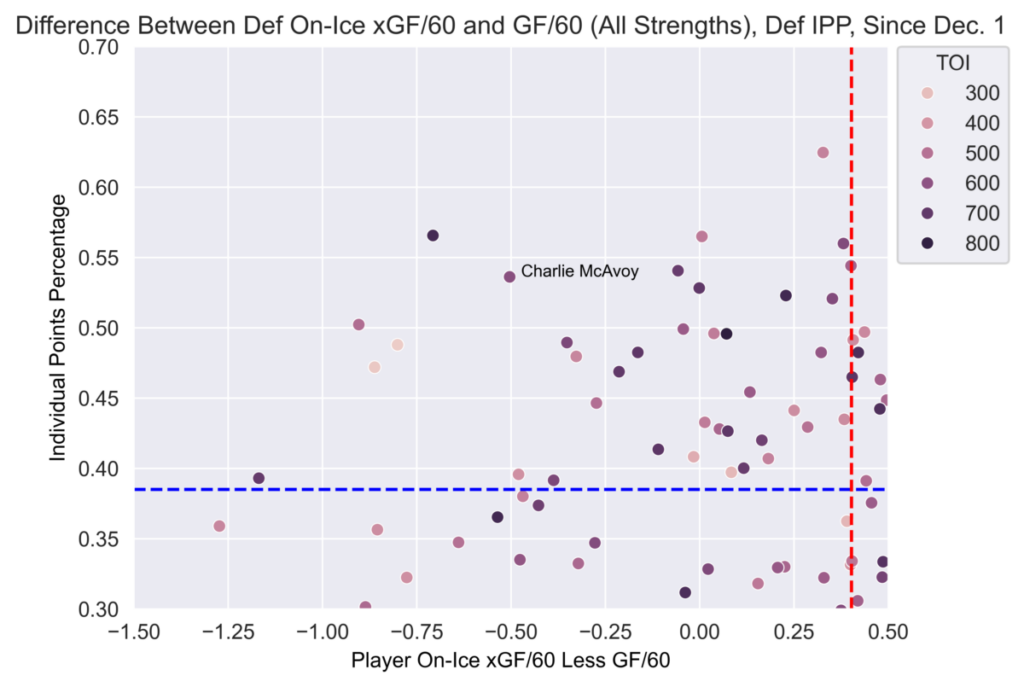
It isn’t hard to buy the fact that McAvoy playing with Pastrňák around 35% of the time at 5-on-5, as well as on the top PP unit, will afford some leeway in that xGF-GF differential. What is harder to buy is McAvoy figuring in on nearly 55% of Boston’s goals when he’s on the ice considering this is his ninth NHL season and only 1 of the previous 8 seasons saw him exceed a 45% IPP. It has given him an extra 4-5 points over his last 25 games, or roughly 15 points over a full season. That is a lot, and when that starts coming down, there isn’t the same level of shots and blocks to help float his value in multi-cat formats. On top of that, Boston has the second-hardest schedule after the Olympic break by opponent points percentage (per Frozen Tools). McAvoy fantasy managers should not be expecting him to post 20+ points over the team’s final 25 games. (feb3)
[Follow the link for more…]
17. In my newsletter a couple of weeks ago, I wrote about what helps make power plays successful. Aside from ‘Have Connor McDavid and Leon Draisaitl‘, it’s important to figure out what kind of data we can look at that can point us in the direction of why power plays are successful, and which power plays could find success in the future.
To that second point, let’s look at the post-Olympic break stretch of games and which teams have power plays that have the hallmarks of a turnaround. We are using tracking data from All Three Zones, the power-play data is at 5-on-4 only, and all data is current as of Wednesday, February 4th.
While I encourage everyone to go read that newsletter post I linked in the first paragraph, the long-and-short of it is that one area of the tracking data that has a strong correlation to power-play goals is scoring chance setups per zone entry. In other words, the teams that can create the most scoring chances per zone entry on the power play are the ones that tend to find the most success. Unsurprisingly, teams like Dallas, Edmonton, Pittsburgh, and Boston are top-5 by chance setups per entry and are also scoring a lot of goals:
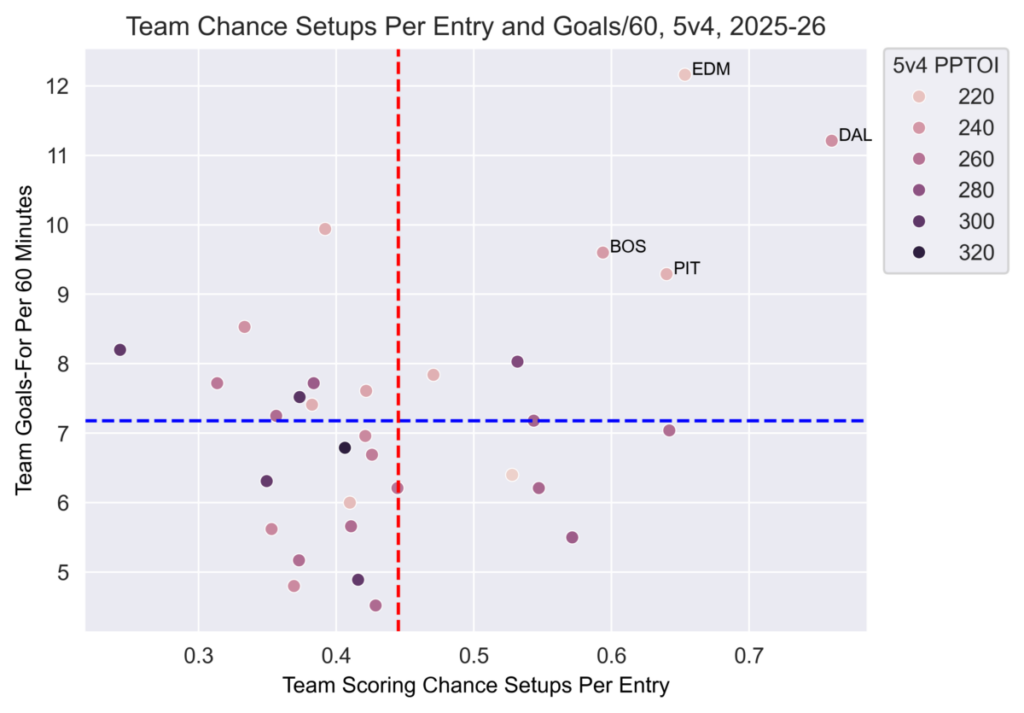
While the members of the top PP units from the Oilers and Stars are going to be rostered in all formats, we have seen a handful of different players assume top PP duties for the Penguins and Bruins, largely due to injuries/suspensions. In that sense, keep an eye on those teams because players like Anthony Mantha, Ben Kindel, Fraser Minten, and Viktor Arvidsson could see a big boost in their fantasy value whenever they do get top power play time.
There has been one exception. There is one team that is third in the league in scoring chance setups per zone entry but has a 5v4 scoring rate right around the league average: (feb5)
[Follow the link for more…]
18. Here at Dobber Hockey, we like to keep the 200-game players in mind. For the uninitiated, Dobber himself has written about 200 regular season NHL games being the mark that regular-sized forwards (between 5’10 and 6’2) need to really start hitting their offensive upside. It doesn’t mean their offensive peak, but generally when they start their real upward trajectory towards that offensive peak. (For bigger/taller forwards, they need closer to 400 games).
Here are a few names who’ve reached 200+ games so far this season: Egor Chinakhov, Luke Evangelista, Jack Quinn, Pavel Dorofeyev, and Dylan Guenther. Each are having great campaigns for their respective roles, and each has a points/60 minutes rate that exceeds their career rate before this season started.
Among the top forwards reaching that mark later this year, provided they’re healthy down the stretch: Connor Bedard, Adam Fantilli, Logan Cooley, and Leo Carlsson. But telling the readers how good Bedard or Carlsson could be feels redundant. For that reason, let’s review a few down-the-roster forwards who are set to reach the 200-game mark later this season and whom fantasy managers will want to keep an eye on.
Player data is from Evolving Hockey, tracking data is from All Three Zones, and all is current as of Thursday, February 5th: (feb6)
19. Bobby Brink (Philadelphia Flyers)
As things stand, Brink is already having the best season of his career with 0.27 goals, 1.69 shots, and 0.59 blocks per game all being career-best marks. The big problem is that he has just 10 assists in his 49 games, an 82-game pace of 17 assists, one season after posting 29 helpers in 79 outings. If Brink had his 2024-25 assist rate in 2025-26, his 82-game pace would be for 22 goals and 55 points. For a guy also on pace for close to 100 hits, that would play very well in multi-cat leagues.
When looking some of the 5-on-5 tracking data we associate with assists – carrying the puck into the offensive zone, or assists on teammate scoring chances – the comparable forwards to Brink’s season look pretty good:
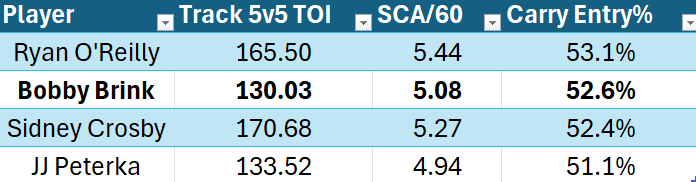
Sidney Crosby, Ryan O’Reilly, and J.J. Peterka are averaging 1.27 assists per 60 minutes at 5-on-5 between them, with Crosby being the lowest at 1.23 assists/60. Brink, on the other hand, is sitting at 0.68 assists per 60 minutes at 5-on-5, a rate 47% lower than the average of the other three players.
It isn’t as if this is just a Flyers problem, either, as they have six forwards with at least 400 minutes played at 5-on-5 with an assist rate north of 1.0 per 60 minutes (and four over 1.2). This is about Brink’s line mates shooting 6.9% with him on the ice at 5-on-5 against a three-year average of 10.2%. With Brink getting close to that 200-game mark, the tracking data comparing similarly to other good-to-great producers, and perhaps some positive regression coming for his line mates’ shooting percentage, the potential for Brink’s upswing after the Olympic break. (feb6)
20. Zach Benson (Buffalo Sabres)
Things were looking up for Benson in the month of January as he skated 16:20 per game and had eight points in the final 12 games of the month. A lot of that had to do with being moved to the top line with Tage Thompson and Alex Tuch – not a bad place to be on one of the hottest, and highest-scoring, teams in the NHL over the last two months. However, he suffered an upper-body injury on Monday and did not play on Tuesday or Thursday. The good news is that with the Olympic break coming, he’ll have a few weeks to rest up.
There is also a lot of good under the hood for Benson. While the 5-on-5 tracking data sample isn’t large so far in 2025-26, his rate of assists on teammate scoring chances (SCA/60) and offensive contributions on the rush (Rush Off/60) are much higher than the average from his first two seasons:

There is a reason why his rate of goals (0.54) and assists (1.19) per 60 minutes are higher this season than the average from his first two seasons (0.53 and 1.04, respectively). His per-minute shot rate is also up 8% with a slightly higher hit rate (but lower block rate).
All that it to say there is a lot that Benson has already done this season that shows he’s on the verge of his breakout, and hopefully he’s healthy down the stretch to make good on that promise. The issue is whether he A) stays on the top line, and B) can ever get top power-play time. Upon his return, if Benson is stuck on the third line with secondary power-play time, then his real breakout will have to wait until next season. (feb6)
21. Alex Holtz (Vegas Golden Knights)
The last player we’ll look at today is Alex Holtz. While he’s not having a big production season, he does have eight points in 25 games for Vegas, already far ahead his pace from last season when he had 12 points in 53 games with the Golden Knights. All those points have come at 5-on-5, too, so his 1.76 points/60 minutes at that strength is 71% higher than what he did last year. That rate is also higher than some Vegas regulars like Tomas Hertl (1.57) and Pavel Dorofeyev (1.54).
There are a couple reasons for including Holtz here. The first being that he was moved up to Jack Eichel‘s line for Vegas’ 5-2 win over Vancouver on Wednesday night. He was eventually moved down to Tomas Hertl‘s line, but either way, he was skating with one of Vegas’ top two healthy, natural centres (Mitch Marner excluded) in that game.
The other reason is that besides Holtz sitting at 188 regular season games played, he’s also shown a big improvement in his expected goals (xG) rate. I have discussed before how some public xG models have been over-counting their xG rates this season, so that’s worth noting. Here are the average rates of individual expected goals per 60 minutes among forwards at 5-on-5 against actual goals per 60 minutes at 5-on-5 from 2021-2025, and then the same for this season alone:

So, if we just straight-up discount individual expected goals rates by 10%, we can get an approximation of what the true xG count would be, at least compared to the average from 2021-2025. Let’s do that with Holtz to compare his career up until this season, and this season, by individual xG per 60 minutes at 5-on-5:
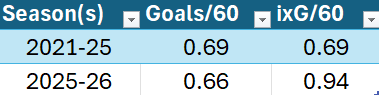
Overall, Holtz’s ixG/60 rate is over 1.0, but if we subtract the 10%, we get to 0.94, which is considerably higher than what he’s done for his career up to this point.
The real problem is Holtz just getting a regular role. He was in the lineup on Wednesday largely because of injuries to Brett Howden, Brandon Saad, William Karlsson, and Colton Sissons. If all those guys are healthy, Holtz probably isn’t in the lineup, let alone skating with either Eichel or Hertl, so a breakout after the Olympic break is very unlikely. Also, as a Holtz booster since his draft year, even I have to admit he hasn’t shown enough all-around game to warrant a top-9 role on a Cup-contending roster. This is more about keeping him in mind for next season as Sissons, Saad, and Reilly Smith are all unrestricted free agents. (feb6)
—
Have a good week, folks!
Thanks for continuing to support the website and if you’re bored and need a fantasy hockey fix – visit the gang in the forum here.
Related Posts
Starting Goalies











Top Skater Views
| Players | Team | |
|---|---|---|
| COLE PERFETTI |
 WPG WPG | |
| LUCA CAGNONI |
 S.J S.J | |
| IGOR CHERNYSHOV |
S.J | |
| TOMMY NOVAK |
 PIT PIT | |
| TRISTAN LUNEAU |
 ANA ANA
| |
Top Goalie Profile Views
| Players | Team | |
|---|---|---|
| DAN VLADAR |
 PHI PHI | |
| JOSEPH WOLL |
PHI | |
| JAKUB DOBES |
 MTL MTL | |
| SEBASTIAN COSSA |
 UTA UTA | |
| ADIN HILL |
 VGK VGK
| |
LINE COMBOS
| Frequency |
 SEA Players SEA Players
| |
|---|---|---|
| 23.4 | MACKIE SAMOSKEVICH JARED MCCANN MATTY BENIERS | |
| 22.5 | CHANDLER STEPHENSON BOBBY MCMANN JORDAN EBERLE | |
| 20.6 | SHANE WRIGHT KAAPO KAKKO BERKLY CATTON | |
DobberHockey Podcasts

Keeping Karlsson: Cole, There’s No Time!
Elan and Brian cover all the action from the first week of the NHL season, and identify our earliest must-adds, can-drops, sell highs and buy lows in your fantasy hockey leagues.
Keeping Karlsson: Matchup Maximizer 2026/27 Week 2
Elan takes a look at the schedule for the upcoming weeks of NHL action and recommends players with good schedules that you should consider streaming in to win your head to head matchups.

Fantasy Hockey Life: Tidy Takes Part 1
TiDy Admiral Ryan Downey and Victor Nuno break down recent trades in the FHL Tiered Dynasty’s top division, the Lord Stanley division. Tune in to consider trades between some of the best dynasty sharks we know, including patron polls on the trades and Victor’s analysis. Have a listen! Our show is part of the Dobber […]
Keeping Karlsson: Short Shifts – I Tried to be Like Parker Kelly
Elan is joined by Ryan Downey for the premiere of season 8 of Short Shifts! — KKUPFL late registration is ongoing! We’re still filling new divisions in the world’s greatest fantasy hockey league. Details at https://www.kkupfl.com/. Join the Keeping Karlsson patron community! Patrons get access to all our perks all year round, including KKUPFL […]
Keeping Karlsson: Shabanov Ranks
Elan and Brian fly through the final preseason lines for every NHL team ahead of opening night, and share their guys to watch– or look away from– in your fantasy hockey leagues.