

21 Fantasy Hockey Rambles
Dobber Sports
2026-02-22
Every Sunday, we share 21 Fantasy Rambles from our writers at DobberHockey. These thoughts are curated from the past week’s 'Daily Ramblings'.
Writers/Editors: Ian Gooding, Michael Clifford, Alexander MacLean, Puneet Sharma, and Dobber
—
1. Update (Feb. 22): Sidney Crosby and Josh Morrissey were not in uniform for the gold medal game against Team USA, who won 2–1 in overtime.
(Feb21) Josh Morrissey has been ruled out of the gold medal game. Considered to be the second-best defenseman on Canada’s roster, Morrissey was injured in the first game and hasn’t returned. Morrissey could still be out of action when the Jets return to action on Wednesday in Vancouver, but at least you have a few days to look for another blueline option. Unfortunately, Morrissey also missed the 4 Nations final last season because of an illness.
As I write this, Sidney Crosby hasn’t been ruled out yet for the gold medal game, with one report suggesting he even has about a 70% chance of playing. Even if he suits up and guts it out, Crosby might have to rest for a game or two when the Penguins return to action on Thursday against New Jersey. The Pens also play back-to-back games on Saturday and Sunday next weekend.
One of the prices to pay from having a midseason international best-on-best tournament is injuries to real NHL teams and the many fantasy teams out there. Even more players are likely battling something. For example, Brad Marchand has missed two games in this tournament and was missing NHL games just before the Olympic break. Nathan MacKinnon‘s leg still might not be 100% after the hit he took that resulted in the Tom Wilson fight. Sam Reinhart has not had a great tournament (2 PTS in 5 GP) – could that be because of an injury?
Elsewhere, congratulations to Finland for securing the bronze medal on Saturday in a 6-1 win over Slovakia. The Finns were led by Erik Haula, who scored two goals. The Finns also dealt with their share of injuries. Mikko Rantanen missed the bronze medal game with a lower-body injury. According to Friedman, Rantanen was injured during the third period of the semifinal game against Canada. He will be re-evaluated once he returns to Dallas. The injury is not believed to be season-ending, but the severity and timeline are unknown. It’s quite possible that Rantanen is not in the Stars’ lineup when they return to action on Wednesday against Seattle. (feb21)
2. This week I’ll discuss two names from Team Canada that appeared among the top searches on Frozen Tools. You know all about Macklin Celebrini and Connor McDavid, so let’s focus on two players serving in more of a supporting cast role.
If the Canucks had a do-over, do you think they would have traded J.T. Miller in 2022-23 and re-signed Horvat instead? The Canucks are believed to have culture and leadership issues, so trading a player like Horvat who has been a positive in both seems like a big mistake (although the Horvat trade tree resulted in Filip Hronek, who might be the Canucks’ next captain). Not to mention that Horvat’s stock has been on the rise overall the past few seasons.
The season Horvat was traded happened to be his best season. He finished that season with a career-high 38 goals and 70 points. Horvat was scoring at over a point per game for the Canucks (31 G and 54 PTS in 49 GP), so the thought at the time was that his value would plummet with a trade to the Islanders. It did initially, but changes to Patrick Roy’s system have benefitted Horvat. If he hadn’t lost 14 games due to injury this season, Horvat would be on pace for 75 points, which would be a new career best. However, his current 0.91 PTS/GP pace (40 PTS in 44 GP) is the best scoring pace of the 30-year-old’s career.
Thought to be a 20-25-goal, 50-60-point player during much of his time with the Canucks, Horvat has taken another step over the last few years. That has a lot to do with a shot rate that has gradually increased over the past decade. In his rookie season of 2014-15, Horvat averaged just 1.4 SOG/GP. Compare that to today, where Horvat averages 3.2 SOG/GP. Improvement isn’t always linear, but you could basically draw a straight line on Horvat’s shot per game average from that rookie season until today. Much of that can be attributed to Horvat’s professional approach to the game. (feb21)
I’m honestly not sure why Sanheim was one of the top-searched players, aside from the fact that he is on Team Canada. If you’re looking for debate on whether Sanheim belongs on the Olympic team, you’ve come to the wrong place. You may have your opinions of him as an overall defenseman. I’ll just stick to saying that he’s a defenseman that I have drafted in the late rounds multiple times when trying to fill out my roster.
Sanheim averages more minutes (24:02) than any Flyers player, which results in him providing modest totals in many fantasy categories. Nothing that jumps out at you, though. Call that high floor and low ceiling, if you will. Sanheim is usually good for about 30 points, just over 100 shots on goal, at least 130 blocked shots, and just under 100 hits. However, you won’t likely be rushing to the waiver wire to add Sanheim, as his career high in power-play points is 5 PPP.
All of that could make Sanheim a better real-life defenseman than fantasy defenseman. But at least you know what you are getting. On top of that, Sanheim is very low risk to be injured, as he has missed only five games over the past six seasons (including this one). Sanheim won’t win you your league, but he’s definitely a set-and-forget piece for deeper multicategory leagues. (feb21)
4. Jeff Skinner was waived by the San Jose Sharks last Monday, and cleared Tuesday, becoming a free agent. This ends his short tenure there, and it is possibly the flashing sign that his run as a full-time NHLer is quickly coming to a close.
The Sharks have had plenty of internal growth, and also look to be buying as the trade deadline approaches, which meant that Jeff Skinner was expendable. Skinner meanwhile can use this opportunity to latch on somewhere else, boost his stock for free agency this summer, and possibly also get another shot as a depth scoring winger for a team that has a hole in their lineup for one reason or another. (feb18)
5. With NHL teams now allowed back on the ice for practice, keep your eyes peeled for some injury updates on players who went into the break with uncertain timelines.
For example, I myself am waiting for an update on Charlie Lindgren, who missed the final few games before the break due to an undisclosed injury. I would like to drop Washington backup Clay Stevenson if Lindgren is due back soon, but if it’s a longer-term issue then in my situation he’s worth holding. (feb18)
6. One bit of good news for the Buffalo Sabres is that forward Josh Norris was at practice and had shed his non-contact jersey, according to Matthew Fairburn. Norris was injured mid-January, but it looks like he’ll be ready to go when Buffalo returns to game action on Wednesday.
Remember that before his injury, Norris was skating on Buffalo’s top PP unit, so Jack Quinn‘s top power-play role is likely gone (for now). (feb20)
7. I know prospects aren’t my usual bread and butter, but sometimes I like to throw in a couple of interesting prospect tidbits too.
One of my favourite under the radar prospects is Luca Marelli, who isn’t on Dobber’s top-50 prospect defensemen list quite yet, but it likely won’t be long. Marelli missed the first four months of the AHL season rehabbing from a shoulder injury, but has hit the ground running in his rookie campaign as a pro. He has seven points in 10 games with the Cleveland Monsters (AHL affiliate of Columbus), and he has been a huge addition to their blueline that has lost some bodies in recent years with trades and promotions.
Marelli is outperforming Stanislov Svozil and Corson Ceulemans there and could even be one of the best bets to make the jump to the NHL ranks in the fall. He has NHL size with his six-foot-three frame, and just needs to bulk up a bit on top of his current 180 pounds. He’s still going to be lower down the depth chart behind Zach Werenski, Denton Mateychuk, and the other Columbus veterans, but Marelli’s developmental path bears noting, and if he keeps rising at this rate then you’ll look good for grabbing him early. (feb18)
8. Another one who has caught my eye lately is Ethan Wyttenbach, whose numbers in his NCAA rookie season have been exceptional. He’s already up to 51 points in 32 games, which would have been tied for sixth last season (with Jimmy Snuggerud and a few others), and already above the numbers that players like Ryan Leonard and Gabe Perreault had last year in five more games. Wyttenbach still has a few games to go this year, and already has an eight-point lead over a couple of Univ. of Michigan teammates as the next best producers.
Wyttenbach is undersized at “only” five-foot-10, and that may be why he fell to the fifth round of the 2025 draft, where the Flames scooped him up. He may need another couple of years in college, but as soon as he’s ready to turn pro, the Flames will likely have space on their roster for him. There isn’t a ton on their roster or in their system at the moment that is going to block ice time from high-offence players over the next few years. (feb18)
9. One other prospect who was at the forefront of everyone’s radar a year or two ago was Devon Levi. He made his NHL debut all the way back in the 2022-2023 season, when he was 21, and since then has strung together three fantastic AHL seasons. His NHL exposure has been fickle, but as the Sabres climb the standings ladder, and Levi continues to ripen, he looks primed to take over as a top-tier starter for a very good team with a deep pipeline.
He might not be cheap, or at least not free on the wire like the two prospects above will be in many leagues, but Levi should be cheaper to acquire than Yaroslav Askarov, Jesper Wallstedt, or maybe even Sebastian Cossa. He’s someone to at least kick the tires on right now while the focus of the prospect world has taken a break from him.
Getting in on goalies at the right time can be very tough, but the top prospect goalies all seem to make an impact right around that age 24-25 season, which for Levi is either the second half of this year, or next season. (feb18)
10. Last week I focused on waiver wire options with 30% roster ownership or lower. This week, I’m highlighting a few players owned in 20% or fewer of leagues, names that are relevant mainly in deeper formats but could make an impact if you are looking to squeeze out every possible edge.
Yakov Trenin – C/LW/RW – Minnesota Wild – 19 %
Yakov Trenin isn’t a points-first fantasy asset but rather his value is entirely peripheral-driven, and that profile has been consistent throughout his career. His offensive ceiling is limited, but his contributions in hits, PIM, and overall physical play make him a useful plug-and-play option in multi-cat formats. Trenin has a modest 17 points, pacing for roughly 24 over a full season, in line with his career norms. His 5v5 P/60 sits at 1.3, and he averages just over one shot per game. The slightly elevated S% should be treated as a bonus rather than a sustainable breakout.
Where Trenin stands out is in category coverage. He already has 279 hits, placing him among league leaders, and over the last three seasons he’s averaged 280+ hits per 82 games. Combine that with steady PIM totals and 13–14 minutes of ice time per night, and you get a predictable floor for multi-cat leagues. He moves around the lineup, skating with everyone from Kirill Kaprizov to bottom-six grinders. Offensive-zone starts are low, and PP time is almost nonexistent but is a reliable deep-league option in banger or multi-cat formats. He delivers elite peripheral stats without hurting other categories and also is a triple threat playing C/LW/RW. He is a quiet, predictable asset who can help secure category margins over the season. (feb16)
11. Bobby McMann – LW – Toronto Maple Leafs – 18%
Bobby McMann has quietly become a viable deep-league fantasy option. The surface production is respectable with 19 goals and 32 points in 56 games, already a career high. Nearly all of his offense comes at even-strengh, with under a minute per game on the PP. Roughly 30 percent of McMann’s even-strength minutes have come alongside Auston Matthews and Max Domi, and he has 13 points with Matthews as his most frequent linemate. His role is simple: play direct, get to the net, and finish secondary looks created by elite talent. His 5v5 S% sits just over 10 percent and his shot rate is north of two per game.
McMann offers sustainable peripheral value, averaging over two hits per game and maintaining solid shot volume, which makes him useful in multi-cat formats even when points aren’t coming. His Power-play deployment is basically nonexistent, and his top-six role is not always guaranteed. He’s a decent add in deeper leagues, especially while paired with Matthews, and easy to drop if his role disappears Keep an eye on trade rumors too; if he’s moved to a contender, his value likely drops as a depth option, making him more of a situational add than a long-term play. (feb16)
12. Jackson Blake – RW – Carolina Hurricanes – 10%
Jackson Blake was drafted by the Hurricanes in the fourth round and has moved from being a depth piece to a usable fantasy asset, but like most Carolina forwards, his value is tightly tied to deployment.
Blake has 33 points in 57 games, putting him on a 47-point pace after posting 34 points in 80 games last season. His ice time is up over two and a half minutes per night, his shot rate has climbed above two per game, and his 5v5 scoring rate has taken a meaningful step forward. The driver is linemate quality. Blake has spent most of his EVS minutes alongside Logan Stankoven, rotating primarily with Taylor Hall and Nikolaj Ehlers on the opposite wing. Those lines have controlled play consistently, and Blake has benefited directly. Blake has 19 even-strength points which have come with Stankoven as his most common linemate who also happens to be another waiver option if he is available in your respective leagues.
Blakes S% is just under eight percent and he has a meaningful PP usage around 2:30 per night and eight PPP to show for it. Yes, the limitations are there. Blake is not a volume shooter, he does not drive heavy peripherals, and his role is not immune to lineup shuffles. Even though we do know that Carolina has been known to shuffle its lineups frequently, we also know that Blake his been locked into a top-six role for sometime now and profiles as a solid 45–50-point winger with moderate PP value. He is worth a look. (feb16)
13. One thing that really matters for good offensive production is efficiency. Not only does that mean being able to drive high shooting percentages – though that is important – but it’s creating as many chances as possible on the fewest number of touches or zone entries possible. We can attempt to quantify that by going over scoring chances off zone entries, so let’s do exactly that today.
For this, we are going to use tracking data from All Three Zones and see which teams are getting a lot of scoring chances off a specific forward’s zone entries at 5-on-5. For example, if Connor McDavid has 100 zone entries, and the Edmonton Oilers create 25 scoring chances off those zone entries, they are averaging 0.25 chances per entry by McDavid.
The following graphs will have team chances per player zone entry as well as that individual player’s overall rate of zone entries per 60 minutes. We are going to limit our sample to forwards with at least 100 tracked minutes this season, which gives us 274 names. All data is current as of the Olympic break. The red and blue dotted lines are the league average for forwards by each stat.
Goal/point data is from Evolving Hockey.
Evgeni Malkin and Tommy Novak (Pittsburgh Penguins)
We have to start with a pair of teammates because they are fascinating on their own as well as a duo:
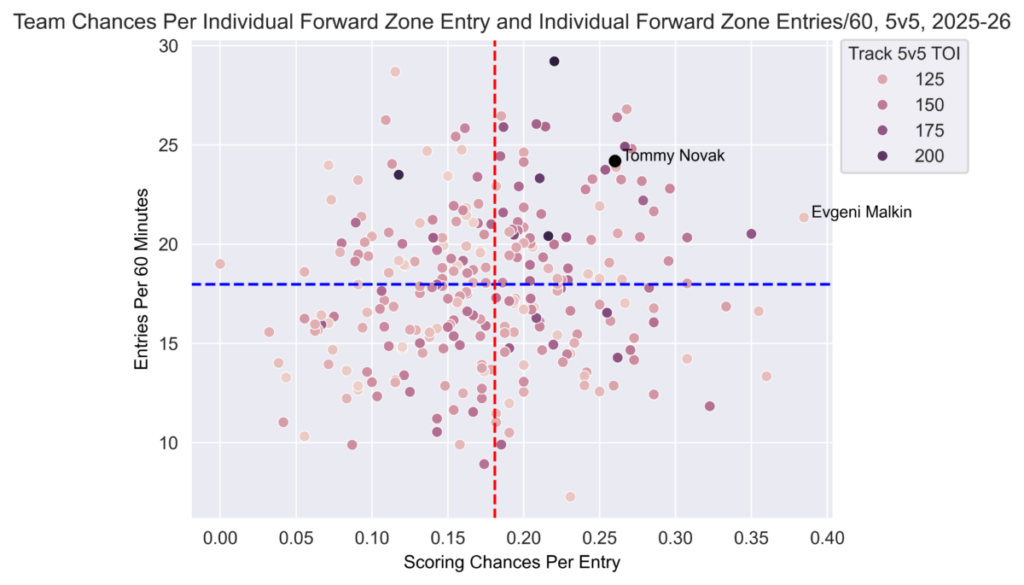
Considering he turns 40 years old this summer, Malkin is having a superlative season with 44 points in 41 games, pacing for his first point-per-game season since 2022-23. His 1.08 primary assists at 5-on-5 have him tied for 20th among forwards with at least 500 minutes at that strength, and his 0.76 total assists per game is his highest rate since before the pandemic.
Knowing this, it’s no surprise that the Penguins are creating so many scoring chances off his zone entries. What is surprising is that he leads the entire league in this regard and clears the next-closest player by 7%. He is also doing that while responsible for far more zone entries per 60 minutes (21.4) than the league average (18.0). Fantasy managers must always be a bit worried about age-related decline, but he also gets three weeks off for the Olympic break and is on a team that has been able to create offence very well this season. As long as he’s healthy, he’s not a player to move on from this season. (feb17)
14. Then we get to Tommy Novak. After a down 2024-25 season that saw him post just 1.54 points per 60 minutes at 5-on-5, he has rebounded in a big way to 2.21 points/60 minutes, a rate of a low-end first-line forward. He has played a fair bit with Malkin, but still only one-third of his 5-on-5 time has been spent next to the future Hall of Famer, and Novak is also 18th out of our 274 forwards by rate of zone entries per 60 minutes. The team is more productive with the two of them skating together than when apart, but Novak has been a significant part of the depth scoring that has helped the Penguins get to a playoff position.
The problem for Novak’s fantasy value is he skates less than 14 minutes per game and doesn’t get top PP time. Combine that with very modest peripherals (85 shots, 20 blocks, and 9 hits in 56 games), and there are a lot of fantasy leagues where he won’t be roster-able. But if injuries hit, he can be a big beneficiary, and it bodes well for next season if the Penguins move on from some veterans. (feb17)
15. Beckett Sennecke (Anaheim Ducks)
It feels like I’m writing about Sennecke every other week, but every time I look at a different aspect of his profile, I walk away impressed. If he were doing this as a 5-year veteran, it would still be impressive, but that he’s doing this as a rookie is a different ball game entirely:
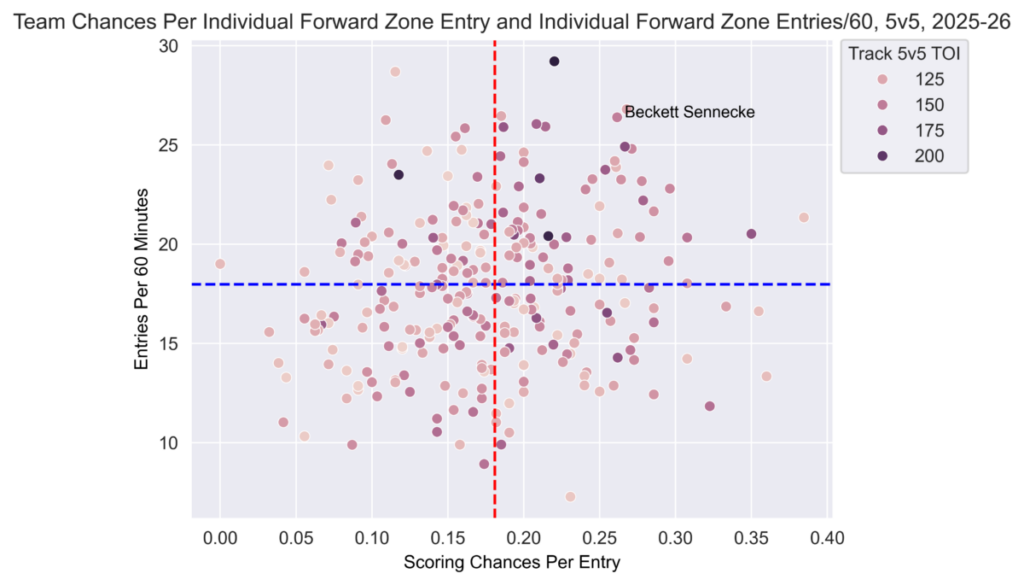
With his rate of chances per entry and overall entries per 60 minutes, Sennecke is 1 of 14 forwards in our sample to be higher than the 84th percentile in both areas. It is no mistake that his rate of points per 60 minutes is in the 83rd percentile of regular forwards, and that he is 1 of 22 forwards to average at least 1.1 goals and 1.1 assists per 60 minutes at 5-on-5.
There is always a concern about a rookie fading down the stretch as the wear-and-tear of an 82-game regular season grinds them down. However, the Olympic break is providing a lot of rookies with the chance to take a breather as they head towards the final 20-something games of the season, and that hopefully helps Sennecke maintain this level of offensive creation. Even if it doesn’t, this is another datapoint that highlights just how special a player he is already and will be for the next 15 years. (feb17)
16. Connor Bedard (Chicago Blackhawks)
In the section on Sennecke, we mentioned 14 players who are at least the 84th percentile by both team chances per zone entry as well as individual entries per 60 minutes. Another one of those 14 players is Bedard, and that won’t be a big surprise to anyone who has watched him this season:
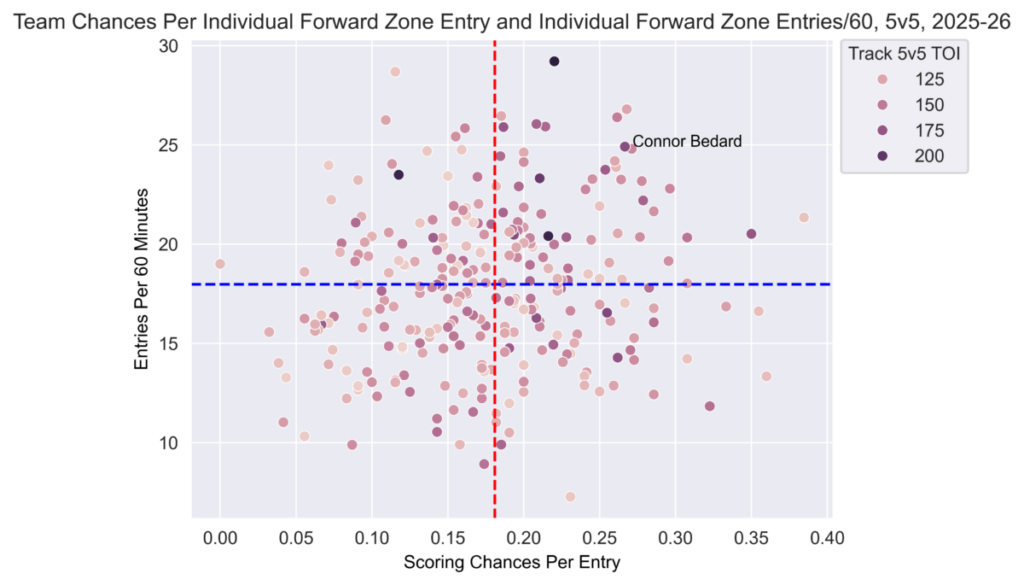
Knowing this, also slotting into the ‘Not A Surprise’ column is that the Blackhawks are scoring 3.23 goals per 60 minutes at 5-on-5 with Bedard on the ice and 1.98 goals per 60 minutes at 5-on-5 with Bedard off the ice. Whatever concerns fantasy managers may have had about Bedard’s 67-point sophomore season should be quelled by his 2025-26 campaign thus far as his 82-game pace is just under 100 points.
In our sample of 274 forwards, Bedard ranks 12th by individual zone entries per 60 minutes, and that is 39% above the league average. While the chances per entry aren’t among the elite, that rate for Bedard is 48% above the league average. He has taken a big step forward this season in being able to carry the offence when he’s on the ice, and as long as he stays healthy, the upward trajectory should only continue as the team around him improves. (feb17)
[Follow the link for more…]
17. In Tuesday’s Ramblings, we covered how many scoring chances were created off zone entries by specific forwards, focusing on the most efficient forwards. Today, we are moving back a bit and doing the same thing for defencemen.
Put simply, we are finding the number of scoring chances created by a team per zone entry by an individual defenceman, as well as the overall rate of individual zone entries per 60 minutes by that defenceman. So, if the New York Rangers create 10 scoring chances off 50 zone entries by Adam Fox, then the Rangers are creating 0.2 scoring chances per entry. If Fox has 50 zone entries in 250 tracked minutes, then he’s responsible for 12 zone entries per 60 minutes (50/250 * 60). The more scoring chances per entry, the more efficient the creation numbers, and the higher the zone entry numbers for the player, the more chances available for the team.
All tracking data is from All Three Zones, are for 5-on-5 play, and cover only the 2025-26 season. Individual and team goal/point data is from Evolving Hockey, and all this is current as of the Olympic break.
We are limiting the sample to defencemen with at least 110 tracked minutes, which gives us 161 defencemen. The red and blue dotted lines on the graphs are the league average rates for our sample of defencemen. Let's start with Carolina's blue line group below: (feb19)
18. Sean Walker, Shayne Gostisbehere, Jalen Chatfield, Alexander Nikishin, and Joel Nyström (Carolina Hurricanes)
We had to start with the Carolina Hurricanes because they are one of the teams that is the most reliant on contributions from defencemen. That becomes very obvious when we understand that in our sample of 161 defencemen, 42 of them are above the league average by both team scoring chances per entry by a defencemen and individual zone entries per 60 minutes, and of those 42 above-average contributors, five of them are from Carolina’s blue line:
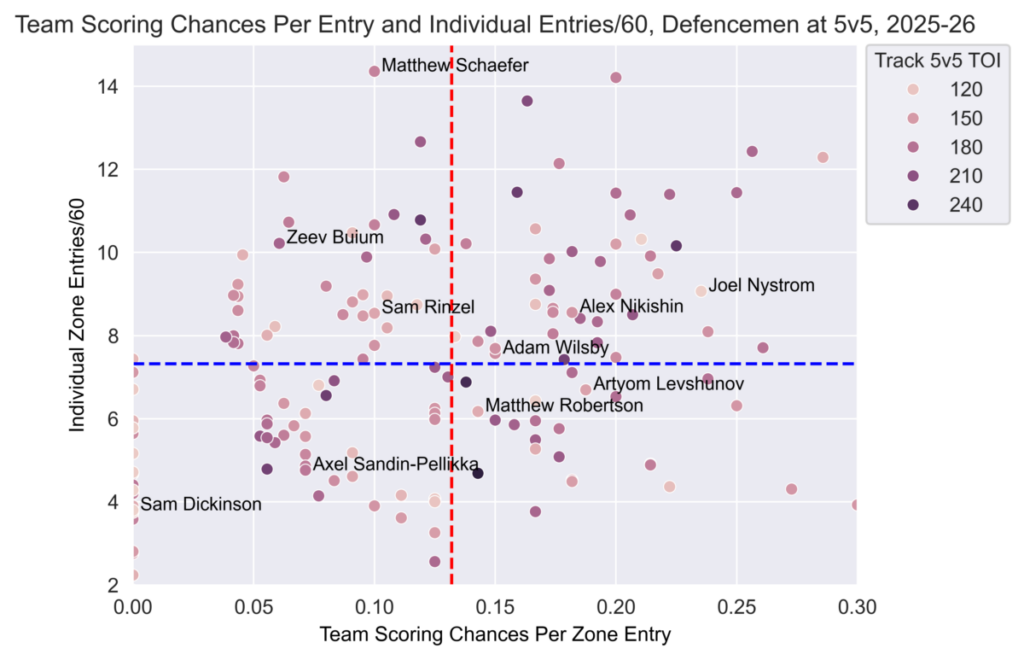
Seeing both Gostisbehere and Walker makes sense, given their respective histories. Instead, let’s focus on the other three names.
Things seem to be working out for Chatfield and his work on offence. With him on the ice at 5-on-5, Carolina is scoring 3.4 goals per 60 minutes. That is the highest rate of his career, exceeding his previous best of 2.9 goals/60 minutes back in 2023-24. He also has 0.85 points per 60 minutes at 5-on-5, the second-highest rate of his career, trailing only the 2023-24 season. It would be even higher, but Frozen Tools has Chatfield participating on just 24.1% of goals scored with him on the ice at even strength this season, the lowest rate of any Carolina defenceman with at least 25 games played.
The best news is that Chatfield is doing this while skating 17 minutes a game at 5-on-5, a career-high. He has been asked to play his biggest role, has been contributing well offensively, and Carolina is decisively winning his minutes on both the goal and shot clock. The problem is that without power-play time and with very modest peripherals, he still doesn’t have fantasy relevance outside of deep fantasy formats. (feb19)
19. Here is the interesting part about Nikishin and Nyström: there are 10 rookie defencemen in our sample, only three of them are above average in both areas we’re studying today, and two of those three are Nikishin and Nyström:
Again, because they are from Carolina, maybe this isn’t a huge surprise, but that they’re both doing something offensively that neither Matthew Schaefer nor Artyom Levshunov are doing stands out and is a good sign for dynasty/keeper managers.
While Nikishin was the one who got the offseason press, it is Nyström who leads all rookie defencemen in points per 60 minutes at 5-on-5 (minimum of 500 minutes), who leads all rookie defencemen in expected goal share, and who is second in actual goal share, trailing only Schaefer. As a seventh-round pick from 2021, Nyström has his work cut out for him, but here’s a little tidbit: Among all defencemen who played at least 125 games between the ages of 20-22 in the Swedish Hockey League this century, Nyström has the most goals and points (per Elite Prospects). Did the Hurricanes find another late-round gem? (feb19)
[Follow the link for more…]
20. A couple of weeks ago, these Ramblings covered some forwards who are set to hit the magical 200-game threshold later this season, including Bobby Brink, Zach Benson, and Alex Holtz. That Ramblings reviewed some of the improvements those three players have made this season which provides hope of good offensive performance either down the stretch this season, or next season.
We will set aside the 200-game barrier for now but keep our focus on improvements players have made to their game. Specifically, we are going to evaluate only defencemen today, and their tracking data changes at 5-on-5 this season compared to what they did across the two seasons from 2023-2025. That data is courtesy of All Three Zones, and any other player/team data is from Evolving Hockey, unless otherwise indicated.
These are the tracking stats we’re covering:
- Contributions off the rush: the shots and assists leading to teammate shots off the rush, per 60 minutes (Rush/60)
- Contributions off the cycle+forecheck: the shots and assists leading to teammate shots off the cycle+forecheck, per 60 minutes (Cycle+Fcheck/60)
- Chance Assists: helpers on teammate scoring chances, per 60 minutes (SCA/60)
- Chance Contributions: individual scoring chances plus chance assists, per 60 minutes (SCC/60)
- Zone entries: how often a player dumps the puck into the offensive zone, carries it in, or passes it in, per 60 minutes (Entries/60)
- Carried Entry Percentage: how often a player’s entries/60 are carried into the offensive zone by that player (Carry%)
- Entries and Exits: combined rate of all zone exits and entries by a player, per 60 minutes (Entry+Exit/60)
- Botch+Fail Percentage: combined percentage of botched defensive zone retrievals and percentage of failed zone exits (Botch+Fail%)
We are going by percentage increase, rather than raw totals. So, if a player usually has 10 zone entries per 60 minutes, and this season they’re at 15 entries/60, the increase if 50% and not 5.0 entries/60. The red and blue dotted lines in the following graphs are the average percentage changed in each stat.
Last bit of warning: we are using a bit over a half-season sample. Once a lot more data comes in, things will change, so we are just using our best judgment as to what the changes mean. (feb20)
Let’s get to it, starting with J.J. Moser below:
21. J.J. Moser (Tampa Bay Lightning)
It was such a good first half of the season for Moser that he earned an eight-year extension from the Lightning. Though he’s typically known as a solid defensive defenceman, Moser is averaging 0.94 points per 60 minutes a 5-on-5, a career-high for him in any season where he’s played at least 50 games, and nearly 15% higher than his two-year average. One of the reasons for this is that he’s seeing huge increases in his Rush/60 and Cycle+Fcheck/60 numbers:
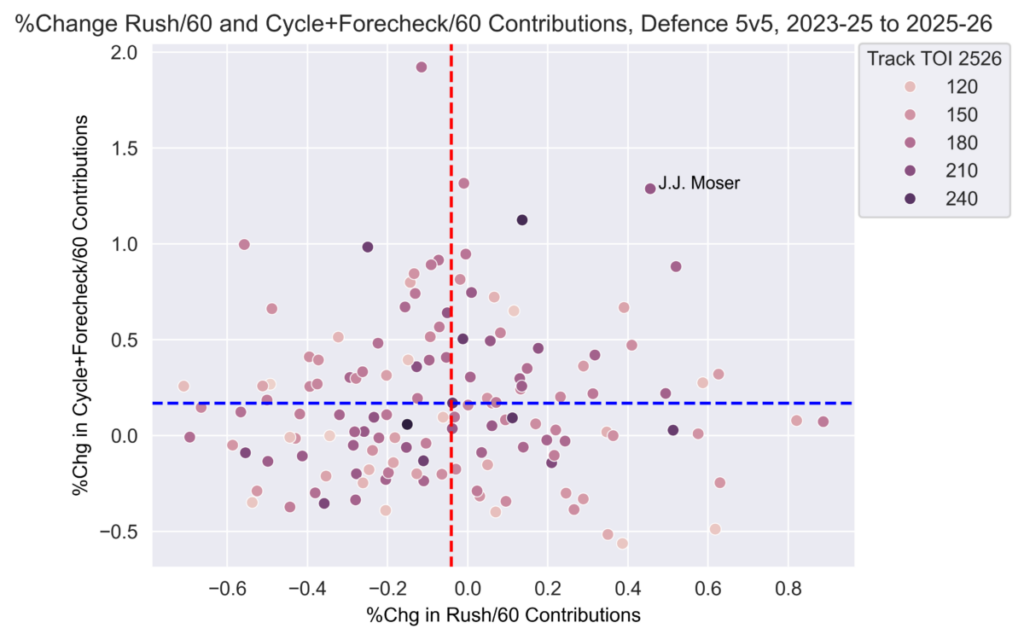
Not only is Moser registering more points than usual, but it’s off the back of some of the largest improvements in his involvement both off the rush and off in-zone cycling/forechecking. In fact, he’s 1 of 3 defencemen whose increase in both areas is at least the 84th percentile of all defencemen (the others are Morgan Rielly and Emil Lilleberg, both of whom were discussed yesterday).
Moser’s problem for the fantasy game is that with Victor Hedman and Darren Raddysh on the roster, there are big obstacles to any meaningful power-play time. Even on a high-powered offensive team like Tampa Bay, if Moser only puts up a couple of power-play points all season, he’ll be hard-pressed to produce more than the 31 points he had in 2022-23. At 1.4 shots and 0.75 hits per game, there aren’t high-end peripherals to cover for the production shortfalls, either.
The lack of power-play role and modest peripherals puts Moser in the ‘Better In Real Life Than Fantasy’ bucket. Playing like this will certainly help the team create more offence, which is good news for Tampa’s forwards and makes Moser a stream-able option some weeks in some leagues, but outside of deep fantasy formats, he is not a regular, meaningful contributor despite the significant improvements. (feb20)
[Follow the link for more…]
—
Have a good week, folks!
Thanks for continuing to support the website and if you’re bored and need a fantasy hockey fix – visit the gang in the forum here.
Related Posts

Starting Goalies












Top Skater Views
| Players | Team | |
|---|---|---|
| COLE PERFETTI |
 WPG WPG | |
| LUCA CAGNONI |
 S.J S.J | |
| IGOR CHERNYSHOV |
S.J | |
| TOMMY NOVAK |
 PIT PIT | |
| TRISTAN LUNEAU |
 ANA ANA
| |
Top Goalie Profile Views
| Players | Team | |
|---|---|---|
| DAN VLADAR |
 PHI PHI | |
| JOSEPH WOLL |
PHI | |
| JAKUB DOBES |
 MTL MTL | |
| SEBASTIAN COSSA |
 UTA UTA | |
| ADIN HILL |
 VGK VGK
| |
LINE COMBOS
| Frequency |
WPG Players
| |
|---|---|---|
| 26.0 | MARK SCHEIFELE COLE PERFETTI KYLE CONNOR | |
| 19.1 | ADAM LOWRY BRAD LAMBERT MORGAN BARRON | |
| 18.5 | GABRIEL VILARDI ISAK ROSEN VIGGO BJORCK | |
DobberHockey Podcasts

Keeping Karlsson: Cole, There’s No Time!
Elan and Brian cover all the action from the first week of the NHL season, and identify our earliest must-adds, can-drops, sell highs and buy lows in your fantasy hockey leagues.
Keeping Karlsson: Matchup Maximizer 2026/27 Week 2
Elan takes a look at the schedule for the upcoming weeks of NHL action and recommends players with good schedules that you should consider streaming in to win your head to head matchups.

Fantasy Hockey Life: Tidy Takes Part 1
TiDy Admiral Ryan Downey and Victor Nuno break down recent trades in the FHL Tiered Dynasty’s top division, the Lord Stanley division. Tune in to consider trades between some of the best dynasty sharks we know, including patron polls on the trades and Victor’s analysis. Have a listen! Our show is part of the Dobber […]
Keeping Karlsson: Short Shifts – I Tried to be Like Parker Kelly
Elan is joined by Ryan Downey for the premiere of season 8 of Short Shifts! — KKUPFL late registration is ongoing! We’re still filling new divisions in the world’s greatest fantasy hockey league. Details at https://www.kkupfl.com/. Join the Keeping Karlsson patron community! Patrons get access to all our perks all year round, including KKUPFL […]
Keeping Karlsson: Shabanov Ranks
Elan and Brian fly through the final preseason lines for every NHL team ahead of opening night, and share their guys to watch– or look away from– in your fantasy hockey leagues.