

21 Fantasy Hockey Rambles
Dobber Sports
2026-03-01
Every Sunday, we share 21 Fantasy Rambles from our writers at DobberHockey. These thoughts are curated from the past week’s 'Daily Ramblings'.
Writers/Editors: Ian Gooding, Michael Clifford, Alexander MacLean, Puneet Sharma, and Dobber
—
1. The NHL Trade Deadline is just a few days away, but many fantasy trade deadlines are either this week or next. With those deadlines looming, fantasy managers making a championship push will want to bolster their rosters. Below are 9 skaters – from top-of-the-lineup options to depth pieces – to target at this deadline.
We are going to use a lot of data from Frozen Tools, including the Schedule Planner and Ice Time Reports. We will also use tracking data from All Three Zones with additional player/team data from Evolving Hockey.
On the following graphs, the blue and red lines are the league average for each stat at each position. Data is current as of Thursday, February 26th.
Will Smith (San Jose Sharks)
Smith is going to be a hard player to trade for in keeper/dynasty formats, and for good reason. When we take into account a variety of tracking stats like scoring chance assists per 60 minutes at 5-on-5 (SCA/60, or the rate at which a player assists on a teammate’s scoring chance), carried entry percentage (how often a player carries the puck in on a zone entry), and points per 60 minutes, the comparable forwards to Smith this season is a very impressive list:
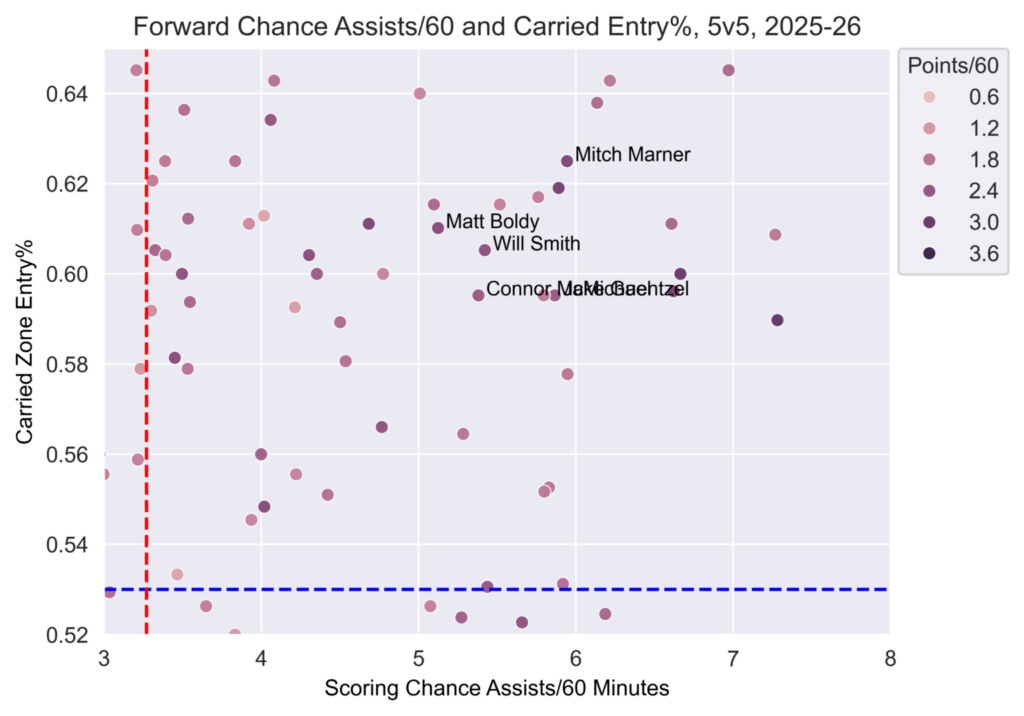
The overlapped names are Jake Guentzel and Connor McMichael. The other names are Matt Boldy and Mitch Marner. Three of those players are bona fide star wingers both in real life and in fantasy, and McMichael has been one of the more promising young players in the league over the last couple of seasons. By playmaking, carried zone entries, and point production at 5-on-5, Smith stacks up well to them all.
An important note here is San Jose’s rest-of-season schedule. From here on out, the Sharks have the most games remaining (26), are tied for the second-most home games (14), tied for the fifth-most games on light days (9), have the third-easiest schedule by opponent points percentage (.530), and their remaining opponents are giving up the most goals per game. From a fantasy perspective, the Sharks might have the best remaining schedule of any team in the league.
The crux, of course, is that Smith skates a lot of his minutes next to Macklin Celebrini. If he were to be moved down the lineup to skate with Alex Wennberg or Michael Misa, the equation changes drastically. However, Smith is next to Celebrini coming out of the break and they’ve been a constant duo over the last calendar year. (feb27)
2. Beckett Sennecke (Anaheim Ducks)
It isn’t often that a rookie should be targeted for the stretch run of a fantasy season, especially when they aren’t considered super-elite prospects like Celebrini or Connor Bedard. All the same, we cannot ignore what Sennecke has done in his first season because he has already inserted himself among some of the most productive wingers in the league. Below is a graph that has comparable forwards to Sennecke by scoring chance contributions per 60 minutes at 5-on-5 (SCC/60, or the chance assists plus individual chances), total zone entries/60 at 5-on-5, and points per 60 minutes at 5-on-5:
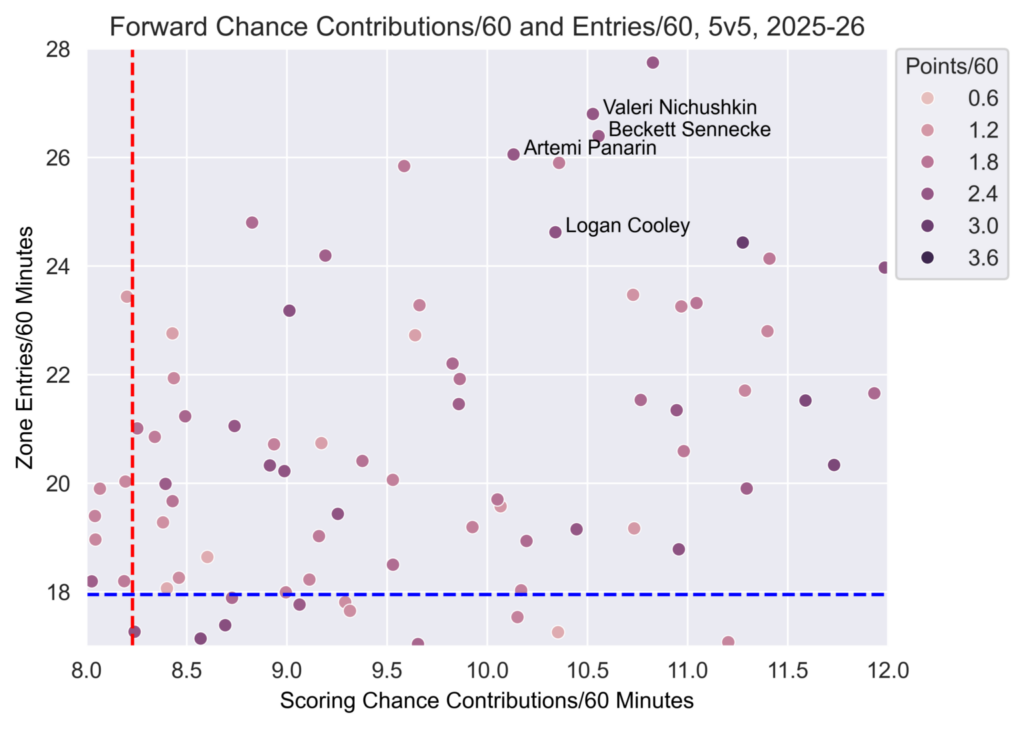
Whenever you’re in a group with Valeri Nichushkin, Artemi Panarin, and Logan Cooley, it’s a good start. Crucially, in the 10 games leading to the Olympic break, Sennecke was second among Anaheim forwards by share of power play time (72.2%), first by even-strength ice time share (31.4%), and second by overall ice time (19:43). In Anaheim’s first game after the break, he was third by even-strength ice time behind Alex Killorn and Mason McTavish.
With 25 games from here on out, the Ducks are tied for the second-most games remaining, have the second-easiest schedule by opponent points percentage, and have the most games left on light days (13). Sennecke is now one of Anaheim’s top wingers and if he remains that for the final two months, the team’s schedule plus his performance are the ingredients for a big 25-game stretch. That he can push for 2.5 shots and 1.0 hits per game means stellar peripheral contributions, too. (feb27)
3. Collin Graf (San Jose Sharks)
San Jose played a lot of the post-Christmas stretch without Will Smith, and they acquired Kiefer Sherwood via trade, but from Christmas until the Olympic break, Graf had the second-largest even-strength ice time share among Sharks wingers. Even with Smith and Sherwood ahead of him now, he would be fourth. That is a top-6 role, and he’s one of their key contributors on the penalty kill, too. A secondary PP role, a primary SH role, and a second-line even-strength role means about 16 minutes per game in ice time. He can put up 0.66 blocks and 1.0 hits per game with those roles and that amount of ice time, so fantasy managers in deeper multi-cat leagues will want to scour the waiver wire; as mentioned in the section on Smith, there is a tremendous schedule ahead for the Sharks. (feb27)
4. Jordan Kyrou (St. Louis Blues)
It is understandably difficult to rely on the Blues to do anything positive offensively, but that they got both Robert Thomas and Dylan Holloway back from injury should help. Despite Kyrou’s struggles this season, there is still a lot of good work under the hood. Looking again at the rate of chance assists, while adding rate of zone entries and rate of shots (all at 5-on-5), here are the comparable names to Kyrou this season:
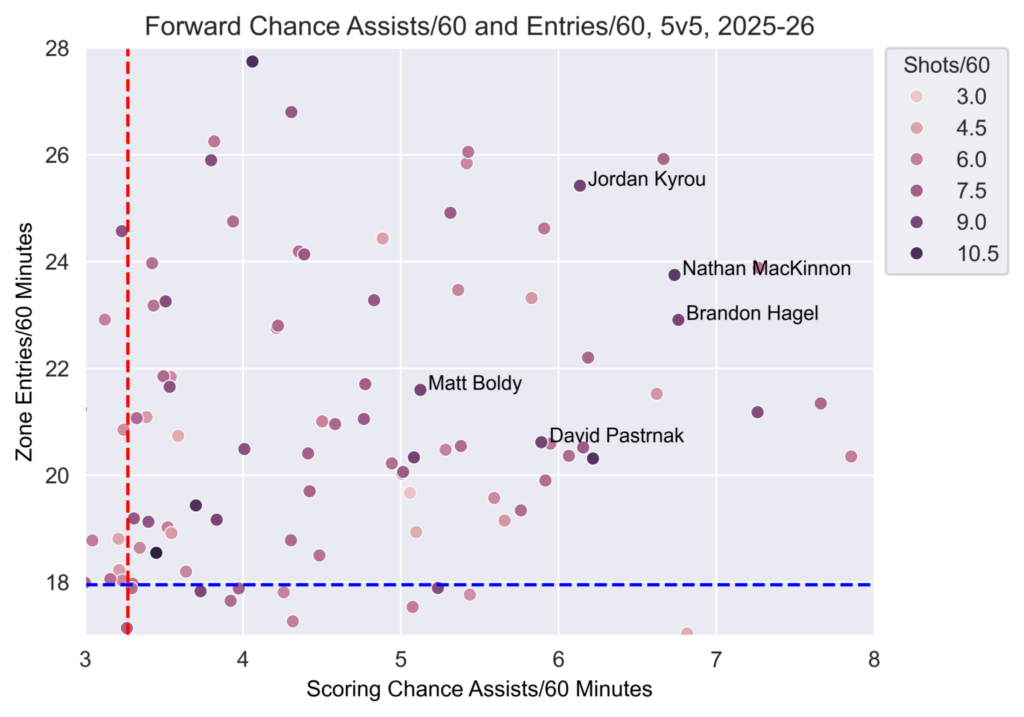
In three key offensive categories, Kyrou compares to Nathan MacKinnon, Brandon Hagel, Matt Boldy, and David Pastrnak. It is hard to be in better company as a winger outside the absolute elite tier like Nikita Kucherov and Kirill Kaprizov.
The Blues don’t have a particularly easy schedule the rest of the way, but it’s not a brutal one, and half their games (12/24) are on light days. Even on stacked championship-calibre fantasy rosters, there is a lot of room for Kyrou to make a big impact down the stretch. And if he’s somehow traded to a high-scoring playoff team? All the better. (feb27)
5. Aliaksei Protas (Washington Capitals)
The one big problem facing Protas is Washington refuses to use him on the power play and that will always cap his production upside. However, leading up to the Olympic break, he was by far their most-used forward at even strength (34.3% of the EVTOI share with Dylan Strome at 31% the next-closest). Add in a prime short-handed role, and he was often skating 19-20 minutes a game. A lot of that stretch was without Tom Wilson, and that matters, but Protas was still their most-used forward at even strength leading up to the Wilson injury.
What also matters is what Protas does with the puck. When looking at comparable forwards at 5-on-5 by contributions off the cycle+forecheck (assists and shots on the cycle or forecheck), zone entries, and individual expected goals, the list is impressive:
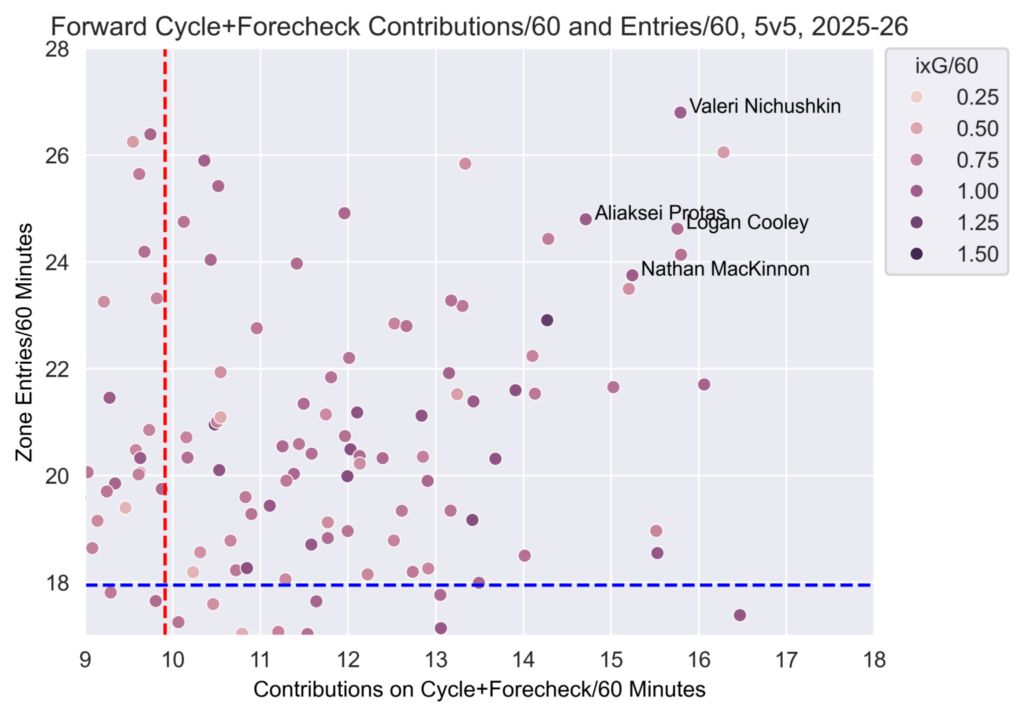
Again, we have a pair of top Colorado forwards plus Cooley, all of which are great names to see.
Protas’ secondary problem is the Capitals have just 22 games left, tied for the fewest in the league. They don’t have a particularly difficult nor easy schedule, so that’s not a concern, but there’s not a lot of runway left for him. All the same, the Caps are healthy, pushing for the playoffs, and he’s a key figure for their forward group. At any rate, he should be cheap to acquire. (feb27)
6. Simon Holmstrom (New York Islanders)
There are a couple of measures in the tracking data to evaluate how well (or poorly) a player exits their zone. One is botched defensive zone retrievals – or how often a player screws up when their opponent dumps the puck in – and failed zone exits, or how often a player has a chance to get the puck out and doesn’t. Being able to keep those percentages low helps their team create more possessions and (often) more goals.
Not that the New York Islanders are a bastion of high-end offence, but Holmstrom has been one of the most efficient forwards in the NHL this season in everything but scoring. When we look at his percentage of zone entries carried in, his combined percentage of botched defensive zone retrievals and failed zone exits, and how many shots he needs for every expected goal created, the comparable list is impressive:
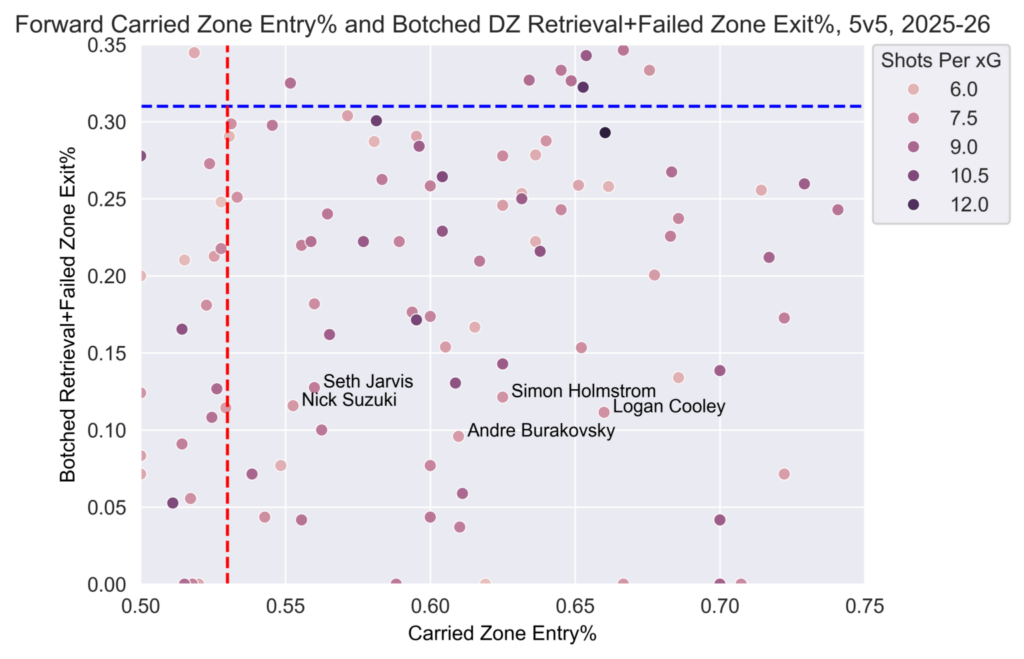
Holmstrom has been strong at not messing up in his own end and getting the puck into the offensive zone with control. And, despite low shot rates, he creates good quality on the few shots he does take. The Islanders are in a playoff chase, and the likes of Jonathan Drouin, Anthony Duclair, and Max Shabanov have been unreliable. The Islanders’ remaining opponents are giving up the third-most goals against per game, Holmstrom saw his role grow heading into the Olympic break, and he’s currently in a top power-play role. He doesn’t hit much, so that hurts his banger value, but he is on pace for over 50 blocks and has a schedule that should help him produce some points. (feb27)
7. Adam Fox (New York Rangers)
Understandably, there should be reticence about acquiring a player whose team traded their top offensive forward before the Olympic break and whose team went into that Olympic break 26th in goals per minute. The interesting part about Fox is that he hasn’t needed Panarin to be productive at 5-on-5. Since the start of the 2024-25 season:
- Fox with Panarin on the ice: 1.84 points per 60 minutes
- Fox without Panarin on the ice: 1.37 points per 60 minutes
There is clearly a gap when he had Panarin skating ahead of him, but 1.37 points per 60 minutes at 5-on-5 over the last two seasons would still be 12th in the league among defencemen (minimum of 1000 minutes), and ahead of names like Victor Hedman, Shea Theodore, Josh Morrissey and Charlie McAvoy. Even without the star winger, Fox can be very productive.
The real problem comes with the power play as the loss of Panarin there will undoubtedly hurt the team. But there’s a difference between ‘the loss of Panarin will hurt Fox’s production’ and ‘the loss of Panarin will make Fox unplayable in most fantasy formats’. Do not be surprised if Fox still posts 16-20 points over the final 24 games. (feb27)
8. Brandt Clarke (Los Angeles Kings)
By remaining opponents’ points percentage, the Los Angeles Kings have the easiest schedule from here on out. Those opponents are also giving up the fourth-most goals against per game. They lost Kevin Fiala, but gained Panarin, so there is an upgrade up front as well.
There is also what Clarke can do with Panarin as a left winger. On the season, when looking at the rate of chance assists, the rate of shots, and the rate of carried zone entries, Clarke compares well across the league:
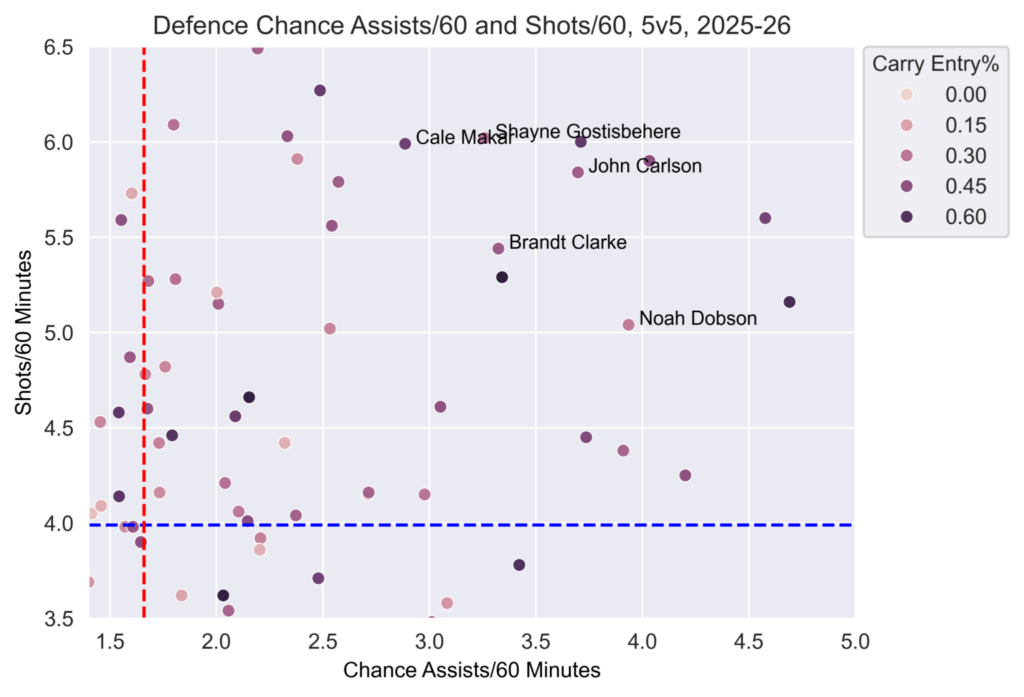
When I see a blue liner who shoots more than Noah Dobson and also assists on more scoring chances than Cale Makar, my ears perk up a little bit.
Importantly, Clarke took over the top PP role before the Olympic break hit, earning over two-thirds of the available power-play time over Los Angeles’ last 15 games before that break. In their first game with Panarin on the roster, Los Angeles went 1-for-1 on the power play and Clarke had a power-play assist. That he can flirt with 2.0 shots and 2.0 blocks per game, even with a lack of hits, gives him solid multi-cat value as well. (feb27)
9. Pavel Mintyukov (Anaheim Ducks)
This isn’t intended as a backhanded compliment, but there’s almost nothing that stands out about his profile so far this season. Below is a graph that will show the comparable names to his contributions off the rush, his points per 60 minutes, and his shots per expected goal rates, which are his best attributes this year:
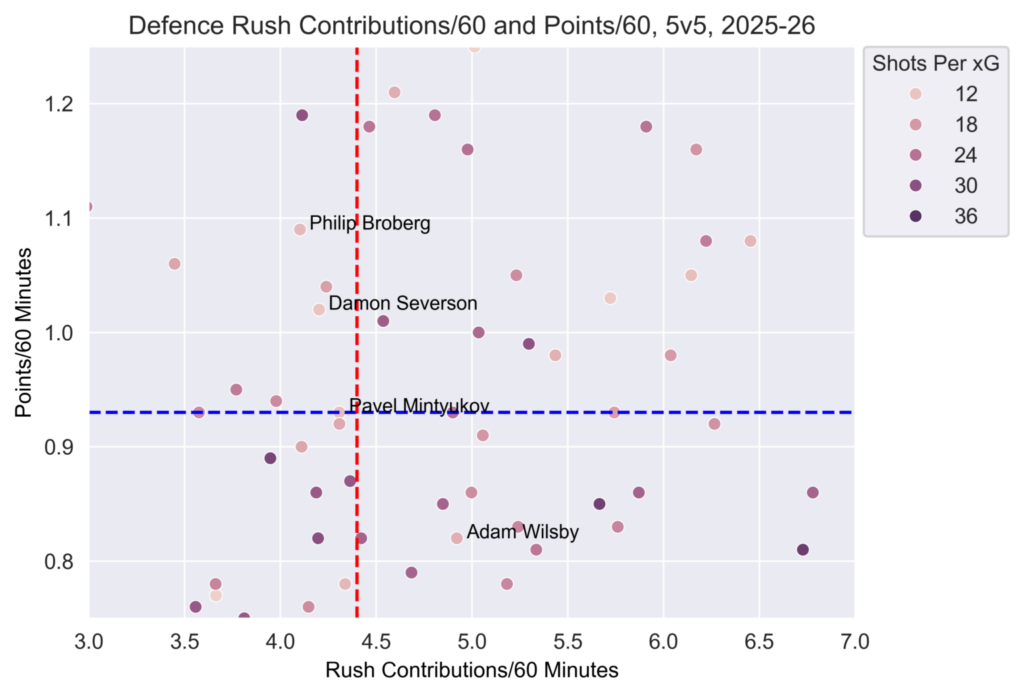
In fairness, there is very little that is outright bad about his profile; there is just nothing that sticks out as great as we saw with Clarke or with some of the forwards.
What is important is that in the 15 games heading into the Olympic break, he had earned the secondary power-play role (37% of the PPTOI share), was the number-3 defenceman at even strength (31.6% of the ESTOI share), and was their most-used defenceman on the penalty kill (57.7% of the SHTOI share). That all led to him skating nearly 21 minutes a night across all three phases, and he had the second-most minutes on Anaheim’s blue line in their first game back. On a team that is now healthy with the firepower that the Ducks possess, just being an average defenceman skating 20-21 minutes a night is valuable. He won’t put up great peripherals, but he can be solid across the board outside of his hit totals. And, as mentioned in the section on Sennecke, the Ducks have a great rest-of-season fantasy schedule. (feb27)
10. In these Ramblings on Tuesday, we discussed forwards who had seen a big increase in their role in calendar 2026. We separated those forwards into two groups:
- Increased offensive minutes, or even strength and power play only
- Increased peripheral minutes, or even strength and short-handed only
Today, let’s continue with the forwards, but look in the other direction for those who’ve seen a big decrease in their role leading up to the Olympic break. We are again separating by offensive minutes and peripheral minutes, using time-on-ice and roster data from Frozen Tools, with additional data from Evolving Hockey. The red and blue dotted lines are the median change by each ice-time measure.
Dmitri Voronkov (Columbus Blue Jackets)
Yahoo Roster – 22%
FanTrax Roster – 64%
ESPN Roster – 68%
There have been beneficiaries to Rick Bowness being hired as Columbus’ coach back in mid-January, but not Voronkov. He went from nearly 16 minutes a game up until December 31st to less than 11:30 per game since that point, and under 10:30 since Bowness was hired on January 12th. Put it all together and Voronkov’s ice time/role decline has arguably been the most severe of any player in the five weeks leading to the Olympics:
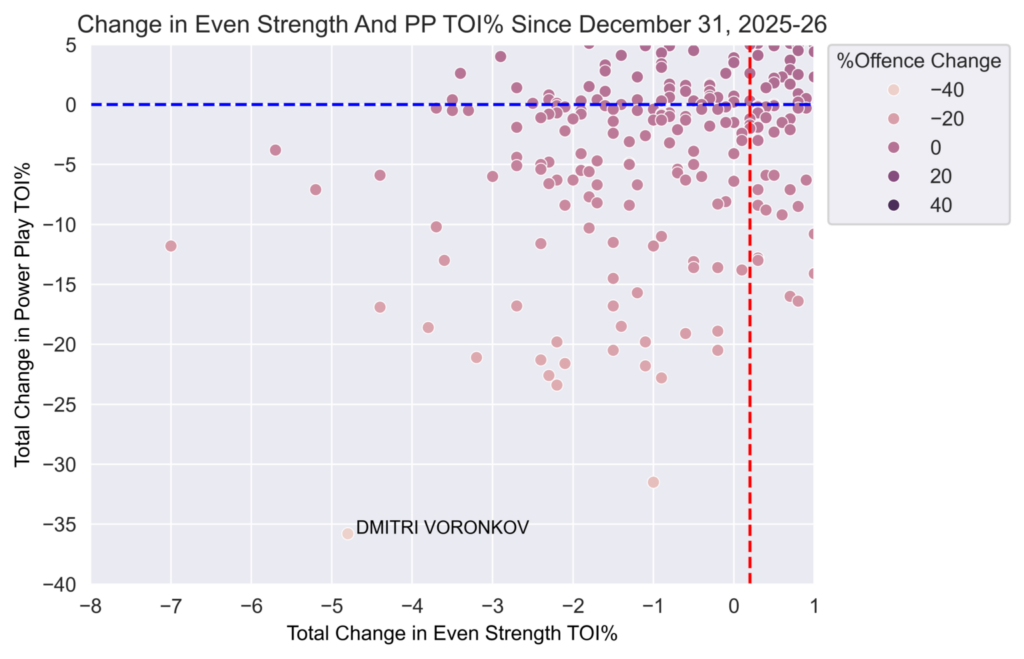
No matter who he skates with or whatever else he can do, Voronkov skating 10-11 minutes per appearance is a death knell to his fantasy value. The saving grace is that he has put up a high hit rate this season, so he still managed 24 hits in 11 games under Bowness. For that reason alone, he can be held onto in deeper banger formats, or some type of deep keeper league. For most fantasy managers, he may be a lost cause as Columbus is 10-1-0 in 11 games under Bowness; as long as they keep winning and can stay relatively healthy, it’s hard to see Voronkov’s situation improving.
It should be mentioned that in Columbus’ first full practice post-Olympics, Voronkov was skating with Sean Monahan on the ‘second’ line, according to Aaron Portzline. Keep in mind that under Bowness, the Adam Fantilli line is the top line and Charlie Coyle‘s line is the real second line by even-strength ice time, but Voronkov skating with Monahan could mean 13-14 minutes a game rather than 10-11. Something to monitor. (feb26)
11. Emmitt Finnie (Detroit Red Wings)
Yahoo Roster – 3%
FanTrax Roster – 35%
ESPN Roster 7%
Finnie is flat-out one of the best stories of the 2025-26 season as the seventh-round pick from 2023 spent a lot of the first half of the season on Detroit’s top line with Dylan Larkin. That Finnie’s managed to stay in the NHL all season is a credit to his work ethic, but the reality is that he’s seen a modest PPTOI decline and a massive even-strength TOI decline:
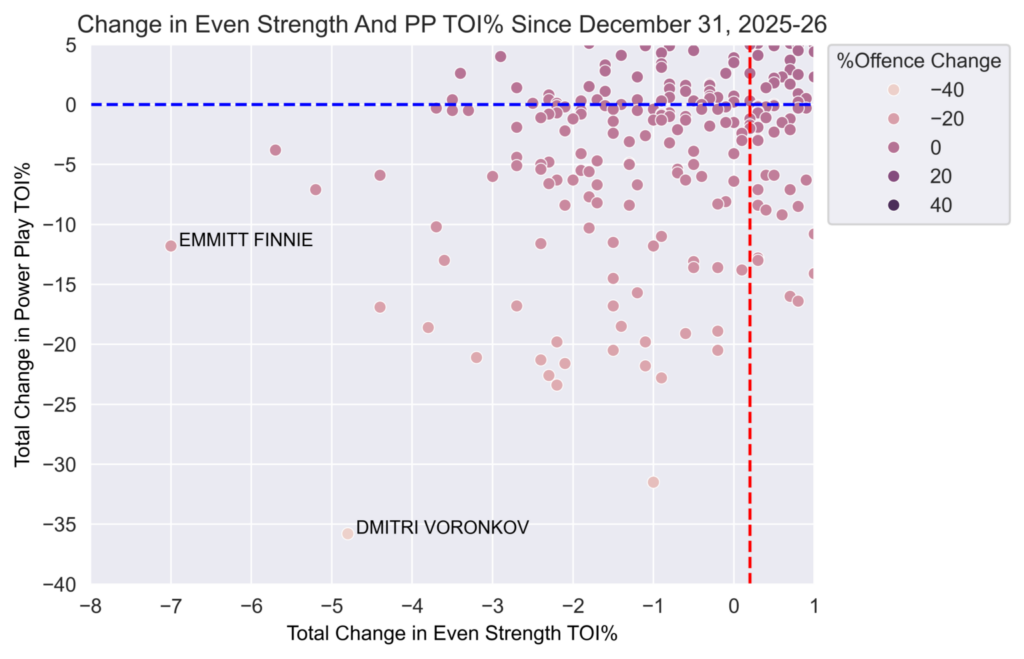
The January-February stretch saw Finnie lose 4:37 per game in ice time and his most recent 15 games saw him fail to crack the 15-minute mark in any of those outings. The second line of Patrick Kane, Andrew Copp, and Alex DeBrincat has been a constant when healthy, and Marco Kasper had seen some recent games on the top line with Larkin. James van Riemsdyk had several games on the top power-play unit, and when we put it all together, Finnie has been a bottom-6 regular.
Some players can maintain modest fantasy value in a bottom-6 role, but Finnie had 19 points in 41 games to start the season, skating roughly 80% of his even-strength time with Larkin. If he was pacing for under 40 points skating 16:53 per game with Larkin as his regular centre, then his new role doesn’t bode well for production. There might be some deep banger value because he can still put up over a hit per game, but things are looking bleak, especially if Detroit adds some offensive depth by the Trade Deadline. (feb26)
12. Jonathan Drouin (New York Islanders)
Yahoo Roster – 2%
FanTrax Roster – 22%
ESPN Roster 2%
Judging by Drouin’s roster numbers on Yahoo and ESPN, fantasy managers had largely given up on him already. With the lack of productive wingers in New York, Drouin had a longer leash than he probably deserved, but even with the lack of productive wingers, he had seen a significant decline in his role leading to the Olympic break:
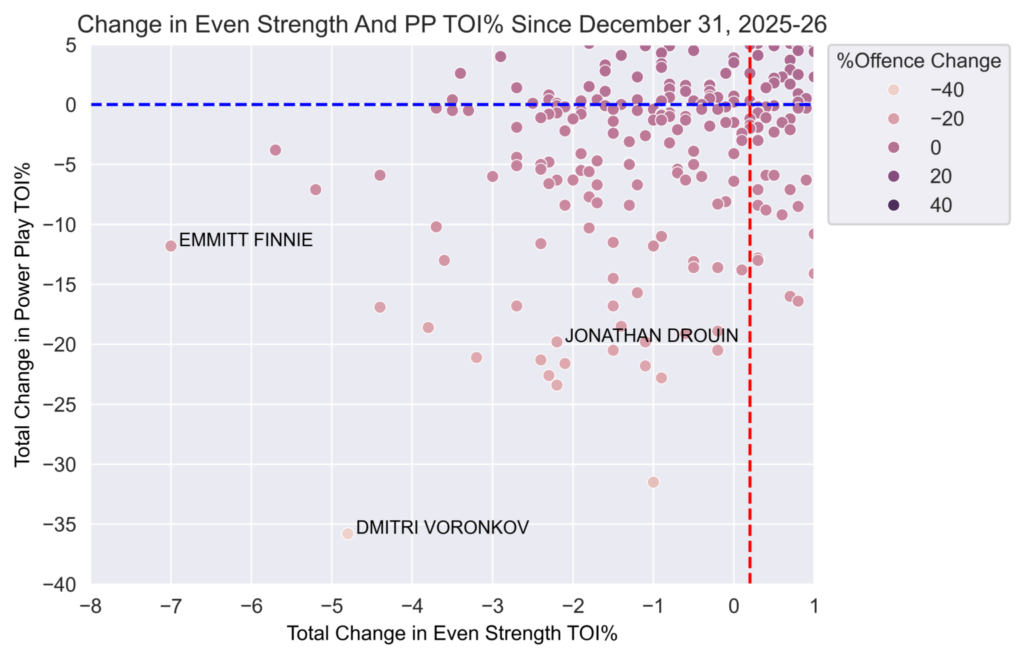
We could forgive Drouin’s low shooting percentage (4.4%), but he’s had two seasons where he shot under 3% (both 2020-21 and 2022-23) and two other seasons where he shot under 8% (2014-15 and 2017-18). Given he has as many seasons shooting under 8% as he does over 11%, it’s not a given that his shooting percentage improves significantly from here on out.
The real problem is he’s managed 1.16 assists per 60 minutes this season, by far his worst rate in any season where he’s played at least 40 games (previous worst was 1.46 in 2017-18). Drouin not scoring is one thing – if he’s not helping his line mates score, there’s not much reason for the coaching staff to increase is role, and he doesn’t have any peripherals to keep him relevant in multi-cat formats. (feb26)
13. Fabian Zetterlund (Ottawa Senators)
Yahoo Roster – 5%
FanTrax Roster – 24%
ESPN Roster – 40%
With Nick Cousins finding success on the checking line with Shane Pinto, and Ridly Greig finding success on the second line with Brady Tkachuk and Dylan Cozens, Fabian Zetterlund has seen his role drastically reduced in Ottawa. The Senators tried him in various spots on their top three lines, but he has been on the fourth line recently, and it’s depressed his ESTOI and PPTOI percentages:
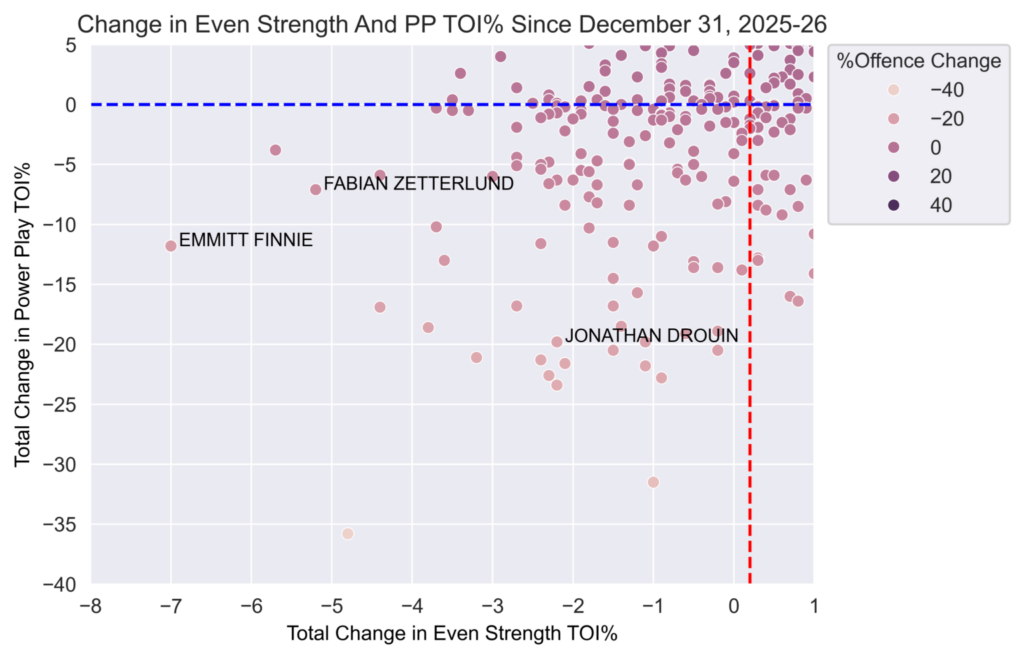
The drop in PP role isn’t steep, but the even-strength decline is, to the point where he’s lost over three minutes per game in ESTOI alone. He went into the break skating under 13 minutes in nine straight games, and under 10 minutes more often than he did over 12 minutes.
As with Voronkov, there is a high enough hit rate here to keep Zetterlund relevant in deeper banger formats – Zetterlund had 31 hits in 15 games heading into the break. Fantasy managers in those leagues might want to hang on and hope he can work his way back up the lineup because it’s not hard to see one of Cousins or Greig being dropped down. (feb26)
14. Mackie Samoskevich (Florida Panthers)
Yahoo Roster – 2%
FanTrax Roster – 37%
ESPN Roster – 10%
The return of Matthew Tkachuk to Florida’s lineup means a top-6, top PP forward back in the fold, the health of Brad Marchand has been an ongoing issue for nearly two months, and the success of A.J. Greer has given the Panthers another solid depth winger option. Put it all together and Samoskevich has seen a sizeable hit to his offensive roles:
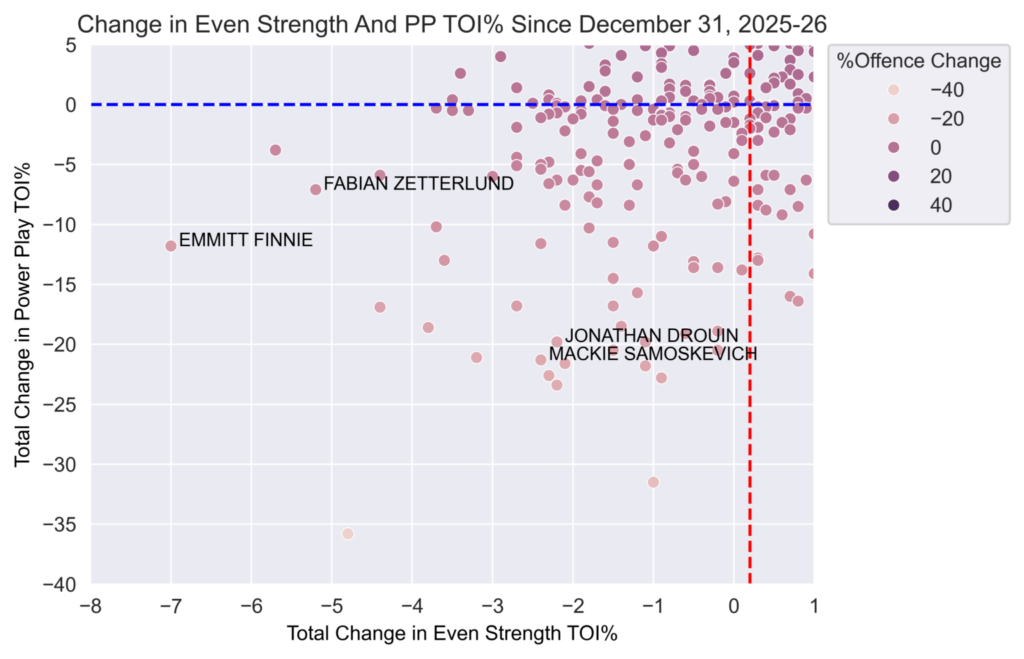
In general, I am a big fan of Samoskevich and his future upside. He has very good shot and hit rates on a per-minute basis, and he’s been able to drive the play in his two years with Florida. The problem is that as a winger on the Panthers, he’s competing with the likes of Tkachuk, Marchand, Sam Reinhart, Carter Verhaeghe, and Eetu Luostarainen. Even worse is they are all signed long term except for Luostarainen, who has another year on his deal (per PuckPedia). For now, Samoskevich may be stuck in a bottom-6 role thanks to their lineup getting healthy, and that may be the case for years to come, too. (feb26)
15. Cutter Gauthier (Anaheim Ducks)
Yahoo Roster – 91%
FanTrax Roster – 97%
ESPN Roster – 96%
Heading into the break, Gauthier was 1 of just 9 forwards who had an ESTOI% decline of at least 2% with at least a 5% decrease in their SHTOI% (he will be the only name listed here to make the graph less cluttered):
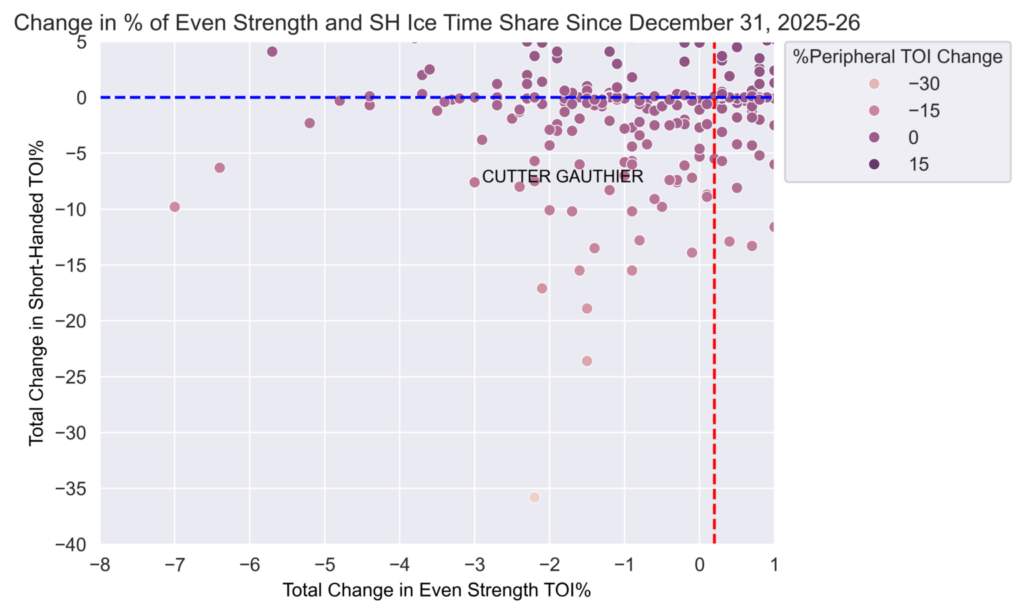
In this stretch, the Ducks played 16 games. Of those 16 games, Leo Carlsson and Troy Terry each played five and Mason McTavish played 11. Carlsson and McTavish are centres and not wingers, but it is still a lot of talent to be missing several games and yet Gauthier still saw a decline in ice time in the peripheral phases. (He did see an increase in PPTOI% because of those missing players.)
Therein lies the problem: even with some of Anaheim’s top forwards missing large chunks of time, Gauthier still lost 1:32 per game after December 31st. What is his role going to look like down the stretch? Maybe the Olympic break gave him the rest he’ll need to be the guy he was in the first two months of the season, but there are no certainties here. (feb26)
[Folllow the link for more…]
16. One of my dynasty leagues has our trade deadline the evening of the NHL trade deadline, which works out well staying up a little later on a weekend in order to finalize some last-minute deals.
If you’re like me and a little more in tune with players’ head to head schedules then you’re hoping that anyone you acquired for their increased game volume later in the season is not going to be moved, and maybe the bigger hope is that any players you do have at least don’t see their situations worsen.
There’s a lot to juggle with players being sat for “roster/trade related reasons”, and the inevitable changes in deployment due to players being moved in or out. We have Fantasy Take articles out on the site for any players of general fantasy relevance that are moved, and the contents typically boil down to: how does this impact ice time, power play time, and linemates for the traded player(s), and for others on the teams involved in the trade, for any secondary ripples. Sometimes there are bigger deals that might also impact the outlook for a goalie as well, but those are usually less common, especially at the deadline.
We may see a few players of Nazem Kadri‘s caliber moved, and that kind of deal would make a lot of room for Morgan Frost at the top of the roster, and Rory Kerins to maybe get a full-time spot. Wherever Kadri goes is likely going to see their second line centre drop off, and possibly see a ripple effect through the power play roles as well. Kadri has noted he wants to be moved, and getting him back in Colorado makes sense as they cleared out some salary by moving Sam Girard. We’ll have a real breakdown if it actually happens though.
In what was both a cap clearing move for the Avs but also a look to get bigger for the playoffs, as mentioned above they shipped out Sam Girard to Pittsburgh yesterday along with a second round pick in exchange for Brett Kulak. It looks like a huge win for the Penguins on the surface, but that won’t matter to the Avs if it both helps them bring in another bigger fish, and win the Cup.
Cliffy had his breakdown of the trade here. (feb25)
17. To wrap it up this week we’ll look at a few players that I’m targeting heading into the trade deadline:
Rickard Rakell (LW) / Bryan Rust (RW) – Pittsburgh Penguins
Both Rust and Rakell have missed some time this year, and they may be missing Crosby in between them as they return from the break, but that’s exactly why you may be able to get one or both. They’re on solid contracts in cap leagues, have multiple years remaining of production, and as the kicker, Pittsburgh has a great fantasy playoff schedule. Owning one of these two for Pittsburgh’s five-game week could really swing the balance in a matchup.
Nikolaj Ehlers (LW) – Carolina Hurricanes
After a rocky start, Ehlers has seen his scoring really take off from Q2. His shot rate has gone down since his first few games as a Hurricane, but the shot selectivity has led to a higher scoring rate, especially on the power play. Ehlers has lots of underlying metrics that could see some positive regression towards his averages with a big final quarter of the season.
Kiefer Sherwood (LW/RW) – San Jose Sharks
Another player who missed some time with injury, Sherwood is in a bit of a different boat as he has also been traded, and his value isn’t just coming from his scoring. Though with the trade and his new plum gig next to Macklin Celebrini, Sherwood should be able to score too. The Hits are where Sherwood really brings some special value, and the added ice time he looks to be getting with San Jose, especially in a puck-retrieval kind of role on the top line, those Hit numbers should remain quite high to finish out the year. San Jose also has the best fantasy hockey playoff schedule this season for those of you in leagues that go all the way to game 82.
Jared McCann (C/LW) – Seattle Kraken
The next best fantasy playoff schedule after San Jose? Well it’s the Seattle Kraken, whose best player is still flying under the radar despite an incredible run recently of 20 points in his last 17 games, eight of which are on the power play, and if the Kraken sell then McCann should see a little added boost of ice time too.
Adam Fox (D) – New York Rangers
In keeping with the theme, Fox and the Rangers have a great schedule to end the year, including a lot of off-nights in busy weeks where there aren’t many to be found. He has been a full participant in practice and should be back in games very soon. He’s pacing at close to a point per game again after a slower season last year, and he’s likely going to come back with a fire lit under him after being left off the American Olympic team that then won gold without him. (feb25)
18. Fantasy managers need to be ready for the stretch run. This is where catching the right player or two who hit a hot streak in a bigger role can mean the difference between a championship or a crushing loss.
Before game action restarts, let’s refresh ourselves on some forwards who saw a bigger role before the break. We are using December 31st as the cut-off and using the percentage share of TOI from Frozen Tools to see who had a bigger role in the weeks leading up to the Olympic break, and whether they can be useful fantasy options down the stretch.
Ice time and roster percentage data are from Frozen Tools while any other data is from Evolving Hockey. We are dividing the forwards into two groups:
- Change in offensive TOI share, or even strength and power play only
- Change in peripheral-heavy TOI share, or even strength and short-handed only
The red and blue dotted lines in the following graphs are the average ice-time changes in each phase.
Linus Karlsson (Vancouver Canucks)
Yahoo Roster – 0%
FanTrax Roster – 12%
ESPN Roster – 0%
One of the bigger recipients from Vancouver’s struggles and injuries has been the rookie Karlsson. He went from under 10 minutes a game in the first two months of the season, to 11:37 in December, up to 13:37 since then, and 14:35 per game in his most recent five appearances. It still isn’t a lot of ice time, but after New Year’s Eve, he was fourth among Canucks forwards in PPTOI per game, and had seen large increases in his even-strength usage as well:
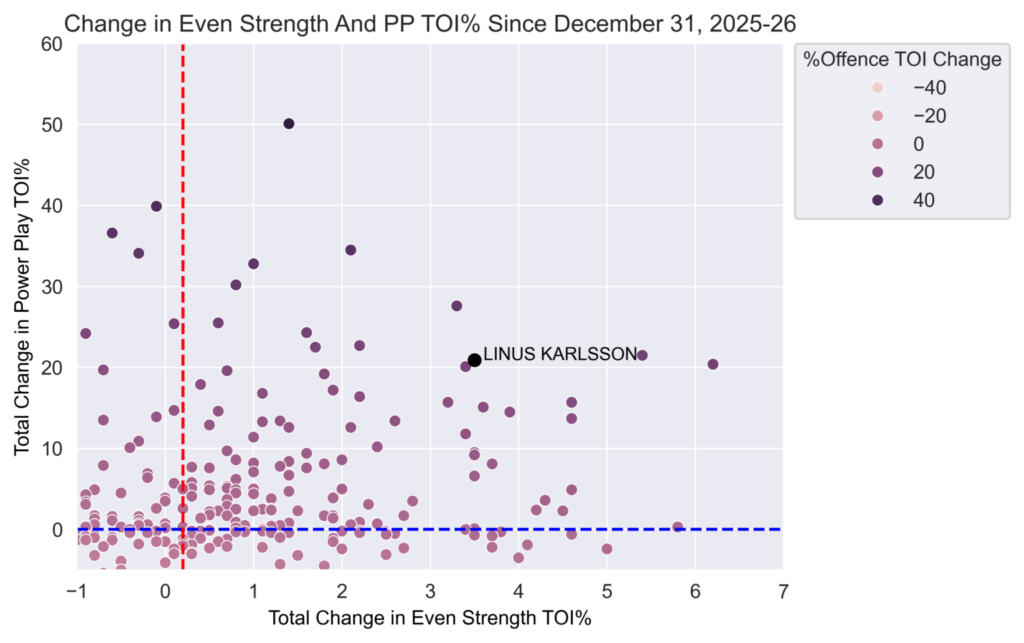
When the Vancouver lineup is healthy, it seems likely all of Elias Pettersson, Brock Boeser, and Jake DeBrusk are on the top power-play unit. It leaves just one spot for the likes of Karlsson, Conor Garland, Marco Rossi, or Evander Kane. However, Karlsson sits third among rookie forwards in points per 60 minutes at even strength, has improved his role as the season has worn on, and the Canucks will be looking to trade some veterans by the Trade Deadline. He is also averaging over a hit per game, so there is some banger value here, and Vancouver is tied for the sixth-most games on ‘light’ days for the rest of the season. Karlsson’s value relies on his lineup slotting, but the same could be said about a lot of depth streaming options. (feb24)
19. Matias Maccelli (Toronto Maple Leafs)
Yahoo Roster – 2%
FanTrax Roster – 25%
ESPN Roster – 7%
Maccelli is a case where it is hard to see him keep earning the power-play role he has. William Nylander played just seven games after December 31st, and that was a big reason for Maccelli’s elevated role, and he did see some of the biggest increases of any forward in the league:
Even without the power play role, Maccelli’s even-strength role increased from 22.7% of the available TOI to 26%, adding 2:30 per game in EVTOI. He doesn’t hit or block shots, so he has very meagre value in leagues counting peripherals, but the Leafs come out of the break with 7 games in 11 days and have the fifth-most games in light days the rest of the way. If Maccelli remains in the top-6 at even strength, and can skate 14-15 minutes a game even without a PP role, he will have some streaming value in deeper formats. (feb24)
[Follow the link for more…]
20. The rumor mill is spinning again, contenders will look to load up before the March 6 trade deadline, and a few non-playoff teams will pivot toward selling. That movement will not just impact real-life rosters, it is going to shake up fantasy lineups as well. Roles will change, power play units will shift, and opportunity can open up overnight. So, buckle up and keep an eye out on your waiver wire.
As I have done for the past few weeks since the Olympic break, I focused on waiver wire options with 30% roster ownership and then followed that up with 20% or lower the following week. This week, I’m spotlighting a few deep cuts owned in 10% or fewer in Yahoo! leagues. These are players who matter most in deeper formats, but if you are trying to find an edge anywhere, they could quietly make a difference.
Oliver Kapanen – C – Montreal Canadiens – 7 %
Oliver Kapanen has put together a strong rookie campaign, sitting fourth in rookie scoring with 31 points and tied for the rookie lead in goals (18) alongside Beckett Sennecke. His 17.6% shooting rate stands out well above league average, so some regression is possible. He is averaging 1.8 shots per game and 7.1 per 60 at 5v5, paired with 2.2 points per 60, showing he can drive offense efficiently at middle-six minutes. Nearly half of his 5v5 ice time comes alongside Ivan Demidov and Juraj Slafkovsky, with more than half of his even-strength points coming with this duo. The trio has been consistent all season, and Kapanen has been central to its effectiveness. However, his PP time is limited with less than a minute per game, so do not expect significant contributions there. In deeper formats, he offers a bit of peripheral value, having taken 254 draws at 47.7 percent. Averaging just over 15 minutes a night in a top-six offensive role, Kapanen is a promising, efficiency-driven rookie who could continue to grow as his overall usage expands. (feb23)
[Follow the link for more…]
21. And last but not least: You really could not have drawn up a better gold medal matchup between Canada and the USA. It had everything you want in a final: pace, layers of skill, quality looks at both ends and a sudden death overtime winner that sent the Americans to their first Olympic gold since 1980 in Lake Placid. The stakes felt heavy all morning and the execution matched it.
Cale Makar scored the lone goal for Canada and was excellent throughout the final, driving play and logging big minutes. Canada pushed hard, outshooting the Americans 42 to 28, but Connor Hellebuyck was the difference. He was outstanding and clearly USA’s best player. Hellebuyck finished the tournament with a 1.23 goals-against average and a .947 save percentage, elite numbers in a short, high-pressure event. He heads back to NHL action riding serious momentum. Winnipeg sits out of a wildcard spot and near the bottom of the Central, so the math is tough, but if anyone is going to push them, it is Hellebuyck.
Connor McDavid finished the Milan Games as the tournament scoring leader with 13 points in six games and was named tournament MVP. Macklin Celebrini was right behind with 10 points, while Lucas Raymond added nine of his own and Juraj Slafkovsky with eight in a strong showing. (feb23)
—
Have a good week, folks!
Thanks for continuing to support the website and if you’re bored and need a fantasy hockey fix – visit the gang in the forum here.
Related Posts

Starting Goalies












Top Skater Views
| Players | Team | |
|---|---|---|
| COLE PERFETTI |
 WPG WPG | |
| LUCA CAGNONI |
 S.J S.J | |
| IGOR CHERNYSHOV |
S.J | |
| TOMMY NOVAK |
 PIT PIT | |
| TRISTAN LUNEAU |
 ANA ANA
| |
Top Goalie Profile Views
| Players | Team | |
|---|---|---|
| DAN VLADAR |
 PHI PHI | |
| JOSEPH WOLL |
PHI | |
| SEBASTIAN COSSA |
 UTA UTA | |
| JAKUB DOBES |
 MTL MTL | |
| ADIN HILL |
 VGK VGK
| |
LINE COMBOS
| Frequency |
 CHI Players CHI Players
| |
|---|---|---|
| 25.9 | FRANK NAZAR ROMAN KANTSEROV PATRICK KANE | |
| 23.2 | COLE SMITH JORDAN GREENWAY RYAN GREENE | |
| 21.0 | TEUVO TERAVAINEN ANTON FRONDELL TYLER BERTUZZI | |
DobberHockey Podcasts

Keeping Karlsson: Cole, There’s No Time!
Elan and Brian cover all the action from the first week of the NHL season, and identify our earliest must-adds, can-drops, sell highs and buy lows in your fantasy hockey leagues.
Keeping Karlsson: Matchup Maximizer 2026/27 Week 2
Elan takes a look at the schedule for the upcoming weeks of NHL action and recommends players with good schedules that you should consider streaming in to win your head to head matchups.

Fantasy Hockey Life: Tidy Takes Part 1
TiDy Admiral Ryan Downey and Victor Nuno break down recent trades in the FHL Tiered Dynasty’s top division, the Lord Stanley division. Tune in to consider trades between some of the best dynasty sharks we know, including patron polls on the trades and Victor’s analysis. Have a listen! Our show is part of the Dobber […]
Keeping Karlsson: Short Shifts – I Tried to be Like Parker Kelly
Elan is joined by Ryan Downey for the premiere of season 8 of Short Shifts! — KKUPFL late registration is ongoing! We’re still filling new divisions in the world’s greatest fantasy hockey league. Details at https://www.kkupfl.com/. Join the Keeping Karlsson patron community! Patrons get access to all our perks all year round, including KKUPFL […]
Keeping Karlsson: Shabanov Ranks
Elan and Brian fly through the final preseason lines for every NHL team ahead of opening night, and share their guys to watch– or look away from– in your fantasy hockey leagues.