

21 Fantasy Hockey Rambles
Dobber Sports
2026-06-07
Every Sunday, we share 21 Fantasy Rambles from our writers at DobberHockey. These thoughts are curated from the past week’s 'Daily Ramblings'.
Writers/Editors: Ian Gooding, Michael Clifford, Alexander MacLean, Puneet Sharma, and Dobber
___
The Fantasy Prospects Report is now available!
If you don’t have yours yet, get it at the Dobber Sports Store.
___
1. There’s a growing belief that the regular season and the playoffs are two distinct entities. In other words, what happens during the playoffs has absolutely no bearing on what will happen the following season. Is there any chance that an amazing playoff run can translate into something meaningful the following season? This is a good opportunity to acknowledge the success of several players in the Stanley Cup Final and discuss what might be in store for next season.
Entering Game 3 on Saturday (yesterday), Howden has emerged as the top sleeper of playoff pools, surpassing his regular-season output of 12 goals in 58 games with 13 goals in just 18 playoff games. Over a third of the shots he has taken during the playoffs have gone into the net, while a 39.4 SH% is never sustainable.
Prior to the playoffs, Howden had yet to emerge as anything more than a third-line forward. Howden, who was a late first-round pick of Tampa Bay in 2016 but started his NHL career with the Rangers, has a career high of 40 points set in 2024-25. However, he has been a 20-goal scorer, as 23 of those points were goals. The 2024-25 season was also the only season in which Howden has taken more than 100 shots, while his shooting percentage is consistently over 10 percent.
Two recent developments have worked in Howden’s favor. One is the hiring of John Tortorella. Power-play time was nonexistent for Howden until the final quarter, where he emerged on the second power play. Although none of Howden’s playoff points have been with the man advantage (but three shorthanded goals), the increased scoring responsibility should be noted. Howden might be Torts’ kind of player, as he has reached 100 hits in three of his past four seasons. The other development is that Howden has been lined up with playmaker Mitch Marner frequently during the playoffs, resulting in more scoring opportunities.
Based on prior regular seasons, Howden doesn’t need to be on your radar for next season’s drafts except maybe for deeper leagues. However, the recent usage is interesting enough for Howden to be a legitimate waiver-wire option next season. (june6)
2. Carter Hart
I’m not sure anyone knew what to make of Hart’s statistical projections once he was reinstated by the NHL. Inactive for nearly two years, Hart seemed rusty upon his December return to the NHL with a 3.28 GAA and an .870 SV% in 12 games before a lower-body injury sidelined him for three months. Yet following his return, Hart has been the goalie we thought he would be in Philadelphia. He gave us a sneak peek of what was to come during the playoffs by finishing the regular season with a 1.66 GAA and .930 SV% in his last six regular-season games.
You never know how Vegas goaltending will play out, as the Golden Knights are VERY much a “what have you done for me lately” organization. However, Hart should have no issues entering the 2026-27 season as the starter. Adin Hill has not played since April 9, although his $6.25 million cap hit with five years left dwarfs Hart’s $2 million roll-of-the-dice cap hit, which lasts another season. Hill had been slowed by multiple injuries this season, playing in just 27 games.
If Hart wins the Stanley Cup, then he should have a bit of rope (as Hill did at first). Hart may simply be showing that he always had the talent but just needed the right environment. That seems ironic to say, as Vegas’s regular-season .884 team save percentage was 27th in the league. I guess they can thank Torts for the defensive turnaround. (june6)
3. Taylor Hall/Logan Stankoven/Jackson Blake line
You know the saying “In order to win, your best players have to be your best players”? That hasn’t been true for Carolina in advancing to the Stanley Cup Final. The Hurricanes’ four leading scorers during the regular season were Sebastian Aho, Nikolaj Ehlers, Andrei Svechnikov, and Seth Jarvis. But for the playoffs? The four leading scorers are Taylor Hall, Jackson Blake, Logan Stankoven, and Ehlers. Aho and Svechnikov in particular have seen their scoring drop with just eight points each in 15 games, while Jarvis has nine points in 15 games.
The Hall-Blake-Stankoven line has picked up the slack during the playoffs with both a 69.2 SF% and a 65.8 CF%. If you didn’t add any of these players to your playoff pool, you can’t really blame yourself that much. Blake was the high scorer among the group with 53 points in the regular season, followed by Hall with 48 points and Stankoven with 44 points.
Overall, all of these players should have a safe floor but not a sky-high ceiling next season, because the Carolina way will never massively boost individual stats. Blake and Stankoven seem like good bets to improve next season – particularly Stankoven, who produced well over point-per-game numbers in both the WHL and AHL. Because Stankoven is a smaller forward (5-8, 165 lbs.), he may need a few more seasons of runway to completely reach his upside. Meanwhile, the 34-year-old Hall has not scored at a 50-point pace since 2021-22. Don’t expect him to suddenly leap well beyond that in the back half of his career. (june6)
Fun fact: Andersen had more really bad starts (12) than quality starts (11) during the regular season. That hasn’t mattered during the playoffs, as Andersen was the Dobber writers’ favorite to win the Conn Smythe Trophy. Whether you believe Andersen has truly found new life in his game or he is a product of Carolina’s system, Andersen has been one of the great stories of the playoffs.
Even though has taken his team to the Stanley Cup Final, Andersen may not be back with the Hurricanes next season. Andersen will be a UFA, while both Pyotr Kochetkov and Brandon Bussi (remember them?) are both still under contract. By the way, Kochetkov and Bussi splitting starts 50-50 seems to be the most likely outcome in the Canes’ net next season.
As for Andersen, he is a potential tandem option himself given his age (36) and injury history. Andersen won’t ever be a top tier fantasy goalie again due to the likely limit on games played. However, he could be productive enough to be a G2 or G3 on fantasy teams next season. We’ll have to wait and see where he lands next season. (june6)
5. Reminder: Dobber's 2026 Fantasy Hockey Prospects Report was released a few days ago and is available now in the Dobber Shop! Both Dobber and the Prospects team has been working for the last 12 months (and more) to highlight what you need to know about the prospects you need to know from the upcoming Entry Draft. It also has an in-depth look at each team's current prospect pipeline and estimated arrivals for their top, young (hopeful) stars. Head on over to the Dobber Shop and grab a copy of the Prospects Report!
6. In case you missed it, Dylan Larkin has reportedly requested a trade from the Detroit Red Wings. Teams that could be in the market for Larkin include Los Angeles, Minnesota, and Montreal. Larkin is as consistent a center as there is in the NHL, as he has ranged between 30-35 goals, 67-79 points, 70-85-point pace, and 212-244 shots over each of his past five seasons. Those numbers place him in the tier of a weak first-line center or a strong second-line center.
A Larkin trade would have significant implications in fantasy leagues for both the acquiring team and the Red Wings, since he is currently the Wings’ number one center. Unless the Wings receive a top-6 center in return in a trade, a former top-10 pick like Marco Kasper or Nate Danielson would need to fill the void. Losing a player of Larkin’s caliber could force the Red Wings to take a step back when they were close to making the playoffs this past season. (june6)
7. A pair of Habs were announced as NHL award recipients on Friday. Cole Caufield has won the Lady Byng Trophy, while Nick Suzuki has won the Selke Trophy. Caufield was one of two players to reach 50 goals this season (finishing with 51), while he received just 14 penalty minutes. His linemate Suzuki was one of eight players to reach 100 points (finishing with 101), while he had the sixth-highest faceoffs taken total (1449). (june6)
Earlier in the week, Zach Werenski won the Norris Trophy, with Rasmus Dahlin and Cale Makar as the other finalists.
8. According to Michael Russo, pending UFA Marcus Johansson has signed a contract with Farjestad in Sweden. Johansson finished with 49 points for Minnesota in 2025-26, which was his best output since the 2016-17 season with Washington. At age 35, Johansson’s days in the NHL might be finished. (june6)
9. Mem Cup winner, Sam O’Reilly, the Tampa Bay prospect, has probably played his way onto their roster projections for the fall with his fantastic season. The Lightning saw something similar happen with Anthony Cirelli a decade ago, after his fantastic OHL season in 2016-17 was highlighted by a solid WJC performance and punctuated by a dominant Memorial Cup run. Cirelli then made his AHL and NHL debuts the next year, most notably thriving in his NHL run with 11 points in 18 games. A similar two-thirds of the season in the AHL might serve O’Rielly best this coming year, but if he does make the team out of camp this year, he could be a big part of that production from the bottom-six that the Bolts lacked this year. (june3)
10. I’m keeping half of an eye on the AHL playoffs, and I thought that it might be interesting to see which of the top AHL playoff scorers might be playing their way into consideration for a full-time roster slot with their NHL team in the fall.
(Stats as of June 3)
Three young Chicago Wolves (Carolina Hurricanes prospects) catch the eye off the bat, with Ryan Suzuki (10 points), Felix Unger Sorum (nine points), and Bradly Nadeau (nine points) leading the way. All three have a case to make the Hurricanes next year, with Suzuki the most developed (at 25 years-old and now recovered from a freak eye injury that robbed him of some key developmental time), Unger Sorum (the most well-rounded), and Nadeau (the best offensive tools) all players worth a look for the Hurricanes in camp. However, they may be hoping for an injury or a trade to get a chance, as the Hurricanes have their full forward core signed for next season. (june3)
11. For the Coachella Valley Firebirds (Seattle Kraken affiliate) we have Oscar Fisker Molgaard leading the way with 11 points in 12 games. The 21-year-old is reliable enough at both ends of the rink, and with some offensive talent to boot, he seems ready to push for a full-time lineup spot after a full year in the AHL. He is one of 12 forwards signed for next year, but if some of the free agents return then space could be tight for the young players. (june3)
12. Ivan Ivan might not be young by NHL prospect standards, but at 24 he’s the youngest of the main scoring group on the Colorado Eagles, and has had a very successful postseason with 11 points in 12 games. He has shown flashes of NHL ability in his brief stints with the Avalanche, and could be someone that makes the roster as a bottom-six depth scorer in the next year or two. Not a ton of NHL upside here, but still a better bet than some. (june3)
13. William Villeneuve is the only defenceman in the top-25 scorers from the AHL playoffs this year, and his 14 points have him sitting third entering Tuesday night. That is in part due to a few more games played, with the Toronto Marlies having had to play more games in each round than the other remaining squads. Regardless, it’s a feather in the cap for the 24-year-old Villeneuve who appears to be as NHL-ready as he will ever be. His scoring numbers show that he could be a solid secondary producer at the NHL level, and his size and handedness (right shot) make him a better bet to be able to break camp with the big club. The Leafs could use some more youth in the lineup, especially on defence, and this would be the best way to do it. (june3)
14. Most end-of-season player and management interviews when a team is eliminated from the playoffs are of little interest. We get some variations of the GM saying they want to improve the team, players saying they want to get a bit better, and not much else. The injury information can be valuable, but that’s about it.
That is what made Montreal’s end-of-season press conference different. Forward Brendan Gallagher, who was healthy scratched at the end of the season and often in the playoffs, made it clear that he had played his last season with Montreal.
There doesn’t seem to be any genuine animosity here, though what players, coaches, and GMs really think is infrequently certain, but it’s easy to understand his frustration given his tenure with the Habs and how it ended. He will finish his career with Montreal 89 games shy of 1000 regular season contests, and has two Conference Final and one Cup Final appearance on the résumé. Wherever he ends up, his new team will get a hell of a leader. (june2)
15. The Vancouver Canucks hired Manny Malhotra to be their new Head Coach. Michael Clifford wrote more about it here.
16. With the schedule light, we’ll get right into it and continue the series, once again using the NHL Fantasy Hockey Projections released back in October 2025 as the baseline for expected production.
Cutter Gauthier – 69 points (Projected: 55)
Cutter Gauthier entered the season viewed as one of Anaheim’s more intriguing centre pieces in the Duck organization alongside Leso Carlsson, but few fantasy managers expected a leap from 43 points to nearly 70 in his first full top-six role. After being projected for 55 points, what impressed most was not just the 69 points seasons but also the 41 goals, making him one of the better mid-round fantasy steals among young wingers.
The biggest fantasy takeaway was how quickly his shot generation translated into elite scoring production. Gauthier jumped from 2.3 shots per game as a rookie to 3.7 this season, finishing with 284 shots while maintaining a strong 14.4 S%. Unlike some young players who rely heavily on power-play inflation, Gauthier drove a large portion of his production at EVS, recording 50 points while consistently generating offense regardless of linemates.
Anaheim’s improving supporting cast also played a major role. Leo Carlsson continued progressing into a legitimate top-line playmaker, Mason McTavish remained a strong complementary power forward, and Beckett Sennecke immediately clicked with Gauthier at even strength. The Ducks suddenly looked far deeper offensively, which helped create more sustainable scoring conditions compared to the previous season. Gauthier primarily spent most of his even strength minutes with Sennecke and McTavish, very rarely being placed on the top line if not at time being bumped down to the third line. His line combinations posted strong possession numbers across the board, particularly alongside McTavish and Sennecke where Anaheim controlled nearly 57 percent of shot attempts.
There are still areas that cap the ceiling slightly in category leagues. His hit totals are decent but not elite, and his assist production remains secondary compared to pure playmaking forwards, but does it matter when he is scoring 40 goals? Still, fantasy managers who bet on the talent and shot volume were rewarded with a legitimate sniper who now looks capable of becoming a perennial 35-to-45 goal scorer entering his prime years. (june1)
17. Morgan Geekie – 68 points (Projected: 57)
Coming off a 57-point projection, most managers viewed him as a mid-to-late round depth winger riding Boston’s system and power-play exposure. Instead, he delivered a 68-point breakout, powered by top-line deployment, elite finishing, and consistent exposure to high-end talent.
Geekie spent a significant chunk of the season next to David Pastrnak and Elias Lindholm, and that combination drove the majority of his fantasy value. Even though the line posted mixed underlying results at times, Geekie’s production was evident. He finished with 39 goals, and that scoring jump came largely from volume and finishing efficiency. His 21.5 S% immediately screams regression, however some of it can be explained by a meaningful increase in both shot quality and role stability rather than pure randomness. He has also posted similar S% in back-to-back seasons.
Boston also leaned heavily on him in key offensive situations. He averaged nearly 3 minutes of power-play time per game and finished with 24 PPP, a major driver of his fantasy relevance. That usage alone pushed him from a secondary scorer into a legitimate top-six fantasy option. When he wasn’t with Pastrnak and Lindholm, he still found ways to stay involved offensively, rotating through different second-unit combinations that kept him from going cold for long stretches. He was not drafted as a difference-maker, but he produced like one for stretches. The question going forward is whether he holds this role or gets pushed down the lineup. If the top-line and PP usage stick even partially, he’s no longer just a depth flier, he’s a legitimate middle-six fantasy hold with upside tied directly to Boston’s elite talent pipeline.
[Follow the link for more…] (june1)
18. In last week's Friday’s Ramblings, we went over some of the top forward peripheral producers for the 2025-26 season. This includes shot, block, hit, and PIM totals, keeping in mind that when discussing PIM totals, we include just 2-minute and 5-minute penalties. We are also including only players who played at least half the season, or 41 games.
Today, we’re going to finish off our run of Ramblings covering peripherals by reviewing some of the top producers among defencemen for the 2025-26 season. We are calculating the per-game rate of the four stats mentioned, and then how their rates compare to the league average rates for blue liners. So, if all rearguards average 1.0 shots per game, and Shayne Gostisbehere averages 2.0 shots per game, he is 100% above the league average, relatively speaking.
Here are the top-15 per-game peripheral producers of the 2025-26 season among defencemen:
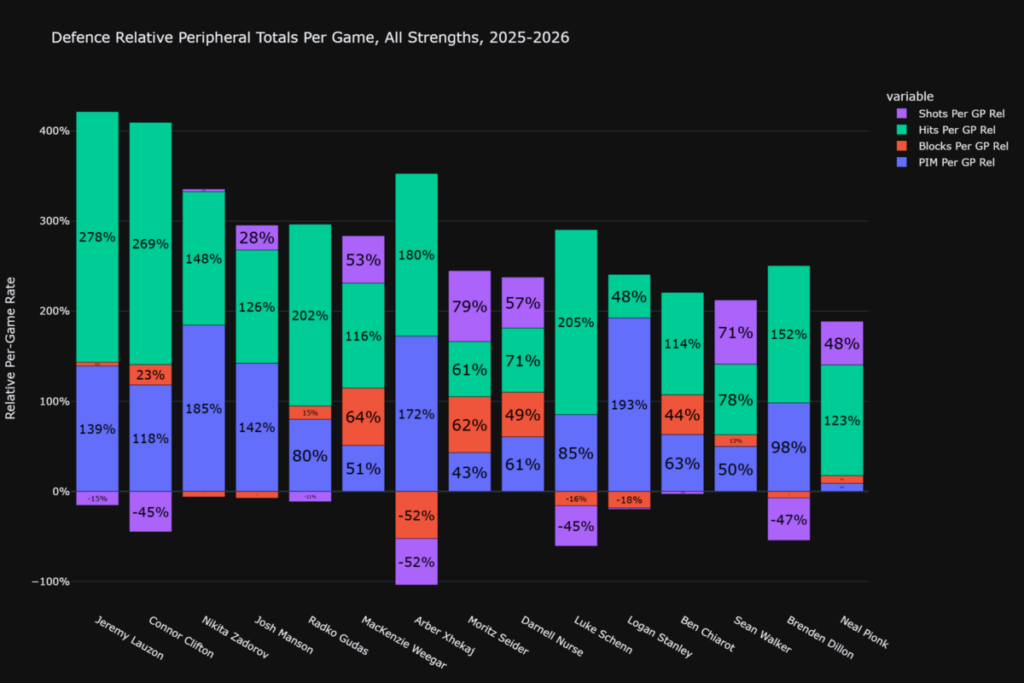
As we saw with the forwards, a huge chunk of peripheral value from the top defencemen come from their hit totals. When we reviewed how peripheral totals have changed at that position over the last five seasons, totals that we would consider outliers back in 2023-24 were basically anything around (or over) 185 hits. In 2025-26, that total was around (or over) 143 hits. With the huge decline in hit totals we’ve seen in recent seasons, defencemen who can still provide high hit totals on a per-game basis become much more valuable.
The additional importance placed on hit volume is why the two highest per-game peripheral producers, Jeremy Lauzon and Connor Clifton, also have the highest percentage of hits per game relative to the league average in that chart; Lauzon put up 3.7 hits per game and Clifton managed 3.6. In a season where the league average rate of hits per game fell under 1.0, those guys putting up that kind of hit volume is a massive edge – they just need to stay in the lineup as Lauzon played 68 games and Clifton just 50.
19. Let’s focus on some individual blue liners from the graph above:
Nikita Zadorov (Boston Bruins)
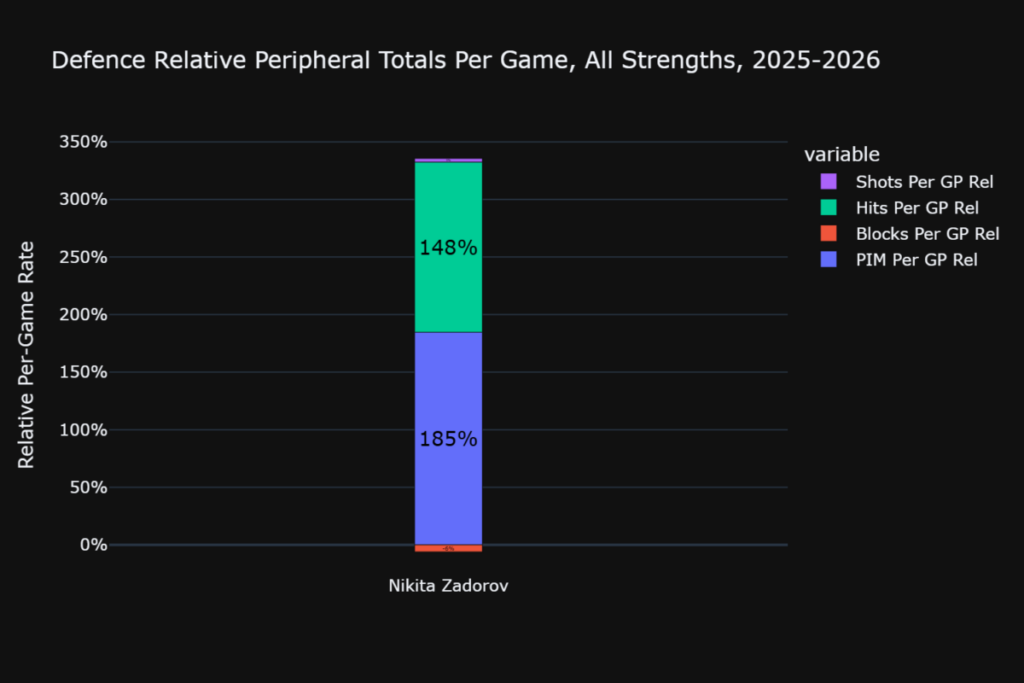
One of the more physical players in the league, Zadorov’s last three seasons have seen him average 146 PIMs (including 10-minute misconducts) and 205 hits per 82 games. Considering the league averages for defencemen in that span are 93 hits and 43 PIMs per 82 games, he is a monster performer in those two categories, specifically.
There is also a lot of consistency to his game as he’s managed between 2.3-2.7 hits and 1.6-1.9 PIMs per game in each of the last three campaigns, so he’s not putting up a monster number and then incurring a big decline as we saw with a couple of the forwards. That kind of safety net is not something we encounter very much in fantasy hockey. Being consistent, while adding over 20 points,100 shots, and 100 blocks a season, makes him one of the more impactful multi-cat fantasy defencemen in the league.
[Follow the link for more…] (june2)
20. For the last few weeks, we’ve been reviewing peripheral contributions across the league, focusing on shots, hits, blocks, and penalty minutes. The last couple of Ramblings alone have covered the top peripheral performers among forwards and then among defencemen. Today, let’s start looking at the entire picture and compare the fantasy performances of some players in 2025-26 to fantasy performances from recent history.
This is how we’re going about it:
- All forwards, regardless of centre/winger designation, are listed as forwards. Once fantasy sites update their player positions this summer, we’ll adjust by centre/winger, but for now, they’re all forwards. All defencemen are listed as defencemen, regardless of handedness.
- We are evaluating things on a per-game basis but limiting our sample to players with at least 41 games played in a season.
- We find each player’s initial fantasy value by comparing each of their stats to the relevant league average at their position, then adding all those individual fantasy value totals together.
- We determine what a ‘replacement level’ player is for each season. To do this, we assume 14-team leagues with 10 forwards per team and 3-4 forwards on the bench, and five defencemen per team with one on the bench. That gives us ~187 forwards and ~84 defencemen.
- We take the group of forwards around the 187th position and the group of defencemen around the 84th position from each season, then evaluate the average fantasy value of each stat for only those borderline players. That gives us our replacement-level value for each stat.
- Finally, we compare each player’s production in each stat to the relevant replacement level. Replacement value will vary depending on league size and players on injured reserve.
- The stats are goals, assists, shots, hits, blocks, PIMs, power-play points, and face-off wins.
To summarize, the charts below give us an idea of the value each player brought in each of the eight fantasy stats, for each of the last five seasons, compared to the replacement-level options at their position.
For most stats, being anywhere from +2 to +3 in relative value is great. Power-play points are different because most players don’t accumulate much, especially among defencemen, but for the rest of the stats, anything in that range is at the top end for that season, and anything above +3 is super-elite.
Most of the data is from Evolving Hockey but some of it is from Natural Stat Trick. For today, we’re reviewing only forwards
Macklin Celebrini (2025-26) and Nathan MacKinnon (2021-22)
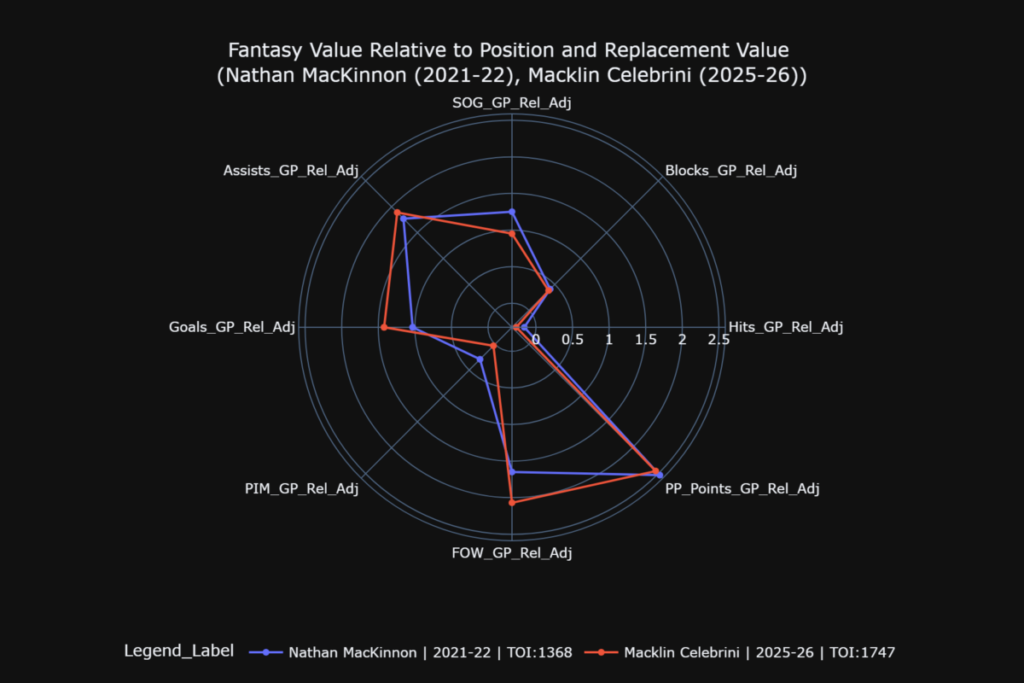
In 2021-22, MacKinnon played just 65 games but remember that the comparative fantasy values are on a per game basis, not per minute or per season. The 2021-22 campaign was the season the Colorado Avalanche won the Stanley Cup, and a season where MacKinnon averaged 1.35 points and 4.6 shots per game. That was a different offensive environment than the 2025-26 season we just finished (particularly for shots on goal), but seeing what MacKinnon did then as a 26-year-old, and what Celebrini just did as a 19-year-old, should help put into context just how high Celebrini’s upside really is.
It will be fascinating to see how fantasy managers evaluate Celebrini for 2026-27. It is hard to imagine anyone but MacKinnon and Connor McDavid as the consensus top-2 players off the draft board, but is Celebrini third? There may be an argument for Nikita Kucherov because he’s a winger and the other three are centres, so in leagues without face-off wins, Kucherov might have an argument in relative value because of his position. In leagues with face-off wins, it would be hard to argue with someone who has Celebrini third overall given what he just did and the fact he doesn’t turn 20 years old until later this month.
MacKinnon followed up 2021-22 by improving his goals per game (+20%), assists per game (+13%), shots per game (+12%), power-play points per game (+13%), and face-off wins per game (+24%). He was an older player on a better team, but can Celebrini come close to those kinds of improvements in his third season? Let’s see what the San Jose Sharks do with their roster this summer, but the sky is truly the limit for the young superstar.
[Follow the link for more…] (june4)
21. In yesterday’s Ramblings, we compared the 2025-26 fantasy seasons of a handful of forwards to other forwards from recent seasons. We used goals, assists, power-play points, shots, hits, blocks, penalty minutes, and face-off wins for our eight categories. We found the average per game “replacement level” values for each of those eight stats in each season, compared the performance of individual forwards in that season to the replacement-level value, and then saw who had similar performances. Some of them are quite surprising.
Today, we’re going to do the same thing, but for defencemen. Which of the top fantasy defencemen from 2025-26 performed similarly to another player from the prior four years? Let’s dig in.
These evaluations will remove face-off wins because we are comparing only among defencemen. If we were to compare across different positions, the values would change because of monster advantage forwards have in the face-off dot.
We are limiting the sample to players who played at least 41 games in the season selected. Remember that this is all on a per-game basis, so if two players have similar overall fantasy value on that per-game basis, but one appeared in 80 games and the other in 50, the 80-game blue liner will have far superior overall value despite the similar per-game value.
Data from Evolving Hockey and Natural Stat Trick.
Quinn Hughes (2024-25) and Darren Raddysh (2025-26)
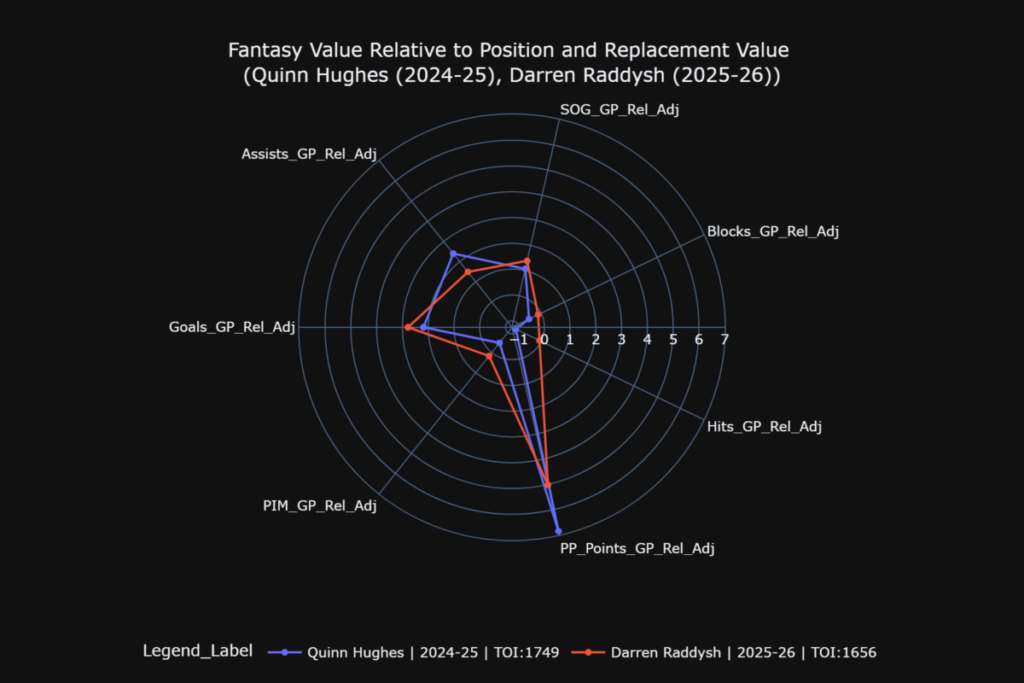
The 2024-25 campaign was the year Hughes really solidified himself as an elite fantasy defenceman regardless of format. He had 17 goals, 92 points, and 199 shots in 82 games the year before, but those were massive jumps compared to what he usually offered, and it was a wonder if it was a career-year blip or the start of a trend. He followed that performance with 16 goals, 76 points, and 192 shots in 68 games, which gave him the track record of being able to do more than just rack up assists and PP points. That came back down in 2025-26, but we would do well to remind ourselves that his 82-game averages across the 2023-2025 seasons were 18 goals and 214 shots.
That brings us to Raddysh who, considering his pre-season draft position, was the most valuable fantasy skater in basically any format. We might be wary of Raddysh making such a big leap because a lot of that jump was due to increased opportunity: Victor Hedman missed over half the season and was largely ineffective otherwise; Ryan McDonagh, Erik Cernak, and Emil Lilleberg combined to miss 87 games. That led to Raddysh earning way bigger minutes, including top PP time. With that said, his points per 60 minutes at 5-on-5 was 1.56, only a slight increase from the year before (1.49). The added minutes (PP or otherwise) made his raw numbers skyrocket, but his 5-on-5 production, on a per-minute basis, was pretty much the same as the year before.
That is why we should have belief in Raddysh, provided he re-signs with the Lightning. This makes two years in a row of a top-10 points rate at 5-on-5 – it’s just a matter of getting ice time and a top PP role. To alleviate concerns about his role: in the 20 games immediately after the Olympic break, with both Cernak and McDonagh in the lineup, Raddysh still skated 23:37 per game, or 3:27 more than the next-closest Tampa Bay blue liner.
[Follow the link for more…] (june5)
—
Have a good week, folks!
Thanks for continuing to support the website and if you’re bored and need a fantasy hockey fix – visit the gang in the forum here.
Related Posts

Starting Goalies













Top Skater Views
 BUF
 N.J
 L.A
 DET
Top Goalie Profile Views
| Players | Team | |
|---|---|---|
| DYLAN GARAND |
 NYR | |
| JOSEPH WOLL |
 PHI | |
| YAROSLAV ASKAROV |
 S.J | |
| SEBASTIAN COSSA |
 UTA | |
| CARTER HART |
 VGK | |
LINE COMBOS
| Frequency |
 MIN Players | |
|---|---|---|
| 36.1 | KIRILL KAPRIZOV JOEL ERIKSSON EK MATT BOLDY | |
| 26.8 | DANILA YUROV YAKOV TRENIN MAXIM SHABANOV | |
| 23.4 | RYAN HARTMAN BLAKE COLEMAN BOBBY BRINK | |
DobberHockey Podcasts

Keeping Karlsson: Never Tell Me the Podz
Elan and Brian do a wellness check on the Maple Leafs, lament Chicago and Buffalo snoozers, wonder whether and which Flyers have figured it out, and pick out the Capital standing out from the crowd.

Fantasy Hockey Life: Ep 505 Prospects With Plenty to Prove Part 1
Victor and Jesse return to talk about prospects with plenty to prove. This week it’s: Tij Iginla, Berkly Catton, Konsta Helenius, Zayne Parekh, Igor Chernyshov, Jett Luchanko, Axel Sandin-Pellikka, Artyom Levshunov, Michael Hage, and Carter Bear. Have a listen! Our show is part of the Dobber Podcast Network and sponsored by Fantrax.com. Email [email protected] and […]
Keeping Karlsson: Matchup Maximizer 2026/27 Week 4
Elan takes a look at the schedule for the upcoming weeks of NHL action and recommends players with good schedules that you should consider streaming in to win your head to head matchups.
Keeping Karlsson: Short Shifts – NHL Frozen Frenzy Recap
Elan and Lewis recap the Frozen Frenzy as well as two big returns and more!
Keeping Karlsson: Delusions of Garandeur
Elan and Brian dive into the latest NHL hot streaks, cold streaks, line changes, outjuries, injuries, buy-lows and sell-highs to give you top notch tips in your fantasy hockey league