

21 Fantasy Hockey Rambles
Dobber Sports
2026-10-04
Every Sunday, we share 21 Fantasy Rambles from our writers at DobberHockey. These thoughts are curated from the past week’s 'Daily Ramblings'.
Writers/Editors: Ian Gooding, Michael Clifford, Alexander MacLean, Puneet Sharma, and Dobber
___
DobberHockey’s 2026-27 Fantasy Hockey Guide is available in the Dobber Shop! Team-by-team overviews updated through to the start of the regular season to reflect injuries, trades, or other pertinent information.
The French version, le Guide des Poolers, is also available. You can pre-order it here.
___
1. The fun thing about fantasy hockey, or any fantasy sport, is that it can humble you very quickly. Case in point: last week, I had a Ramblings where I discussed defencemen and goalies I had yet to draft and probably wouldn’t draft before the season started. One of them was Edmonton Oilers blue liner Evan Bouchard. It wasn’t that I was terribly low on him – he was sixth in my rankings – but that was low enough to ensure I wouldn’t get to draft him.
Then, in Edmonton’s season opener, Bouchard goes out and scores the first opening-night hat trick for a defenceman in nearly 50 years, adds a pair of assists, totals six shots and three blocks, and is already a week-winning blue liner for anyone in head-to-head leagues. Egg, meet face. Sometimes, it can be like that. (oct1)
2. Regular-season fantasy hockey is back! It’s great to be able to break down meaningful games and the implications for fantasy leagues, so let’s discuss a few players that made noise a few days into the regular season and what that could mean going forward.
In just two games entering Saturday action – both against his former team, the Vancouver Canucks – Podkolzin has racked up three goals, one assist, three power-play points, 11 shots, and seven hits. As a result of his recent success, Podkolzin has shot up to being rostered in over half of Yahoo leagues. Over those two games, Leon Draisaitl has consistently been his even-strength linemate, while he has also skated with Connor McDavid at times. As a result of injuries to both Zach Hyman and Ryan Nugent-Hopkins, Podkolzin is also getting reps on the top power play.
Podkolzin will no doubt cool down scoring-wise, and he will probably find himself on one of the Oilers’ less appealing lines at some point. At the very least, Podkolzin should provide modest scoring while generating multiple hits per game. That makes him rosterable in bangers leagues regardless of the situation. (oct3)
One observation that I’ve made in the 2026-27 season is that Pettersson seems to be smiling more. A lot more. This may not seem like the hard-hitting number crunching that you came here for, but Pettersson hasn’t appeared to enjoy the game of hockey for the past couple of seasons.
Perhaps because the Canucks have nothing to lose this season, Pettersson may not feel as much pressure. That has shown in his numbers so far, as he contributed two goals and two assists in the two-game goalfest between the Canucks and Oilers on Thursday. Also notable is the fact that Pettersson had eight hits in that game, as this is a category that he is usually average at best. I’m not forecasting a return to 100 points, but a return to 60-70 points seems to be within reach and would result in less hand-wringing about Pettersson. (oct3)
4. Luca Cagnoni
In my deepest league, I added Cagnoni three years ago as a late pick in the entry draft. He seemed like the perfect all-or-nothing swing-for-the-fences pick that should be made late in a fantasy draft. Cagnoni was a fourth-round pick of the Sharks who could score at a point per game at the WHL level, but there were question marks about his defense.
Fast forward to today, and those question marks may still exist to some degree (The Journey). However, Cagnoni is manning the point on an up-and-coming Sharks’ top power play. In his season debut against Florida on Thursday, Cagnoni scored a goal while adding a power-play assist in 21 minutes of icetime. He may have the higher-pedigreed Sam Dickinson looking over his shoulder, but for now Cagnoni is a must-add for teams looking to improve scoring on the blueline. If the scoring dries up and/or defensive woes become apparent, then he may lose appeal in single-season leagues. (oct3)
5. Some injury notes:
The New York Islanders gave Mathew Barzal an ‘injured non-roster’ designation on Monday, per Andrew Gross. He currently has a knee injury and remember that he had knee surgery in February of 2025. His designation means he did not pass his physical at training camp, so this is clearly a lingering knee issue, which is worrisome. He is eligible to return to the lineup whenever he’s medically cleared, but when that will be is still up in the air. (sept29)
Best wishes to Brock Faber who is nursing a fractured skull. He had a procedure done on it after sustaining the injury during Friday’s preseason game, and he has an unknown recovery timeline – per Michael Russo of The Athletic. (sept30)
Dallas Stars forward Matt Duchene had suffered a lower-body injury during training camp and it was exacerbated later in camp. With that in mind, we got news that he was put on long-term injured reserve on Thursday with a back date to Tuesday. That means the earliest he can return is October 25th, so he’s looking at missing at least the first month of the season. Not a great start for someone who missed 35 games last year.
The Columbus Blue Jackets announced that defenceman Ivan Provorov is week-to-week. Add Provorov to a list with fellow blue liners Damon Severson and Dante Fabbro, both of whom are also week-to-week. For the time being, the Jackets are without half their blue line, so expect a ton of minutes for Zach Werenski. It also led to Denton Mateychuk getting top-pair minutes on Thursday night, so he stands to benefit a lot here, too.
Some news on St. Louis Blues defenceman Logan Mailloux:
@MDeFranks: Blues GM Alexander Steen said Logan Mailloux had a hand procedure yesterday and will be re-evaluated in eight weeks.
That timeline would put his return sometime after American Thanksgiving. He was the only real threat to Philip Broberg getting top power-play time – Cam Fowler could slide in but that would mean things have gone horrifically wrong – so it’s bad news for Mailloux and the Blues but good news for Broberg backers.
6. Still with injuries, Pittsburgh Penguins forward Ben Kindel is skating in a non-contact jersey, a good step forward in his injury recovery. There was even more good news on Thursday:
@OtherNHLCrosby: Ben Kindel is practicing in a regular yellow jersey. Has been considered week-to-week with a lower-body injury.
The team didn’t offer a firm timeline of when he’ll return, but if he went from non-contact to contact in 24 hours, it seems his recovery is coming along nicely. (oct2)
With Kindel and Bryan Rust injured, and Andrei Kuzmenko away from the team for family matters, the Penguins opened the season in Philadelphia on Wednesday to face a full-strength Flyers team. And the Penguins absolutely brutalized them.
Offseason addition Nick Robertson opened the scoring less than 7:30 into the game and the Penguins piled on six more goals to take a 7-0 win against the Flyers. Robertson would add a second goal (short-handed) in the third period, totaling four shots, two PIMs, and a block. It was Robertson’s first two-goal game since April of 2025, and not a bad way to endear himself to a new fanbase. (oct1)
7. Some signings:
The Anaheim Ducks extended defenceman Tristan Luneau for six years with an AAV of $7.2M per season. That isn’t a typo: a defenceman with a grand total of 14 NHL games played by the age of 22 just got a $43.2M contract. Do with that information what you will. (oct2)
Fresh off signing the extension, Luneau logged 26:58 in icetime while registering an assist and five blocked shots. Although Luneau has now appeared in just 15 NHL games (including Friday), the Ducks have high hopes for the 22-year-old Luneau and are granting him the icetime to back up the contract. Luneau was paired with Jackson LaCombe, who led all skaters on Friday with 29:37 in icetime. Luneau has registered enough points over his past two seasons in the AHL (93 points in 129 games) to receive consideration in fantasy leagues. (oct3)
The Buffalo Sabres announced a four-year extension for rearguard Louis Crevier. The Very Large Human made his Sabres debut on Thursday night but it seems the team already liked what they have in him as he’s now going to figure into the Stanley Cup contending plans through the end of the decade. (oct2)
The Dallas Stars announced they’ve extended goalie Casey DeSmith for two years at $2.5-Million per season. That puts him under contract for the next three seasons, carrying him to his age-38 season. For a guy who never reached the NHL until he was 26 years old and had fewer than 60 career starts by the time he turned 30 years old, he will have gotten a decade in the league. An interesting trajectory.
The Stars don’t really have any high-rated goalie prospects banging down the door – Arno Tiefensee split time between the AHL and ECHL last year – so this buys the team a few years to figure out their goaltending depth past Jake Oettinger.
8. Remember last year when the New York Rangers struggled for weeks to score at home? On Thursday, goaltender Igor Shesterkin decided to do his part early in the 2026-27 campaign and scored the first (probably only) goalie goal of the season, Shesterkin also stopped 24 of 25 shots for his first win of the year to go with his goal. I guess that’s a pretty good multi-cat night of his own? (oct2)
On a related note, it was a surprise that Dylan Garand cleared waivers before the season, but an injury to Joonas Korpisalo resulted in Garand being recalled from the AHL shortly after. Garand showcased that talent on Friday, stopping all 22 shots he faced in the New York Rangers’ 2-0 win in Detroit – his fourth career NHL game. The shutout was the first of Garand’s NHL career. Garand, who was an exceptional goalie for the Kamloops Blazers of the WHL, has spent the past three seasons in the AHL and appears ready to be at least an NHL backup. He appeared in the second game of back-to-backs for the Rangers and may be held to little more than that with Shesterkin as the starter. (oct3)
9. The Columbus Blue Jackets completed a massive trade on the eve of the NHL regular season by sending winger Kirill Marchenko, winger Miles Wood, and goalie Elvis Merzlikins to the Toronto Maple Leafs for winger Matthew Knies, winger Steven Lorentz, defenceman Emil Andrae, and a second-round pick in 2027. Marchenko was then extended by the Leafs for six years at $12.5-Million per season. Marchenko was in the last year of his current deal, so this puts him under contract with Toronto for seven years. Puneet posted a take on the trade yesterday and that can be read here.
What is notable about the difference between Marchenko and Knies is that tracking data from All Three Zones shows Marchenko being much better on zone transition (exits and entries) over the last couple years than Knies. Knies is younger – he turns 24 years old in a few weeks – but Marchenko’s transition work fits in with a lot of the changes the Leafs have made to the team this summer: Jack Roslovic is about league average while both Darren Raddysh and Nick Blankenburg are good-to-great in various transition measures. These changes seem to be in service of getting the Leafs to play faster. Regardless, Marchenko being on Auston Matthews‘ wing and on Toronto’s new top PP unit seems like a big upgrade for him. (sept29)
10. On Thursday, Knies had a dream debut with two goals (one PP), an assist, and four shots as Columbus downed the Buffalo Sabres 6-3. Adam Fantilli also scored once on two shots, adding six hits, while Kent Johnson managed an assist, a shot, and a pair of PIMs. All in all, a pretty good night for the Jackets’ new top line. (oct2)
Meanwhile, two days earlier on Tuesday, the newly acquired Marchenko made his Leafs debut and did look sharp, but couldn’t bury his best scoring chance off a nice feed from Jack Roslovic. Roslovic was sharp as the third member of the top line centered by Auston Matthews. It could be a productive slot for him, and his fantasy outlook likely jumps a little as a result of the Marchenko/Matthew Knies swap. (sept30)
11. Some rookie debuts:
James Hagens, the seventh overall pick in last year’s draft, scored his first NHL goal on Friday. Hagens was playing in his fourth NHL game, logging 12:52 in this game. (oct3)
Hagens should get LW designation in Yahoo in short order, if that’s something that would be of use to those of you who have him on the bubble of your roster for this year (obviously hold him in keeper leagues). His debut earlier in the week was fairly unremarkable, notching only one SOG and two Blks, playing on the left side of the third line. (sept30)
Viggo Bjorck made his NHL debut in that Friday game against the Bruins, logging 14:45 in icetime while playing on a line with Gabriel Vilardi and Isak Rosen. (oct3)
Adam Jiricek, the 16th overall pick in 2024, also made his NHL debut for the Blues on Friday. Jiricek scored a power-play goal that was overturned after an offside challenge, so he was held without a point in 16:35 of icetime. Of note is the fact that Jiricek received more power-play time (2:33) than Philip Broberg (0:51) in this game, with Cam Fowler (5:00) on the top power play. Something to watch if you drafted Broberg. (oct3)
In a bit of a surprise, Alberts Smits made the opening night lineup for the Rangers. He is in a rotation with seven others, so he may not play every day, at least at the beginning. However, the names at the bottom of the depth chart are expendable, so Smits could easily become a fixture for the Rangers. His opening day debut was fairly unremarkable, picking up two Hits in third pairing minutes, while finishing a little below even in the shot-share column. (sept30)
Roman Kantserov made his NHL debut as a top-line center against Vegas on Tuesday. He went minus-one with a SOG and three Hits, while winning one-third of his 15 faceoffs. (sept30)
For the Golden Knights, Trevor Connelly was also making his debut, and scored his first career goal. He’s going to have lots of opportunities to score if he keeps it simple and gets to the net. (sept30)
12. Nikita Klepov and Roger McQueen have both made the Ducks’ opening night roster. After the Leo Carlsson and Cutter Gauthier contracts (and to a lesser extent Pavel Mintykov) used up all of the available cap space, the Ducks weren’t able to fill their depth out like they might have been planning at the beginning of the offseason. Makes you wonder how soon they regretted the $4.25 Million per season price tag on A.J. Greer. Klepov and McQueen earned their spots through a solid training camp, though there might not have been spots to earn if the roster and cap planning was better executed. One or both could end up being fantasy relevant this year, and maybe the more likely one is Klepov who could slide up to the top line, which is where he spent a lot of time in training camp. (sept30)
13. T.J. Hughes is one of the big surprises from training camp, coming into it with the Avs and not being a likely bet to make the team, and then finishing camp on the top power play. Lots of short-term upside there. (sept30)
14. We have an annual tradition here at Dobber Hockey that all the editors, writers, and Dobber himself send in their predictions for the upcoming season. Predictions include award winners, players to disappoint/rebound, division winners, and Stanley Cup champion. To get all our thoughts on the 2026-27 campaign, go check it out here.
If you need more projections, you can still get the Fantasy Guide, updated with the latest trades, cuts, and need-to-know info to manage those first FA adds and trade inquiries for the new season. (sept30)
15. Tough times in Detroit. Without Dylan Larkin, the Wings are extremely thin at center. To give you an idea, Andrew Copp is centering the top line with Alex DeBrincat and Lucas Raymond. Copp, who logged 22:17 in total icetime on Friday, is also on the top power play because the Wings need a center there. He might be worth a waiver-wire pickup, but Detroit may have trouble scoring if Friday is any indication. That’s not good news if you drafted DeBrincat or Raymond. (oct3)
16. Having completed all four of my drafts (two partial keepers and two full re-drafts), I was not expecting that the most common player that I drafted this year to be Trevor Zegras – selected in all four leagues. He always seemed to be a draft value where I got him, and I’m realizing that I am treating him as a point per game player entering the year where many others are expecting only 65 points or so out of him. Two of my leagues count FOWs as well, where he gets a huge bonus with his wing eligibility. (sept30)
17. Now that the fantasy draft season is over (or nearly over), I want to get to some of my final rankings. I avoid doing this earlier because the Dobber Fantasy Guide has its own rankings and projections, so giving mine away for free doesn’t make sense. But I said I would post my own rankings, so I will.
As I’ve been using in recent Ramblings discussing my projections, the evaluation method is called ‘Z-Score’, which measures how far above (or below) a player is from a replacement-level option at their position. That gives each player a specific value for a specific fantasy category within the context of being a forward/defenceman/goalie, then we add the values together for one overall number. The fantasy stats used are goals, assists, shots, blocks, hits, and power-play points.
Data for projections come from Natural Stat Trick, Evolving Hockey, All Three Zones, and Frozen Tools. Every player is projected for 84 games, even if we know guys like Connor Bedard and Seth Jarvis are starting the season injured. When I did my own drafts, I adjusted their GP for their anticipated absence, but for season-long evaluations, I leave it at 84 games.
Groups of players are assembled into tiers, and for the sake of brevity, I will only discuss my first 9 tiers of players which comprises the top 101 fantasy values.
Tier 1

We have Nathan MacKinnon and Zach Werenski in my top tier. The forward won’t surprise anyone, but I imagine not many people have Werenski at their top of the board for blue liners. My projections have Werenski second in points among defencemen (behind Quinn Hughes), projected for a couple more goals and assists than Cale Makar. With a huge edge in shots on goal, Werenski moves to the first defenceman overall. Last year, Werenski finished fourth by fantasy value at his position using this format in 75 games played. Maybe he doesn’t finish as the top blue liner, but a healthy season makes him a near-lock for finishing top 5 at the position.
18. Tier 2
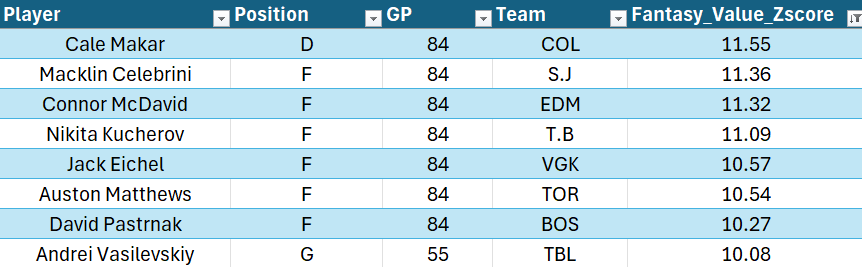
This next tier rounds out our top-10 with top forwards being sandwiched by Makar and Andrei Vasilevskiy.
The one player that might stand out is Jack Eichel. His Fantrax ADP is somewhere in the 15-20 range while Yahoo has him 20-25. A big reason for my bullishness is that part of my projection modelling includes regressing shooting percentage for high-volume shooters, and those guys average 13-14%. My projections have Eichel at 13.8% shooting, but his best conversion season with Vegas was 12.1% in 2022-23. If the rest of his projections remain the same, but he shoots 11% instead of 13.8%, he drops out of the top 10. There is also the fact that he hasn’t played 80 games in a season since his rookie year, so there’s plenty of risk labeling him a top-10 option.
Tier 3
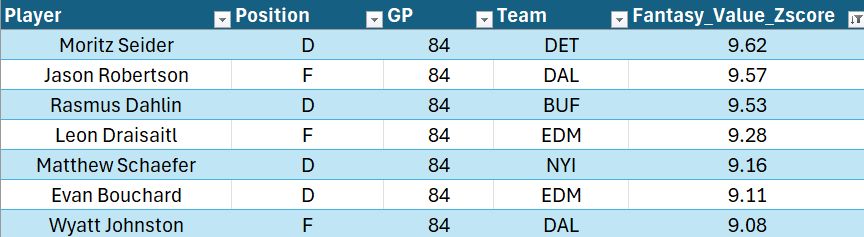
This tier is when it becomes obvious that the way fantasy drafts unfold and the way these rankings work is not the same. Defencemen become highly valued when evaluating by position scarcity because the elite fantasy blue liners offer so much compared not only to replacement-level value, but even a top-25 option. There are 17 players in my first three tiers and six of them are defencemen, and in 99% of fantasy drafts, you would not see six defencemen taken among the top 17 picks, but that doesn’t mean they don’t bring immense value to a fantasy roster.
19. Tier 4

The reason there are only three players in this tier is that the gap between Matt Boldy and the player above him (Wyatt Johnston) is just under 4% of fantasy value, and the gap between Nick Suzuki and the player below him (Juraj Slafkovsky) is just over 4% of fantasy value. When discussing the top fantasy options, 4% of fantasy value is a lot, so these three are truly in a tier of their own.
Quinn Hughes is my seventh defenceman and there’s no chance he’s being drafted outside the first five blue liners. I would point out that in this format last season, Hughes finished 10th overall. That was with just 74 games played, but even if we pro-rate to 80 games, he finishes fourth. In a points-only format, there’s a good argument that Hughes should be the first defenceman selected. In a multi-cat format like this, his drag on hits and blocks really hurts his value.
Tier 5
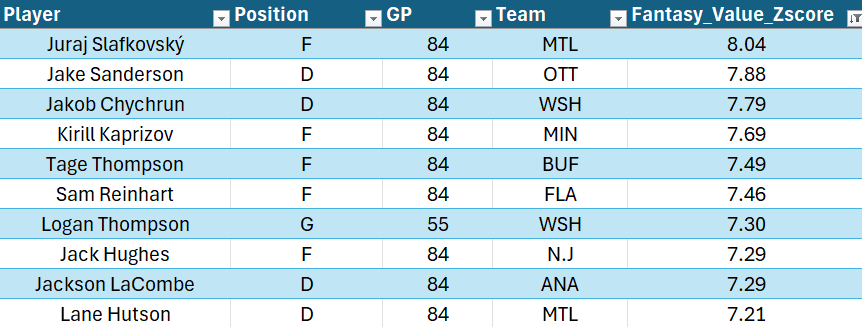
Kirill Kaprizov is the name that stands out, but the concern is he contributes so few hits and blocks that he’s substantially negative value in both categories. If he were just average in those areas, he would be my 13th overall player, and if we were to assume only one defenceman and no goalie were taken in the first round, he rises to 10th, which is more in line with his ADP. It is also a reminder that fantasy rosters are a jigsaw puzzle; if I think I can get the hits and blocks I need later in a draft, then Kaprizov’s negatives are somewhat nullified. But he does put you in a hole to start with.
As with Hughes, it’s worth noting that last season in 78 games played, using this format, Kaprizov was the 30th overall skater and 15th overall forward.
20. Tier 6
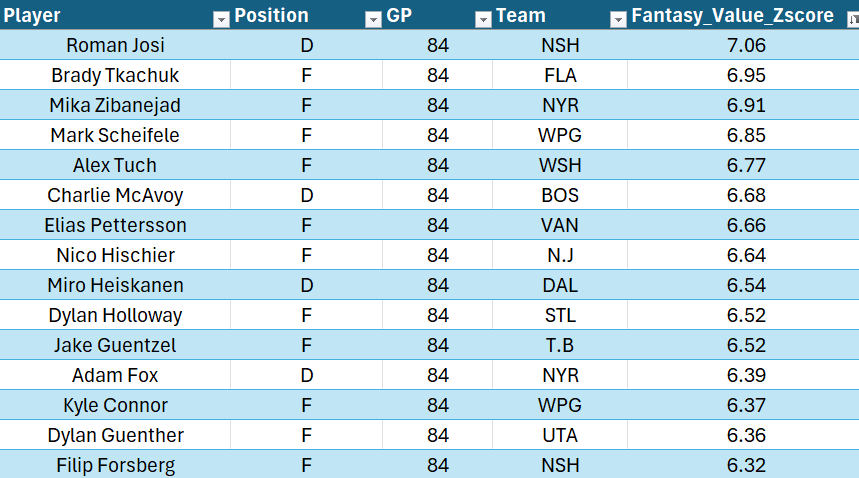
To be honest, my projections for Mika Zibanejad make me nervous. Last season was a big bounce-back year for him, and he had 34 goals and 78 points; my projections have him with 35 goals and 88 points. Projecting a 33-year-old player to have his best season in four years is why I’m nervous, but my modelling believes that the New York Rangers’ blue line has been substantially improved offensively to a point where they are a difference-maker. The nice thing about Zibanejad rating this highly is that he is almost never a top-50 pick in fantasy drafts, so there’s some safety built into having him projected where he is.
There is also a huge multi-cat season predicted for Dylan Holloway with 30 goals, 73 points, 215 shots, 58 blocks, and 190 hits. It makes him a top-40 value.
Tier 7
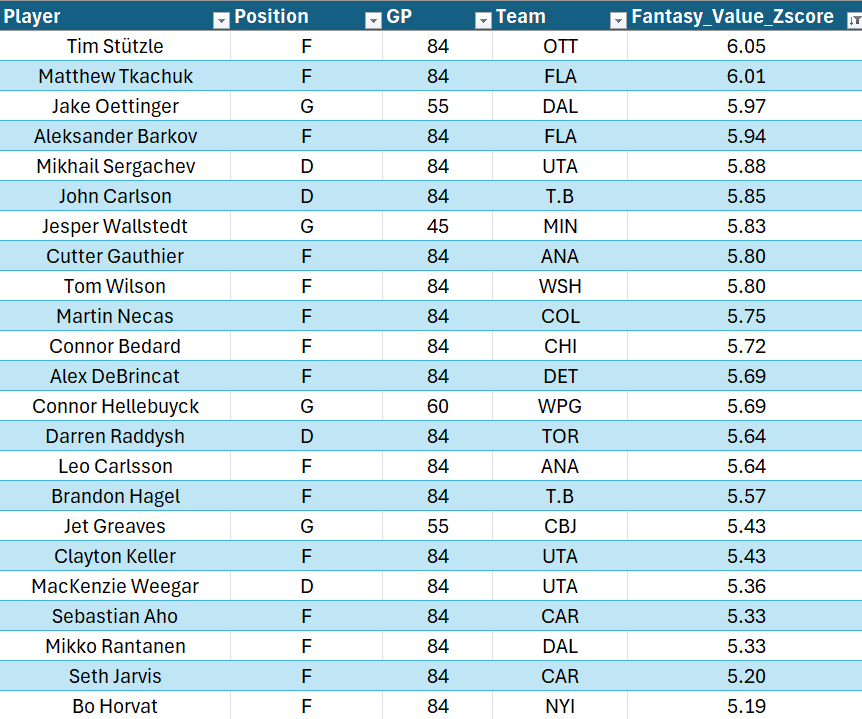
Here we have our biggest chunk of players, all separated by just 17% of fantasy value.
Matthew Tkachuk being ranked here is the name that will stand out. My projections have him for 34 goals, 86 points, and a shade over 3.0 shots per game. That is a great production season. However, I do wonder if people realize Tkachuk has a grand total of 19 blocks in 83 games over the last two seasons. A replacement-level fantasy forward posts over double that total in an 84-game season. If Tkachuk could be just average in blocked shots, he goes from a top-50 fantasy player to a top-25 fantasy player – that is how much he hurts fantasy managers in that category.
21. Tier 8
Cole Caufield will be the one that surprises people, and it’s understandable given his 50-goal season. Last week, I wrote about why I wasn’t drafting him, so go read that for a bit more context.
The other name is William Nylander, but he falls into the same bucket we’ve seen from other forwards: he is such a huge drag on hits and blocks – he’s averaged 44.7 combined hits and blocks per 82 games over the last two years – that it crushes his overall fantasy value. Being average in those areas takes him from 81st overall on my board to 41st overall on my board, and much closer, or even right in line, with his ADPs. As with Kaprizov, if I think I can get my blocks/hits in other areas to make up for Nylander’s shortcomings, then that negates his lack of peripherals, but he will be a massive drag in one-third of the fantasy categories we’re using and that’s a problem.
Tier 9
Our final tier is loaded with players similar to Kaprizov and Nylander, but who aren’t quite as productive in the other four categories: Jesper Bratt, Lucas Raymond, Robert Thomas, Brayden Point, and Artemi Panarin are all ranked somewhere between 85-101. If any of them can have a surprise year and give us some hits or blocks (or both) that we weren’t expecting, it drastically changes their fantasy outlook.
Also take note of Anton Frondell here. I have mentioned it during this fantasy draft season, but I am rarely anywhere near as high on rookies as most people seem to be (in redraft leagues), and it keeps me from almost ever drafting them. Frondell is an exception, as he falls just inside my top 100 fantasy values. Whether he lives up to it, we’ll find out in the next 6.5 months, but this is an extreme rarity for me so it’s worth mentioning.
Have a good week, folks!
Thanks for continuing to support the website and if you’re bored and need a fantasy hockey fix – visit the gang in the forum here.
Related Posts
Starting Goalies













Top Skater Views
| Players | Team | |
|---|---|---|
| TRISTAN LUNEAU |
 ANA ANA | |
| LUCA CAGNONI |
 S.J S.J | |
| ADAM JIRICEK |
 STL STL | |
| MARCO ROSSI |
 VAN VAN | |
| IGOR CHERNYSHOV |
S.J
| |
Top Goalie Profile Views
| Players | Team | |
|---|---|---|
| JOEL HOFER |
STL | |
| NICO DAWS |
 N.J N.J | |
| DYLAN GARAND |
 NYR NYR | |
| ARTURS SILOVS |
 PIT PIT | |
| SERGEI MURASHOV |
PIT
| |
LINE COMBOS
| Frequency |
 MIN Players MIN Players
| |
|---|---|---|
| 21.1 | MICHAEL MCCARRON NICK FOLIGNO MARCUS FOLIGNO | |
| 18.1 | JOEL ERIKSSON EK BLAKE COLEMAN MATT BOLDY | |
| 16.4 | YAKOV TRENIN RYAN HARTMAN BOBBY BRINK | |
DobberHockey Podcasts

Keeping Karlsson: Matchup Maximizer 2026/27 Week 2
Elan takes a look at the schedule for the upcoming weeks of NHL action and recommends players with good schedules that you should consider streaming in to win your head to head matchups.

Fantasy Hockey Life: Tidy Takes Part 1
TiDy Admiral Ryan Downey and Victor Nuno break down recent trades in the FHL Tiered Dynasty’s top division, the Lord Stanley division. Tune in to consider trades between some of the best dynasty sharks we know, including patron polls on the trades and Victor’s analysis. Have a listen! Our show is part of the Dobber […]
Keeping Karlsson: Short Shifts – I Tried to be Like Parker Kelly
Elan is joined by Ryan Downey for the premiere of season 8 of Short Shifts! — KKUPFL late registration is ongoing! We’re still filling new divisions in the world’s greatest fantasy hockey league. Details at https://www.kkupfl.com/. Join the Keeping Karlsson patron community! Patrons get access to all our perks all year round, including KKUPFL […]
Keeping Karlsson: Shabanov Ranks
Elan and Brian fly through the final preseason lines for every NHL team ahead of opening night, and share their guys to watch– or look away from– in your fantasy hockey leagues.
Fantasy Hockey Life: Western Conference Catchup and Mustard
Jesse and Victor are here to Catch Up on everything in the Western Conference that transpired ofter our team previews. We also have our annual spicy mustard competition – two hot takes per team. Our show is part of the Dobber Podcast Network and sponsored by Fantrax.com. Email [email protected] and ask to join our free […]