

21 Fantasy Hockey Rambles
Dobber Sports
2026-03-08
Every Sunday, we share 21 Fantasy Rambles from our writers at DobberHockey. These thoughts are curated from the past week’s 'Daily Ramblings'.
Writers/Editors: Ian Gooding, Michael Clifford, Alexander MacLean, Puneet Sharma, and Dobber
—
1. The trade deadline has now come and gone. You can view trades both big and small on the Trade Deadline Tracker, including links to Fantasy Takes and Forum posts. Cliffy, Alex, and Puneet took care of the Fantasy Takes for you (in particular Cliffy, who worked like a madman). (mar7)
2. Just because I only have so much time and space on this column with other topics to discuss, I’ll focus strictly on only one traded player today: Nazem Kadri. Not only was he quite possibly the biggest name dealt on Friday, but I’m also bringing him up because I received a trade offer last weekend that included the other team’s Kadri. I asked the other team manager if I could wait until the Friday trade deadline to decide, since Kadri might be traded. He then asked me if I would rather take Brad Marchand, which I agreed to do.
I told my league counterpart, who I’ve had many a hockey discussion with through the years, that Kadri’s value could depend on where he lands. At the time, I projected Minnesota to be an ideal landing spot for Kadri, as the Wild had a clear need for a second-line center (and still do). The team that I thought wouldn’t be a good landing spot for him? Colorado. My concern is that Kadri could be buried as the third-line center behind Nathan MacKinnon and Brock Nelson. We’ve seen this scenario occur in the past, where a top scorer on a bad team moves to a contending team, where he is not needed as much.
You may remember Kadri’s best season with the Avalanche in 2021-22, when he piled up 87 points in just 71 games en route to a Stanley Cup. Kadri averaged 19 minutes while also setting a career high in power-play points (29). It’s possible that Kadri is moved back onto the second line (maybe with Nelson), and he could also be back on the Avs’ top power-play – a unit that is in the bottom 5 in terms of efficiency (16.2%). All of that would be ideal for Kadri channeling his previous Colorado experience.
Kadri is also 35 years old, so he could also be on the downside of his career with declining production both this season and last. (I will acknowledge that I picked a 37-year-old player over him, but this trade may only be for the rest of the season based on the league’s rules.) As much as the Kadri trade provides Colorado with outstanding depth at an important position, I’m a bit concerned about the individual value of Kadri, as well as Nelson for that matter.
Anyway, Cliffy is more optimistic about Kadri than I am in his Fantasy Take: Kadri Returns to Colorado; Calgary Loads Up on Picks and a Prospect. (mar7)
3. Perhaps lost on trade deadline day was the fact that a few notable players signed extensions to remain with their current teams.
We’ll start with Jordan Eberle, who signed a two-year extension with a cap hit of $5.5 million. Credit is due to the 35-year-old Eberle, who actually earned a raise on his current $4.75 million cap hit. Of course, the rising cap has something to do with that. However, the Seattle captain is outperforming his scoring pace of last season by reaching 42 points in 59 games this season. Eberle has scored 30 goals just once in his career, which was way back in 2011-12 with Edmonton. With 22 goals this season, he has an outside chance of reaching that 30-goal mark a second time.
4. The Islanders extended Jean-Gabriel Pageau to a three-year contract with a $4.85 million cap hit. The 33-year-old Pageau is on the final year of a contract with a $5 million cap hit. Pageau is producing at a 40-45-point pace just as he was last season and not unlike each season since he came to the Islanders in 2019-20. The faceoff dot is where Pageau is most effective, as he has a career-best 60.1% faceoff win percentage. Among the 21 forwards with more faceoff wins than Pageau (493), none have a better faceoff win percentage.
5. Alex Nedeljkovic signed a two-year extension with a $3 million cap hit to stay in San Jose. In his first season with the Sharks, Nedeljkovic has posted better ratios (2.83 GAA, .899 SV%) than starter Yaroslav Askarov (3.55 GAA, .887 SV%). Fresh off signing the new deal, Nedeljkovic allowed three goals on just 14 shots in the Sharks’ 3-2 overtime loss to St. Louis. (mar7)
6. Because he is in the final year of his contract and because the Panthers will probably miss the playoffs this season, Sergei Bobrovsky‘s name surfaced in trade rumors leading up to the deadline. Not only was he not dealt on Friday, but he also backstopped the Panthers to a 3-1 win over Detroit later that day. Bobrovsky stopped 28 of 29 shots he faced in earning his second consecutive quality start. Bob is now 37 years old, and his minus-15.32 GSAx (goals saved above expected) is among the worst in the league. It might not be a total surprise if the Panthers decide to move on from him during the offseason.
Matthew Tkachuk scored all three Panthers’ goals in that game. That gives him nine points in his last six games, pushing him over the point-per-game mark (17 PTS in 16 GP) for the season. If you were able to stash him on IR for the first half of the season, you are being rewarded for your patience. (mar7)
7. Despite not making his season debut until mid-November, Zach Hyman has been one of the league’s most productive goal scorers. With 27 goals in just 44 games, Hyman is scoring goals at only a slightly slower pace than he was two seasons ago, when he scored 54 goals in 80 games. Like Tkachuk mentioned above, Hyman is a player paying real dividends now after being out of the lineup for an extended period.
Still with the Oilers, I’m avoiding starting Tristan Jarry right now. You should do the same. Jarry has four consecutive really bad starts after allowing five goals in three of those four games and four goals in the other game. In 10 games with the Oilers, Jarry has a dismal .862 SV% and his goals-against average is dangerously close to 4.00. As a team, Edmonton has allowed at least four goals in 10 of its last 12 games. Hey, at least they have really good scoring. (mar7)
8. Chris Kreider is bouncing back in Anaheim. Kreider scored a goal and added three assists in the Ducks’ 6-5 shootout win over Montreal on Friday. The 34-year-old Kreider had a disastrous final season in New York, registering just 30 points in 68 games before being traded to Anaheim in the offseason. Kreider has been making noise recently with 14 points over his last 12 games. I’ve added him in a couple of my leagues within the past month or so to try to take advantage of Anaheim’s off-night-heavy schedule. He has been off and on Anaheim’s top power play all season, but he has been on it recently. (mar7)
9. On Friday, Robert Thomas made a statement on the ice that he is doing just fine in St. Louis. The subject of extensive trade rumors recently, Thomas scored two goals including the overtime winner over San Jose. Thomas hasn’t let the rumors bother him, as he has at least one goal and two points in all three of his games this week. Despite an overall down season, Thomas could be in store for a better final quarter if he can stay healthy.
Once all was said and done on trade deadline day, the Blues managed to keep Thomas, Jordan Kyrou, and Colton Parayko. However, Brayden Schenn and Justin Faulk were both moved. (mar7)
10. Tyler Myers was traded from Vancouver to the Dallas Stars for a second-round pick and a fourth-round pick. He gives the Stars a much-needed right-shot defenceman as the likes of Ilya Lyubushkin and Alex Petrovic are options but not great ones while Nils Lundkvist can’t stay healthy. Expect him to slot on the second pair, but going from a poor offensive team to a good one is a boost to his fantasy profile. It isn’t good news for Lundkvist’s potential upside for the next 1.2 seasons, though. (mar5)
11. The Chicago Blackhawks traded defenceman Connor Murphy to Edmonton for a second-round pick. Murphy can be a fine defensive defenceman who has solid block/hit totals if he gets enough minutes, but his biggest impact might be Jake Walman losing ice time. It isn’t hard to envision a second pair of Murphy and Darnell Nurse with Walman on the third pair with someone like Ty Emberson or Spencer Stastney. We have to wait and see how this shakes out in their first few games, but Walman fantasy owners should have a bit of concern here. (mar3)
12. I wanted to touch on the MacKenzie Weegar trade because he’s a very good player having a very bad season and that makes for interesting discussion points. Weegar was traded late on Wednesday night and Alex broke the trade down at the time. His write-up can be read here.
When it comes to the former Flames blue liner, there are several things that are true at the same time (as is usually the case for any player/team).
To start with, from 2021-2025, he was a genuine #1 defenceman. As some evidence, Evolving Hockey had him as 16th out of 185 defencemen by goal differential-driving per 60 minutes at even strength. He was also 29th by EV time on ice per game. So, he was skating #1 minutes while also driving goal differential as a mid-tier #1 defenceman.
Over at HockeyViz, their Synthetic Goals model (a measure of player impact given a 1200-minute season) had Weegar as a top-pair defenceman for several years and truly elite in 2024-25:
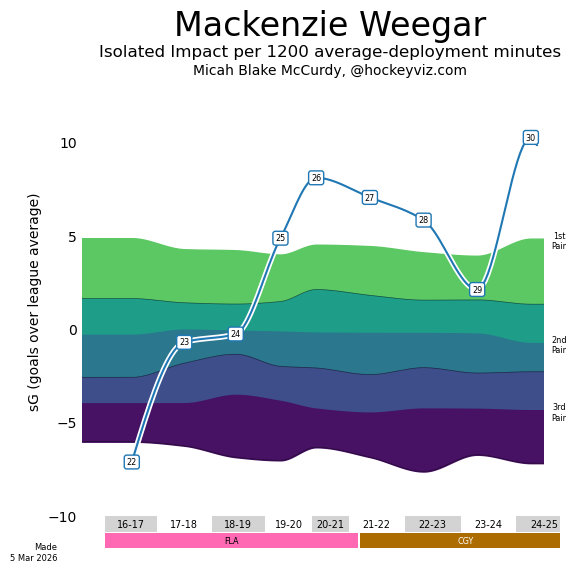
Heavy minutes allowed him to average 10 goals, 34 assists, 191 shots, 168 hits, and 198 hits per 82 games over those four seasons. His per-minute production wasn’t great – outside the top-30 defencemen both at even strength and overall – but three of the four years saw him skate around 23-24 minutes a game. Being able to drive the play and play a lot of minutes made him a reliable producer with monster peripherals. (mar6)
13. The next thing that’s true is that 2025-26 has been a poor season from him. Granted, the Calgary Flames are a bad team, but Weegar’s goal differential-driving has dropped from a mid-tier #1 defenceman to dead last in the NHL (minimum of 500 minutes).
The funny thing is when I looked at his tracking data from All Three Zones, it wasn’t wholly different from last season (which was arguably the best of his career). In fact, some of the data I use that is helpful for fantasy value – scoring chance assists/contributions, zone entries, botched defensive zone retrievals, failed zone exits – are better than last year:
Skaters with declining results will often have declining results in their tracking data (Jonathan Huberdeau and Elias Pettersson are recent examples of this). That isn’t the case with Weegar.
Now we look at the percentages. From 2022-2025, the Flames shot 8% with Weegar on the ice at 5-on-5 and the team had a .911 save percentage. This season, Calgary is shooting 5.8% with Weegar on the ice and the goalies have posted an .879 save percentage. That gives Weegar a .936 PDO at 5-on-5, which is dead last in the NHL by a good margin (next-lowest is Tyler Myers at .949). There is a similar gap between Weegar and the 10th-worst PDO mark (Sean Walker at .964) as there is between the 10th-worst mark and the 60th-worst mark (Ben Chiarot at .992). Not only is Weegar last by PDO, but he’s basically in a tier of his own.
Here we have a player who performed as a top-pair defenceman, if not a #1 defenceman, for several years. Then his on-ice percentages crashed and his value tanked. The underlying tracking data is similar to, or better than, what he did in 2024-25, which indicates no decline in his skills. Now, he moves to a Utah team that sits in a playoff position and is scoring 0.71 more goals per game than Calgary is.
When we put this all together, it seems like a good bet that Weegar will be just fine. There is always a concern about age-related decline when any player crests the 30-year-old mark, and he turned 32 years old in January. Until we see a real skills decline in his underlying numbers, I would bet on a player with his kind of track record rebounding in a much better environment. He won't get top PP time, but considering he had just five PPPs in 60 games with Calgary, it isn't a big hit to his current fantasy value.
This is bad news for the prospect Utah defencemen, though. All of Weegar, Mikhail Sergachev, Sean Durzi, Nate Schmidt, and John Marino are signed through next season, and the first four names are signed for two more years (per PuckPedia). The Mammoth have a handful of solid defence prospects who are now facing a very big hill to climb to not only stay in the NHL, but be fantasy relevant, in the next year or two. (mar6)
14. The San Jose Sharks have extended winger Kiefer Sherwood to a five-year contract with an average annual value of $5.75-million, as reported by Elliotte Friedman. After a breakout season with 19 goals and 40 points in 2024-25, Sherwood has 18 goals and 25 points so far in 2025-26 between his time in Vancouver and San Jose. This extension will carry him through the end of his age-35 season.
Sherwood will be moved around the lineup, but this provides the Sharks with a reliable veteran winger who will give younger guys like William Eklund, Will Smith, and Philipp Kurashev some competition for ice time. (mar5)
15. The LA Kings have pulled the plug on Jim Hiller, with D.J. Smith stepping in as interim head coach for the rest of the season. Hiller’s seat had been warm for weeks, and with the addition of Artemi Panarin raising expectations, combined with the Kings flirting with the playoff cut line, a shake up needed to happen. From a fantasy angle, expect the top six to lean heavier minutes as they try to push the pace and generate more consistent offense. Brandt Clarke is also someone who should log heavier than normal minutes. (mar2)
16. Still with the Kings, Alex Laferriere has been a multi-category beast over the last two months since he was moved to centre full-time. He is averaging over two SOG per game, over three Hits per game, and adding a handful of faceoff wins to boot. His last 19 games are where those numbers have really picked up, and do you want to guess what milestone he hit exactly 19 games ago? Yes, that was his breakout threshold of 200 career GP.
In those 19 games, he has seen upwards of 20 minutes six times, with that happening only once in the 40 games prior. In his first game under the new head coach, that ice time remained consistent, but he was playing mainly with Warren Foegele and Corey Perry. Tough to blame Laferriere’s lack of an offensive jump at his breakout threshold on just him, when he’s having to prop up a 40-year-old and a nine-point player. The offence will come with Laferriere, but the breakout seems to be a little delayed due to the linemate situation. In the meantime, his peripherals can help keep his value up.
17. We are six weeks away from the end of the regular season and there are a lot of younger players on playoff (or potential playoff) teams that should factor into their team’s success. Let’s go through the league and look at six forwards, all in their age-26 season or under, who aren’t the focal points of their teams but will have fantasy relevance for those managers chasing a championship.
Player/team data is from Evolving Hockey, schedule data is from Frozen Tools, tracking data is from All Three Zones, and all is current as of March 2nd, 2026. All the data is at 5-on-5 unless otherwise indicated.
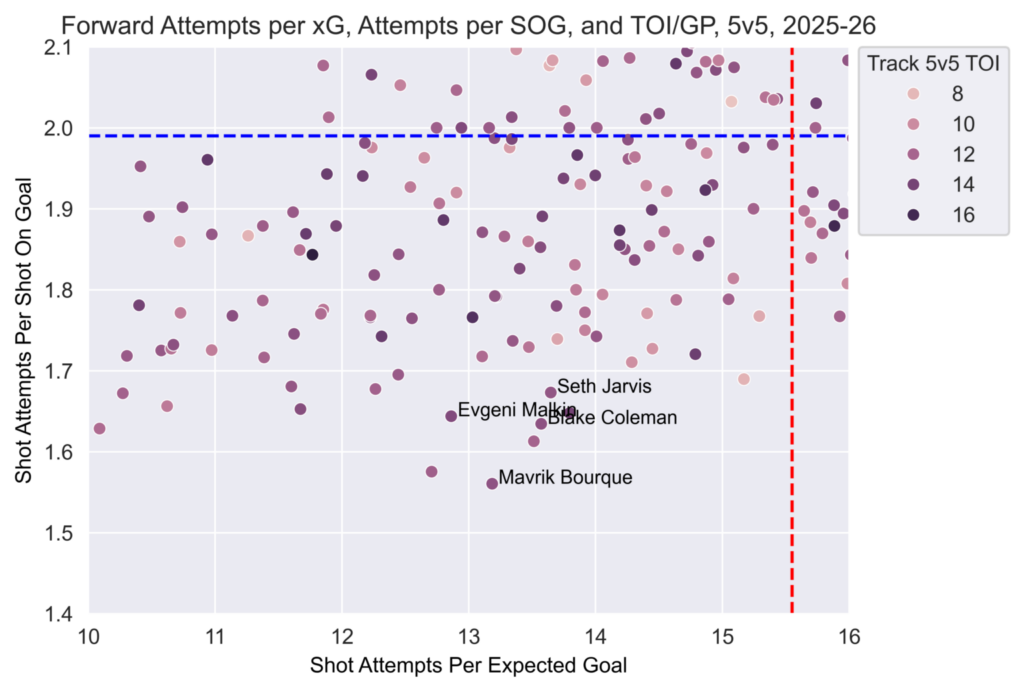
The red and blue dotted lines in the following graphs represent the league average in those specific stats among all forwards.
Marat Khusnutdinov (Boston Bruins)
At 1.86 points per 60 minutes at 5-on-5, Khusnutdinov has produced at a rate commensurate with a second-line forward. It isn’t elite, but it’s good, and he’s often found himself skating on a line with David Pastrnak (though they did make some swaps in their recent game against the Philadelphia Flyers). Skating with Pastrňák certainly helps with production, but Khusnutdinov has been performing well individually, too. Looking at some of the tracking data, here are some comparable names by rate of scoring chance assists (helpers on teammate chances) and percentage of zone entries carried in, and who are responsible for an above-average rate of zone entries overall:
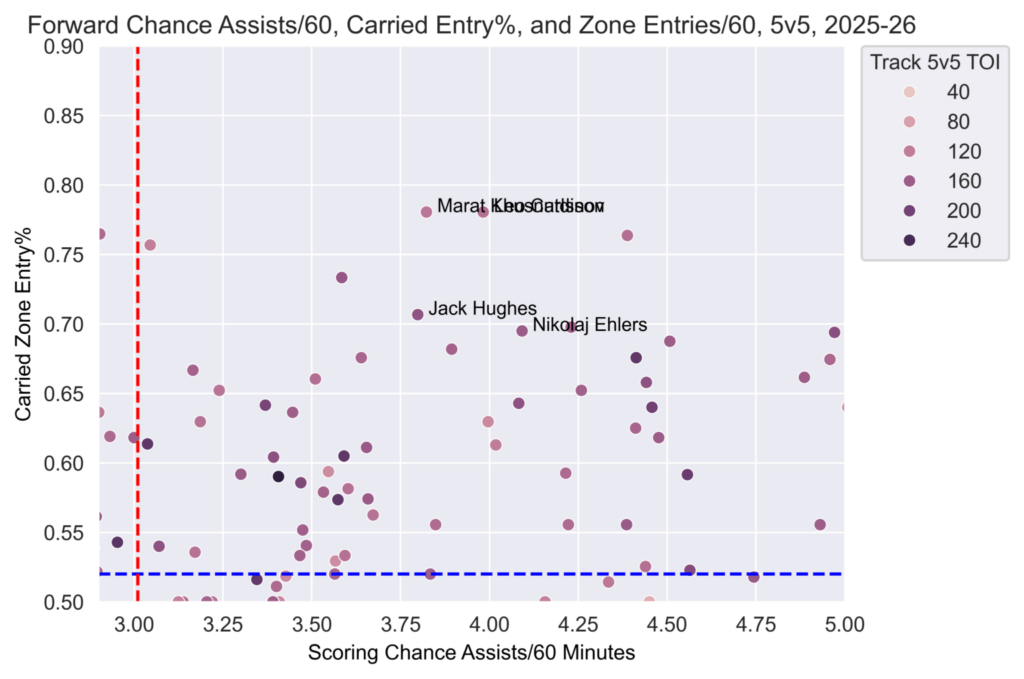
We clearly see the names Jack Hughes and Nikolaj Ehlers, and the overlapped names are Khusnutdinov and Leo Carlsson. Suffice to say that is an excellent list of comparable players for the young Bruins forward to find himself with and speaks to the growth he’s seen this season.
There are some issues for Khusnutdinov’s fantasy value, starting with being highly role dependent because he won’t get top power-play time without some key injuries, and that caps his production upside. If he is moved to the third line – as he was on Saturday – then it will be hard for him to maintain even a 0.5 points/game pace.
Compounding that is a lack of peripherals. His 60-minute shot rate at all strengths is that of a fourth-liner and his rate of hits puts him near the bottom 30% of forwards. Not only would a third-line role keep him away from the team’s top stars, but it lowers his ice time which would mean minimal peripherals. As long as Khusnutdinov is skating with Pasta, he has relevance in deeper formats, but if he’s anywhere else, he’s un-roster-able in anything but the deepest leagues. (mar3)
18. Mavrik Bourque (Dallas Stars)
The Dallas Stars’ top, erm, stars will get all the press, but Bourque is having himself an interesting season. His raw production totals, and his 60-minute rates, are nothing special, but there is some efficiency under the hood worth highlighting. When looking at his shot attempts per expected goal, and shot attempts per shot on goal, he compares well to other top-6 forwards across the league:
What is key for Bourque is the injury to Mikko Rantanen. While it’s unlikely to lead Bourque to top power-play time – though that’s still possible – it has already led to monster minutes coming out of the Olympic break: he skated 18:13 and 21:45 in the two games Dallas played last week. Those are his two highest TOI games of the season and led to nine shots on goal. Even without top power-play time, the Stars will lean heavily on their top two lines until Rantanen returns, and Bourque’s shot efficiency in a much bigger role bodes well for his production down the stretch. He also has 30 hits in 19 games in calendar 2026, so there’s banger value here. (mar3)
19. Jack Quinn (Buffalo Sabres)
The issue facing Quinn is the depth of Buffalo’s forward group, particularly on the wing. Alex Tuch is the top guy, Josh Doan is having a breakout season, Peyton Krebs has found a home on the top line, Jason Zucker is a reliable veteran, and Zach Benson has upside though he’s having a down year. With all that said, Quinn has been excellent this season as there are two comparable wingers by rate of chance assists and primary points (goals and first assists) while also having an above-average rate of zone entries:
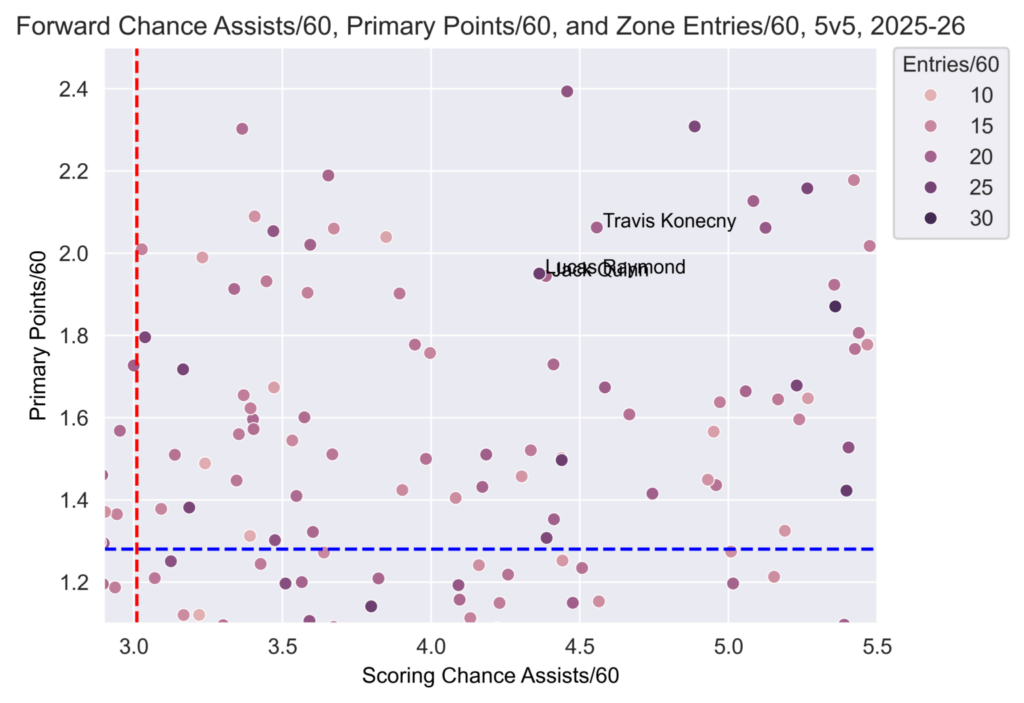
There is Travis Konecny, and Quinn’s name is overlapped with Lucas Raymond. Quinn has had one poor season (2024-25), though that may be excused by recovering his game following two serious surgeries. Other than that, there are now three seasons of very good production. He won’t see prime minutes this season without the team suffering a couple key injuries, but Buffalo’s next three weeks sees two games against San Jose, and one game against each of Anaheim, Los Angeles, Toronto, Washington, and Nashville. The problem is that just one of those games is on a day where there are fewer than nine games, so fantasy managers looking for a streamer might not be able to fit him in. (mar3)
[Follow the link for more…]
20. In Tuesday’s Ramblings (above), we went over some secondary forward fantasy options that managers may want to either target in a trade or off the waiver wire. Today, we’re going to do the same thing but for defencemen, and focusing on five low-owned blue liners (under 20% on Yahoo/ESPN). We are taking tracking data from All Three Zones, player/team data from Evolving Hockey, and schedule and roster percentage data from Frozen Tools.
Everything is at 5-on-5 unless otherwise indicated, and is current as of Wednesday, March 4th. We are limiting the sample to defencemen with 400 minutes at 5-on-5 and 100 tracked minutes.
Sam Malinski (Colorado Avalanche)
Yahoo Roster:18%
FanTrax Roster: 45%
ESPN Roster: 7%
A couple of weeks ago, these Ramblings discussed improvements from defencemen, and Malinski was one of them. It was noted how much more he has been contributing to offence off the rush and cycle this season compared to the previous couple campaigns.
Mentioned in those Ramblings is that there was more good news under the hood, and this is it: by rate of chance assists per 60 minutes (helpers on teammate scoring chances), zone entries/60, and percentage of entries carried in, here are the comparable defencemen to Malinski this season:
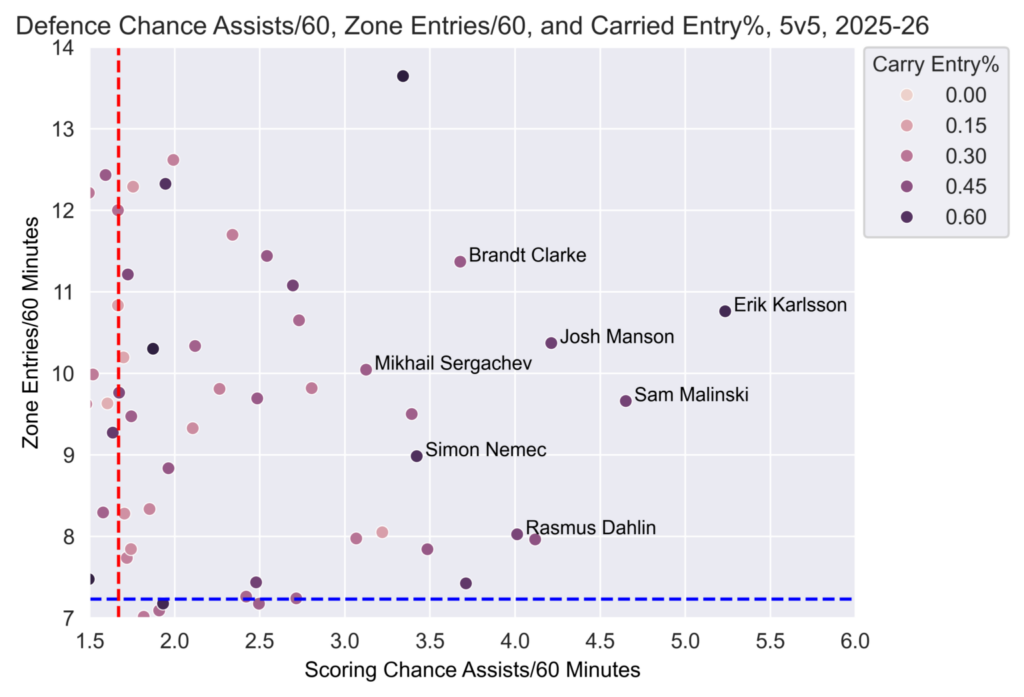
There is teammate Josh Manson, the young Simon Nemec, and then four good-to-great offensive defencemen. Malinski is obviously in a great environment in Colorado, but it’s still impressive that his 1.4 assists per 60 minutes at 5-on-5 is the fourth-highest rate in the league, trailing only Shayne Gostisbehere, Lane Hutson, and Evan Bouchard.
From here on out, Colorado’s opponents have a combined .540 points percentage, which gives the Avalanche the fourth-easiest schedule as they’re tied (with a lot of teams) for the third-most games remaining. Ice time is an issue – Malinski is unlikely to earn 20+ minutes a game without an injury elsewhere – but this level of involvement on a great offensive team makes him appealing down the stretch. (mar5)
21. Philip Broberg (St. Louis Blues)
Yahoo Roster: 5%
FanTrax Roster: 37%
ESPN Roster: 8%
The Trade Deadline could be both a boon and a hit to Broberg’s value. If Justin Faulk is dealt, that would open a lot of minutes at all strengths. If Robert Thomas is dealt, the team’s best player and best offensive player being sent elsewhere is rarely a good thing for those left behind.
With that said, Broberg has been showing very well by the same measures we just went over with Malinski:
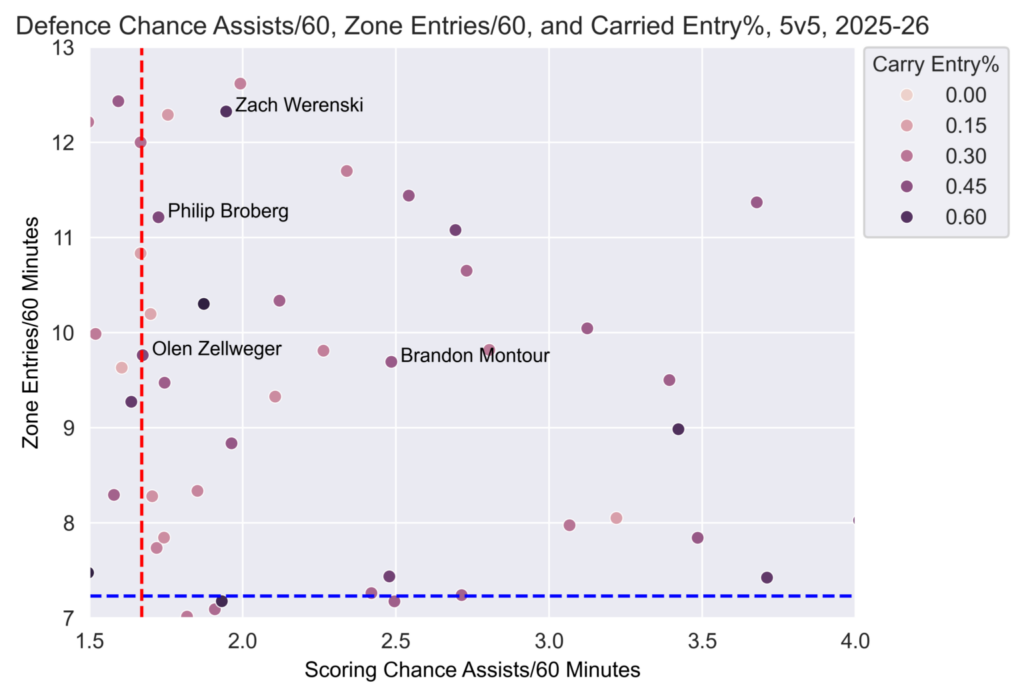
In calendar 2026, the Blues are 22nd by goals per 60 minutes. Being below average isn’t ideal, but it’s much better than being dead last by goals/60 as the Blues were up until December 31st. Broberg is averaging nearly 23 minutes a game over his last five games and that could rise if Faulk is dealt. If Broberg is skating 23-25 minutes a game, the Blues don’t need to be a great offensive team for him to have meaningful fantasy value; they just need to not be awful as they were in the first half. That, with an average schedule by opponent strength, could see Broberg’s best 20-game stretch of the season yet to come. (mar5)
[Follow the link for more…]
—
Have a good week, folks!
Thanks for continuing to support the website and if you’re bored and need a fantasy hockey fix –visit the gang in the forum here.
Related Posts


Starting Goalies














Top Skater Views
| Players | Team | |
|---|---|---|
| TRISTAN LUNEAU |
 ANA ANA | |
| LUCA CAGNONI |
 S.J S.J | |
| ADAM JIRICEK |
 STL STL | |
| MARCO ROSSI |
 VAN VAN | |
| IGOR CHERNYSHOV |
S.J
| |
Top Goalie Profile Views
| Players | Team | |
|---|---|---|
| JOEL HOFER |
STL | |
| NICO DAWS |
 N.J N.J | |
| DYLAN GARAND |
 NYR NYR | |
| ARTURS SILOVS |
 PIT PIT | |
| SERGEI MURASHOV |
PIT
| |
LINE COMBOS
| Frequency |
 UTA Players UTA Players
| |
|---|---|---|
| 21.1 | VINCENT TROCHECK NICK SCHMALTZ CLAYTON KELLER | |
| 21.1 | ANDERS LEE DYLAN GUENTHER LOGAN COOLEY | |
| 15.4 | JACK MCBAIN BARRETT HAYTON LAWSON CROUSE | |
DobberHockey Podcasts

Keeping Karlsson: Matchup Maximizer 2026/27 Week 2
Elan takes a look at the schedule for the upcoming weeks of NHL action and recommends players with good schedules that you should consider streaming in to win your head to head matchups.

Fantasy Hockey Life: Tidy Takes Part 1
TiDy Admiral Ryan Downey and Victor Nuno break down recent trades in the FHL Tiered Dynasty’s top division, the Lord Stanley division. Tune in to consider trades between some of the best dynasty sharks we know, including patron polls on the trades and Victor’s analysis. Have a listen! Our show is part of the Dobber […]
Keeping Karlsson: Short Shifts – I Tried to be Like Parker Kelly
Elan is joined by Ryan Downey for the premiere of season 8 of Short Shifts! — KKUPFL late registration is ongoing! We’re still filling new divisions in the world’s greatest fantasy hockey league. Details at https://www.kkupfl.com/. Join the Keeping Karlsson patron community! Patrons get access to all our perks all year round, including KKUPFL […]
Keeping Karlsson: Shabanov Ranks
Elan and Brian fly through the final preseason lines for every NHL team ahead of opening night, and share their guys to watch– or look away from– in your fantasy hockey leagues.
Fantasy Hockey Life: Western Conference Catchup and Mustard
Jesse and Victor are here to Catch Up on everything in the Western Conference that transpired ofter our team previews. We also have our annual spicy mustard competition – two hot takes per team. Our show is part of the Dobber Podcast Network and sponsored by Fantrax.com. Email [email protected] and ask to join our free […]