

21 Fantasy Hockey Rambles
Dobber Sports
2026-08-16
Every Sunday, we share 21 Fantasy Rambles from our writers at DobberHockey. These thoughts are curated from the past week’s 'Daily Ramblings'.
Writers/Editors: Ian Gooding, Michael Clifford, Alexander MacLean, Puneet Sharma, and Dobber
—
DobberHockey’s 2026-27 Fantasy Hockey Guide is now available in the Dobber Shop! Team-by-team overviews, a schedule breakdown, players due for positive and negative regression, long-term projects to invest in, and a whole lot more. Also included with the purchase is an interactive draft list that includes point projections, peripheral projections for blocks, Hits, shots, penalty minutes, and plus/minus, as well as goalie projections.
All this is updated through to the start of the regular season to reflect injuries, trades, or other pertinent information. Help support what we do year-round and grab a copy of the Draft Guide!
The French version, le Guide des Poolers, is also available. You can pre-order it here.
—
1. It’s the dead time of the NHL offseason but the Dobber Hockey Forum never sleeps, and they just completed their annual fantasy hockey mock draft. I don’t participate in it partially because of vacations I sometimes have around this time of the summer, but also because I like to see where players I might have picked actually end up getting selected. For example, if I want to see where someone like Cutter Gauthier is going this year, and I might have picked him in round three (unlikely, but bear with me), but I want to know if he will possibly slip to round four or five, then this is a great way to check in with where people will actually end up taking him around you.
Today I wanted to review that mock draft, and see what info we can pull out of it for the upcoming season. You can find the thread with the full set of details and picks here.
The setup is that there are 13 teams, 28 rounds, and all players’ stats count for the full season in a ROTO scoring setup. Here are the additional roster and scoring details:
Scoring: G, A, Pts, PPP, +/-, PIM, Hits, Blocked Shots, SOG, and W, Sv, Sv%, GAA, SHO
Positions: 14 F, 6 D, 2 G, 6 UTIL – Any position (including goalies)
The first round is always the biggest thing to look at, and determining how all the top players should be sorted. Those are the players that you can usually find some consensus on an order, and the gaps between one pick to the next have a bit more of a drop off.
Unsurprisingly, the top two picks were Connor McDavid and Nathan MacKinnon, in that order, as they should be in every league. It’s an advantage to pick early – don’t overthink it.
With the third piece we got the first bit of a surprise with Macklin Celebrini going off the board. If he keeps his trajectory, then it’s a great pick, but if he stagnates a little bit then his offensive numbers won’t likely be able to keep up with a couple of the other top-five selections. Celebrini is a top-10 pick this year in redraft leagues, but I’m not sure he’s quite #3 yet, with more sure things in Nikita Kucherov, Leon Draisaitl, David Pastrnak, and Cale Makar on the board.
Brady Tkachuk went fifth, which has some merit as he’s unmatched in the peripheral categories, while maybe able to find another gear of offence in Florida among a better supporting cast. It really depends on the league setup with him. He’s a top-10 pick in leagues with more peripheral categories, but he drops a few rounds in points-only leagues. (aug12)
2. Rounding out the top-10 we had Kirill Kaprizov and Auston Matthews. I think Matthews has to be picked in this range because of the upside, though at 29 for the start of the season and multiple years removed from his two 100-point seasons (which were also his only two years above 85 points – partially due to health) he may not necessarily be a top-15 or -20 pick for much longer. However, if he can come back fully healthy this year, and clicks with Gavin McKenna as well as being more supported by a revamped cast, it would be tough to watch a leaguemate walk away from the draft with a top-five talent that they managed to select around pick 20.
Those 10 above though are likely the same 10 I will have at the top of my board for my one-year roto league draft this year, though ideally I would like to be inside the top seven, and avoid the question marks around the band-aid-boy status from Matthews and Makar.
After that stage, we get into that next tier of players who could provide top-10 value, but are maybe 50/50 at best to provide that kind of value. The next few picks included Zach Werenski, Jason Robertson, Quinn Hughes, Evan Bouchard, Nick Szuki, and a couple of others that make up that next tier down to around pick 20. Personal preference generally with that group, but ideally I do like to try and get one defenceman in round two or three here.
A couple of players who could be considered in this tier as well (and I definitely would consider them around pick 15 or so) but fell outside of it into rounds 2-4 include Jack Hughes, Rasmus Dahlin, Matthew Tkachuk, Mitch Marner, Tage Thompson. Around this same area you have the safe picks who you know are going to be top-40 players, but don’t necessarily have the upside to have a chance to jump into the top 15, including players like Jake Guentzel, Kyle Connor, Filip Forsberg, William Nylander, and others. Usually I end up picking more players from the former list rather than the latter, though it’s a very fine line between the two groups sometimes. (aug12)
3. Other players in the next few rounds who I think are worth making some notes about:
Matthew Schaefer – Selected 29th, ahead of Jakob Chychrun, Jake Sanderson, Miro Heiskanen, Adam Fox, and others, this feels a little early for Schaefer who may be a fantastic player, but his underlying numbers speak to the fact that he might have some difficulty passing the 65-point mark this coming season. A mark that most of those other names will approach or pass as well, despite some of them going 40 points later.
Sidney Crosby – Crosby has been as consistent as they come, and we will see a drop off at some point, but the superstars are usually able to produce at a high level until around the age of 40, and players with a high IQ game as well keeping up for a couple of extra years, so for this season I’m not concerned about Crosby’s production, and pick 35 seems very reasonable, perhaps even a little late for him.
Cutter Gauthier – After a hot start that fueled a fantastic season, Gauthier does look like someone who could grow into being worth a third-round pick, but if you take out his Q1 production, the remaining 45 points in 55 games isn’t something that is worth a pick above #50 or so, which is probably as early as I would consider him here. The high shot rate does provide a high floor though, and even after the hot start there were four shots per game in his slower period.
Tom Wilson – Wilson has been getting better and better the last few years, and has a lot of value with these categories, however with the depth added to the Caps’ forward core, Wilson may end up losing some ice time which causes a hit to his peripherals. Wilson saw a career high 19:28 per game last season, and if that drops down (likely) into the 17 minute per game range, then an equivalent drop in peripherals might mean Wilson loses his elite shine. A risky pick at this stage, but lots of cross-coverage upside too.
Leo Carlsson – Like Gauthier, Carlsson’s hot first quarter boosted his overall numbers, and now he is the highest paid player in the NHL. He has better hope he can live up to that contract with numbers that more closely resemble the Q1 numbers of 28 points in 21 games, instead of the 39 points in 49 games which followed. I like this bet at pick 45 more than the Gauthier pick, and it seems about the right range, though I might end up selecting someone like Aleksander Barkov or Mark Scheifele in this range instead.
Mark Scheifele – As we just noted, Scheifele was selected in that same range, who was one of only eight players last year to hit the 100-point milestone. Getting him around pick 50 seems like a coup, and I wonder if there were a few managers thinking “I don’t want to pick him and have him regress too much for me”. Except the regression maybe gets him back to the 90-point range, which is a great safe bet in this range while there were other similar “safe” players picked in rounds two and three. Don’t sleep this much on Scheifele in your own drafts.
J.T. Miller – In my roto league we count a lot of categories, including Hits, PIMs, FOWs, and all the typical scoring stats. Miller has been a top-20 selection the last few years, and with a bit more support to go with some bounce back after last year’s unlucky season. He’s someone that may slip in drafts this year before he ends up putting up 75 points, 200 SOG, 200 Hits, and some additional value across the rest of the board. Excellent value for being picked nearly 30 spots after Tom Wilson. (aug12)
4, The goalie run started with Andrei Vasilevskiy after pick 40, which seems late for the first goalies to come off the board, and if the top two or three options are there after my top-25 or so skaters are gone then I’m jumping in. Typically in my league drafts though they don’t last that long, so I think the actual slip of goalies this far in this draft is more a result of the league format itself as opposed to anything else.
Vasilevskiy should be the first goalie off the board, but after the run of seven goalies leading up to pick 50, there wasn’t any more goalie value on the board until Linus Ullmark was left around pick 100. After that, I liked Spencer Knight, John Gibson, Joey Daccord, Dan Vladar, and a couple other later goalie picks. If you have read my writing at all then you know that I like to fade goalies, and there is always more relative value to be found with goalies after at least pick #80, and definitely after pick #125. (aug12)
5. Roman Josi, Dougie Hamilton, and Seth Jones may all be on the wrong side of 30, but all three were solid value picks after the 100 mark for Dmen in this draft. Jones especially I am going to end up with a lot of shares this year if he keeps falling that far. He’s the only real option as a PPQB in Florida with their stacked top of the lineup, and he’s only really being overlooked because of his injury last year. His missing games is an issue if you can’t backfill easily, but he paced for 50 points in his first full season in Florida, which is not easy to find in the later defencemen.
Gavin McKenna went around pick 150, which seems like the right range for someone who could finish anywhere from 30 points to 75, assuming he plays the full year in the NHL. Anton Frondell went shortly after, and would be the safer bet with similar upside this year, while Porter Martone was selected before pick #90. Martone fills a lot of categories, but Frondell and McKenna are no slackers there either, and all three are likely Calder finalists when all is said and done. No need to reach for the first one when you can probably get the next one a little while later.
My favourite late fliers (pick #275 and later) were Dmitry Voronkov, Jiri Kulich, Gage Goncalves, and Gabe Landeskog. All with some questions, but all with much higher upside and a decent floor compared to some of the other picks in this range.
Off the top of my head, the player I would have picked in the last round who didn’t get drafted would have been Konsta Helenius, who looks NHL ready, and could force his way into the top-six in Buffalo very quickly. They have a lot of C depth, but no one is firmly entrenched.
[Follow the link for more…] (aug12)
6. Although the summer months tend to be pretty quiet when it comes to actual hockey news, the speculation around players and where they could potentially fit into their new lineups can be both fun and frustrating, especially when it comes to players who have recently joined a team through a trade or free agency. We all know who the top players are and generally have a good idea of where they stand and what their production could look like. It’s the players we aren’t quite sure about that make this so much fun. These are the players that could be sitting on your watchlist or available on waivers who can sometimes make all the difference for your fantasy team. So, over the next couple of days, let’s take a look at some players who are worth keeping an eye on and could be ready to make some noise.
William Eklund enters Ottawa in a much better fantasy situation than the one he had in San Jose. The Senators acquired Eklund this summer after he posted 53 points in 78 games, but his fantasy value could take another step forward with his new opportunity. In San Jose, he didn’t consistently play alongside Macklin Celebrini, with Alexander Wennberg actually being his most common linemate. In Ottawa, Eklund is projected to skate on the top line with Tim Stützle and Drake Batherson following the departure of Brady Tkachuk.
The opportunity is what makes Eklund particularly interesting as Stützle gives him access to a high-end offensive centre, while Batherson provides another proven scoring threat. Eklund recorded 38 assists compared to 15 goals last season, so he doesn’t necessarily need to suddenly become a 30-goal scorer to take a significant step forward, he’s always been more of a playmaker. There is also some room for improvement in his finishing. Eklund's 8.5% S% last season was below his 10.4% career average, so if he can maintain his shot volume in a more favourable offensive environment, we may see an increase in production. He has already shown he can be a useful fantasy player, but this could be the season where he takes that next step. The most important will how he is deployed on the powerplay. If Eklund sticks with Stützle and Batherson at even strength and earns a spot on PP1, he could quickly become a player who gets scooped up in your draft before ever seeing the waiver wire, depending on your league size. If the chemistry is there, the upside could be significant, not only this season but even more so moving forward. (aug15)
7. Nico Daws
Nico Daws might have a serious chance at the crease heading into the season, but the road to becoming New Jersey’s No. 1 goalie is far from a straightforward one. With Jacob Markstrom shipped off to Florida, the Devils are now looking at a three-way battle between Daws, David Rittich and Jake Allen. Current depth charts have Allen ahead of the other two, and realistically, he could still end up taking the lion’s share of the starts early on. That said, what makes Daws worth keeping an eye on is that this is a legitimate opportunity. He isn’t simply competing for a backup job anymore. GM Sunny Mehta has already expressed excitement about giving Daws a real chance to establish himself, and if he can take advantage of that opportunity, there is a path toward becoming the eventual heir to the crease. The bigger question is when that happens. There are some reasons to be optimistic. New Jersey had the lowest 5v5 S% in the league last season, a number that should have some room to bounce back. Better offensive support would certainly help their goaltending. The problem is that there are still a lot of unknowns. Allen remains the safest option, Rittich has NHL experience, and Daws still needs to prove he can handle a larger workload. For now, I wouldn’t be counting on Daws as a reliable fantasy starter, but he is definitely a name I’d have on my watchlist. If he starts to separate himself from Allen and Rittich, the fantasy value could come quickly but it will be a tough climb. (aug15)
Chernyshov is one of the more intriguing names on my fantasy watchlist heading into the season. He drew the short straw last year because he was waiver-exempt while San Jose had several players who were not, resulting in some time between the NHL and AHL. Despite that, the Russian winger made a strong impression when given the opportunity, recording nine goals and 19 points in just 28 NHL games while adding 33 points in 41 AHL games. For a 20-year-old playing on one of the NHL's youngest rosters, there was plenty to like.
What makes Chernyshov even more interesting is the chemistry he showed with Macklin Celebrini. He averaged around 15 minutes per game and received just 25% of the Sharks' power-play opportunities, leaving plenty of room for his fantasy value to grow if his role expands. The biggest question is where he ultimately fits in the lineup. The addition of Ivar Stenberg gives San Jose another young forward competing for top-six minutes, which could push Chernyshov down fantasy draft boards.
That may not be a bad thing. If Chernyshov earns a top-six role alongside Celebrini and sees more power-play time, his fantasy ceiling becomes much more appealing. Even if he starts on the second line, I still see enough offensive upside to keep him firmly on the radar. There is a lot of young star power coming together in San Jose, which could make Chernyshov less of an obvious choice, but that's exactly why you need to keep tabs on him. (aug15)
9. Now that we’re into the dog days of summer, things can get pretty quiet and there isn’t a whole lot of fantasy news to focus on, especially with most of the top free agents already signed. So, I figured it was a good time to go down the rabbit hole and take a look at some NHL players who remain unsigned but could still provide some value if they land in the right situation. Keep in mind, most of these players are more likely to be waiver-wire additions than must-draft players. But depending on where they end up, there are still a few names here who could provide some value, even if it comes in waves.
On the surface, you’re looking at a 28-year-old who scored 20 goals as recently as 2024-25, but 15 of those came on the power play. That tells you pretty much everything you need to know about where his value currently sits. If you’re a rebuilding team, you probably want your developing players getting those power-play opportunities. If you’re an established team, you’re likely looking for someone who can give you more at even strength in a depth role rather than relying heavily on the man advantage. Laine has always been more of a power-play player, however, the last time he was a decent powerplay player was two years ago when he scored 15 on the man-advantage over 52 games due to injury. Which leads me to the bigger concern over everything else, his injury history and staying healthy. Laine has not played over 60 games in a season since his time with the Winnipeg Jets in his 2019 season. Not to mention his defensive game which has never been a strength, and when the goals aren’t coming, there isn’t a whole lot else he brings to the table. Putting all that aside, Laine is still a seven-time 20-goal scorer with 224 career goals, so there’s clearly something there. He will likely sign a cheap short-term deal in a power-play specialist role somewhere. (aug10)
Tarasenko finds himself in a unique spot at this stage of his career. Last season he posted 47 points (23 goals, 24 assists) in 75 games with the Wild last season, adding five points in 11 playoff games. He has two Stanley Cups under this belt and seven 20-goal seasons as a 34-yeard-old. If he’s feeling it, he can still give you 20 goals, but everything around those goals needs to be set up just right. He needs skilled linemates who can create the opportunities and cover for some of his defensive shortcomings. His primary even-strength linemates were Danila Yurov and Yakov Trenin while seeing prime deployment on the powerplay with Kirill Kaprizov and Matt Boldy. Let someone else do the work and Vlad can capitalize with that shooting ability, what he is known for. Much like Liane, it is hard to value players because the right situation can make all the difference. The problem for Tarasenko is that most NHL lineups have already taking shape, leaving him sitting on an island waiting for an opportunity. Oddly enough, for a player who can still score 20-plus goals and at his age, he may have to settle for a PTO and because of his pedigree and veteran experience he could still make some teams regret overlooking him. (aug10)
11. Eeli Tolvanen
This is an interesting case on Tolvanen not yet being signed with any NHL team. At 27, he’s coming off a 36-point season (12 goals, 24 assists) in 78 games and has 190 points in 423 career games. He’s not going to drive a top-six line, but that doesn’t mean he cannot be useful. The NHL continues to trend toward physical bottom-six players, and Tolvanen fits that role pretty well. He plays a tough game, defensively responsible and can contribute offensively rather than simply being there to throw hits. Over an full season pace, he’s around 75 blocks and 200+ hits, while still giving you enough scoring to keep him relevant. The obvious concern is that he’s a 5-foot-10 winger who isn’t an above-average skater and doesn’t necessarily drive play offensively. That makes him more of a complementary player, and teams may question how much impact he can have in a bottom-six role. The Kraken moved on from Tolvanen while adding Mackie Samoskevich and Bobby McMann, leaving him looking for a new home. He may have to wait for an injury to create an opening, but if the right opportunity comes, Tolvanen could quietly provide more value than your typical bottom-six winger. (aug10)
12. Evander Kane
There are a lot of reasons why most teams won’t sign Kane, and some of those are that he is 35-years-old coming off a brutal season with a Vancouver Canucks team that finished dead last, scoring just 13 goals, his lowest total in more than a decade. The next question is whether there’s still something left in the tank. Prior to the Canucks, Kane spent four seasons in Edmonton and, at one point, was a very good fit alongside the Oilers’ top players. A top-nine winger who can play up and down the lineup regardless of the linemates, isn’t that bad of an idea and the Oilers don’t have to wonder how Kane would fit. They’ve already seen it work. Kane missed the entire 2024-25 regular season dealing with a variety of issues before returning for Edmonton’s Stanley Cup Final run, so there may be reason to believe last season was simply tougher to get back into stride after missing a year of hockey. At this stage, a league-minimum deal is probably the best he can hope for, and even that may require a PTO first. However, if Kane can prove he’s healthy and still capable of bringing his physical game while chipping in some secondary scoring, there should be a team willing to take the gamble. (aug10)
13. “If He Gets PP1” All‑Stars is exactly what it sounds like to seasoned fantasy managers: players who already drive offense for their teams but, for one reason or another, are stuck on the second power‑play unit instead of the top one.
The gulf between PP1 and PP2 can be enormous. Look at Edmonton in 2025–26 — their first‑unit regulars piled up 54, 42, 33, and 29 power‑play points. (You can probably guess at least some of the players.) Zach Hyman, the fifth member of that group, missed more than a quarter of the season and still produced 15 PPP. Every one of those players handled at least 80% of the team’s power‑play minutes when healthy. No other Oiler cracked 7 PPP, and no skater who played at least 25 games reached even 30% of the available minutes.
League‑wide, every one of the top 30 scorers logged more than 50% of their team’s power‑play time last season. For the players highlighted here, a single deployment shift could unlock a massive jump in production.
Brandon Hagel (45% PP)
Hagel was the only top‑60 scorer in 2025‑26 who didn’t receive at least 50% of his team’s available power‑play minutes while in the lineup — a rare feat in today’s NHL. He’s becoming the new Nikolaj Ehlers in that sense: a highly productive even‑strength winger who continually gets shortchanged on PP1 opportunities.
Despite the limited usage, Hagel still tied for 10th in the league with 61 even‑strength points, adding just 12 more on the power play. Simply put, Hagel made the most of the minutes he did get. For context, Oliver Bjorkstrand logged 62.4% of his team’s power-play time — more than Hagel. However, Bjorkstrand has since signed with the Rangers, potentially opening the door for Hagel to climb.
There’s also a meaningful playoff data point. Hagel spent much of the Lightning’s seven-game first-round series with Montreal on the top power play, scoring two power‑play goals, showing he can produce when given the role.
If Tampa finally commits to him as a full‑time PP1 fixture, Hagel’s ceiling rises meaningfully. Even if he remains stuck around 45% power-play usage, his elite even‑strength production keeps him fantasy‑relevant. A deployment bump could turn him into a borderline elite player. (aug9)
14. Alex Tuch (33.1% PP)
Tuch has never been a major power‑play producer, and that didn’t change in 2025‑26. Even while receiving essentially PP2‑level deployment in Buffalo, he still showed encouraging signs, posting a career‑high 7 power‑play goals and a strong 75% PPIPP, proving he can contribute when he’s actually involved.
Now he’s heading to a new team (Washington) on a fresh contract, and his power‑play outlook becomes one of the biggest fantasy questions. Pushing someone like Alex Ovechkin off PP1 is a tall order, but the real battle may be between Tuch and fellow newcomer Jordan Kyrou for that final PP1 spot. A rising young talent like Ryan Leonard could also factor into the mix.
Tuch’s even‑strength production is already reliable. If he lands meaningful PP1 minutes, even intermittently, his ceiling jumps noticeably. His fantasy value in 2026‑27 may hinge entirely on how that competition shakes out. (aug9)
15. Ivan Barbashev (19.1% PP)
Across his first five seasons in St. Louis, Barbashev recorded just one power‑play point. The Blues simply didn’t view him as a scoring threat, and he never earned meaningful power-play usage. Even now, despite settling in as a reliable 45–60 point forward, Barbashev has still never cracked double‑digit power‑play points in a season because he’s never been a true PP1 fixture.
That doesn’t look likely to change. Although Pavel Dorofeyev was moved in the offseason, the most realistic candidate to fill Vegas’s open PP1 spot is Shea Theodore, not Barbashev. Unless a regular PP1 forward gets injured, Barbashev is almost certain to remain an even‑strength producer.
The good news: Barbashev still carries fantasy value in multicategory formats thanks to his hit totals and steady 5‑on‑5 scoring. But without a path to PP1, Barbashev’s ceiling remains capped, and managers should continue to view him as an even‑strength specialist rather than a power‑play breakout candidate. (aug9)
16. Brock Faber (20.9% PP)
No player was expected to feel the impact of the Quinn Hughes trade more than Faber. He had been rotating on and off Minnesota’s top power‑play unit before Hughes arrived, and the assumption was that Hughes would push him off PP1 entirely and suppress his fantasy value in the process.
That didn’t happen. While Faber won’t reclaim PP1 as long as Hughes is in town, his production held up far better than most anticipated. Before the trade, he posted 15 points in 31 games, including four power‑play points. After Hughes joined the Wild, Faber actually increased his scoring pace, recording 36 points in 48 games — a 61‑point pace over a full season. He added seven power‑play points during that stretch, not a huge total but certainly respectable for a secondary‑unit defender.
Faber’s defensive reliability and two‑way ability remain his calling card, but Minnesota’s depth and the likelihood he continues to skate alongside Hughes should keep his production fantasy‑relevant. Even without PP1 access, he’s shown he can generate enough offense to remain rosterable in most formats. (aug9)
17. Noah Dobson (31.2% PP)
For the first time in five seasons, Dobson finished with single‑digit power‑play points, a clear sign of how much his role changed in Montreal. Just as Hughes pushed Faber off PP1 in Minnesota, Lane Hutson has a firm hold on the Canadiens’ top unit, and he isn’t giving it up to Dobson or anyone else.
Dobson’s late‑season production also raised concerns. He posted just two points in his final 14 regular‑season games, then followed that with one point in 13 playoff games. It’s not a guarantee he hits another wall in 2026‑27, but his upside is undeniably capped on PP2, even if Montreal ice's a competent second unit.
The most realistic expectation is that Dobson’s fantasy output ends up looking similar to Faber’s: solid even‑strength production, respectable totals, but limited ceiling without PP1 access. He’ll remain useful, but the days of top‑tier power‑play upside appear to be over, at least in Montreal’s current setup.
Honorable mentions
Beckett Sennecke (60 PTS, 13 PPP, 44.4% PP) – gap in icetime between PP1 and PP2 in Anaheim not that wide, has spent time on PP1 and could be on PP1 this season
Anthony Mantha (64 PTS, 13 PPP, 49.1% PP) – possible PP1 with New Jersey
Rasmus Andersson (47 PTS, 13 PPP, 41.1% PP) – was often on PP1 in Calgary before being traded to Vegas, in similar boat as Barbashev (aug9)
18. Rick Roos is looking for a few more mailbag questions to be answered in next week's article. To get your questions to him, private message “rizzeedizzee” via the DobberHockey Forums or email [email protected] with “Roos Mailbag” as the subject line. No one does a deeper dive on your questions than Rick, and now is the time to get those keeper and draft questions in before it's too late.
19. In a pair of Ramblings last week, I looked at which forward stats correlated well to future goal and point production at 5-on-5, then I repeated the same thing for defencemen stats. Go read those to get a foundation on what we’re discussing.
Today, we’re going to look at the relevant stats mentioned for future production to see which players are showing signs of a breakout or just a career upswing. To do this, we are using standard player data from Evolving Hockey and tracking data from All Three Zones. We will start with the tracking data; this is all at 5-on-5 and on a 60-minute basis. We are limiting the sample to forwards with total 5-on-5 ice time and tracked 5-on-5 ice time above the median for both the two seasons from 2023-25 and the single season in 2025-26. It gives us 160 forwards to sort through. The focus will be on point production for the 2026-27 season.
Two of the tracking stats that we focused on in the write-up on correlation with future point production are:
- Chance Contributions – A player’s individual scoring chances plus their assists on teammate scoring chances.
- Rush Contributions – A Player’s shots taken off the rush plus assists on teammate shots off the rush.
The red lines in the following graphs are the average change in the 60-minute rate in 2025-26 compared to 2023-2025 among these 160 forwards. The yellow dots are the forwards whose improvement in their rates of chance contributions and rush contributions were both top 25 increases, and the blue dots were below that top 25 threshold in at least one if not both areas.
Juraj Slafkovsky (Montreal Canadiens – RW)
In a season where Slafkovský posted his first career 30-goal campaign, his first career 70-point effort, and managing over 2.0 shots per game for the first time, it makes sense that he had increases in some of the underlying processes, and that’s exactly what happened with his chance and rush contributions:
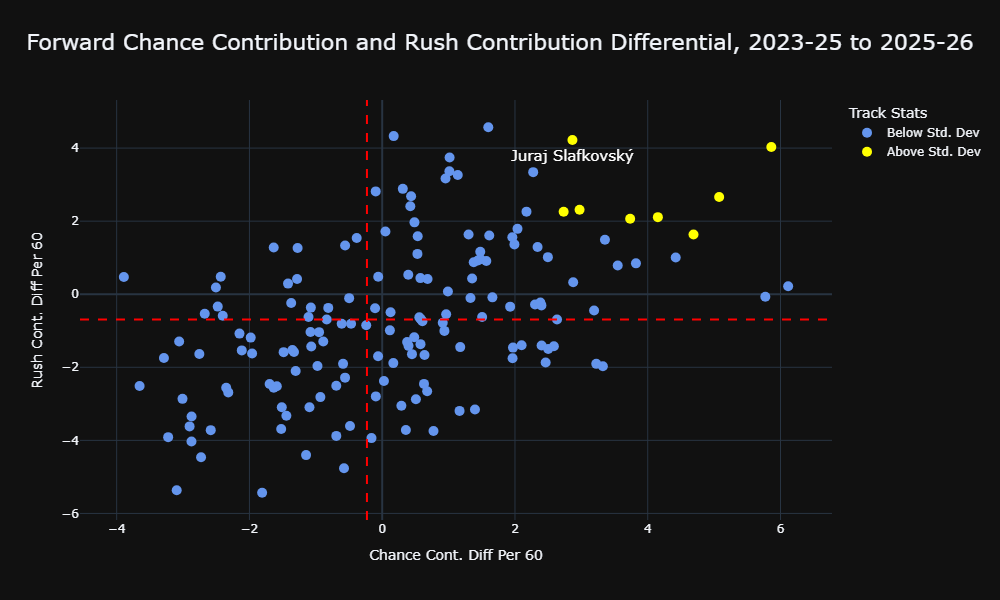
The interesting part for me is that Slafkovský had a higher increase in his chance contribution rate (+2.87) than both his usual line mates Nick Suzuki (+2.38) and Cole Caufield (+1.51). Additionally, Slafkovský’s increase in his contributions off the rush was the third-highest increase among the 160 forwards in our sample (+4.22) while both Suzuki and Caufield saw slight declines. Slafkovský spent over half his 5-on-5 ice time with that duo, but his changes were considerably larger than either of them.
Slafkovský now has 3.5 NHL seasons to his name but he’s still just 22 years old. The 2026-27 Dobber Fantasy Guide has the Large Adult Winger projected for 28 goals and 80 points in 83 games, increasing his point output by about 10%. I do wonder where his ADP is going to land because early ADP data from Underdog Fantasy has him 44th overall. That format tends to devalue goalies, so maybe it’ll be around picks 50-60 in other standard leagues. That feels about right to me.
[Follow the link for more…] (aug11)
20. Today, we will go in the other direction to search for players who saw a decline in two key tracking stats, and why that is not a good sign for their output this coming season. The tracking stats are from All Three Zones, and they are:
- Chance Contributions – A player’s individual scoring chances plus their assists on teammate scoring chances.
- Rush Contributions – Whenever a player takes a shot off the rush or assists on a teammate’s shot off the rush.
This will go through what a player did in the combined seasons from 2023-2025, how it changed in 2025-26, is all at 5-on-5, and with 60-minute rates. We are using ice time limitations for the seasons which winds our sample down to 160 forwards.
In the following graphs, the red lines are the average change in the 60-minute rate of each stat. The yellow dots are forwards who had among the 25 largest declines in both stats, while the blue dots are forwards who were not in the bottom 25 in either or both areas.
Any other non-tracking player data is from Evolving Hockey. Positional designations are from Fantrax.
Kevin Fiala (Los Angeles Kings – LW)
In fairness to Fiala, he was injured during the Olympics and missed the rest of the regular season. There is the possibility that he would have otherwise posted a late-season surge and not been on this list, but he still had the largest decline in contributions off the rush of the 160 forwards in our sample:
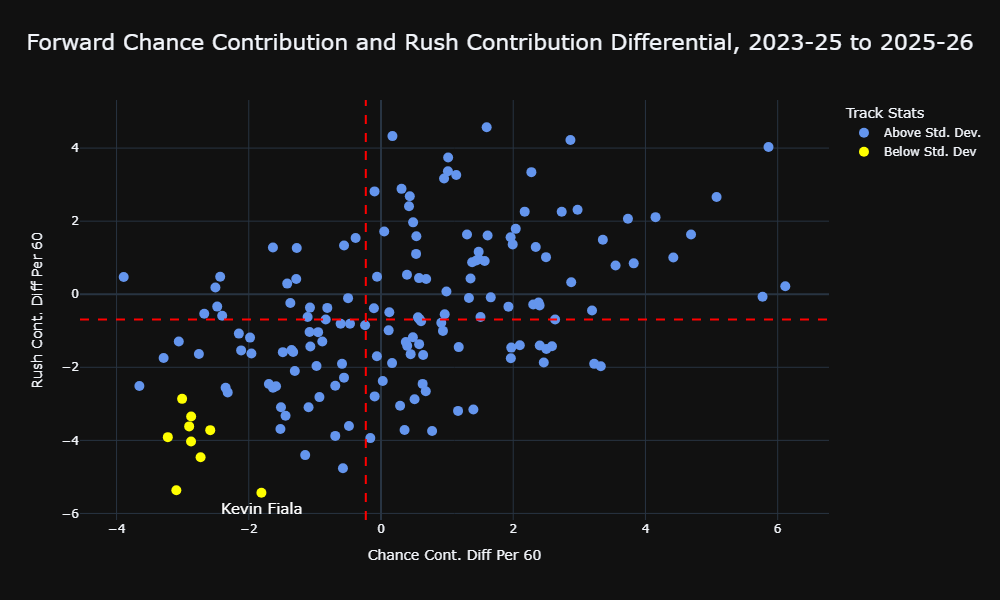
Before he got hurt, Fiala had posted 1.41 points per 60 minutes at 5-on-5, the lowest rate of his career. Even worse is the fact that he posted 3.06 points per 60 minutes back in 2021-22, and that rate has declined every season since. His goal scoring remains strong, but his playmaking has fallen considerably, and that has put downward pressure on his assist totals: he posted 1.5 assists per 60 minutes in his first two years with the Kings, but in the last two years that has cratered to 0.54 assists per 60 minutes over the last two years, by far the worst rate among regular Los Angeles forwards. A drop in secondary assists is a big part of that, but even his primary assist rate is seventh out of nine regular Los Angeles attackers.
Dobber’s 2026-27 Fantasy Hockey Guide has Fiala projected for 59 points in 75 games. My concern is whether he retains a top power-play role thanks to the additions of Artemi Panarin and Mats Zuccarello. Power play or not, I think the point-per-game seasons of 3-4 years ago are a thing of the past, and he’s now a 60- to 70-point player.
[Follow the link for more…] (aug13)
21. On Tuesday we went over some forwards who had large increases in two key 5-on-5 tracking stats that correlated well to future point production, including Juraj Slafkovsky, Gabriel Vilardi, and William Eklund. Yesterday, we went in the other direction to see which players saw declines in those tracking stats, including Kevin Fiala, Artemi Panarin, and Pavel Dorofeyev.
Today, we’ll look at two other stats that correlated well to future point production:
- Chance Assists/60 – This counts how often a player assists on teammate scoring chances per 60 minutes.
- Assists/60 – The rate of a player’s actual assists per 60 minutes.
One often leads to the other, and both lead to points, but both are some measure of playmaking ability, so we’re going to lump them in together.
The tracking data is from All Three Zones and the player data is from Evolving Hockey. This is all at 5-on-5 and just among forwards. The comparison will be a player’s 2025-26 output compared to the two years from 2023-2025. There is an ice-time cutoff of the median total ice time and tracked ice time in our seasons, which gives us a sample of 160 forwards. The positional designations are from Fantrax.
In the following graphs, the red dotted lines represent the league average change per 60 minutes in the two stats for our 160 forwards, the yellow dots are players with top 40 improvements in both areas, and the blue dots are players who fell short in either or both stats.
Martin Necas (Colorado Avalanche – RW)
It shouldn’t be much of a surprise that in Nečas' first full season with Colorado, a year where he spent the vast majority of his ice time next to Nathan MacKinnon, he turned in a career season. What might be a bit surprising is that along with a big increase in his overall assist rate, his chance assist rate improvement was 35% larger than the next-closest forward in our sample:
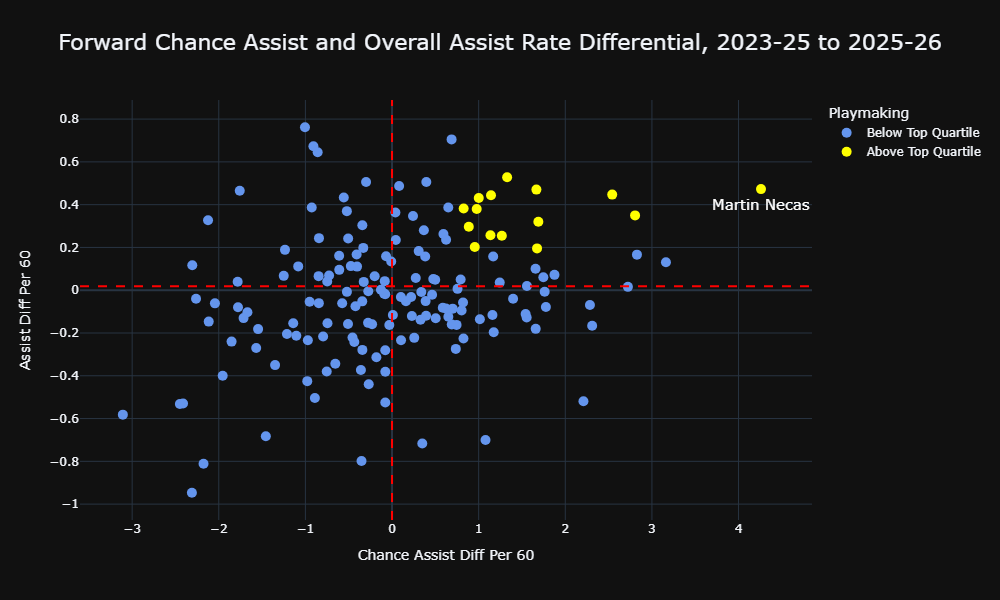
Not only did he have the far-and-away largest improvement in chance assists, but his overall chance assist rate led all 160 forwards in our sample and was 39% larger than the third-highest rate. It wasn’t just that Nečas saw improvements, or big improvements. It is the fact that he was in a tier of his own, and by a good margin.
A career year of 100 points will be tough to improve upon, but the avenue for improvement is the power play. Even if he had 24 power-play points, good for a top 50 mark in the league, Colorado was tied for 20th in PP goal scoring. They have too much talent to not be better than that, and Nečas did have 15 power-play points in 30 games the prior year with the Avs. An improved Avalanche PP would mean a lot more PP production for Nečas, and that is a big reason the Dobber Fantasy Guide has him projected for 108 points in 80 games. He is at the perfect intersection of skill, opportunity, and line mates.
[Follow the link for more…] (aug14)
***
Every offseason here at Dobber Hockey, the entire group of editors and writers go team by team to review their respective offseason moves and what it means for player fantasy values in the upcoming campaign. There is one team posted each day, and we are covering them in reverse alphabetical order this season, having started with the Winnipeg Jets. Go here to check them out.
***
Have a good week, folks!
Thanks for continuing to support the website and if you’re bored and need a fantasy hockey fix – visit the gang in the forum here.
Related Posts
Starting Goalies









Top Skater Views
 S.J
S.J CHI
CHI CBJ
CBJ COL
COL
Top Goalie Profile Views
| Players | Team | |
|---|---|---|
| JOEL HOFER |
 STL STL | |
| TRISTAN JARRY |
 EDM EDM | |
| JACOB MARKSTROM |
 FLA FLA | |
| SERGEI BOBROVSKY |
 TOR TOR | |
| DAN VLADAR |
 PHI PHI
| |
LINE COMBOS
| Frequency |
FLA Players
| |
|---|---|---|
| 18.4 | BRADY TKACHUK SAM REINHART ALEKSANDER BARKOV | |
| 18.3 | CARTER VERHAEGHE MATTHEW TKACHUK SAM BENNETT | |
| 13.4 | SANDIS VILMANIS EETU LUOSTARINEN ANTON LUNDELL | |
DobberHockey Podcasts

Keeping Karlsson: Shabanov Ranks
Elan and Brian fly through the final preseason lines for every NHL team ahead of opening night, and share their guys to watch– or look away from– in your fantasy hockey leagues.

Fantasy Hockey Life: Western Conference Catchup and Mustard
Jesse and Victor are here to Catch Up on everything in the Western Conference that transpired ofter our team previews. We also have our annual spicy mustard competition – two hot takes per team. Our show is part of the Dobber Podcast Network and sponsored by Fantrax.com. Email [email protected] and ask to join our free […]
Keeping Karlsson: Matchup Maximizer 2026/27 Week 1
Elan takes a look at the schedule for the upcoming weeks of NHL action and recommends players with good schedules that you should consider streaming in to win your head to head matchups.
Fantasy Hockey Life: Dallas Stars with Taylor Newby
Taylor Newby joins the program to discuss the Dallas Stars.
Keeping Karlsson: KKUPFL Tier 1 Draft Roundtable
Elan and Brian are joined by several KKUPFL Tier 1 managers, to bring you inside their draft table decisions and thought processes in building the teams competing in the top division of the world’s best fantasy hockey league.