

21 Fantasy Hockey Rambles
Dobber Sports
2026-07-05
Every Sunday, we share 21 Fantasy Rambles from our writers at DobberHockey. These thoughts are curated from the past week’s 'Daily Ramblings'.
Writers/Editors: Ian Gooding, Michael Clifford, Alexander MacLean, Puneet Sharma, and Dobber
___
1. If you were looking for drama this offseason, you’ve got it. Not one, but two offer sheets! Two days after the Devils offer sheeted Barrett Hayton, the Philadelphia Flyers have unleashed an atomic bomb. Leo Carlsson has signed on the dotted line with the Flyers for five years with an AAV of $18 million. Yes, $18 million per season. That will make Carlsson the highest-paid player in the league. I think the Ducks were prepared for a team to offer sheet Carlsson, but I don’t think they were prepared for a team to go THAT high.
The Ducks, who currently have $35 million in cap space, have seven days to match. If they don’t, they receive four first-round picks from the Flyers. The Ducks have the cap space to do this, but they also have operated using a lower internal salary cap in the past. On top of that, they also need to sign RFAs Cutter Gauthier, Pavel Mintyukov and Tyson Hinds. Gauthier is particularly notable, as he is a former first-round pick of the Flyers who did not want to play in Philly. Revenge from the Flyers? Carlsson has played three NHL seasons, reaching close to a point per game (67 PTS in 70 GP) in 2025-26. At age 21, he likely has yet to peak and is an important part of Anaheim’s future. (july4)
2. In the end, I think the Ducks match the offer. What are the chances of any of the four first-round picks becoming the level of player that Carlsson is or turns out to be? Assuming the Flyers don’t finish near the bottom of the standings over the next four years or win the draft lottery, that is certainly not a sure bet. In addition, the picks won’t fit the timeline of the Ducks’ contention window once development time is factored in.
One note: Gauthier is NOT offer sheet eligible because he is a 10.2(c) RFA, as per PuckPedia. However, Mintyukov is offer-sheet eligible, and he might be next. Negotiations with Gauthier could become complicated too.
From a macro salary cap perspective, it will be interesting to see whether teams treat this as simply an outlier, or if it significantly shifts the landscape for what teams will pay for star players. I expect the latter within a few years. The league’s first $20 million player should be on the horizon very soon. On top of that, NHL salaries trail those in other North American professional sports leagues by a wide margin. This offer sheet will also have major implications for salary cap leagues, particularly those that do not increase their cap limit. (july4)
3. For more on how teams can strategize the offer sheet, check out our recent article The Offer Sheet War: Four Strategies to Entice an NHL Team to Part with a Young Talent. Ed. note: Keep in mind that this article was submitted just before the Carlsson offer sheet, so it does not break down Friday’s events specifically.
4. Jamie Benn is back for one more season in Dallas. The Stars have re-signed their captain to a one-year contract worth $850,000 plus performance bonuses. Benn will be appearing in his 18th NHL season, all with the Stars.
Benn finished 2025-26 with 36 points in 60 games, which worked out to a 49-point pace over 82 games. Benn will be 37 years old when the season starts, and both his scoring and hit totals have declined. He isn’t worth rostering in all leagues at this point like he was when he won the Art Ross Trophy in 2015. However, he may be a worthwhile streaming or waiver-wire option if he lands on one of the Stars’ scoring lines due to injuries or line juggling.
Elsewhere, the Penguins have signed Hendrix Lapierre to a two-year, $1.3 million AAV contract. A 2020 first-round pick (22nd overall), Lapierre was acquired by the Pens from the Capitals about a week ago. He finished 2025-26 with 16 points in 74 games.
The Leafs have signed 2026 first overall pick Gavin McKenna to a three-year, entry-level contract. Just the natural next step in his hockey journey. His next decision might be what number he will choose if he has agreed for Sergei Bobrovsky to keep #72 with the Leafs. That should serve as a strong hint that he’ll play with the big club this season.
Ivar Stenberg, the second overall pick, also signed his entry-level contract on Friday. (july4)
5. Here are a few prominent free agents that were left on Saturday. Check today's (Sunday) Ramblings for more.
Of all the remaining unsigned UFAs, Mantha was the only player to crack both 30 goals and 60 points. I’m sure teams are interested in Mantha, but the stalemate is probably term. At age 31, Mantha is likely trying to secure multiple years or as many years as he can. However, his history as a Band-Aid Boy might have teams thinking only short-term – perhaps even one year.
Mantha’s selling point is the fact that his 33 goals and 64 points in 2025-26 both represent career highs. Signed to a one-year contract by Pittsburgh last offseason, Mantha came off a season where he appeared in just 13 games because of a torn ACL. The Penguins appeared to be at the start of a rebuild, so they had absolutely nothing to lose by signing Mantha. It’s fair to say that both the player and the team far surpassed expectations. The 2024-25 season aside, Mantha may be less of an injury risk now. He played in 81 of 82 games this past season, and he has appeared in at least 67 games in three of the past four seasons.
In terms of projections, I doubt Mantha gets to 30 goals and 60 points again, and that’s because games played has to be projected as well. He should be a useful secondary scoring option for a team if he can remain healthy. (july4)
Tolvanen is an interesting one. Unlike most of the prominent names remaining, he is only 27 years of age. He has taken a bit of an unusual career path, debuting in the NHL less than a year after being drafted 30th overall by Nashville. A few years later, he was claimed off waivers by Seattle.
Tolvanen could benefit in the right system. He is already a banger averaging more than 200 hits per season over the past three seasons while he doesn’t sacrifice much in scoring. As Dobber pointed out, Seattle killed his scoring upside with a 38.1 OZ% in 2025-26. Seattle is simply one of those teams that you don’t look forward to a player joining.
As well, Tolvanen earned 14 power-play points last season despite receiving only 41.6% of the team’s available power-play minutes. Only three Kraken had more power-play points, and all were consistent PP1 options. At this point of free agency, Tolvanen might be more of a bottom-6 option, but he has tremendous potential value if he sneaks onto the top 6 and a team’s top power play. (july4)
One of the hockey insiders reported that Giroux will be signing with the Flyers. That hasn’t happened yet, and perhaps the Flyers are focused on whether they will land the most expensive duck first.
Giroux is now 38, but he has been the picture of health, having missed just one game over the past four seasons combined. His scoring has declined to a 50-point pace over the past two seasons in Ottawa, and that probably won’t change much regardless of the team. One benefit of adding Giroux: he still produces on the power play. The last time Giroux did not reach double-digit power-play points was back in 2009-10. He averaged 18 PPP over his four seasons in Ottawa while only reaching above 50% power-play time in one of those four seasons.
Giroux is no longer the top-drawer scorer that he was in Philly, but he still has something to offer real-life teams. He’s probably a streaming or waiver-wire option next season, though. (july4)
8. Thursday’s Ramblings summarized and provided thoughts on some of the big moves on the opening day of free agency, including the extensions for Bowen Byram, Nico Hischier, and Ivan Demidov, the trades of Nick Robertson, Mavrik Bourque, and Devon Levi, as well as the signings of Mason Marchment, Mats Zuccarello, and Sergei Bobrovsky.
Today, we’ll go over some of the other deals that went down. Contract information from PuckPedia. Other player/team data is from Evolving Hockey.
All the write-ups for the trades and signings can be ready in our ‘Fantasy Take‘ section.
Alex Ovechkin Returns
The Washington Capitals’ offseason, with the trade for Jordan Kyrou, the sign-and-trade for Alex Tuch, and the signing of Boone Jenner, indicated to me that Ovechkin would indeed be retiring. Well, my read was completely wrong as Ovechkin is returning for another season, signing a $1M contract that is heavy on bonuses. The Caps have clearly loaded up for a Stanley Cup run, and Ovechkin didn’t want to miss out.
The Washington forward group is two things:
- Very deep
- A disaster for fantasy value
Not that guys won’t be significant fantasy options, but good luck figuring out who goes where. Assuming that Dylan Strome, Pierre-Luc Dubois, and Boone Jenner or Ilya Protas are the top-3 centres, that leaves Kyrou, Tuch, Ovechkin, Tom Wilson, Aliaksei Protas, Ryan Leonard, and the odd-man-out between Jenner/Protas for top-9 winger spots. Someone very talented – Jenner and Leonard are the likely candidates – is going to end up on the fourth line.
Of course, that is when everyone is healthy, but it is going to lead to moderate ice time for a lot of their wingers. This is a case where it’s great for the team, and good for depth fantasy options, but bad for the middle-of-the-road guys like Kyrou and Leonard. (july3)
9. Vincent Trocheck Traded to the Utah Mammoth
It was heavily rumoured that Trocheck was on his way out of New York, and the Rangers made it happen as he was traded for Sean Durzi, Cole Beaudoin, and a third-round pick in next year’s draft. Ian had his thoughts on the deal here.
One thing that stands out was mentioned by Ian, and it’s Trocheck’s 56.9% face-off win rate last season. He has been over 56% in each of the last four seasons and he’s averaged 57.9% in that span. Of the 75 forwards with at least 1500 face-offs won since 2022, that win rate is third in the league (per NHL.com). Last year, Kevin Stenlund led the Mammoth at 54.2%, but he’s not a power-play guy. Barrett Hayton managed a 52.6% win rate but he just signed an offer sheet and may not return. Their two power-play centres – Logan Cooley and Nick Schmaltz – finished between 44-46%. This gives the Mammoth a centre who can win face-offs and has a lot of experience playing on the (typically successful) top PP unit for the Rangers. Putting two and two together here, it spells disaster for the fantasy value of either Schmaltz or Cooley.
My guess is Trocheck slides onto the second line with Dylan Guenther, but he may even move to the top line with Schmaltz and Clayton Keller, and Trocheck gets a crack at the top PP unit. Great for him, bad for Schmaltz or Cooley (my guess is Schmaltz gets relegated).
[Follow the link for more…] (july3)
10. The Toronto Maple Leafs traded winger Nick Robertson to Pittsburgh for a fourth-round pick. Over the last three years, he’s scored 1.09 goals per 60 minutes at 5-on-5, a rate similar to names like Jordan Kyrou and Brandon Hagel. His issue in Toronto was he was never going to be a top forward due to their Core Four being around for so long. That he scored so well in a depth role bodes well, but the Penguins have a slew of talented veterans, plus promising young forwards like Ben Kindel and Rutger McGroarty. Robertson’s situation may not improve all that much, though we have to see what the team does with the roster this offseason.
Elsewhere, the Nashville Predators acquired winger Mavrik Bourque from Dallas for a second- and third-round pick. After a great season in the AHL in 2023-24, he finally had a productive NHL season in 2025-26 with 20 goals and 41 points. It should be mentioned that this is not a young forward in the traditional sense – he turns 25 years old in January – but he won’t cross the 200-game threshold until the middle of next season.
When it comes to power-play potential, the Predators have Ryan O’Reilly, Steven Stamkos, and Filip Forsberg as top-unit locks. That leaves one spot for the likes of Jonathan Marchessault, Luke Evangelista, and Bourque. They also have young guys like Brady Martin and Matthew Wood they’re hoping can take another step. Bourque can be a 20/20 guy again, but it’s hard to see much more than that unless he can sustain a top PP role, which seems unlikely. (july2)
11. There were three big extensions Wednesday that we’ll touch on quickly.
Bowen Byram signed a six-year extension at $12.5M per season. This extension doesn’t kick in until the 2026-27 season, but even if the cap rises to ~$113M as it’s expected, that is 11% of the cap. Judging by other players who had a similar cap hit in the first season of their extension (using PuckPedia’s Dashboard), that kind of money is not just a top-pair guy, but a perennial top-10 defenceman like Cale Makar, Roman Josi, and Evan Bouchard. Safe to say he’ll be a name to avoid in salary cap formats.
Nico Hischier signed a five-year extension worth a little under $12M a season. He was set to hit free agency after the 2026-27 season but he’ll be around through his early 30s. Again using an upper-limit of about $113M next season, Hischier will cost around 10% of the cap, which would put him around a top-30 forward. In salary cap leagues, he might be worth it if the league counts face-off wins – he has over 200 more FOWs across the last two seasons than the next-closest player – but in leagues without FOWs, that’s probably a pass.
The last extension was Ivan Demidov re-upping with the Montreal Canadiens for eight years at $9.1M per season. Like Byram, that won’t kick in until the 2027-28 season, so fantasy managers will have time to wait. That said, if his ascension continues, that number is around 8% of the cap, or Matthew Knies/Gabriel Vilardi money. Assuming that ascension, he should be very much worth it in cap formats, though multi-cat formats with hits and blocks require a bit more analysis. (july2)
12. With all the significant trades this offseason, and all the long-term extensions signed during the season, there was a lack of top free agents available this year. It doesn’t mean there weren’t significant additions from a fantasy perspective, so let’s dig into those.
To read Ian’s take on the Zuccarello trade, just click here.
In a Ramblings a couple weeks ago, I wrote about Mats Zuccarello and how his biggest strength – and this shouldn’t be much of a surprise – was his playmaking. Even at his age (39 years old in September), he can still dish the puck extremely well, and that’s something the Los Angeles Kings sorely needed. Using tracking data from All Three Zones, here is how Kings forwards fared in 2025-26 compared to 2024-25 by assists on scoring chances, assists off the rush and cycle, as well as high-danger passes:
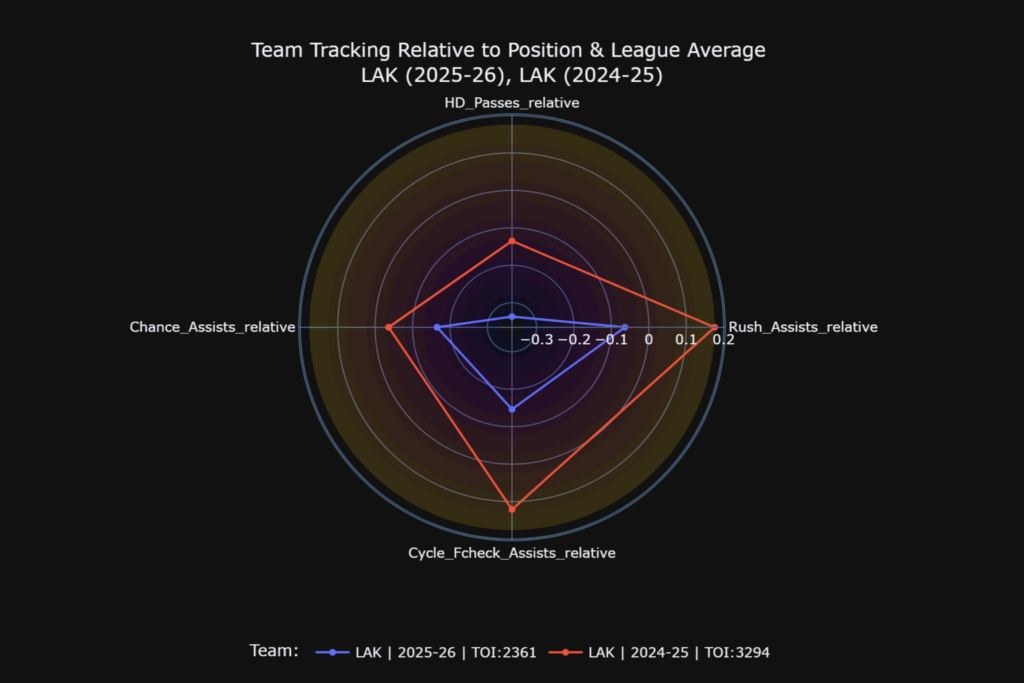
The Kings were passable-to-good in these areas in 2024-25 but below average across the board in 2025-26, sometimes falling into ‘outright bad’ territory. This is still a lineup with plenty of holes, but Zuccarello should be able to maintain, or elevate, the scoring of guys like Quinton Byfield, Alex Laferriere, and Adrian Kempe. (july2)
13. Mason Marchment
For my money, the best free agent forward left when July 1st rolled around was Marchment. To read what Puneet had to say about the deal, check this out.
As is the case with any Sharks forward, at least for right now, there are two states in which they exist: skating with Macklin Celebrini, or skating without him. While I have belief in the future upside of Michael Misa and Will Smith, and veterans like Alex Wennberg and Tyler Toffoli both bring valuable skills, Celebrini might be one of the five best offensive forwards in the league right now. The gap between him and anyone else on the Sharks’ roster is large. So, how productive Marchment is will be directly related to how much time he gets next to Celebrini, and that’s very much a toss-up.
When I wrote about Marchment a couple weeks ago, the big takeaway was his versatility on offence. He can create both off the rush and off the cycle, he can fire his own scoring chances or set up teammates for theirs. That kind of dual-threat nature is not something a lot of wingers possess, and that, along with the fact that he’s 6’5 and likes to play a physical game, indicates to me that he’ll get a crack next to Celebrini to start the year. I think the top-6 looks something like this:
Marchment – Celebrini – Smith
Sherwood-Misa-Toffoli
Then you have Wennberg on the third line in a checking role with the likes of Collin Graf and Ty Dellandrea. A lot will depend on Misa’s ability to contribute in a middle-6 role, but I think that’s how things line up.
Over the last three seasons, Marchment has averaged 25 goals and 32 assists every 82 games, doing so while managing just 11 power-play points per 82 in that span. If he can get some top power-play time, and ends up next to Celebrini both at 5-on-5 and on the PP, he can genuinely reach the 30-goal, 40-assist plateaus. It all depends on how they use him, but he has the skills and the opportunity to really level up his fantasy value. If he doesn’t get that spot, he can absolutely help elevate Misa’s fantasy value. (july2)
14. Sergei Bobrovsky
After trading Joseph Woll and letting Samuel Ersson go to Ottawa, the Leafs had to go find a second goalie to pair with Anthony Stolarz, and they landed on Bobrovsky. Dobber himself shared his fantasy thoughts on the deal here.
To me, the Leafs should undoubtedly be a better team in 2026-27 because Darren Raddysh and Emil Andrae are big upgrades on Brandon Carlo and Simon Benoit. If the blue line stays healthy, and Auston Matthews stays healthy, this should be a team that at least competes for a playoff spot. That matters to Bobrovsky.
What also matters is Goalie Bob’s skills. No matter the metrics we look at, he’s declined each of the last two seasons, and while the injuries Florida had last season were part of it, goalies have good seasons on bad teams all of the time – Igor Shesterkin, Dustin Wolf, and Spencer Knight all had good-to-great years on bad teams in 2025-26. That Bobrovsky fell off a cliff and turns 38 years old in September is concerning. When goalies truly start their age-related decline, things can go south in a hurry (Marc-André Fleury just went through this before he retired). There is a chance that Bobrovsky plays poorly right from the jump just because of his age, and also a chance that happens just because that can happen to any goalie regardless of age. It is a big risk.
On top of that, provided Anthony Stolarz stays healthy – and that’s a big “if” – they probably want to keep Bob as rested as possible for a potential playoff run. I wouldn’t rely on Bob for more than 50 games if I was a fantasy manager, and be prepared for him to start 40-50 games rather than 50-60.
This could work out very well for the Leafs if the team improves and Bob can get spelled off for two out of every five games, but there is a lot of risk here. I’m sure he’ll be a target of late-round fantasy goalie drafters, but I might be inclined to wait even later and draft Stolarz. (july2)
15. Devon Levi
Dobber also had thoughts on the Levi acquisition here.
All I’ll say is this. For now, the Edmonton Oilers have two goalies: Levi and Tristan Jarry. The latter showed his… let’s call it unreliability… last season. This is still a team with Stanley Cup aspirations, and whatever we think of Mike Babcock, my guess is the Oilers will be a better defensive team in 2026-27 than they were in 2025-26. If I’m a fantasy manager looking for a late-round goalie, Levi is a name I have circled. Maybe he falls flat on his face, but this was one of the most highly-touted goalie prospects in the world a few years ago and it’s not as if he’s been bad in the AHL. In fact, over the last three years, he has the same AHL save percentage as Jet Greaves (.914) and higher than Brandon Bussi (.910). The former is now the starting goalie in Columbus and the latter just won a Stanely Cup. As far as potential fantasy value goes, Levi to the Oilers might be the most impactful addition any team made on July 1st.
* Update: Thursday night, Frederik Andersen signed with the Oilers, so it'll be interesting to see what Edmonton does here. Levi would need to clear waivers to be sent to the AHL, so it seems as if they're running with a three-goalie setup to start the season. That helps nobody, fantasy-wise, and I would still rather make a cheaper bet on Levi in fantasy drafts than a more expensive one on either Jarry or Andersen. (july2)
16. The New Jersey Devils traded Jacob Markstrom to the Florida Panthers before his latest extension had even kicked in. In it, Evan Rodrigues went back to the Devils, who needed depth at forward more than they needed another sub-par season from Markstrom. You can find Cliffy's take on the deal here.
In Markstrom and recent acquisition Akira Schmid, the Panthers have revamped their goaltending to be much cheaper but also more uncertain than in previous season. This could be a season with more wins for Markstrom, but not necessarily an improvement in Gaa/Sv%. Schmid gets another chance as a full-time NHL goalie, but he could easily be replaced if he doesn’t perform.
To finish the day for the Devils, they re-signed Areseni Gritsyuk to a three-year deal at $3.25 Million per season. (july1)
17. Following up on my Ramblings from last week where I had my own fantasy draft rankings for the 2026 class, I was asked by a couple of readers to expand on who saw their value rise or fall based on the draft, and who might be in a position to make a more immediate impact.
First off, the risers:
Keaton Verhoeff going to San Jose at #9 was a steal for the team, and the best-case scenario for Verhoeff. They don’t need him this year, or maybe even next, and they have shown with Sam Dickinson that they can wait for the development that the player needs. Verhoeff’s upside in San Jose is about as high as a fantasy owner could ask for from a Dman who is outside of the Cale Makar/Zach Werenski tier. He jumps ahead of Carels for me now.
Mathis Preston being selected by Anaheim gives him a great spot where he won’t be rushed to the NHL (very important for him after the time lost to injury), but where there is still space in the top-nine with a very young, strong, and talented group moving forward. There are still question marks with him, but Anaheim is a great path that in my mind increases the likelihood of him hitting his eventual upside. He’s now up in the early teens for me.
Liam and Markus Ruck ending up in any NHL system together is a boon for their value, but on a team as ready as Pittsburgh will be to enter a new chapter in the coming years feels like the perfect opportunity for both players to come up to the league together at that point. There will be room for these two on the NHL roster as soon as they show they’re ready. I would bump them up a couple spots each.
Xavier Villeneuve is an excellent addition to the Chicago blueline, which already has a ton of size, and will accommodate Villeneuve’s style well. Villeneuve has one of the highest offensive upsides in the class, and while there are other puck-movers on the Chicago blueline, those players can be moved into all-around roles. If/when Villeneuve makes it, he would make it in part because he is going to be the power play specialist. An added bonus was the Blackhawks mentioning at the draft that he may not be done growing yet. Mid-to-late teens in fantasy drafts seems reasonable depending on your risk appetite and attitude towards Dmen.
I also thought the picks of Jonas Lagerberg Hoen and Jaxon Cover by Ottawa showed that the team was aiming for upside to try and fill out their sad prospect pool. For Lagerberg Hoen and Cover, it means that they could just to the top of the depth chart for players outside of the NHL very quickly, and have an easier path to playing games in the next few days. (july1)
18. Now, the fallers:
Ryan Lin looks to have the growth potential to be a solid #2/3 defenceman at the NHL level. However, with Dickinson and Verhoeff ahead of him on the depth chart, and likely others in the way as well by the time Lin is a regular, there just isn’t much space for him to become hugely fantasy relevant with the Sharks. He drops way down my list.
For Alberts Smits, one of Seattle or Winnipeg felt like the natural spot in the draft for him to be picked, and in those locations there wasn’t as much stopping him from being used in a bit more of a Mortiz Seider “do-everything” kind of role. However, in New York, Adam Fox is already established while still being reasonably young. Smits won’t have the space to really produce more than as a PP2 option for the next decade, which really caps his upside. He’s now somewhere in the early-to-mid teens.
Carson Carels was selected by the Flames, making it almost a homecoming for the Manitoba native. The problem is, between Simon Nemec and Zayne Parekh, the offensive time for the blueline is mostly accounted for already, and it may put Carels along a similar career path as Ryan Suter, who was always very reliable, but never the top offensive defenceman, which made him a better name value than actual fantasy asset. The high floor keeps him around 10 on my list, but the lower ceiling drops him out of the range of the top-five.
Ethan Belchetz being selected to Utah doesn’t necessarily change his outlook, but it was the combo of public scouts lately being more negative about his upside and projection, being matched with slipping below his expected range in the draft that throws up a red flag for me, and pushes him into the 18-22 range on my updated list.
19. Looking at players and depth charts now, we can make some educated guesses about which players may provide some value right away. Every year there are a few players that make an impact, but it’s almost always fewer players than people expect, and there are always a few surprises.
The top players in Ivar Stenberg and Gavin McKenna will likely play the year in the NHL. They’re of that quality to have an impact (though likely not star level right away), and they are developmentally ahead enough to stick.
After those two it gets a bit murky. Caleb Malhotra would have a big jump from the OHL to NHL, and the Canucks are going to be awful again. Viggo Bjorck has been touted as being NHL ready, but Winnipeg doesn’t necessarily have a lot of extra roster space, and they also have Brayden Yager who might steal that C2 spot. Bjorck is likely best served by one more year in Europe. Smits and Carels could make the jump as well, but neither seems like a sure thing. Verhoeff, Daxon Rudolph, and Cameron Reid are best served by at least one more year of development as well. After that, the talent in the draft fell off a little, and it would be the players who could play C3 or D5 right away that would have a chance of making it. There are a couple of possibilities like Alexander Command, Malte Gustafsson, or Gleb Pugachyov could make their respective clubs in depth roles, but they likely wouldn’t have much of an offensive impact in the NHL soon even if they did make it this fall. (july1)
20. There were a couple of big trades to take place last weekend during the NHL Draft. The first saw J.J. Peterka be traded to the Boston Bruins and the second was Mason McTavish being moved to the St. Louis Blues. Ian had his take on both those trades: the Peterka swap was covered here and the McTavish deal was discussed here. I wanted to offer my thoughts on the deals.
The important point Ian raised when he wrote about Peterka was his power-play usage in Utah. He skated just 42% of the power play time for the Mammoth, which was sixth among their forwards. The trio of Clayton Keller, Dylan Guenther, and Nick Schmaltz were top PP staples while Logan Cooley, Barrett Hayton, and Peterka each had their turn as the fourth forward. The year before, Peterka led the Buffalo Sabres with 63.9% of the PP ice time. Compounding the problem was that Utah’s second PP unit scored 36% less on a per-minute basis than the top unit. That disparity in scoring combined with the loss in overall ice time is why Peterka’s PP production dropped so much.
The second crucial point Ian raised was Peterka’s point rate. In his only season with Utah, he managed 2.1 points per 60 minutes at 5-on-5. Across his three full seasons with Buffalo, he tallied 2.1 points per 60 minutes at 5-on-5. His production at that strength was the same as his three-year average, so, again, it’s the power play that mattered.
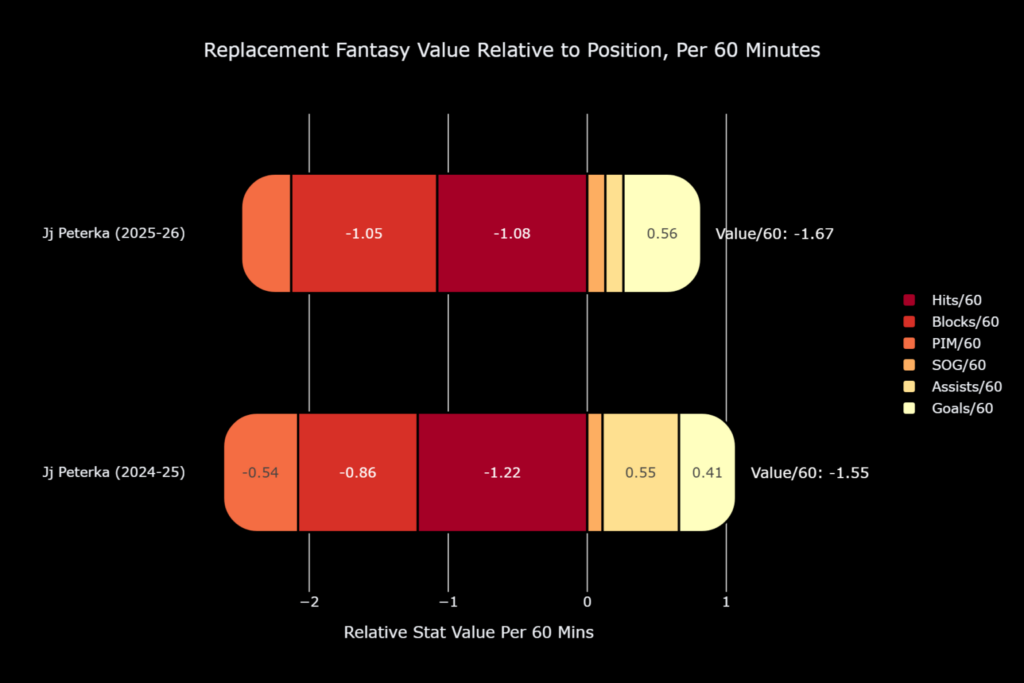
This becomes very obvious when we see his fantasy value breakdown. Using goals, assists, shots, hits, blocks, and penalty minutes on a 60-minute basis, Peterka’s replacement fantasy value relative to other forwards in 2025-26 was nearly identical to what it was in 2024-25:
However, if we add power-play points to the mix, that is where the disparity becomes obvious, as his fantasy value was twice as high in 2024-25 compared to 2025-26:
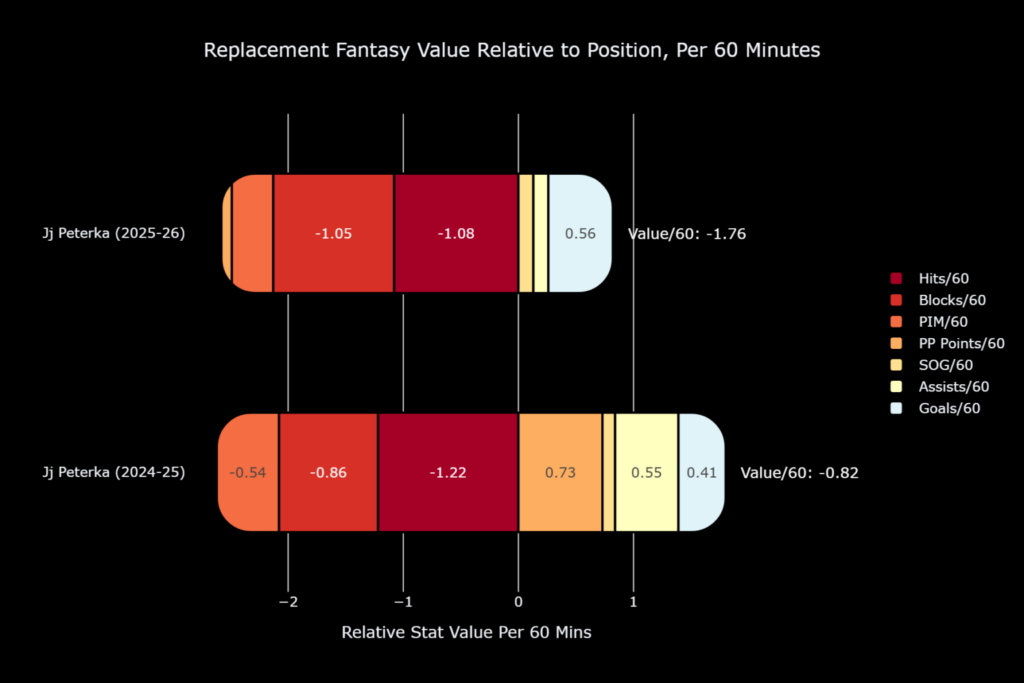
This disparity is why it’s important that Peterka still managed 2.1 points per 60 minutes at 5-on-5. He spent half his ice time without at least one of Clayton Keller or Dylan Guenther on his wing (per Natural Stat Trick), so he proved he can still be productive even without a star offensive player on his line. Now that Peterka’s in Boston, we would love to see him play 75% of his ice time with David Pastrnak, but even if he spends half the season on the second line with the likes of Casey Mittelstadt, Pavel Zacha, or Morgan Geekie, he can still be productive.
It all comes down to whether gets top PP time, and I don’t think it’s a sure thing. The Bruins’ PP consists of Pastrňák, Geekie, Zacha, and Elias Lindholm. Replacing Lindholm makes sense, but it would also take one of the two centres off the power play. Teams like to have two centres on the power play, preferably of opposite handedness to take faceoffs on their strong side, and to have a backup in case one centre gets kicked out of the faceoff for some kind of violation. We just saw the Carolina Hurricanes’ power play find a lot of success by having Jordan Staal on the top unit for the faceoff, and then he’d change for Nikolaj Ehlers when he had a chance. Maybe Boston tries the same thing as Carolina, maybe they replace Lindholm with Peterka and have Geekie take faceoffs on his strong side (which he’s done in the past), or maybe Peterka replaces Geekie and Boston keeps their two centres. Or maybe Peterka just winds up on the second PP unit for most of the season.
I’m not convinced that Peterka is a staple of Boston’s top man advantage quintet all season. He will assuredly get a crack at it, and maybe they score well enough that he stays, whatever its composition, but I’m not sure of it, or even close to sure. And as we just saw with Utah, that usage matters a lot, being the difference between 20 power-play points or five PPPs. The good news is that coming off a down year, I imagine Peterka is a lot cheaper at the draft table than he was a year ago. (june30)
21. Mason McTavish
Before getting to his fantasy profile, the primary issue with McTavish’s fantasy value isn’t his offence, it’s his defence. Regardless of the public model we look at, he is anywhere from below-average to outright-bad defensively. Unless a player is both an offensive dynamo and a veteran with a long track record (someone like Mark Scheifele or Erik Karlsson), NHL coaches are very hesitant to give bad defensive players a lot of minutes. As other players passed him on the depth chart and his defensive game struggled, that’s what happened to McTavish in Anaheim as the Ducks dropped his even-strength TOI share from 28.1% in 2024-25 to 26.1% in 2025-26. It cost him over a minute per game in EVTOI and kept him on the third line for a big chunk of the season. In St. Louis, he’ll be no better than the second-line centre behind Robert Thomas, and if McTavish shows poor defensive results again, he could easily be moved down the lineup for Pius Suter.
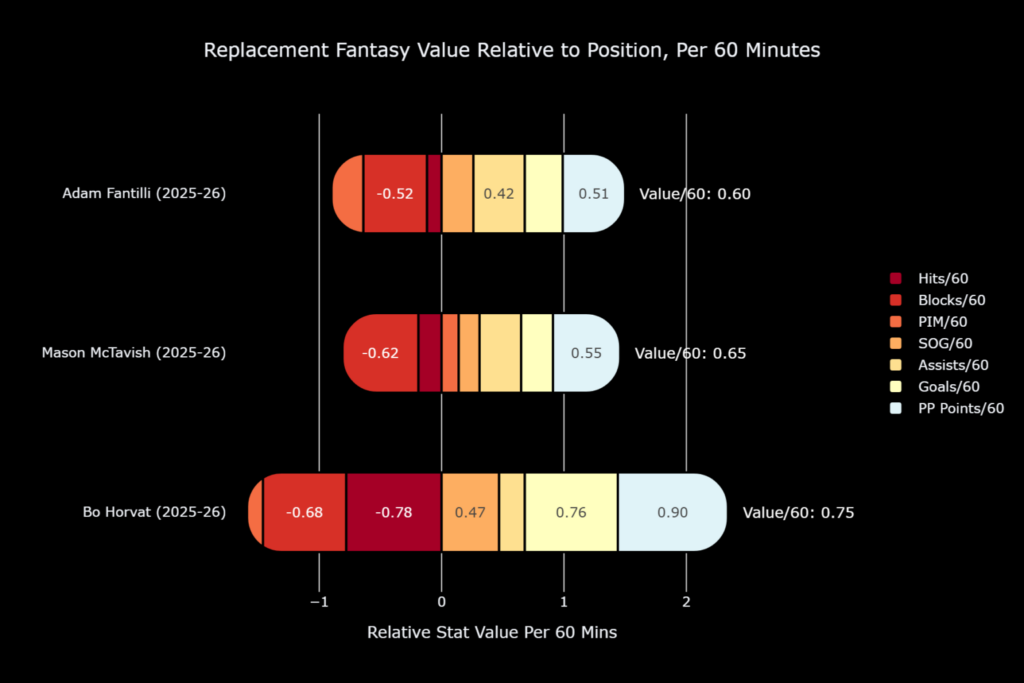
Here is the good news: McTavish’s 2025-26 fantasy production was not as bad as it seemed on the surface. If we look on a 60-minute basis using the same stats we used for Peterka, McTavish landed somewhere between Bo Horvat and Adam Fantilli:
And, despite the ice time, McTavish’s fantasy value was just fine on a per-game basis. Among players with at least 41 games played, he was on the fringes of the top-150 forwards, and similar to a guy who had 82-game paces of 30 goals, 35 assists, and 207 shots:
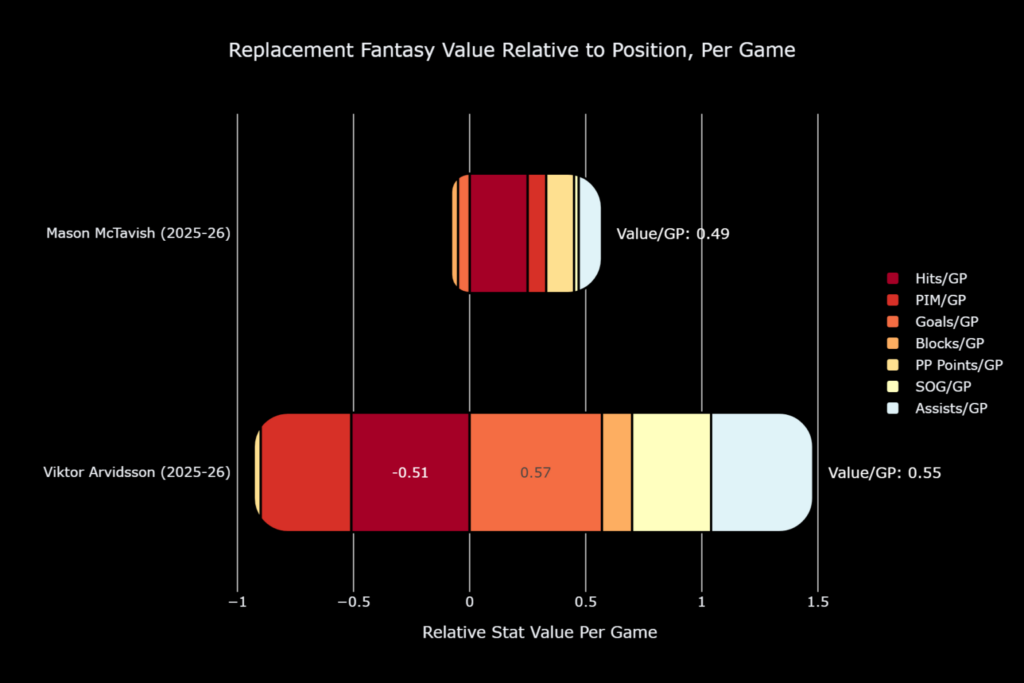
McTavish took a step back in 2025-26 on a per-game basis, but he was still roster-able in anything but shallow fantasy formats, and being productive despite a reduced role works in his favour.
Assuming McTavish gets a second-line role, the concern is his line mates. The Blues traded Jordan Kyrou, and Jimmy Snuggerud seems to have found a home next to Thomas. Unless Pavel Buchnevich turns the clock back 3-4 years, it leaves just Dylan Holloway as a high-end scoring winger for McTavish to play with. If, for whatever reason, Holloway doesn’t end up on McTavish’s line (he skates the top line, he skates the third line, or he’s injured), then McTavish doesn’t have much offence to skate with. Then there is the St. Louis blue line, which really struggled to move the puck last season, and might not get a lot better next season thanks to the addition of Brandon Carlo.
Whatever we think of McTavish’s value in real-life NHL terms, I don’t have major concerns that he’ll be a useful fantasy option in 2026-27. I have fewer questions about him than I do about the team that surrounds him, which presents us with a big problem. It is conceivable that McTavish improves his skills, adds 1:30-2:00 per game in ice time, gets a regular turn on the top PP unit, and his fantasy needle doesn’t move significantly because the Blues don’t have much offensive depth. St. Louis is a much worse offensive environment than Anaheim, especially for anyone not skating with Robert Thomas, so this is a case where the player’s skills and usage improve, but the downgrade in his surroundings is enough to negate that a big portion of that improvement. His fantasy value should increase, but if the team treads water offensively, that increase won’t be as much as we’d hope for. (june30)
***
Reminder: Dobber's 2026 Fantasy Hockey Prospects Report is available now in the Dobber Shop! Both Dobber and the Prospects team highlight the prospects you need to know. It has an in-depth look at each team's current prospect pipeline and estimated arrivals for their top, young (hopeful) stars. Head on over to the Dobber Shop and grab a copy of the Prospects Report!
***
Have a good week, folks!
Thanks for continuing to support the website and if you’re bored and need a fantasy hockey fix – visit the gang in the forum here.
Related Posts
Starting Goalies













Top Skater Views
| Players | Team | |
|---|---|---|
| TRISTAN LUNEAU |
 ANA ANA | |
| LUCA CAGNONI |
 S.J S.J | |
| ADAM JIRICEK |
 STL STL | |
| MARCO ROSSI |
 VAN VAN | |
| IGOR CHERNYSHOV |
S.J
| |
Top Goalie Profile Views
| Players | Team | |
|---|---|---|
| JOEL HOFER |
STL | |
| NICO DAWS |
 N.J N.J | |
| DYLAN GARAND |
 NYR NYR | |
| ARTURS SILOVS |
 PIT PIT | |
| SERGEI MURASHOV |
PIT
| |
LINE COMBOS
| Frequency |
 MTL Players MTL Players
| |
|---|---|---|
| 19.7 | NICK SUZUKI CHRIS KREIDER COLE CAUFIELD | |
| 15.1 | JURAJ SLAFKOVSKY ALEX NEWHOOK IVAN DEMIDOV | |
| 13.8 | JAKE EVANS ZACHARY BOLDUC JOSH ANDERSON | |
DobberHockey Podcasts

Keeping Karlsson: Short Shifts – I Tried to be Like Parker Kelly
Elan is joined by Ryan Downey for the premiere of season 8 of Short Shifts! — KKUPFL late registration is ongoing! We’re still filling new divisions in the world’s greatest fantasy hockey league. Details at https://www.kkupfl.com/. Join the Keeping Karlsson patron community! Patrons get access to all our perks all year round, including KKUPFL […]
Keeping Karlsson: Shabanov Ranks
Elan and Brian fly through the final preseason lines for every NHL team ahead of opening night, and share their guys to watch– or look away from– in your fantasy hockey leagues.

Fantasy Hockey Life: Western Conference Catchup and Mustard
Jesse and Victor are here to Catch Up on everything in the Western Conference that transpired ofter our team previews. We also have our annual spicy mustard competition – two hot takes per team. Our show is part of the Dobber Podcast Network and sponsored by Fantrax.com. Email [email protected] and ask to join our free […]
Keeping Karlsson: Matchup Maximizer 2026/27 Week 1
Elan takes a look at the schedule for the upcoming weeks of NHL action and recommends players with good schedules that you should consider streaming in to win your head to head matchups.
Fantasy Hockey Life: Dallas Stars with Taylor Newby
Taylor Newby joins the program to discuss the Dallas Stars.