

21 Fantasy Hockey Rambles
Dobber Sports
2026-05-24
Every Sunday, we share 21 Fantasy Rambles from our writers at DobberHockey. These thoughts are curated from the past week’s 'Daily Ramblings'.
Writers/Editors: Ian Gooding, Michael Clifford, Alexander MacLean, Puneet Sharma, and Dobber
___
1. I figured I would preview the third round a little (Ed. note: Alex wrote this before it got going. You can also check out our panel of DobberHockey writers' predictions here.)
First up, the matchup we have known for a little longer, Vegas versus Colorado. Though Minnesota was my pick to come out of the West (and I wonder whether that might have been closer to happening if Joel Eriksson Ek was healthy), no one is surprised that the Avs are here, after they had a dominant regular season. They have depth at every position, that was firmly reinforced at the trade deadline, and most of their players manage to avoid the band-aid-boy list year after year.
Vegas on the other hand has a few stars that are often in and out of the lineup, and some of those health questions cloud the projections for round three. They did get a boost at centre with William Karlsson returning, but with Adin Hill not having been himself this year, Mark Stone out of the lineup again, and multiple defencemen clearly banged up, the uncertainty is palpable with the Golden Knights crew.
My money is on Colorado in a shorter series here, but if Cale Makar‘s injury is more serious and Vegas has Stone return, then it’s a very close matchup. (may20)
2. On the Eastern Conference side, we have another tale of two very different teams, with Carolina barreling through their first two opponents, not losing a game, not allowing more than two goals against in any one game, and now that Nikolaj Ehlers and Alexander Nikishin are back at practice, the team looks to be relatively healthy to boot.
Meanwhile, Montreal needed game seven to dispatch both Tampa Bay and Buffalo, and they were outplayed in both of those final games. They are still very deserving of winning the East though, as their whole lineup is chipping in right now, and their youth just seems to be bringing the team more energy in each successive game. This series could very well come down to which team’s hot goaltender can make one or two extra saves. As a result of Montreal’s early-season goaltending woes, it does seem like they are being discounted a bit despite the recent run.
I have Carolina winning in five here, but I think this could go either way with a lot of one-goal games. The Canes didn’t let the long rest affect them in round two, and odds are they will be able to come out strong in round three as well. (may20)
3. In talking about the Avs above, it made me think about a larger oversight I had in team planning in my dynasty league this year centering on the Avalanche. After dealing with a lot of my star players resting the year prior, when I had looked ahead to the playoff schedule, Colorado had one of the best in terms of game volume, off-night schedules, and weaker matchups. In my cap-league dynasty, the top-of-the-lineup players like Nathan MacKinnon and Martin Necas were untouchable, and hot starts from Brock Nelson and Artturi Lehkonen put them out of my price range in trades. However, my theory was that with the Avs running away with the President’s trophy, that they would rest some of those top players in important playoff weeks. As a result, I thought players like Parker Kelly, Gaving Brindley, Zakhar Bardakov, and other depth players would be more relevant (obviously still not star level). I targeted Ross Colton, Jack Drury, and Sam Malinski through the season, but couldn’t get those done.
However, what I failed to account for was that the team would slow mid-season, needing a late push to keep the President’s Trophy locked away. In addition, there were a number of reinforcements brought in, in the form of Nazem Kadri and Nic Roy, pushing the depth players out of the lineup once the team was fully healthy. If there were some lingering injuries then likely the Avs would have brought in even more reinforcements at the deadline.
Top teams tend to bring in a couple of pieces, and inevitably the bottom line that starts the year with the team is at least partially phased out in favour of better options. Next year my trade deadline targets are going to be more geared towards the middle of the pack teams who maintain something to play for right up until the final week of the season. (may20)
4. Just a reminder of the starting goalies remaining in this year’s Stanley Cup playoffs (before the winner between Montreal and Buffalo was known):
Frederik Andersen
Scott Wedgewood
Carter Hart
Jakub Dobes
Alex Lyon/Ukko-Pekka Luukkonen
The highest salary of that group belongs to Luukkonen, who earns $4.75 million. He hasn’t even started the majority of the playoff games for the Sabres, but I’m including him here because I think he’ll start Game 7. After that, it’s Andersen at $2.75 million.
In the modern NHL, having a top-tier goalie may not be as important as you think it is. Having a serviceable goalie might be enough, especially with a hard salary cap and dollars that can be used on top-tier scorers. (may17)
5. Good news from the Sabres, prospect Jiri Kulich can begin with his rehab and workouts to ramp up for a return to hockey in the fall. He was out with a blood clot in his ear, which he finally had removed in March. He only played 12 games this past season, putting up five points, so he still qualifies as a prospect in my books (and for most). However, he looked like a full-time player when he was on the ice, and he should be a top-nine option for the Sabres again next season.
One of those players looking to battle with Kulich for only a few remaining lineup spots is Konsta Helenius. Helenius put up a fantastic season at the AHL level with 63 points in as many games, nearly doubling his production from last season. He then put an exclamation mark on his season with his presence in the NHL playoffs, and is now off to the World Championship with Finland, where he could further raise his stock heading into next season. Kulich and Helenius could put up similar scoring seasons next year for the Sabres, but one of them is going to be a lot more difficult to acquire through the summer. (may20)
Before the Western Conference Final kicked off on Wednesday, the Buffalo Sabres announced a two-year extension for head coach Lindy Ruff. The Sabres are coming off their most successful season in over a decade so it makes sense that the coach be rewarded for that effort. (may21)
6. We’re starting to hit those lighter nights on the NHL schedule where there’s just not much to cover, and tonight is one of them. With no games on tap, I decided to take a deeper dive into a few players for one reason or another that didn’t fully take that next step. In a lot of cases, it comes down to opportunity not quite catching up yet such as shifting roles, inconsistent linemates, or teams still figuring out how to best deploy them in the lineup. The key difference in this group is how the production is actually being generated. Some players lean on shot volume and steady involvement in the offense, others are more finish-driven and power-play dependent, and a few are still waiting on stable roles before their numbers can fully scale. Once you strip away the raw point totals, the separation becomes clearer between those producing within strong environments and those whose output is still heavily context-driven.
Josh Norris reaching the 70-point mark really comes down to one factor above everything else: health. The offensive talent has never really been the concern, but durability continues to prevent him from fully putting everything together over a complete season. Norris still has not played a full NHL season and has yet to even hit the 70-game mark once in his career. His high remains 66 games back in 2021-22, which also happened to be the best offensive season of his career from a PPG perspective at 0.83. This past season followed a familiar pattern, limited to just 44 games because of multiple injuries, though the production remained strong with a 0.77 PPG pace, the second-best mark of his career. Buffalo looks far more competitive than in previous years, and the roster has started trending in the right direction. More support throughout the lineup should help create better offensive conditions overall, especially for a player like Norris who thrives when he has skilled playmakers around him and consistent power-play deployment.
That said, once you dig into the underlying profile, there are still reasons for caution. Norris produced at a 63-point pace this season and his 5v5 scoring results were strong, but a lot of the production leaned heavily on efficiency rather than volume. His on-ice numbers were inflated by percentages that are difficult to confidently project year over year. Norris finished with a 1024 PDO at 5v5, driven largely by a 12.5% on-ice S%. There was also a gap between actual and expected goals, with his line scoring 37 at even strength on just 25.1 expected. That level of overperformance usually points to regression risk. Role also remains part of the equation. His deployment has been more balanced than heavily offensive, which naturally caps some of the upside from a fantasy perspective. At the end of the day, Norris still profiles more like a strong 60–65-point player than a player who can hit that next tier. It’s not to say it isn’t possible; however, he would need to stay healthy, keep his power-play role, and get a stable top-six deployment for a full year. Everything would need to break perfectly for that to happen. (may18)
Mantha’s career arc tells a pretty consistent story: strong per-minute production, flashes of top-line finishing ability, and just enough inconsistency in usage and health to cap his ceiling in the mid-60s.
This past season in Pittsburgh was another example of that balance. Mantha finished with 64 points in 81 games, producing at a 65-point pace. On the surface, that looks close enough to suggest a 70-point season could still happen under the right circumstances. There are definitely positives in the profile that support that idea. His 21.7 S% was extremely high, but even with some regression, Mantha still projects as an efficient finisher. His 3.1 PTS/60 at 5v5 was legitimately strong, while his 7.4 SOG/60 showed he remained involved enough offensively to sustain solid production. He also benefited from favorable deployment, starting over 63% of his shifts in the offensive zone, which naturally helped boost his counting stats.
The problem is that the limitations show up just as clearly once you dig deeper. Mantha still is not a true play driver. His 47.9 CF% and near break-even 50.7 xGF% point toward a player who benefits more from his environment than controls it himself. That matters when trying to project a jump from the mid-60s into the 70-point range because players who consistently reach that level usually drive play at even strength or produce at an elite level on the power play. Mantha has not consistently done either. Despite spending time with high-end talent, he finished with just 13 PPP’s and has never really profiled as a high-end playmaker.
At even strength, he moved throughout the lineup, spending significant time with players like Justin Brazeau and Ben Kindel while only getting brief stretches alongside Evgeni Malkin and Sidney Crosby. His best offensive runs usually came in short bursts with stronger linemates, but overall, the deployment leaned more middle-six than true top-line usage.
The uncertainty around Pittsburgh’s veteran core is of concern and it cuts both ways for Mantha. On one hand, should Mantha return to Pittsburgh it could open up more usage, potentially pushing him into a larger offensive role with increased TOI and more power-play responsibility. On the other hand, it likely weakens the overall offensive ecosystem. Mantha has historically been a complementary scorer, so removing those elite linemates from the equation could probably hurt his efficiency more than increased volume would help it. (may18)
Dorofeyev is a very different case compared to the previous names you’ve worked through. He is a player who has already taken that next step and is now trying to prove the production is repeatable at a higher tier.
His 64-point season jumps off the page and the biggest driver has been elite deployment. He spent significant time riding shotgun with Mitch Marner and Tomas Hertl at even strength, and was also a staple on a loaded top power-play unit alongside Jack Eichel and Mark Stone. That unit alone accounted for 20 of his 30 power-play points, which is a massive chunk of his overall production. His S% at 16.1% is elevated, but not outrageous for a player getting high-end looks in a premium offensive role. His 2.8 shots per game rate paired with 9.6 SOG/60 suggests this wasn’t a passive passenger role. He was actively driving offense within those lines, not just finishing plays.
Even his xGF at 5v5 (49.33) closely aligned with actual output (48 GF at 5v5), which is a strong indicator that what we saw wasn’t purely luck-driven. The key question isn’t whether Dorofeyev can produce, but whether he can maintain this exact environment. His value is heavily tied to role insulation. He benefited from elite linemates and a top-tier power play that was operating at an extremely efficient clip. He has currently posted 11 points in 12 playoff games with nine of those being goals and his primary line mates have been Jack Eichel and Ivan Barbashev while also seeing time on the to man-advantage.
Dorofeyev finished at a 64-point pace over a full 82-game season, so we’re not asking for a massive leap, just marginal growth. The key is, if he holds the same role, a bump to 70 is absolutely within reach. Even a slight increase in assists, which is possible given the talent around him, could get him there without needing another jump in goal scoring. (may18)
Byfield’ s tools, progression, and impact are all there, but the way he was being deployed was capping him in the box score. The numbers are clearly underwhelming with back-to-back seasons hovering in the mid-50s followed by a slight dip to 49 points giving the impression of stalled growth. However, all of his underlying numbers suggest that Byfield is still driving play at a strong level. He is actively involved in generating offense rather than just riding shotgun. His PTS/60 dropped from 2.5 to 1.9, and his shot rate sits at 6.8 SOG/60, which is modest for someone expected to anchor a top line. That’s the key tension in his profile right now. A big part of that comes back to deployment. His offensive zone start rate fell and he has been leaned on in more balanced situations which pulled down his counting stats. The revolving door of linemates didn’t help either. While there have been stretches alongside Kevin Fiala and Adrian Kempe, his longest run came with Trevor Moore and Alex Laferriere. Solid players, but not the kind of elite finishers who consistently convert chances at a high rate. Add in time with more defensively inclined wingers like Joel Armia and Warren Foegele, and the offensive environment has lacked consistency. For a player still defining his offensive identity, that matters.
The clearest cap on his upside shows up on the power play. Despite logging close to two minutes per game, similar to is PP TOI the previous season, he finished with just 11 power play points four more than last season. The issue isn’t inefficiency, it’s role. He’s not the focal point. That still ran through Anze Kopitar, Fiala, and Kempe. Byfield’s PPIPP sat at 52.4%, which reflects more of a secondary, support role rather than a primary creator or shooter. Until those changes, the ceiling remains limited.
We may see his production change for the better next season now that Anze Kopitar will no longer be in his way and the recent addition of Artemi Panarin prior to the trade deadline. He’s already logging over 20 minutes a night and holding his own in all situations, which is a strong foundation. The question isn’t ability, it’s environment. Until we see more of a stable offensive role, it’s hard to believe the jump in production. (may18)
10. Yesterday I listed three players I regretted drafting in single-season leagues. Here are three more. The first number is where I drafted the player, while the second number is their Yahoo ranking in the league for the season.
Jordan Kyrou (95, 198)
Kyrou should no longer be viewed as a rising star in fantasy hockey. Now 28 years old, Kyrou has seen a gradual decline for the most part from his career-best 75 points in 74 games from 2021-22 to just 46 points in 72 games this past season. The shift in St. Louis transitioning into a semi-rebuild and Kyrou’s defensive issues under two different coaches (Craig Berube, Jim Montgomery) have resulted in his icetime decreasing, limiting his production.
In addition to his overall production declining, Kyrou’s shooting has dropped (3.4 SOG/GP in 2022-23 to 2.4 SOG/GP in 2025-26), as has his power-play production (23 PPP in 2022-23 to 14 PPP in 2025-26). Kyrou’s goal total was cut in half from 2024-25 (36 G) to 2025-26 (18 G), which can be attributed to both fewer shots (239 SOG to 173 SOG) and a lower shooting percentage (15.1% to 10.4%). As well, 2025-26 was the first season in his last four seasons that Kyrou received fewer than 50 percent of his team’s power-play minutes (47.9%).
If things start to break Kyrou’s way, again, it’s possible that he returns to a 30-goal, 70-point pace again. However, Kyrou is not a player that I would expect will take another step in 2026-27, especially with the players around him on a St. Louis squad likely to be a bubble playoff team at best next season. (may17)
11. Drew Doughty (118, 423)
If you had to ask me which player I regretted drafting the most, I’d tell you Doughty. Maybe because I foolishly drafted him in two leagues thinking he still had a lot left in the tank and would still be a legitimate power-play threat. Or maybe because I eventually dropped him in both of those leagues. Regardless, if you held onto Doughty all season, he probably contributed negative value (or something related to that) to your team.
The signs of Doughty’s flattened value were already there. Doughty’s scoring rate had regressed slightly in the three seasons prior from 0.79 PTS/GP in 2021-22 to 0.64 PTS/GP to 0.61 PTS/GP to 0.57 PTS/GP in 2024-25, when he played in just 30 games. Doughty had always retained his role on the top power play, which along with his usual high icetime number was the reason I targeted him. However, even that PP1 role was lost to Brandt Clarke, while Doughty’s scoring average fell to a career low 0.32 PTS/GP (23 PTS in 72 GP). Even with the power-play time he did receive, Doughty picked up a grand total of one power-play point.
Doughty can still contribute somewhat with peripherals (101 SOG, 52 hits, 76 blocks), but those numbers don’t stand out even in any one category. Doughty seems to be transitioning into a shutdown role, which is another way of saying that his real-life value is surpassing his fantasy value. At this point, Doughty should not be drafted in standard-sized fantasy leagues next season, given how much his scoring has fallen off and how unlikely a rebound is. I haven’t even mentioned his controversial addition to Canada’s Olympic roster, which isn’t related to his fantasy value but hockey fans will no doubt have opinions about. (may17)
12. Auston Matthews (6, 109)
This was a hard one to decide whether to include. My scoring on this team was fine throughout the season and even in the final, but getting more mileage out of my first-round pick would have been nice. Especially when David Pastrnak, Quinn Hughes, Kirill Kaprizov, and Jack Eichel were all still available. It wasn’t a slam dunk that my first-round pick would have been the right call, as Mikko Rantanen and Brady Tkachuk were both injured for significant portions of the season along with Matthews.
In addition to the season-ending MCL injury at the hands (or knee) of Radko Gudas, Matthews saw his scoring decline for the second consecutive season. I figured that losing Mitch Marner could impact Matthews’ production, and that could have been a major factor in Matthews falling below a point-per-game pace (0.88 PTS/GP) for the first time since his rookie season of 2016-17. The good news is that his shot volume remained high at almost four shots per game, and some shooting percentage recovery might help his goal total get back on track. Over the past two seasons, Matthews has averaged 30 goals over 64 games, which falls just below a 40-goal pace over a full season. Not elite, but still very good.
However, questions about Matthews’ long-term health are now real, as he has not reached 70 games in back-to-back seasons. Although he could be a later first-round pick next season in 12-team leagues, Matthews is more of a gamble that he has been in past seasons. Don’t forget that where he will be playing next season isn’t 100% certain either. (may17)
13. As I continue reviewing the past season, I’m highlighting the waiver‑wire pickups that delivered the most value for me. Today, I’ll break down three of them, with three more coming tomorrow (look for them in Sunday's Ramblings). Their roster percentages and the timing of when I added them vary, but the common thread is simple: each player offered a clear, compelling reason to be scooped up at some point during the year.
I dropped Stamkos in one league but added him in another, so technically he qualifies for this list. Guess which of these teams missed the fantasy playoffs and which of these teams made the finals? Of course… I made it to the final in the league where I dropped him.
Stamkos qualifies as a waiver-wire pickup because he was dropped in many leagues after a rough start of two points in his first 14 games. After a disappointing first season in Nashville that saw his scoring fall 29 points, Stamkos appeared to clearly be on the downside of his career. However, a resurgence that started in late November saw Stamkos pile up 38 goals and 61 points in 60 games. That is more like the Stamkos we saw in Tampa Bay.
With 42 goals last season (tied for ninth with Matt Boldy), Stamkos still has elite finishing ability. He has also retained his status as a power-play weapon with 14 PPG and 26 PPP. As well, Stamkos still shoots the puck with regularity, as he reached 200 shots again. However, he doesn’t check all multicategory boxes, as he has totaled only 49 assists over two seasons in Nashville, while his plus/minus leaves a lot to be desired. His hits and blocked shots numbers are okay but not outstanding.
Overall, Stamkos should be a top-100 fantasy player entering the 2026-27 season. However, he is now 36, and he is no longer the elite fantasy option that he was in Tampa Bay. He’s a solid mid-round target in standard-sized one-year leagues, as 30-40 goals should be a reasonable projection. His keeper value is falling due to age and the recent decline in production. (may23)
14. Trevor Zegras
Fantasy leaguers were so certain that Zegras would bounce back after his trade to Philadelphia that… Zegras was drafted in 4 percent of Yahoo leagues. Yet by the end of the season, Zegras was rostered in 67 percent of leagues – to match his point total for the season! The skepticism was warranted, as Zegras had a combined 47 points in 88 games over his prior two seasons in Anaheim (0.53 PTS/GP).
I added Zegras on November 5 after he busted out of the gate with 15 points in his first 13 games. Aside from a third quarter slowdown of 11 points over 21 games, Zegras was a near point-per-game scorer for much of the season. The only advanced stat that indicates any worry is a 15.6 SH%, which partially explains the jump from 18 goals over those past two seasons to 26 goals in 2025-26.
There could be more worry about Zegras playing in the Flyers’ system under Rick Tocchet. If you’ve noticed what is happening with Matvei Michkov, you’ll understand that a skilled and creative forward like Zegras could easily find himself in Tocchet’s doghouse. As a result, Zegras should be treated as a high-risk, high-reward fantasy option. Given his career production, Zegras has a relatively low 40-point floor (over a full season), but he could easily hit 70+ points if things line up properly for him. (may23)
15. Brock Nelson
I added Nelson in mid-November after he had been on the waiver wire for about two weeks. In his first full season with the Avalanche, Nelson started off slowly with just two points in his first nine games. Since fantasy leaguers tend to quickly drop underperformers during the first few weeks of the season, Nelson (29% drafted) was the kind of player who could shake loose in shallow to mid-sized leagues.
Nelson was a point-per-game player through the second and third quarters of the season, scoring 24 goals and 42 points in 41 games before cooling off to just three goals and 12 points over his last 20 games. When he was traded from the Islanders to the Avalanche, Nelson didn’t seem like a sure thing to be on the Avs’ top power play. Sure enough, he maintained a spot on there for much of the season, cashing in with a decent 10 power-play goals and 18 power-play points.
Nelson is now 34 years old, but his game should age well because his strengths are a quick release and hockey IQ. Nazem Kadri being acquired may have been a factor in Nelson’s final-quarter drop, but Nelson still averaged 20 minutes per game over the final quarter. Nelson hasn’t produced as much during the playoffs either (3 PTS in 11 GP), so having both Nelson and Kadri on the roster will be something to watch next season. Nelson seems safe for 55-60 points next season, including 25-30 goals, but not much higher than that. (may23)
16. The season review continues as today’s Ramblings will look at defencemen who saw some under-the-hood improvements in 2025-26 which didn’t necessarily lead to big fantasy value improvements. In these Ramblings on Friday, we reviewed four forwards fitting this bill in Anton Lundell, Dmitri Voronkov, Alex Turcotte, and Simon Holmstrom.
Tracking data is at 5-on-5 only and compiled by All Three Zones. The player/team data is from Evolving Hockey. We are limiting the sample to defencemen with at least 340 tracked minutes across the 2023-25 seasons and 150 tracked minutes in 2025-26. That gives us 147 defencemen to pick through.
Braden Schneider (New York Rangers)
One thing to look at in the tracking data is called ‘scoring chance assists per 60 minutes’, or SCA/60. What that measures is how often a player assists on a teammate’s scoring chance. The chance may not turn into a goal, but it does show a player looking for his teammates in dangerous shooting positions, which is a crucial step to scoring goals, and thus point production.
Across the 2023-24 and 2024-25 seasons, Schneider’s SCA rate wasn’t very good, leading to below-average rates of scoring chance contributions (those assists plus that player’s individual scoring chances). That changed dramatically in 2025-26 as he had the second-largest increase in SCA/60 among our 147 defencemen, leading to an 80% increase in his total scoring chance contributions (SCC/60):
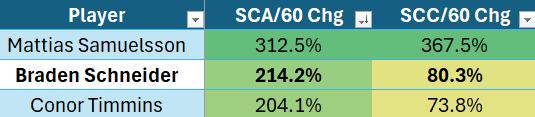
Anyone watching the 2026 NHL playoffs regularly should notice just how much success the teams with very active defencemen – Colorado, Anaheim, Montreal, Buffalo, Carolina – are having. Whatever people may think of Schneider’s defence, or his consistency, this kind of additional playmaking from the blue line can help the Rangers generate goals when Adam Fox is off the ice (assuming Schneider is in a Rangers uniform next season).
Schneider’s true breakout prospects are very murky because as long as Fox is in the lineup, Fox will take top PP minutes, and that limits Schneider’s upside. The Rangers are also in the middle of another re-tool, so how good their forwards are at 5-on-5, especially in a full year without Artemi Panarin, is another question. Regardless, if Schneider can maintain these improvements with the heavier usage he got from December onward, he can be a 30-point defenceman even without that top PP role. (may19)
17. Kaiden Guhle (Montreal Canadiens)
The first note on Guhle is that he passed the 200-game plateau back in March and turned 24 years old in January. He is entering his prime years, which we have to keep in mind.
What has held Guhle back over the last couple years are injuries. He has played just 94 regular season games over the past two seasons and 164 over the last three. He won’t have a lot of fantasy value if he misses one-third of every season.
Knowing that, Guhle’s key to fantasy ascendance is his peripheral production: over the last three seasons, Guhle is 1 of 7 players to average at least 100 shots, 150 blocks, and 150 hits every 82 games across the prior three campaigns. That kind of across-the-board production could make him a multi-cat monster if he improves his production (which is actually fine at 25 points every 82 games). That is why Guhle having sizeable increases in his SCA and zone entry rates is worth highlighting:

Montreal uses its defencemen to create offence at some of the highest rates in the league, and while guys like Lane Hutson and Noah Dobson will get the attention, it applies to every rearguard in the lineup. Guhle just being healthy for 80 games would make him a huge multi-cat asset. If he can stay healthy and keep up the offensive improvements he’s shown? He could be one of the more valuable multi-cat defencemen in fantasy hockey.
[Follow the link for more…] (may19)
18. The season review rolls on. Here is what we’ve covered over the last few weeks, starting with forwards:
- Forwards with improvements including Dmitri Voronkov, Anton Lundell, and more.
- Forward power-play contributions including Connor Bedard, Adam Fantilli, Elias Pettersson, and more.
- Forward shot volume increases including Shane Pinto, Leo Carlsson, Cole Perfetti, and more.
- Forward shot volume declines including Matias Maccelli, Brady Tkachuk, Peyton Krebs, and more.
- Forwards whose projections I missed on including Jonathan Marchessault, Dylan Larkin, Mason McTavish, and more.
And then moving to defencemen:
- Defencemen with improvements including Braden Schneider, Kaiden Guhle, Ryker Evans, and more
- Defencemen power-play contributions including Adam Fox, Rasmus Dahlin, Brandt Clarke, and more
- Defencemen shot volume increases including Mattias Samuelsson, Darren Raddysh, Luke Hughes, and more
- Defencemen shot volume declines including Quinn Hughes, Noah Dobson, Nils Lundkvist, and more
- Defencemen whose projections I missed on including Dougie Hamilton, Vince Dunn, MacKenzie Weegar, and more
We are going to stay with the theme of separating forwards and defencemen, and today the focus will be on peripherals, and specifically how the peripheral rates have changed at each position. We know that shots on goal have been declining over the last couple of seasons – how the NHL counts a shot on goal is a big culprit – but what does that mean for shot totals, and how does that affect a player’s peripheral profile? What about hits, blocks, and penalty minutes? Let’s look at all that:
19, To start with, let’s look at the changes at all strengths. As mentioned, shots on goal have been declining for the last few seasons, but how does that impact the importance of other peripherals? Here are the 60-minute rates for shots, blocks, hits, and penalty minutes (excluding 10-minute misconducts) among forwards for each of the last five campaigns:
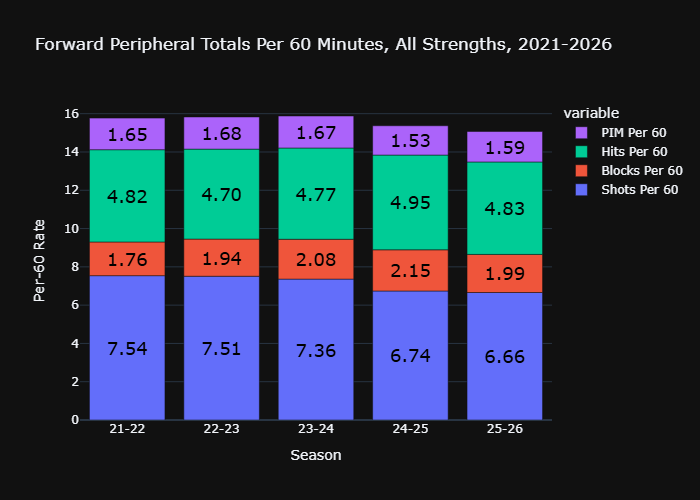
Since 2021-22, forwards have gone from 7.54 shots per 60 minutes to 6.66. For a player skating 1000 minutes across 82 games, that would mean going from about 126 shots in a full season to 111 shots. That is a sizeable drop and tells us we need to keep re-adjusting our expectations for shot totals; a forward putting up 200 shots (48 occasions in 2025-26) just doesn’t happen nearly as much as it did four years ago (68) or even two years ago (71). It makes high shot totals more valuable.
This becomes more obvious when we look at the average peripheral profile of an NHL forward. Four years ago, nearly 48% of a player’s peripheral profile – shots, blocks, hits, and PIMs – was comprised of shots on goal. This past season, it fell to nearly 44%:
[Follow the link for more…] (may21)
20. In yesterday’s Ramblings, we continued reviewing the 2025-26 season, specifically focusing on changes among peripheral stats for forwards, including shots, blocks, hits, and penalty minutes. That covered both play at all strengths and at 5-on-5, and we included 60-minute rates as well as percentages of all peripheral stats. Go check that out for a more macro view of trends across the league over the last five years.
Today, we’re staying with forwards, but going down to the individual level. It is all well and good to understand that shots on goal have been declining as hit rates have been increasing, but in fantasy hockey we are concerned with totals – my total needs to be higher than everyone else in the league (or my opponent in head-to-head formats) to win. Those totals are the focus below with data from Evolving Hockey.
To start with, let’s consider shots on goal at all strengths. It was mentioned a few times yesterday, and as any fantasy manager paying even a modicum of attention has realized, shots on goal are becoming less prevalent in the league. What does that look like over the last five seasons? Glad you asked:
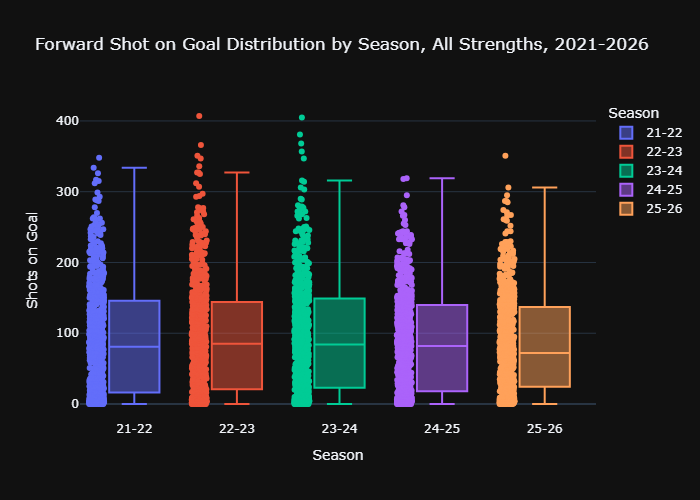
Anyone that may have pushed Grade 9 math out of their head, this plot shows the distribution of shots on goal among forwards in the league. The rectangular box itself shows totals between the 25th percentile (fringe fourth liners) and the 75th percentile (fringe first liners). Above the top of the box are the high-end shot totals and under the bottom of the box are the low-end shot totals. The league average forward landed 1.7 shots per game and plays under 70 games, so most season totals will be under 140 shots.
There are a couple of important takeaways here:
21. First, back in 2023-24, we had one forward reach 400 shots (Nathan MacKinnon) and eight others surpass the 300-shot plateau. This past season, MacKinnon led the league with 351 shots and the only other player to reach the 300-shot mark was Connor McDavid. Ultra-high shot volumes just aren’t a thing anymore, and it makes the elite shot totals that MacKinnon puts up much more valuable. Consider this:
- In 2023-24, MacKinnon landed 405 shots and Auston Matthews had the third-highest total with 368. MacKinnon managed 37 more shots than Matthews, or 10% more.
- In 2025-26, MacKinnon put up 351 shots, and Jason Robertson had the third-highest total with 295. MacKinnon registered 56 more shots than Robertson, or 19% more.
If MacKinnon can exceed the third-highest shot rate by nearly 20%, his elite shot volume becomes one of the most important fantasy value differentiators of any player in the league.
The next important takeaway is the forward group posting 200+ shots…
[Follow the link for more…] (may22)
—
Have a good week, folks!
Thanks for continuing to support the website and if you’re bored and need a fantasy hockey fix – visit the gang in the forum here.
Related Posts
Starting Goalies













Top Skater Views
 S.J
S.J ANA
ANA VAN
VAN EDM
EDM CHI
CHITop Goalie Profile Views
 NYR
NYR STL
STL PIT
PIT UTA
UTA COL
COL
LINE COMBOS
| Frequency |
 PHI Players PHI Players
| |
|---|---|---|
| 14.7 | MATVEI MICHKOV TYSON FOERSTER NOAH CATES | |
| 12.4 | PORTER MARTONE TRAVIS KONECNY CHRISTIAN DVORAK | |
| 11.9 | CARL GRUNDSTROM SEAN COUTURIER NOEL ACCIARI | |
DobberHockey Podcasts

Keeping Karlsson: Short Shifts – I Tried to be Like Parker Kelly
Elan is joined by Ryan Downey for the premiere of season 8 of Short Shifts! — KKUPFL late registration is ongoing! We’re still filling new divisions in the world’s greatest fantasy hockey league. Details at https://www.kkupfl.com/. Join the Keeping Karlsson patron community! Patrons get access to all our perks all year round, including KKUPFL […]
Keeping Karlsson: Shabanov Ranks
Elan and Brian fly through the final preseason lines for every NHL team ahead of opening night, and share their guys to watch– or look away from– in your fantasy hockey leagues.

Fantasy Hockey Life: Western Conference Catchup and Mustard
Jesse and Victor are here to Catch Up on everything in the Western Conference that transpired ofter our team previews. We also have our annual spicy mustard competition – two hot takes per team. Our show is part of the Dobber Podcast Network and sponsored by Fantrax.com. Email [email protected] and ask to join our free […]
Keeping Karlsson: Matchup Maximizer 2026/27 Week 1
Elan takes a look at the schedule for the upcoming weeks of NHL action and recommends players with good schedules that you should consider streaming in to win your head to head matchups.
Fantasy Hockey Life: Dallas Stars with Taylor Newby
Taylor Newby joins the program to discuss the Dallas Stars.