

21 Fantasy Hockey Rambles
Dobber Sports
2026-06-14
Every Sunday, we share 21 Fantasy Rambles from our writers at DobberHockey. These thoughts are curated from the past week’s 'Daily Ramblings'.
Writers/Editors: Ian Gooding, Michael Clifford, Alexander MacLean, Puneet Sharma, and Dobber
___
The Fantasy Prospects Report is now available!
If you don’t have yours yet, get it at the Dobber Sports Store.
___
1. The Carolina Hurricanes are now one win away from a Stanley Cup thanks a 4-2 win over the Vegas Golden Knights in Game 5 on Thursday night. Carolina has a chance to lift the Cup when these teams meet up for Game 6 tonight (Sunday).
One question I wanted to look at was whether either team winning would have a specific impact on the fantasy landscape.
Well, both teams had one big Free Agent signing this past summer (yes I know technically Mitch Marner was traded), but it’s the idea behind it. Both have run through multiple goalies this season, neither one has a top-tier defenseman playing every second shift in regulation, and neither one made a huge swing at the trade deadline either.
The Flames first round would transfer if Vegas wins the Cup, while Carolina’s approach might be more likely to change whether they win the Cup or not. The Canes might go big-game hunting for a goalie if they lose, but if they win they would more likely run things back with Brandon Bussi and Pyotr Kochetkov. The cap space they have going into the summer allows for more change as well, especially for a roster that is more locked into place.
If Vegas wins, be warned that the late-season coaching change may become a more frequent tactic as well, hoping to time the new coach bounce perfectly for a 20-game run through the playoffs. (june10)
2. We’re now approaching the opening of the first buyout window, and there are a few notable candidates this year. With the cap rising there is less need overall for it, and especially with so many contracts working in buyout proof bonus structures, so there are less options this year than we might typically see.
Jesperi Kotkaniemi – Current Contract: $4,820,000 Cap hit for four more years
This is an interesting case, since Kotkaniemi is still only 25 years old, which would mean his buyout cap hit would only be one-third of the total amount remaining, spread out over twice the length of time. Usually an eight-year buyout would be intimidating, but here the annual cost against the cap would just be $850,833 or less, which is very palatable for a team in the middle of their Cup window, and with a nearly full roster signed already.
Looking at Kotkaniemi’s numbers, his career high of 43 points came four seasons ago, and this past year he paced for less than 20 in a bottom-six role. If he was given middle-six minutes and secondary power play time again, could he regain his 40-point form? Looking under the hood, the previous IPPs, luck metrics, and expected goal share numbers all seem to indicate someone who still has another gear. He would make a great reclamation project for someone like Calgary or Vancouver who has the roster space and nothing to lose. (june10)
3. Brendan Gallagher – Current Contract: $6,500,000 Cap hit for one more year
Like Carolina, the Canadiens are looking at their Cup window and they are going to try to find ways to maximize it. They have some cap space at the moment, but with Kirby Dach, Zack Bolduc, and Arber Xhekaj needing new contracts, along with an extension likely coming for Ivan Demidov, some extra cap space would go a long way towards providing some remaining space to fill the second-line centre role.
Brendan Gallagher has already noted that he will likely be moving on from the Canadiens, which could happen via a trade, or a buyout. As the Canadiens are not extremely capped out at the moment, it would make more sense for them to swallow the buyout in the short term and keep the extra asset that it would likely cost to move Gallagher’s contract off of their books.
Gallagher’s underlying numbers actually show that he might have been a little lucky in his previous two seasons compared to the most recent campaign, which would make the scoring drop off even more concerning. He’s not someone I would target in any league, unless a 25-point fourth-line player is actually useful based on your league size. (june10)
4. Ilya Lyubushkin – Current Contract: 3,250,000 Cap hit for one more year
Dallas might be the team with the most Cap issues this year, as they need to sort out what new contracts look like for Jason Robertson and Mavrik Bourque, decide whether they bring back Jaime Benn and what that costs, and then re-sign RFA Arttu Hyry who was a great support player last season up and down the lineup. Sounds simple, but the issue is that they only have $10 million in cap space to do it, and Robertson alone is going to cost that much.
Ideally for Dallas that means a trade, and not tying up dead money in a buyout, but it has to be on the table for them. The buyout cap hit would be $1.65 Million and then needing to bring in someone else at a cap hit of at least the league minimum of $850K means that this buyout doesn’t save much, and every penny counts. What makes it more likely is that Lyubushkin isn’t even guaranteed a lineup spot anyways, as he was severely deemphasized last season, so one way or another his contract is likely coming off the books for Dallas this summer. (june10)
5. Ross Colton – Current Contract: $4,000,000 Cap hit for one more year
After Colton was a healthy scratch in the playoffs and again failed to take a step forward in the regular season, he’s now being pushed down the lineup, and a top contending team like Colorado can’t really afford to have a $4 Million player so far down the depth chart.
Colton’s buyout would save the Avs $2.6 Million for the 2026-27 season, costing only $1.3 Million the following season. This would nearly double the available cap space for the Avs this upcoming season, which will be needed in order to fill out at least three more roster spots, two of them being defensemen who are typically more expensive. (june10)
6. Puneet had his fantasy take from the Peter Laviolette hire in LA here. He noted Panarin’s offensive surge under Laviolette, and it’s interesting that Kevin Fiala broke into the league as a full-time player under Laviolette as well, so there’s some additional familiarity there (assuming Fiala is fully healthy after his Olympics injury).
Overall LA is not a team I’m targeting for next year, but the outlook seems to at least be less negative now that Laviolette is in charge.
It’s also an interesting transition year for the team, as two of the top-three centres that the team started the year with in Anze Kopitar and Philip Danault are gone. That’s a whole lot of defensive zone starts that have suddenly disappeared, and there are hardly any centres on the market. We could see a lot more faceoffs next year from Alex Laferriere and/or Adrian Kempe, who both took a fair share this past season. (june10)
7. When looking at free agents, buyout candidates, mock drafts, etc, it does feel like sometimes we get stuck in a rut of thinking until the real process unfolds in a different way and we think “why didn’t we see that as an option before”. Well, if you think you know where I’m going with this, it’s not sending Dylan Larkin to Ottawa or Mat Barzal to Edmonton, but instead looking at the small chance that Alex Ovechkin plays in the NHL next year… somewhere other than with the Capitals.
Could he really move on from the team he has spent his whole career with? Well, with John Carlson gone, Tom Wilson is the only player left on the team from the prime days of Ovie’s career and the Capitals’ Cup win back in 2018. Perhaps Ovie wants to stay and play, but maybe he doesn’t feel a need to do it in Washington. Could playing with Evgeni Malkin (and Sidney Crosby) be an interesting enough proposition for the soon-to-be 41-year-old? As hockey fans, we can dream about seeing them play together, even if the chances seem slim.
I’m holding out hope and still believing that Ovie will return, though his production will likely continue to slip, just as we saw this past season. (june10)
8. There have been a few players who have already signed over in Europe this summer. We have seen Marcus Johansson leave for Sweden despite the likelihood that he would have had multi-year NHL offers. Lassi Thomson signed overseas as well, perhaps not liking the outlook of his chances to move up the Sens’ depth chart. Neither was extremely fantasy relevant for next year, but both were owned in my Cap League dynasty and were dropped as a result, so if you happened to miss the news then you can move on from these guys. (june10)
9. The Wild did manage to re-sign Michael McCarron to a six-year deal with a $3.3 Million annual cap hit. McCarron saw his ice time, SOG rate, and Hit rate decline upon joining the wild last season, and that should be expected to continue next season, making him less rosterable even in multi-category leagues, and droppable in most every Cap league. In his first game with the Wild, McCarron potted two points, but then only had three points in the last 19 games. Again, this re-iterates the point of his fantasy value dropping in Minnesota. (june10)
10. Utah Mammoth prospect Vadim Moroz signed a two-year ELC with the Mammoth through the 2027-28 season. Moroz's offensive production dipped in the KHL last year as Dynamo Minsk added veteran talent but he still produced at a respectable rate. Moroz’s move to North America should help his game develop, giving him an opportunity to adjust to the AHL alongside a strong wave of Utah prospects. For a deeper look at Moroz and every NHL organization's prospect pipeline, be sure to check out the latest Dobber Prospects Report. (june8)
11. Former power forward Milan Lucic officially announced his retirement after a 17-year NHL career. Lucic finishes with 233 goals, 354 assists, and a Stanley Cup championship as a member of the 2011 Boston Bruins. While his fantasy relevance faded years ago, there's no denying the impact he had during his prime as one of the league's most physical and intimidating players. (june8)
12. Interesting note from Elliotte Friedman on X regarding Toronto’s ongoing coaching search, with Joe Pavelski now emerging in the mix. It’s a fascinating angle, and at this stage of the process it feels like the Leafs are clearly in the “leave no stone unturned” phase. Given some of their previous front office and organizational choices around names like John Chayka and Mats Sundin, nothing really seems off the table. The Martin St. Louis comparison being floated for Pavelski is an intriguing one, even if it’s more of a stylistic reference than a direct parallel. At this point, it’s one to watch rather than anything concrete. (june8)
13. There have been rumblings that this offseason could be a busy one for trades and even trade requests. The Stanley Cup Final is not over yet and already two players have reportedly requested trades: Dylan Larkin and Darnell Nurse. I wrote about Larkin last week, while today I’ll focus on Nurse.
The general hockey narrative around Nurse focuses on his defensive shortcomings (I’ll let the chart below explain) relative to his contract (four more years at a $9.25 million cap hit).
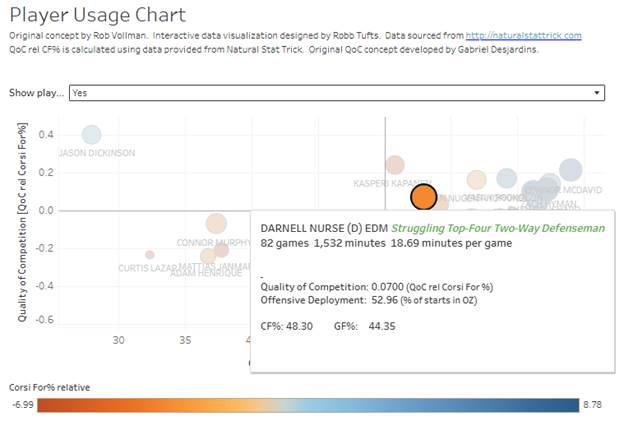
Nurse should be viewed differently in fantasy hockey, though. In terms of cross-category coverage in peripherals, Nurse is an asset. When adding the three categories of shots, hits, and blocks, Nurse finished eighth in the league this past season with 466 SOG+HIT+BKS. Alter it slightly to the pure bangers categories of penalty minutes, hits, and blocks, Nurse finished ninth in the NHL with 407 PIM+HIT+BKS. If it’s just hits and blocks, Nurse finished 17th with 303 HIT+BKS.
In pure scoring leagues, Nurse can be largely ignored with just 24 points in 82 games in 2025-26. He has reached 40 points in the past, so he’s not completely a defensive defenseman either. In deciding whether Nurse is worth rostering, league settings really matter.
How a trade would affect Nurse’s value could depend on at least a couple factors. One big one is deployment, as Nurse needs icetime to accumulate the stats he specializes in. Over the past five seasons, Nurse’s icetime has trended downward from over 25 minutes in 2020-21 to just under 21 minutes this past season. A further decline could result in fewer shots, hits, blocks, and potentially even penalty minutes. On top of that, will a different coach emphasize Nurse focus on the areas he excels at, along with of course granting him top-4 minutes? We’ll find out this offseason whether the Oilers are actually able to move Nurse. (june13)
14. Continuing my look back at the past season, I’m making space both today and tomorrow spotlighting players who truly dominated a single category. Sure, many of them contributed elsewhere too, but each one stood out for being exceptionally strong in one particular area.
Goals: Steven Stamkos
It’s hard to find a goal scorer that doesn’t help with other categories in some ways. However, Stamkos wasn’t that strong in a few other notable categories. Stamkos was tied for ninth in goals with 42 goals, bouncing back from a disappointing first season in Nashville.
In comparison, Stamkos recorded just 24 assists, which was the lowest assist total among the 35 players that scored at least 32 goals. Stamkos’ 204 shots wasn’t a terrible number on its own, but his 20.6 SH% is high enough relative to other recent seasons that his goal total could drop next season. If your league counts plus/minus, Stamkos finished with a minus-17, which is his third consecutive season with a double-digit negative plus/minus.
At 36 years old, Stamkos’ future value will depend a lot on his ability to continue scoring goals. If the goals dry up, then so will much of his fantasy value.
Assists: Quinn Hughes (defensemen)
Hughes shouldn’t be anyone’s idea of a goal scorer. Over the previous two seasons he totaled 17 and 16 goals, which were his only double-digit goal totals. In 2025-26 he was back below 10 goals, scoring just seven times compared to 69 assists. After scoring just two in 26 games with the Canucks, Hughes scored five in 48 games with the Wild.
Among qualified defensemen, Hughes finished fourth with a 1.03 PTS/GP average, which was his lowest in three seasons. The goal total had plenty to do with that. His 3.7 SH% was his lowest shooting percentage in five seasons, while his shot average (2.5 SOG/GP) remained relatively consistent. Better luck in the goal department should result in more points for Hughes next season.
Hughes almost never hits anyone, as he has 20 total hits over the past two seasons. With low-to-moderate penalty minute and blocked shots totals, his value won’t improve in bangers leagues. It’s all scoring with Hughes.
[Follow the link for more…] (june13)
15. As we know, a lot can change over the course of an NHL season. What looks like a secure fantasy situation in October can suddenly become far less certain by April as younger players emerge, coaching staffs adjust deployment, and teams begin reshaping their offensive identities. I took a look at a handful of players and their powerplay production this past season. While the overall fantasy value remains intact in most cases, the outlook on the man advantage may not be quite as straightforward as it appears.
Faber finished with 11 power-play points in 80 games this season after recording 16 as a rookie. While his overall fantasy value remains extremely strong thanks to his massive workload, all-situations deployment, and heavy even-strength usage, the power-play production itself actually dipped despite seeing time on the top unit. He posted an 84.6% PPIPP, a number that is exceptionally high for a defenseman and often difficult to maintain over multiple seasons. Typically, defensemen who sustain those levels are functioning as the primary offensive engine of the power play. Faber's individual creation metrics suggest a different story. His 1.5 shots per 60 minutes and 5.2 individual shot attempts per 60 on the power play are fairly modest and numbers that fall well short of what is usually seen from elite fantasy quarterbacks.
We already know that Quinn Hughes is a true offensive engine on the man advantage and is the number one quarterback for any team. Hughes drives offense through his own creativity, constantly creating movement and forcing defensive adjustments. Faber is more of a facilitator within the structure, moving pucks efficiently and keeping plays alive rather than serving as the focal point of the attack. Both approaches are be effective, but one naturally produces more fantasy-friendly power-play numbers. The sustainability conversation really comes down to role versus offensive ceiling. Faber’s overall fantasy value still looks extremely safe because the foundational usage remains elite. He logs massive minutes and contributes reliable peripherals and none of that appears likely to disappear. The concern is specifically tied to the power play ceiling itself.
When you also add in healthier linemates such as Mats Zuccarello, JEEK and a small obstacle in Quinn Hughes it becomes difficult to see a jump in power play production from where Faber currently sits. A realistic and sustainable range is closer to what he produced this past season (10 -15 PPP). Pushing beyond 20 PPP likely requires either permanent uncontested PP1 control or a major offensive evolution in his game which is unlikely to happen with Hughes in the picture. Any opportunity within Minnesota’s structure and also playing alongside Quinn Hughes will also boost your production but expecting another major jump on the man advantage may be overly optimistic.
[Follow the link for more…] (june8)
16. In a pair of Ramblings last week, we highlighted some of the top fantasy performers among forwards and defencemen this past season, and then compared them to similar performances in any season from 2021-2025. We do this to find some comparable players that could give us insight into what we can expect in the future from this season’s top performers.
Today, we’re going to do the same thing but discussing younger forwards. We’re going to review the fantasy seasons of some key under-25 players, a player they compare to from recent seasons, and what that might tell us about their future. The stats we’re using are goals, assists, power-play points (PPP), shots, blocks, hits, face-off wins (FOW), and penalty minutes (PIM).
Keep in mind that these evaluations are on a per game basis, and players are compared to replacement-level forwards. All that was discussed in more detail in the earlier Ramblings.
Wyatt Johnston (2025-26) and John Tavares (2022-23)
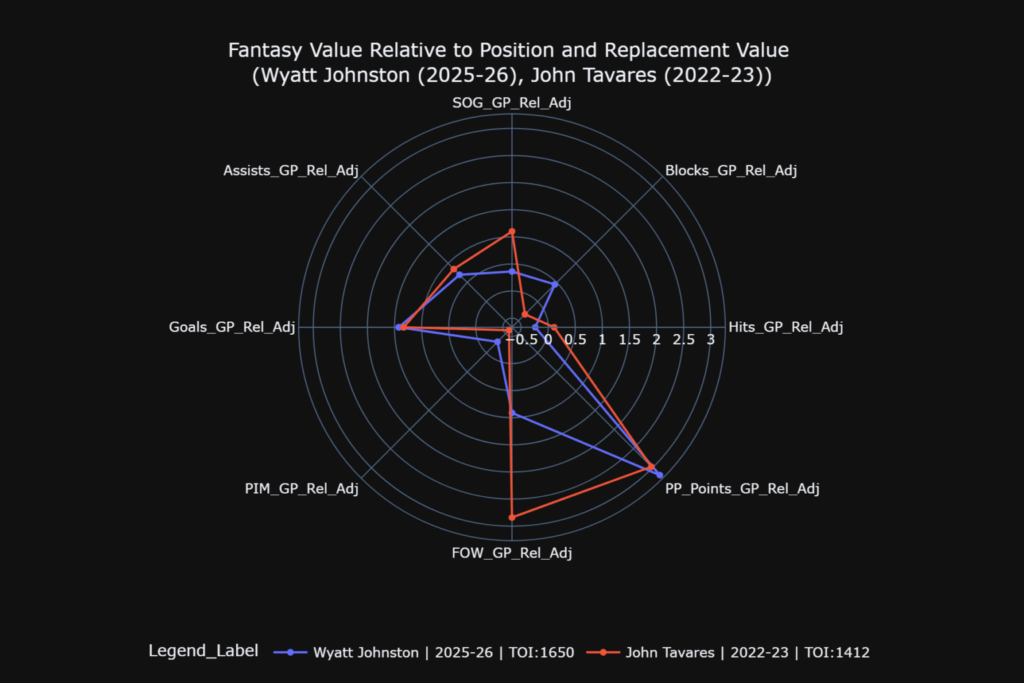
There are minor differences between the two seasons mentioned, but what stuck out to me are the similarities in goals, assists, and power-play points. Johnston’s season saw him as 1 of 3 players with at least 40 goals, 40 assists, and 40 PPPs, with the others being Connor McDavid and teammate Jason Robertson. He has three straight seasons with at least 30 goals, 30 assists, and 200 shots, is sixth in PPPs over the last two seasons, and just turned 23 years old a month ago.
The reason the similarities stuck out to me isn’t just because of what Tavares did in 2022-23, but what Tavares has done for his career: According to Hockey Reference, he is 1 of 7 players with at least seven seasons of 30 goals, 30 assists, and 200 shots since the 2011-12 campaign. The others are all future Hall of Famers: McDavid, Nikita Kucherov, Nathan MacKinnon, David Pastrnak, Sidney Crosby, and Alex Ovechkin.
That Johnston’s fantasy value in 2025-26 compares well to Tavares’ campaign three years prior is nice to see. What might be more important is that Johnston is showing the same traits that Tavares showed for much of his career, namely great goal scoring with solid assist and shot totals. Johnston is still a young player, but he now has three seasons of good-to-great production. Maybe the comparison isn’t that far-fetched. (june9)
17. Juraj Slafkovsky (2025-26) and Gabriel Landeskog (2021-22)
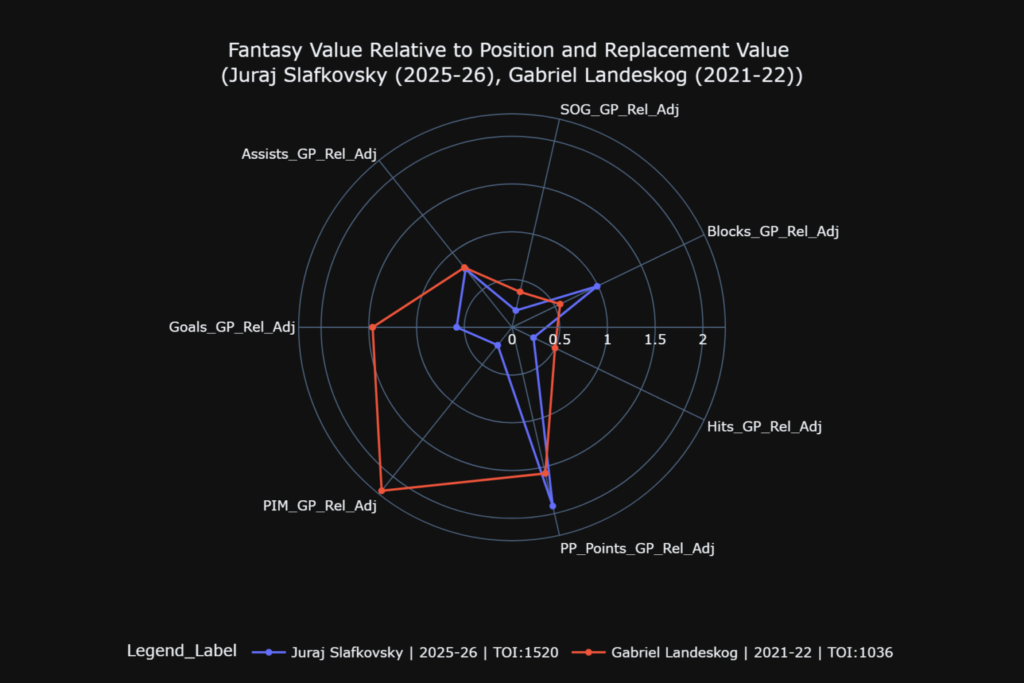
Because these two guys are both wingers, we removed FOWs from the final tally here. What is interesting is that the big difference between Slafkovský’s 2025-26 campaign and Landeskog’s final season before his career-altering knee surgery are the penalty minutes. We take that out, and the two have near-identical fantasy value.
As with Johnston and Tavares, it is the similarities that stick out. Slafkovský and Landeskog were close in value by assists, shots, hits, and power-play points. When Landeskog was at his best in the late 2010s and early 2020s, he had 82-game paces exceeding 30 goals, 40 assists, and 1.5 hits per game. Slafkovský just finished his age-21 season with 30 goals, 43 assists, and 1.3 hits per game. We have a higher scoring environment in the NHL now than we did 10 years ago, but Landeskog didn’t consistently hit his stride until his age-25 season. Slafkovský just turned 22 years old in March.
These two aren’t identical players, as Landeskog was more responsible defensively early in his career than Slafkovský is. All the same, we’re here for fantasy value, and it’s hard to not see the similarities between the two: good goal and assist rates with a solid dose of shots and hits. Whether Slafkovský turns into the elite two-way forward that Landeskog was in his prime remains to be seen, but the comparison for fantasy value seems apt given their respective profiles.
[Follow the link for more…] (june9)
18. In my last few Ramblings, we have been comparing the fantasy production of some top performers to see whom they compared to from recent seasons, and if we can draw any kind of conclusions from that comparison. We had:
- Some top forward performers in Macklin Celebrini, Nick Suzuki, Vincent Trocheck, Sidney Crosby, and Leon Draisaitl.
- Some top defence performers in Cale Makar, Darren Raddysh, Charlie McAvoy, Moritz Seider, Jakob Chychrun, and Roman Josi.
- Some young forwards including Wyatt Johnston, Juraj Slafkovsky, Lucas Raymond, Beckett Sennecke, and Logan Cooley.
To round out the quartet of Ramblings, we are moving to the blue line to look at some top performers among young blue liners and their comparable counterparts.
As outlined in the other Ramblings, this is how the comparisons are made:
- We are calculating per-game production in goals, assists, power-play points, shots, hits, blocks, and penalty minutes relative to that player’s position, so defencemen are compared to other defencemen and forwards are excluded.
- We figure out the ‘replacement level’ values. In this case, they are the average per-game production rates for roughly the 85th-most valuable defenceman in this kind of fantasy setup.
- We compare each defenceman’s per-game production in each stat to that ‘replacement level’ value to find who had what kind of fantasy value in each stat, in each season, on a per game basis.
All this is explained with a bit more depth here.
Data is from Evolving Hockey and Natural Stat Trick, and we are only considering blue liners with at least 41 games played in a season.
Matthew Schaefer (2025-26) and Jakob Chychrun (2024-25)
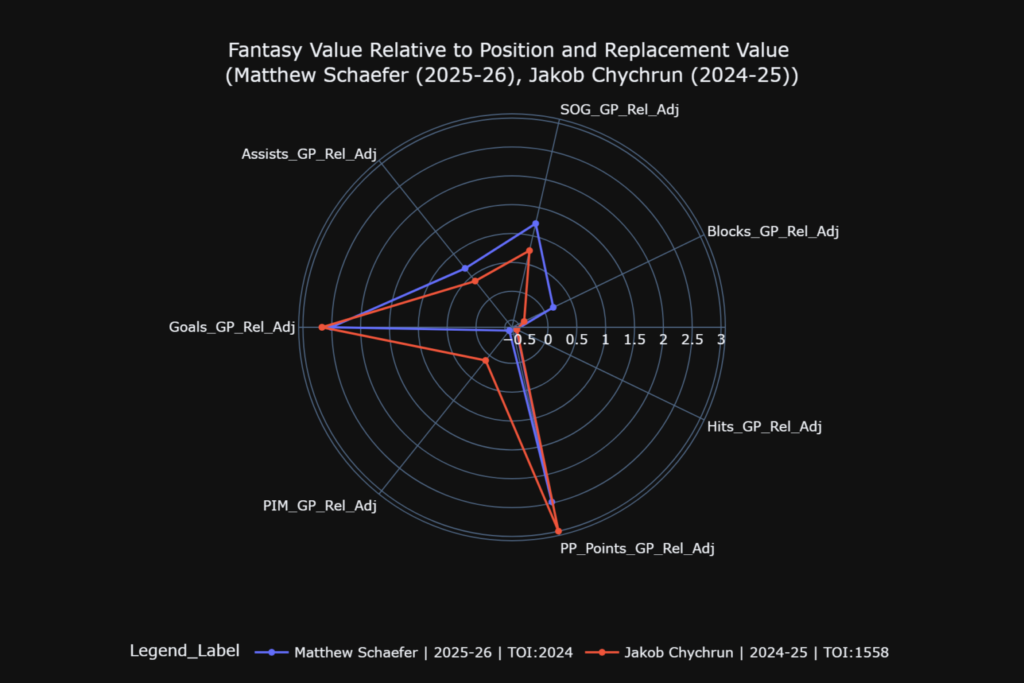
This is where comparisons can be both illuminating and misleading. Chychrun’s performance in this setup with these replacement-level calculations made him the 14th-most valuable blue liner in 2024-25; Schaefer was 17th in 2025-26. Both provided more value through their goal scoring than their assists, both provided good value through their shot rates, and neither was overly physical. That Schaefer gave us this kind of performance as an 18-year-old defenceman – and he doesn’t turn 19 until September – is an incredible effort.
Despite those similarities, anyone who watches these two defencemen would not say they have similar play styles. Schaefer is already a dynamic skater who is in control of his team’s offence, and while Chychrun has shades of that, they are shades and not full colours. Schaefer is just beginning to scratch the surface of what he’s capable of doing while Chychrun, at that time, was 26 years old.
That does not mean the fantasy value comparison is not an apt comparison. What makes a defenceman a truly elite option is not only the skill he possesses, but the team that surrounds him. Cale Makar is a Norris Trophy-calibre defenceman every year, but what makes him an elite (or near-elite) fantasy defenceman every year is that the Colorado Avalanche have been a top-10 scoring team each of the last five seasons, top-5 in three of them, and the top team twice. Makar is a part of that, but so are (or were) Nathan MacKinnon, Mikko Rantanen, Martin Necas, Artturi Lehkonen, Valeri Nichushkin, etc.
Therein lay the issue for Schaefer. His 2026-27 could see him take a leap in development, but if the New York Islanders finish as a bottom-10 scoring team again, he has a tough road to significantly increasing his fantasy value. Maybe he turns in an effort like Erik Karlsson did in 2022-23, but that is a very unlikely outcome. The team around Schaefer needs to get a lot better offensively for him to have a realistic chance at being a top-3 multi-cat defenceman. (june11)
19. Lane Hutson (2025-26) and Adam Fox (2022-23)
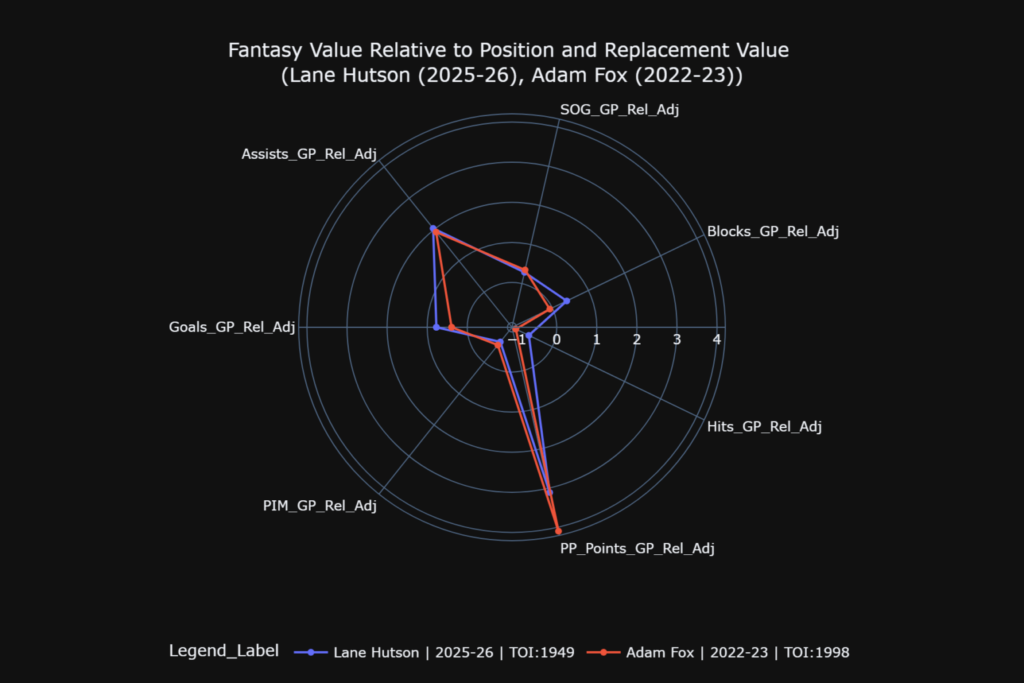
This comparison helps highlight how changes in peripheral production over the last five seasons are important to keep in mind when comparing across seasons, which was something I discussed a couple of weeks ago in these Ramblings. Fox’s 2022-23 season saw him post 1.94 shots per game whereas Hutson’s 2025-26 season had him at 1.51. Despite that disparity, they had near-identical shot-per-game values relative to their position in their season.
This comparison should also help highlight what Hutson’s upside really is. Looking at his season against Fox’s 2022-23, Hutson had a slight edge in fantasy value for his goals, assists, blocks, and hits. That was Fox’s age-24 season, and Hutson’s was his age-21 season. That was also when the New York Rangers started nearing their end of their Stanley Cup window – the Montreal Canadiens are just opening theirs. Montreal finished seventh in goal scoring this past campaign. If they can improve a couple of roster spots, and get more growth from players like Ivan Demidov and Juraj Slafkovsky, it’ll only help Hutson’s fantasy upside.
Hutson has one glaring question for his fantasy value and that is the shot volume we discussed earlier. It isn’t awful, but it’s not high, and it’s nowhere near a top-end mark. He doesn’t need to shoot the puck like Roman Josi in his heyday, but even in a lower-shooting environment like the NHL is now, putting up around 1.5 shots per game is not a lot. Fox never really took another step in his shot volume, so Hutson needs to resemble what Quinn Hughes has done over the last few years, rather than Fox, for Hutson to have a real chance at being an elite multi-cat fantasy blue liner.
[Follow the link for more…] (june11)
20. As noted above, we have been reviewing the fantasy production of some top performers to see whom they compared to from recent seasons, and if we can draw any kind of conclusions from that comparison. Across my last four Ramblings, we had:
- Some top forward performers in Macklin Celebrini, Nick Suzuki, Vincent Trocheck, Sidney Crosby, and Leon Draisaitl.
- Some top defence performers in Cale Makar, Darren Raddysh, Charlie McAvoy, Moritz Seider, Jakob Chychrun, and Roman Josi.
- Some young forwards including Wyatt Johnston, Juraj Slafkovsky, Lucas Raymond, Beckett Sennecke, and Logan Cooley.
- Some young defencemen including Matthew Schaefer, Lane Hutson, Brock Faber, Brandt Clarke, and Luke Hughes.
We have two more comparisons to make. Today, we’re returning to forwards and looking at lower-tier options. Which forward wasn’t a high-end performer, but showed some similarities to a player who went on to have high-end seasons? Let’s dig in.
Again, these comparisons are made with two adjustments. The first is that the parallels we’re drawing are on a per-game basis at the same position, so it’s relative to other forwards, with defencemen being excluded entirely. The second is that we’re evaluating each forward relative to a ‘replacement level’ fantasy option. In short: on a per game basis and among forwards only, how did a forward’s fantasy production compare to top waiver wire options? A more in-depth breakdown of these adjustments can be read here.
The eight stats we use for forwards are goals, assists, power-play points, shots, hits, blocks, penalty minutes, and face-off wins. Data is from Evolving Hockey and Natural Stat Trick. We are also considering only players who played at least 41 games in a season, and we’re covering the last five regular seasons.
Dylan Holloway (2025-26) and Andrei Svechnikov (2022-23)
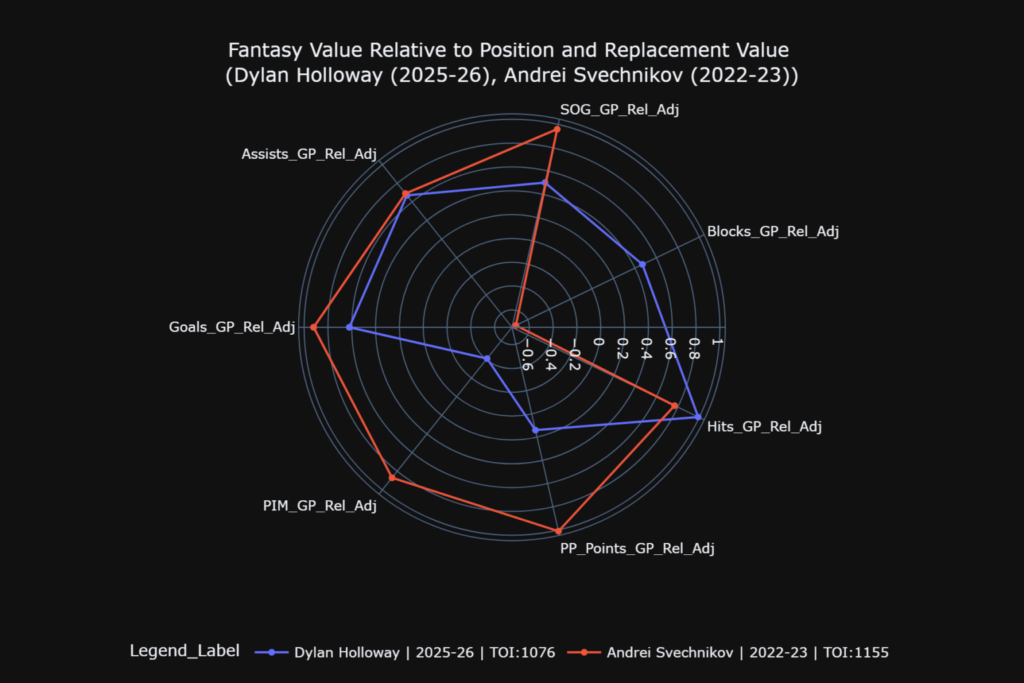
We see Svechnikov with a big edge in PIMs, and we see Holloway with a big edge in blocks. The real difference was power-play points. That has been a problem for Holloway, who has 21 power-play points in 136 regular season games as a member of the St. Louis Blues, or a little under 13 PPPs every 82 games. That is solid, but it’s not great, and turning in seasons with under 15 PPPs makes it hard to have elite multi-cat seasons, especially when he doesn’t take many penalties. It also highlights how Holloway’s value is elevated in multi-cat leagues that don’t count PIMs.
Holloway just finished his age-24 season while Svechnikov’s 2022-23 campaign was his age-22 year. However, Holloway was late establishing himself as an NHLer whereas Svech was a regular from the age of 18. Holloway just crossed the 200-game plateau, totaling 225 career games, which is a much lower number than what Svech had accumulated by the end of the 2022-23 campaign, as he had totaled 347 games by that point. Now that Holloway is in his mid-20s with over 200 appearances to his name, he should really be hitting his prime production years.
When it comes down to it, Holloway’s fantasy value is at the mercy of the players around him. Over the last two seasons, the Blues are 27th in the league by total power-play goals, worse than teams like Seattle and Calgary. Because Holloway can post good shot and hit volumes, he will always have good multi-cat value. To take that next step in the fantasy realm, he needs to be able to push to, or past, the 20 power-play point plateau. To do that, he needs help from his teammates, but it remains to be seen when (or if) that happens.
21. Matthew Knies (2025-26) and Mason Marchment (2021-22)
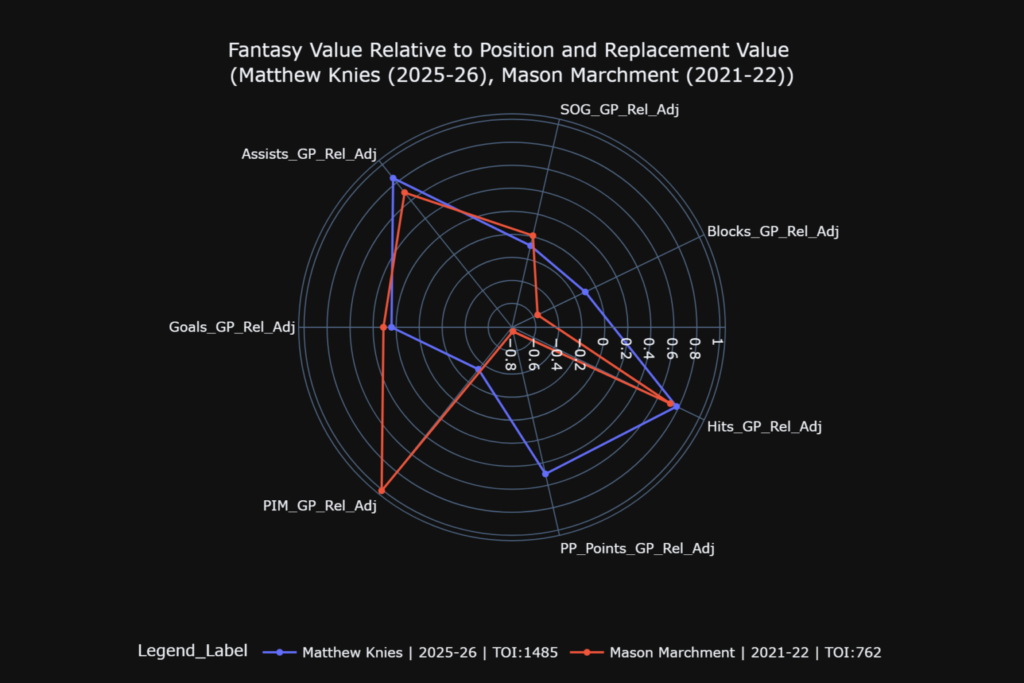
Here we see Marchment’s breakout season in Florida contain a healthy amount of penalty minutes, where Knies had a large edge in power-play production. Everything else was relatively similar, and I’m sure if fantasy managers were told that Knies’ next four seasons would be reminiscent of what Marchment has done over the last four seasons, they would be disappointed.
We do have to keep two things in mind, and the first is the age difference. Knies just finished his age-23 season, which is three years earlier than the breakout campaign from Marchment. The second is that Marchment’s fantasy value problem isn’t that he’s not productive, it’s that he doesn’t get a lot of ice time. Over the last four years, his primary points per 60 minutes at 5-on-5 (goals and first assists) is 1.58. That is higher than Matt Boldy, Mathew Barzal, Nick Suzuki, Bo Horvat, and Brad Marchand. However, Marchment has just had one season with over 16 minutes a game (this past 2025-26 campaign), and it was his first season with at least 2:00 minutes per game in PP ice time. Knies has back-to-back seasons with at least 18:30 per game and averaged between 2:25 – 2:50 per outing in PPTOI. That greatly differentiates his fantasy profile compared to what Marchment has typically had.
It is an interesting summer for the Toronto Maple Leafs as a new General Manager is hoping to turn them back into a playoff team, and that begins with having the top pick in the Draft. As with Holloway, Knies just crested the 200-game plateau during the 2025-26 campaign and is heading into his age-24 season. He has already been a very good across-the-board multi-cat performer, and his best days are still ahead of him.
[Follow the link for more…] (june12)
***
Reminder: Dobber's 2026 Fantasy Hockey Prospects Report was released a few days ago and is available now in the Dobber Shop! Both Dobber and the Prospects team has been working for the last 12 months (and more) to highlight what you need to know about the prospects you need to know from the upcoming Entry Draft. It also has an in-depth look at each team's current prospect pipeline and estimated arrivals for their top, young (hopeful) stars. Head on over to the Dobber Shop and grab a copy of the Prospects Report!
***
Have a good week, folks!
Thanks for continuing to support the website and if you’re bored and need a fantasy hockey fix – visit the gang in the forum here.
Related Posts
Starting Goalies













Top Skater Views
 S.J
S.J ANA
ANA VAN
VAN EDM
EDM CHI
CHITop Goalie Profile Views
 NYR
NYR STL
STL PIT
PIT UTA
UTA COL
COL
LINE COMBOS
| Frequency |
 T.B Players T.B Players
| |
|---|---|---|
| 18.1 | BRANDON HAGEL JAKE GUENTZEL ANTHONY CIRELLI | |
| 15.6 | BRAYDEN POINT ILYA MIKHEYEV NIKITA KUCHEROV | |
| 11.4 | JANSEN HARKINS GAGE GONCALVES CONOR GEEKIE | |
DobberHockey Podcasts

Keeping Karlsson: Short Shifts – I Tried to be Like Parker Kelly
Elan is joined by Ryan Downey for the premiere of season 8 of Short Shifts! — KKUPFL late registration is ongoing! We’re still filling new divisions in the world’s greatest fantasy hockey league. Details at https://www.kkupfl.com/. Join the Keeping Karlsson patron community! Patrons get access to all our perks all year round, including KKUPFL […]
Keeping Karlsson: Shabanov Ranks
Elan and Brian fly through the final preseason lines for every NHL team ahead of opening night, and share their guys to watch– or look away from– in your fantasy hockey leagues.

Fantasy Hockey Life: Western Conference Catchup and Mustard
Jesse and Victor are here to Catch Up on everything in the Western Conference that transpired ofter our team previews. We also have our annual spicy mustard competition – two hot takes per team. Our show is part of the Dobber Podcast Network and sponsored by Fantrax.com. Email [email protected] and ask to join our free […]
Keeping Karlsson: Matchup Maximizer 2026/27 Week 1
Elan takes a look at the schedule for the upcoming weeks of NHL action and recommends players with good schedules that you should consider streaming in to win your head to head matchups.
Fantasy Hockey Life: Dallas Stars with Taylor Newby
Taylor Newby joins the program to discuss the Dallas Stars.