

21 Fantasy Hockey Rambles
Dobber Sports
2026-08-23
Every Sunday, we share 21 Fantasy Rambles from our writers at DobberHockey. These thoughts are curated from the past week’s 'Daily Ramblings'.
Writers/Editors: Ian Gooding, Michael Clifford, Alexander MacLean, Puneet Sharma, and Dobber
___
DobberHockey’s 2026-27 Fantasy Hockey Guide is now available in the Dobber Shop! Team-by-team overviews updated through to the start of the regular season to reflect injuries, trades, or other pertinent information.
The French version, le Guide des Poolers, is also available. You can pre-order it here.
___
1. Bubble Keeper Week has begun at Dobber Hockey! If you’re not familiar, our writers will be discussing keeper decisions for players who are on the “bubble.” Who might be on the bubble depends on league size and league rules. For example, a keep-four format could involve cutting universally rostered players. On the other hand, an unlimited keep format could involve decisions on truly fringe players or even prospects. Either way, keeper/dynasty leagues in all shapes and sizes allow for some interesting choices.
For my next three Ramblings, I’ll go through a long list of players that I have to decide whether I will be keeping in one of my leagues. Along the way, I will make my observations on each player, which you can hopefully use if you’re deciding on the same player.
Relevant League Rules
This is an auction league — a format far more common in fantasy baseball than fantasy hockey. Teams can retain players who finished below a specific point threshold last season. A player’s new salary is determined by whichever is higher: a calculation based on last season’s salary or a calculation based on last season’s league point total.
The keeper rules are set up so that managers can easily keep players who finished below a specified league point total. This can include prospects, non-star players, and even star players who miss significant time due to injury. Because I traded away most of my prospect capital while pushing for a championship (successfully), my farm system is thin. As a result, I only have one player I’m genuinely interested in keeping among the following group. There is no maximum or minimum number of players I can keep among this group.
The player I’m planning to retain is Marchand. The new salary is a bit steep, and his recent announcement of requiring hernia surgery could force him to miss some games at the start of the regular season. However, these issues won’t significantly impact my roster, and he’s unlikely to be a long‑term hold anyway given his age (38).
Marchand was one of the players I acquired to help with a win‑now push, but he landed on season‑ending IR shortly after the trade I made. Although it looks like I’ll be carrying an injured player even longer (could be 6-10 games if he underwent the surgery right before he announced his last-minute surgery via a video), the strength of this team is currently on the wings, so Marchand is more of a supporting piece than a core player to this team anyway.
Despite being limited to 52 games last season due to a lower‑body injury, he still produced at a point‑per‑game pace (54 points). The concern this year is deployment: he may lose PP1 time and slide to the third line with Brady Tkachuk arriving and several injured Panthers also returning. His CF% fell just below 50% for the third consecutive year, which may hurt his cause on a deep Panthers squad. Even so, he should remain on PP2 and in a deep top‑nine, and injuries always shuffle lines.
There’s some uncertainty due to his age, role, and injury risk. But on a Cup‑contending Panthers team, Marchand is still a worthwhile dice roll due to his upside. (aug22)
Stephenson was an in‑season waiver pickup after injuries left me thin down the middle. Losing Aleksander Barkov for the year and dealing with absences from Jared McCann and Connor Bedard forced my hand.
Stephenson has been reliably consistent over the past three seasons (two with Seattle), posting 13–16 goals and 49–51 points each year. In real life, the issue isn’t his production so much as his contract: Dom at The Athletic listed Stephenson’s deal as one of the ten worst in the NHL. He has five years remaining at a $6.25M cap hit, largely because Seattle has tried to deploy him as a shutdown center — a role he hasn’t excelled in. That’s not directly fantasy‑relevant, but it does matter for how he’s used.
His offensive‑zone start percentage was an extremely low 31.8% last season, down from 44.8% in his first year with the Kraken. If Seattle ever shifts him into a more offensive role, his scoring could tick up. The problem is structural: the Kraken lack enough high‑end scorers to elevate his numbers, and they don’t have another true shutdown center to take over his current responsibilities. That makes it unlikely his usage or his production will meaningfully improve.
Given his role and the limited upside, Stephenson isn’t worth keeping at his current price in this league. (aug22)
Kreider’s first season in Anaheim was a genuine rebound. After an ugly final year in New York, he matched his goal total and boosted his assist count by 20, showing he still has meaningful offensive touch.
He’s now 35 and entering the final year of his contract, and it’s unclear whether he fits into the Ducks’ long‑term plans. If Anaheim takes a step back and falls out of the playoff race, he’s a logical trade candidate rather than a piece of their young core. On top of that, Anaheim still needs to fit Cutter Gauthier‘s new contract into the salary cap. Trading Kreider soon could be one option toward making that happen.
Last season Kreider held a spot on the top power play, producing eight PPG and 17 PPP, but that role is far from guaranteed. The Ducks continue to prioritize reps for their younger players, and his 51.5% PPIPP doesn’t scream irreplaceable.
The encouraging angle is his chemistry with Leo Carlsson, as Kreider was Carlsson’s regular linemate in 2025‑26. If Carlsson takes another leap, Kreider could ride that wave. But like Marchand, he’s a high‑ceiling/high‑risk profile: he could thrive, or he could be the odd man out. I’m less convinced he’s headed for a big season.
[Follow the link for more…] (aug22)
4. I had a leaguemate of mine who was debating between Linus Ullmark, Jakub Dobes, and Lukas Dostal to fill his one keeper goalie slot. There isn’t really a market for goalies right now, so it’s simply keep one and drop the rest. This is a H2H league with 12 teams and W, Sv, GAA & Sv% as the categories, making it similar enough to the Yahoo default, but with quantity of starts mattering more evenly with quality.
Last season, Lukas Dostal led the trio in both Wins (narrowly) and Svs (by a solid 300 save margin), but was the worst in GAA and Sv% by a decent margin. Generally my approach to goalies is taking the volume and hoping for the ratios, because you’re more likely to come out ahead than by picking goalies for ratios (which are less consistent year to year) and hoping for volume. As a result, Dostal would be my pick of the three.
Linus Ullmark missed a big chunk of time last season, and only has Samuel Ersson as a backup, which gives him a solid likelihood of staying close to Dostal for the volume. He would be my next choice, especially considering the strength of Ottawa’s defense core relative to Anaheim’s. However, Ullmark is seven years older, and hasn’t been extremely consistent with playing large volumes during the season, so there’s more risk there both for the one year and as a keeper asset, which leans the choice again back towards Dostal.
Dobes meanwhile is the youngest of the trio, and on the best team, which on the surface should make him the choice, especially after putting up much better save percentage numbers than Ullmark or Dostal last year. However, with Samuel Montembeault and Jacob Fowler in the picture, Dobes could realistically end up only seeing 30 starts next season even if he’s healthy. On the high end, he’s likely capped at 50. Fowler especially is a risk to Dobes’ playing time, as his upside is higher, and he’s viewed as the heir apparent to the starter role, on a timeline which would match the contention window of the skater core almost perfectly.
With only one goalie keeper here, you have to get it right, and that likely means Dostal is the right pick. That can change in hindsight, but on paper right now that’s the way to go.
Interestingly, with Yahoo open now, those three goalies are ranked in reverse order of what I came up with there, as Dobes is ranked 91, Ullmark at 151, and Dostal interestingly all the way down at 200. Don’t just go off of the rankings, because when you add in context the value often shifts. (aug19)
5. There are some other late goalies of interest too. The later goalies I’m looking at are the ones being passed over because they either are seen as the 1B option or because they are on a poor team despite being locked in as the more full-time starter.
The top six goalies are all debatably well ordered, but after that set of undisputed top-tier starters, things get real hazy real fast. The next few options are lifetime backup Scott Wedgewood, 23-year-old Jesper Wallstedt who will have to fend off incumbent Filip Gustavsson for the back-75% of the season, and 36-year-old Jacob Markstrom who just put up the worst season of his career.
After that you get back to a couple reliable starters on (possible) playoff teams in Karel Vejmelka and Jeremy Swayman, before things really start to get iffy and there’s not much distinction between goalie #12 on the board and goalie #30. I’m either going to get one of the last of the reasonable starters at a decent spot, or both of my goalies are going to be between 25th and 30th off the board. (aug19)
6. We need to have a quick chat about Alexander Ovechkin this year. I mentioned him recently in my review of the Capitals’ depth up front, and after going through that I don’t have a rosy outlook on his production. His rank and ADP have him around 100, and there are at least 50 more players I would pick over him this year. After pick 150 though he’s someone I would consider for the upside of repeating what he did last year, but I don’t expect that at all, because the PP time will be cut, the even strength ice time will be cut, and both the peripherals and scoring will suffer as a result. Don’t fall for the name value this year. (aug19)
7. Yahoo is reliably inconsistent when it comes to position allocation, and it’s tough to tell this year whether there is going to be any further pruning ahead of draft day. Lots of Cs are just eligible at that single position, but there are also plenty like J.T. Miller, Cutter Gauthier, Mitch Marner, Morgan Geekie, Rickard Rakell, and others, who are eligible at all three positions. None of them should or need to be listed at all three, and should have been pared down to one or two. If you’re drafting one of those players (or any multi-position player in an early draft, be wary that the position eligibility could still be reduced – though it will likely be added back in season once the positions loosen up as usual.
There are already plenty of dual position centers worth noting as well, including Wyatt Johnston, Tage Thompson, Connor Bedard, Evgeni Malkin (all three), Leon Draisaitl, Jack Hughes, Tim Stutzle, etc. These guys are very relevant in leagues that could faceoff wins, and with there being more of them at the start of the season this year, it probably makes things a little easier to stock up and plan around. However, it also means other teams are more likely to reach for these players as well – bit of a double edged sword to it. (aug19)
8. As a continuation to my last Ramblings, I was looking ahead to the upcoming season with new opportunities, different line combinations and increased roles on the horizon with plenty of players who could see their fantasy stock rise once the season gets underway. These aren’t necessarily the obvious names, but rather the players who could be worth adding to your watchlist now before their value starts to climb.
Roman Kantserov is coming off a dominant KHL campaign with Metallurg Magnitogorsk, scoring 36 goals and 64 points in 67 games while leading the league in goals. His 36 goals also broke Kirill Kaprizov's record for the most goals by a U22 player in KHL history. Despite his smaller frame, Kantserov plays with a relentless motor and has the skill, creativity and offensive instincts to create chances consistently. That combination gives him legitimate top-six upside as he makes the jump to the NHL.
The opportunity in Chicago could be a big one for Kantserov, as he is expected to step directly into the Blackhawks lineup and could find himself in a top-six role, potentially alongside Connor Bedard when healthy or Frank Nazar. Obviously, we can’t expect his KHL production to translate directly to the NHL, and there will be an adjustment period as he gets used to the pace and physicality of the league. That said, playing against men in the KHL has given Kantserov experience that some of the other rookies entering the NHL this season simply don’t have, and that could give him an edge early on.
The addition of Patrick Kane could complicate things a little on the right side, with Teuvo Teravainen also in the mix, but a little healthy competition never hurt anyone. Having Kane around could also give Kantserov a veteran presence to lean on as he makes the transition to the NHL. He may not be one of the first five rookies off the board in fantasy drafts, but that’s exactly what makes him appealing. Kantserov is firmly on my late-round target list, and he could end up being one of those players fantasy managers wish they had grabbed a few rounds earlier. (aug17)
9. Danila Yurov
Danila Yurov is one of the more interesting fantasy watchlist players heading into the season, largely because the opportunity in Minnesota has opened up. With Marco Rossi, Mats Zuccarello and Vlad Tarasenko no longer in the picture, the Wild have some significant minutes and offensive production to replace. Yurov could be one of the biggest beneficiaries, especially after spending stretches of last season alongside Kirill Kaprizov. Now entering his second NHL season, there is a legitimate opportunity for Yurov to establish himself as Kaprizov's new running mate and potentially take on a much larger offensive role.
Yurov showed plenty of flashes during his rookie season after making the jump from the KHL, but his deployment was inconsistent as he moved throughout the lineup. The talent is there, and getting consistent top-six minutes alongside a player like Kaprizov could be exactly what he needs to take the next step. With the Wild's depth beyond their top line and top defensemen looking more like third-line talent, there should be opportunities for Yurov to move up the lineup and become a bigger part of the offense. There are still plenty of moving pieces in Minnesota, so I wouldn't pencil Yurov into a top-six role just yet. There could be some line shuffling within the top six to start the season, but it’s something I’ll be watching closely throughout training camp and into the season. However, if he can secure consistent top-six minutes and meaningful power-play time, his fantasy value could take a pretty big jump. He may not be one of the more obvious picks heading into fantasy drafts, but the combination of his age, offensive upside and increased opportunity makes Yurov exactly the type of late-round target I want to take a chance on. (aug17)
10. Devon Levi
Devon Levi is another goalie I would have on the fantasy watchlist, although his situation in Edmonton makes him a difficult player to evaluate heading into the season. The Oilers brought in Frederik Andersen after his Stanley Cup run with Carolina while still holding onto Tristan Jarry, who was acquired last season, creating a three-goalie situation much like I indicated in my last Ramblings with Nico Daws. Andersen will likely enter camp as the favorite to see the most starts, but that doesn't necessarily mean he'll be the most effective of the three. Moving away from Carolina also means facing a much heavier workload, while Jarry has already shown how inconsistent he can be during his time in Pittsburgh and Edmonton.
That leaves Levi as the wild card. Once viewed as the future of the Sabres, the 24-year-old now gets a fresh start in Edmonton and an opportunity to rebuild his value behind Connor McDavid and Leon Draisaitl. Similar to Nico Daws, Levi doesn't need to win the job outright on Day 1 to become interesting. If Andersen or Jarry struggles for an extended stretch, Levi would be next in line quickly giving him a chance to prove he can live up to the expectations that once surrounded him. I'm not drafting Levi expecting him to become Edmonton's starter immediately, but the upside is too intriguing to ignore. If he outplays the veterans in camp or takes advantage when one of them falters, his fantasy value could change in a hurry. For now, Levi is a late-round goalie flyer and waiver-wire watch, but he's the type of player who could become very valuable if the Oilers' three-goalie experiment doesn't last long.
[Follow the link for more…] (aug17)
11. Last week, I created a “If He Gets PP1” All-Star team, which you can view here. The players listed are deserving candidates for their team’s top power play, but for various reasons did not appear there for at least part of 2025-26.
Looking at the other side of the coin, here are some players who were not particularly productive on their team’s top power play in 2025-26. Could these be candidates to be moved off the top power play in 2026-27? These players all appeared in at least 60 games with above 55% of their team’s available power-play minutes while they were in the lineup.
Brayden Point (63 GP, 11 PPP, 74.7% PP)
Point was a disappointment in 2025‑26, as covered previously. At age 30, it’s fair to wonder whether he’s entering the early stages of decline, though the lower‑body injury that cost him nearly 20 games may have played a major role in his downturn. What shouldn’t be in question, however, is his spot on Tampa Bay’s top power‑play unit.
Point remains the only true center on the Lightning’s PP1, and his track record there is elite: three straight seasons with 30‑plus power‑play points prior to last year’s injury‑affected campaign. That kind of sustained production makes it highly unlikely he’ll be replaced, especially by someone like Anthony Cirelli, who managed just four power‑play points last season.
Even if Point’s overall scoring doesn’t fully rebound, his PP1 role is secure. That alone keeps his fantasy value afloat heading into 2026‑27. (aug16)
12. Alexander Wennberg (80 GP, 15 PPP, 64.5% PP)
Wennberg looks poised to lose his spot on San Jose’s top power‑play unit. The Sharks have younger, higher‑upside options on the way in Michael Misa and Ivar Stenberg who could step into PP1 sooner rather than later. Wennberg may have been used on the top unit primarily for faceoffs, but even that justification is shaky given his 46.8% FOW rate last season.
His 55‑point campaign also appears to be an outlier when compared to the 30–40‑point range he posted in each of the previous four seasons. Without PP1 deployment, maintaining last year’s production becomes unlikely. Over that time, Wennberg has mainly been deployed on his team’s second-unit power play anyway.
Unless injuries open the door, Wennberg is trending toward an even‑strength and penalty-killing role with limited power‑play involvement. That means his fantasy value will take a hit, especially in formats that rely heavily on special‑teams scoring. (aug16)
13. Tyler Toffoli (79 GP, 15 PPP, 57.3% PP)
Toffoli’s power‑play production mirrors Wennberg’s on paper, but his role seems more secure — at least for now. Toffoli has long been a power‑play specialist, using his shot to record double‑digit power‑play points in seven straight seasons, and that track record gives him a stronger claim to San Jose’s PP1 than most veterans.
He’s not without risk, though. The same factors threatening Wennberg’s PP1 spot apply to Toffoli as well: the Sharks have young, high‑upside forwards pushing for more responsibility, and Toffoli’s own usage trended downward last season. His average power‑play time dropped from 3:05 in Quarter 1 to 2:08 in Quarter 4, a meaningful decline.
Toffoli should open the season on PP1, but his grip on that role isn’t ironclad. If his minutes continue to slip or a younger Shark forces the issue, his power‑play value and overall fantasy ceiling could take a hit. (aug16)
14. Sam Bennett (76 GP, 14 PPP, 59.2% PP)
Bennett held a PP1 spot in 2025‑26 largely because Florida spent most of the season battling injuries and because the Panthers simply needed a healthy center to anchor the unit. That situation won’t repeat itself in 2026‑27.
The answer to whether Bennett stays on PP1 is straightforward: Aleksander Barkov almost certainly bumps him off. Barkov missed the entire 2025-26 season with a knee injury, and he has consistently recorded 25-30 PPP over the last four seasons. Bennett has been below 50% power‑play usage in every other season of his career, and his temporary promotion last year was more about necessity than long‑term role.
With Barkov healthy and the Panthers’ forward group deeper again, Bennett is expected to return to his usual PP2 deployment. That shift limits his ceiling and makes last season’s power‑play totals unlikely to repeat. (aug16)
15. Adrian Kempe (81 GP, 12 PPP, 66.9% PP)
The Kings’ power play was a major weakness in 2025‑26, finishing bottom‑five in both conversion rate (17.0%) and total power‑play goals (38). Kevin Fiala‘s absence after the Olympics only amplified the problem — he led the team with 17 PPP in just 56 games, and losing him left a noticeable void. Kempe ended up tied for fourth on the roster in power‑play production, which underscores how thin the Kings were in that area.
Given his scoring ability and the team’s lack of established PP1 options, it’s hard to imagine Kempe not returning to the top unit. That said, he shouldn’t be viewed as a premium power‑play producer relative to others in his fantasy tier. His value on the man advantage is more about opportunity than elite power-play efficiency.
Kempe should remain a PP1 fixture, but expectations should be tempered. He’s a strong even‑strength scorer who benefits from volume and role, not a power‑play specialist. (aug16)
16. Tom Wilson (72 GP, 12 PPP, 56.9% PP)
Washington’s offseason forward additions raise a real question: can Wilson hold onto his PP1 spot? The Capitals brought in Alex Tuch and Jordan Kyrou, while Ryan Leonard is pushing hard for more responsibility. That’s a lot of competition for a role Wilson only secured two seasons ago.
Wilson has never been an elite power‑play producer — his career highs of 11 PPG and 17 PPP both came in 2024‑25, the first season he was consistently used on PP1. Prior to that, he spent most of his career on secondary units, relying on even‑strength scoring and physical categories for fantasy value.
He could still open 2026‑27 on PP1, but the path is far less clear than it was two years ago. With new talent arriving and his power‑play track record limited, Wilson’s grip on the top unit is anything but guaranteed. His fantasy value remains strongest in banger formats, but managers should be prepared for a potential drop in power-play usage. (aug16)
17. Morgan Rielly (78 GP, 6 PPP, 54.9% PP)
Leafs fans don’t need convincing about how ineffective Rielly was on the power play last season. The numbers, and Toronto’s subsequent decisions, make the case even clearer. Even though Rielly didn’t spend the entire year on PP1, finishing with just 6 power‑play points and a 26.1% PPIPP is exceedingly poor for a veteran offensive defenseman.
Toronto’s acquisition of Darren Raddysh signals a definitive shift: Rielly’s days on PP1 are effectively over, whether the Leafs trade him or keep Rielly. At 32 years old, he no longer profiles as a reliable top‑unit quarterback, and the team has clearly moved on.
Rielly can still provide value at even strength, but fantasy managers should adjust expectations. His era as a regular PP1 contributor for any team appears to have ended.
Honorable mentions:
Travis Konecny (77 GP, 14 PPP, 57.4% PP) – Role appears safe and second on team in power-play points, but Philly’s 15.7 PP% was dead last in 2025-26 and needs upgrades
Auston Matthews (60 GP, 12 PPP, 66.6% PP) – Meets bare minimum of this article for games played, but power-play total will need to be much better for him to remain a truly elite option
Matty Beniers (82 GP, 11 PPP, 60.3% PP) – PP1 slightly more defined under Lane Lambert than in years past, but Beniers will need to improve to maintain his spot (aug16)
18. Every offseason here at Dobber Hockey, the entire group of editors and writers go team by team to review their respective offseason moves and what it means for player fantasy values in the upcoming campaign. There is one team posted each day, and we are covering them in reverse alphabetical order this season, having started with the Winnipeg Jets. Go here to check them out.
19. A couple of weeks ago, I wrote about some of the stats that correlate well to future production both among forwards and among defencemen. The next three Ramblings after that focused on forwards whose tracking data improvements portend point production improvements, forwards whose tracking data has declined, and which forwards showed playmaking increases. Today, we’ll round out the forward group and highlight those with drops in their playmaking indicators, which raises questions for the 2026-27 campaign.
As a refresher, these are the two 5-on-5 playmaking stats we’re focused on:
- Chance Assists/60: The rate at which a forward assists on a teammate’s scoring chance per 60 minutes at 5-on-5.
- Assists/60: The rate of a player’s actual assist production per 60 minutes at 5-on-5.
Tracking data is compiled by All Three Zones with player data from Evolving Hockey. We are focusing on what forwards did in the 2025-26 season compared to the two years from 2023-2025. Using a 5-on-5 ice time cut off for both all their minutes and their tracked minutes, we get a sample of 160 forwards. The positions listed for each attacker come from Yahoo.
In the following graphs, the yellow dots are the players in the bottom 25% for changes in both their chance assist and overall assist rates at 5-on-5, the blue dots mean the player didn’t reach that threshold in both categories, and a red dot highlights one player among a clump of options for the sake of clarity. The red lines represent the average changes among the forwards in our sample.
Aliaksei Protas (Washington Capitals – LW/RW)
Back in 2024-25, Protas had a breakout year with 30 goals and 66 points. He had as many 5-on-5 assists as Leon Draisaitl (30) and did so in 126 fewer minutes played. Things came back down to earth in 2025-26 as he had the third-largest drop in his chance assists per 60 minutes while his actual assist rate dropped over 0.5 per 60 minutes:
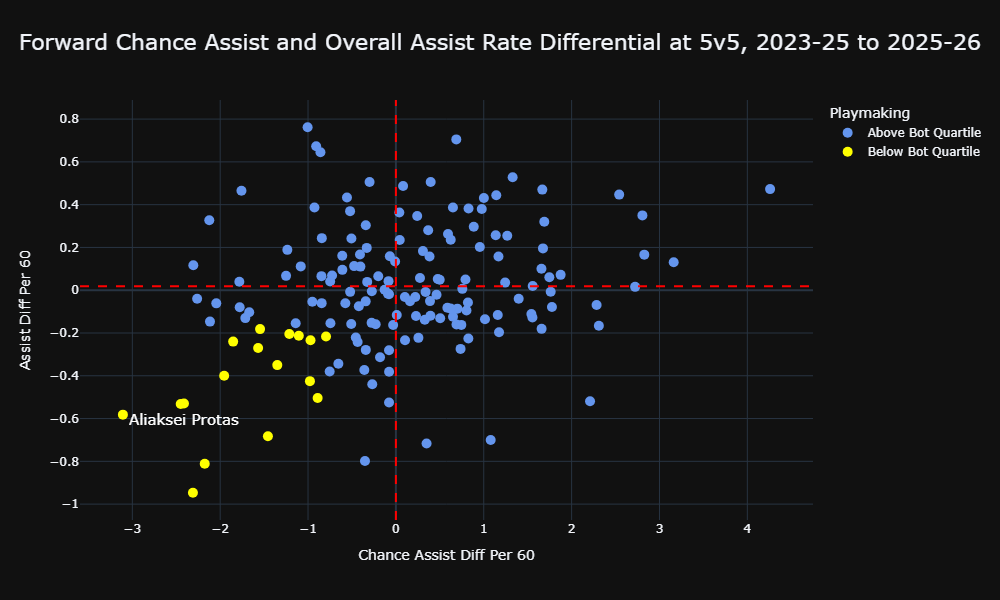
It is a wonder how the lengthy injury from Pierre-Luc Dubois factored in as Protas often skates on the second line and that largely keeps him away from Dylan Strome. Dubois is healthy, the Capitals stocked up on forwards during the offseason, so it would seem as if Protas is poised for a rebound.
Here is the problem. Over the last two years, there were 147 instances of a forward reaching the 60-point mark. Protas’ 2024-25 season is the only time a player posted at least 60 points and had five-or-fewer power-play points. Of the 147 seasons with 60+ points, just two others (Alex Tuch and Ivan Barbashev in 2025-26) reached that plateau with fewer than 10 PP points. With the additions of Tuch and Jordan Kyrou, and some growth expected from Ryan Leonard, there is a lot of competition for ice time in Washington; I don’t think Protas reaches 18:14 per game again. Without hyper-efficiency or a power-play role, and considering the playmaking declines, that 66-point mark seems out of reach.
[Follow the link for more…] (aug18)
20. We are just a little over two weeks away from training camps beginning and fewer than six weeks from the start of the regular season. Time flies, Labour Day is almost here, so the fantasy hockey preparation is in full swing.
I have begun to assemble my personal projections and want to discuss some early findings. My typical process is to do separate skater projections for even strength, the power play, and the penalty kill excluding rookies, then refine those further, and then add rookies in. These Ramblings will discuss some of these projections, but keep in mind that changes will come, and first-year players are not included.
For today, the focus will be on changes in goal scoring and shot totals among forwards. We are going to take each player’s 84-game pace from 2025-26, compare it to my projected 84-game pace for the 2026-27 campaign, and see who the biggest risers are. This is for even strength only but without empty-net situations. Those will be added eventually.
These are my personal projections using data from Evolving Hockey, All Three Zones, and Frozen Tools. Positional designations are from Yahoo. The red lines on the charts are the average change for each stat among all projected forwards, the yellow dots are forwards in the top 25% for improvement in both goals and shots, and the blue dots are forwards who fall under that threshold in at least one of those categories.
Juraj Slafkovsky (Montreal Canadiens – LW/RW)
The Dobber Guide projects a big uptick for Slafkovský with 80 points in 83 games. My projection has his even-strength production taking a huge upswing, adding 15 EV points in an 84-game season. A big chunk of that comes from a significant increase in goal scoring:
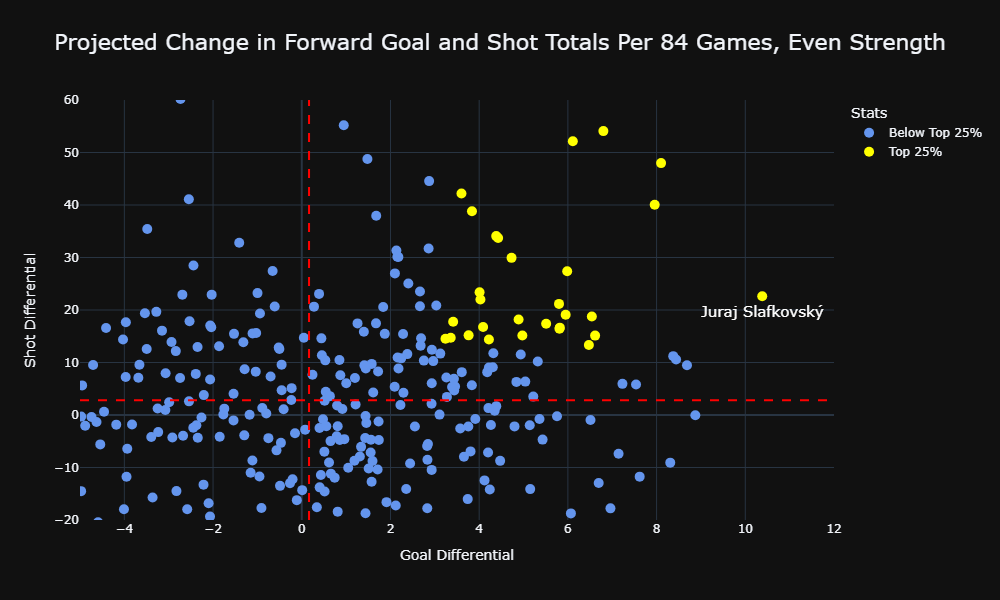
One reason for the big increase is added ice time: my projections have Slafkovský adding about 45 seconds per game in EVTOI. It isn’t a massive leap, but any added ice time matters.
The other reason is a big rebound in shooting percentage. From 2023-2025, Slafkovský shot 12.6% at even strength, excluding empty-net situations. That fell hard to 9.1% in 2025-26. Had he shot 12.6%, he would have had an extra four even-strength goals. That difference is a big portion of the uptick. Add an extra 23 shots, and the improvement in shooting percentage and shot volume accounts for most of the goal increase.
There is always a big risk with projecting such an increase, but Slafkovský is now 22 years old with over 300 NHL games (regular season and playoffs) to his credit. A lot of the offensive tracking data shows very well for both him and the Habs, and a rising tide lifts all boats. This increase with some empty-net situations and a locked top PP role makes Slafkovský a 40-goal threat.
[Follow the link for more…] (aug20)
21. In my Ramblings yesterday, I started going through my projections and discussed some forwards projected to have significant increases to their goal and shot totals at even strength. Today, we’ll look at the same thing but for defencemen. The even-strength outlook does not include rookies, and it does not include empty-net situations. Those will be added a bit later once I have my first pass across all positions and strengths completed. Also, these will be refined a bit further in the coming weeks, so there will be changes, and some of them potentially significant. This is just a first glance at what my projections have spit out.
We are taking each defenceman’s pro-rated 84-game goal and shot production in 2025-26 and comparing that to their 84-game projection for 2026-27. These are my personal projections using data from Evolving Hockey, All Three Zones, and Frozen Tools.
In the following graphs, the red lines are the average changes for each stat. The yellow dots represent defencemen who’s projected 84-game goal and shot differentials are in the top 25% compared to last season, and the blue dots are defencemen who fall short of that mark in at least one of the stats, if not both.
Quinn Hughes (Minnesota Wild – D)
The headliner is the eldest Hughes brother whose projected jump in EV goals is nearly two full goals higher than the next-closest player. He is also projected for a substantial leap in his EV shot volume, and that puts him pretty much in a tier of his own:
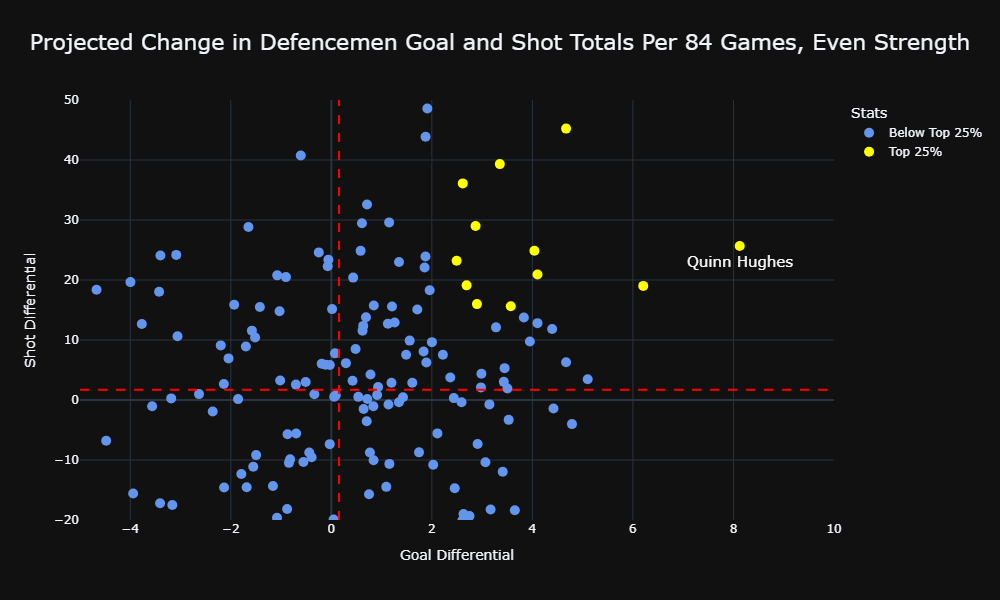
In the two seasons from 2023-2025, Hughes shot 7.7% at even strength. In 2025-26, that was more than halved, dropping all the way to 3.6%. That alone cost him six goals, so if he puts up 13 goals in 74 games rather than the seven goals he actually scored, he wouldn’t be on this list. All that aside, his usage rate in Minnesota was preposterous, skating 1:33 per game more at even strength than the next-closest defenceman in the league after his trade. Even if I do have some concerns about his per-minute shot volume, skating 23-24 minutes a game at even strength alone does a lot to alleviate those concerns.
Overall, my projections have Hughes for over 60 EV points in 2026-27, a feat only accomplished once in the last 19 years (Erik Karlsson in 2022-23). Even if we pro-rated that to an 82-game schedule, he’d still crest that 60-point mark. Anytime a projection gives me something that would be a genuine outlier, I have concerns. However, my general rule is that I bet on outlier projections from outlier players, and Hughes is an outlier player both in skill and in usage. A decline in usage would be a problem, but if I had to bet on any non-Cale Makar defenceman to have a 90-point season, it’s Hughes.
[Follow the link for more…] (aug21)
Have a good week, folks!
Thanks for continuing to support the website and if you’re bored and need a fantasy hockey fix – visit the gang in the forum here.
Related Posts
Starting Goalies









Top Skater Views
| Players | Team | |
|---|---|---|
| DECLAN CARLILE |
 PIT PIT | |
| COLE PERFETTI |
 WPG WPG | |
| BEN KINDEL |
PIT | |
| JACK QUINN |
 BUF BUF | |
| LUCA CAGNONI |
 S.J S.J
| |
Top Goalie Profile Views
| Players | Team | |
|---|---|---|
| JOEY DACCORD |
 SEA SEA | |
| SERGEI MURASHOV |
PIT | |
| JAKUB DOBES |
 MTL MTL | |
| DAN VLADAR |
 PHI PHI | |
| SAMUEL ERSSON |
 OTT OTT
| |
LINE COMBOS
| Frequency |
OTT Players
| |
|---|---|---|
| 11.3 | FABIAN ZETTERLUND WILLIAM EKLUND DYLAN COZENS | |
| 10.7 | SHANE PINTO CLAUDE GIROUX MICHAEL AMADIO | |
| 8.2 | TIM STUTZLE WILLIAM EKLUND DRAKE BATHERSON | |
DobberHockey Podcasts

Keeping Karlsson: Cole, There’s No Time!
Elan and Brian cover all the action from the first week of the NHL season, and identify our earliest must-adds, can-drops, sell highs and buy lows in your fantasy hockey leagues.
Keeping Karlsson: Matchup Maximizer 2026/27 Week 2
Elan takes a look at the schedule for the upcoming weeks of NHL action and recommends players with good schedules that you should consider streaming in to win your head to head matchups.

Fantasy Hockey Life: Tidy Takes Part 1
TiDy Admiral Ryan Downey and Victor Nuno break down recent trades in the FHL Tiered Dynasty’s top division, the Lord Stanley division. Tune in to consider trades between some of the best dynasty sharks we know, including patron polls on the trades and Victor’s analysis. Have a listen! Our show is part of the Dobber […]
Keeping Karlsson: Short Shifts – I Tried to be Like Parker Kelly
Elan is joined by Ryan Downey for the premiere of season 8 of Short Shifts! — KKUPFL late registration is ongoing! We’re still filling new divisions in the world’s greatest fantasy hockey league. Details at https://www.kkupfl.com/. Join the Keeping Karlsson patron community! Patrons get access to all our perks all year round, including KKUPFL […]
Keeping Karlsson: Shabanov Ranks
Elan and Brian fly through the final preseason lines for every NHL team ahead of opening night, and share their guys to watch– or look away from– in your fantasy hockey leagues.